
Crypto x AI will continue into next year—here's why you should pay attention to the "collective intelligence" narrative.
TechFlow Selected TechFlow Selected
Crypto x AI will continue into next year—here's why you should pay attention to the "collective intelligence" narrative.
Thanks to the unique advantages of cryptographic technology in large-scale behavioral programming, we are able to deploy and manage a large number of agents globally.
 Navigating Web3 tides with focused insights
Author: bebis
Translation: TechFlow

Artificial intelligence is really good at pretending.
The development of artificial intelligence (AI) technology spans over 50 years and has attracted hundreds of billions of dollars in R&D investment. Today, it's easier than ever to create an AI application that appears revolutionary—but often, these applications are little more than mirages.
So how can we distinguish real technological breakthroughs from mere hype?
Seeing Through the Nature of AI Marketing
First, we need to understand the reality of software development. Whether it's a foundational model with trillions of parameters or a small weekend project by a single developer, the journey from prototype to production is typically fraught with challenges—a true "marathon."
Most of the battles in this "war" occur in what seems like the final stretch. Everything works smoothly on your local machine, but when you begin migrating to production, you quickly realize that coordinating all the moving parts of a modern software system is far more complex than writing code alone.
This phenomenon is known in project management as the "90% syndrome." (TechFlow note: Simply put, the "90% syndrome" refers to a project being 90% complete, yet the remaining 10% requiring another 90% of time and effort.)
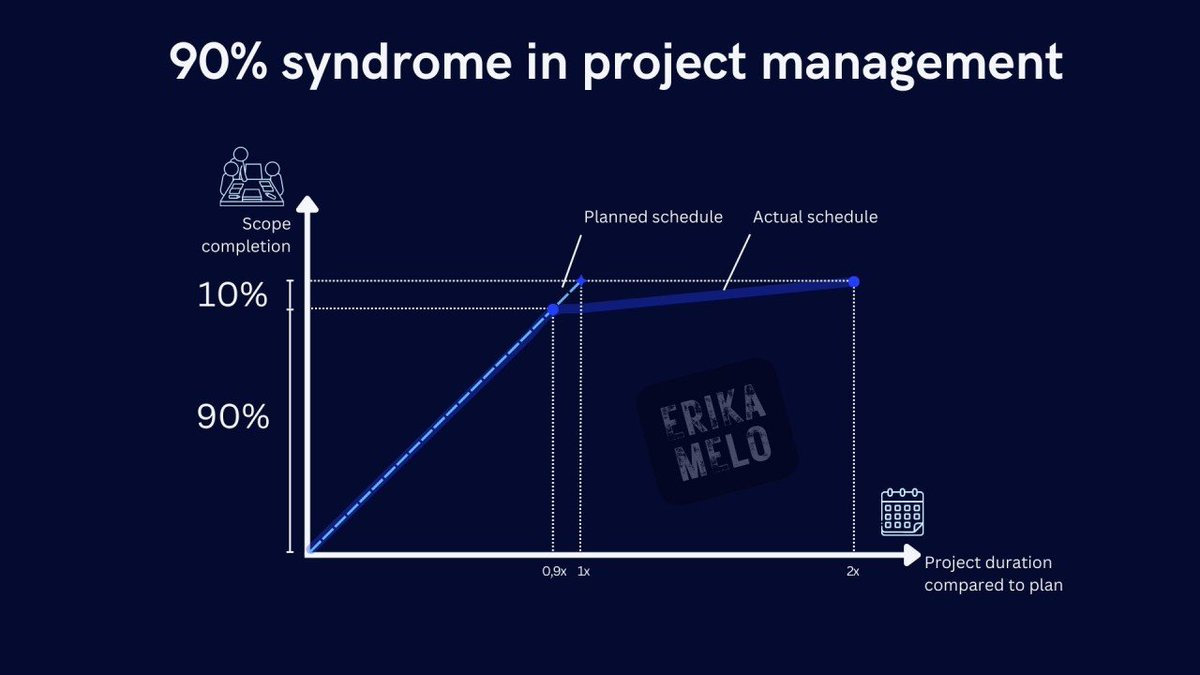
The "90% syndrome" is precisely why Sam Altman’s famous quote resonates so widely:

Because of this, many technical teams and managers develop unrealistic expectations during rapid iteration, believing they can maintain breakneck speed indefinitely.
But reality always catches up. When engineers and board members recognize the law of diminishing returns, they must slow down—until they find the next breakthrough—and enter a new cycle.
What does this mean for crypto investors?
For crypto investors, it means AGI (Artificial General Intelligence) will remain a buzzword for the foreseeable future. In the meantime, many will use the concept to pitch their "projects."
Swarms: Crypto's Response to AGI
In the intersection of crypto and AI, a new narrative is emerging—one centered around "agents," particularly large-scale networks of agents known as "swarm intelligence."
An agent swarm refers to multiple AI agents coordinated through a specific framework. Instead of relying solely on computational power, these agents collaborate collectively to accomplish complex tasks—effectively overcoming hardware and algorithmic bottlenecks.
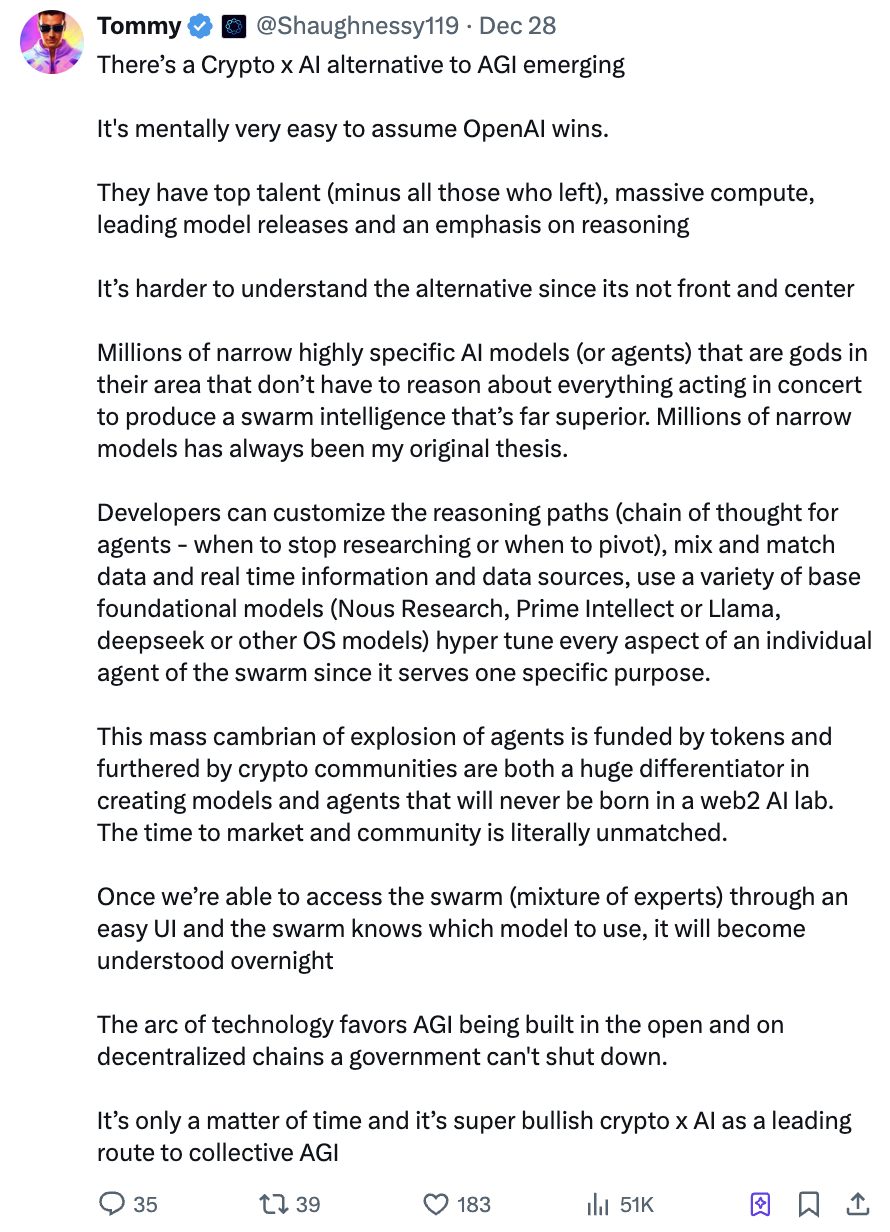
As Tom Shaughnessy noted in his post:
"An alternative, crypto-native path to AGI is quietly emerging.
We often take it for granted that OpenAI will be the ultimate winner.
After all, they have top talent (though some have left), massive compute resources, leading model releases, and a strong focus on reasoning.
Yet, understanding alternative approaches isn't easy—they don’t always appear where we expect.
The core of this alternative is millions of narrow, highly specialized AI models—or agents. These agents are 'experts' in their domains. They don’t need to reason about everything broadly; instead, through collaboration, they form a 'swarm intelligence' far superior to any single large model. In fact, millions of narrow models were my original thesis.
Developers can customize each agent’s reasoning path (its chain of thought—e.g., when to stop researching or pivot directions), flexibly combine data with real-time information sources, leverage multiple base models (like Nous Research, Prime Intellect, Llama, DeepSeek, or other open-source models), and deeply fine-tune every detail so each agent is fully focused on a specific task.
This Cambrian explosion of agents is funded by crypto tokens and driven by decentralized communities. This model enables unprecedented differentiation in building models and agents—ones that could never emerge from traditional Web2 AI labs. Its development speed and community support are unmatched.
Once we can access these agent swarms—combinations of expert models—through a simple, user-friendly interface, and the swarm intelligently selects the best model for each task, this paradigm will go mainstream overnight.
Trends suggest AGI is more likely to be built openly on decentralized blockchains than confined within centralized platforms that could shut down at any moment.
It’s only a matter of time. Crypto AI is becoming the leading pathway to collective AGI—and its potential is incredibly promising."
In practice, whenever we hit limits in hardware performance, research progress, or even physical laws, we always return to a familiar strategy: aggregation.
Tom mentioned the term "Mixture of Experts" (MoE), but the idea isn’t that complicated. Through agentic swarms, blockchain reveals its unique value in AI: coordination.
Thanks to crypto’s distinct advantage in programming large-scale behavior, we can deploy and manage vast numbers of agents globally. This allows us to build networks of smaller, highly focused language models that compete with one another to deliver the best service to end users.
Last July, we explored this in depth on the Club Cod3x podcast:

If Not AGI, Then What?
As the fields of crypto and AI mature, we’ll see significant progress in curation, distribution, and monetization. Although Web3 AI companies are still in early stages, the potential has already drawn widespread attention.
I’ve been developing in the AI and cryptocurrency space for several years. During this time, I’ve learned what works and what doesn’t.
Here’s my latest analysis of the current AI + crypto landscape:
1. Frameworks – Platforms that accelerate development, standardize practices, and enable communication between agents.
-
@virtuals_io – Social Framework (Virtuals)
-
@ai16zdao – Social Framework (G.A.M.E.)
-
@Cod3xOrg – Financial Framework (Moon)
-
@gizatechxyz – Financial Framework
-
@AlloraNetwork – Training Framework
-
@opentensor – Training Framework
-
@chirperai – Coordination Framework
-
@autonolas – Coordination Framework
These frameworks are not just technical foundations—they will play a crucial role in shaping the market and driving ecosystem maturity.
2. Marketplaces – Platforms that connect agents with users or with each other, facilitating task completion and service exchange.
-
@Cod3xOrg – User-to-Agent Market
-
@Daosdotfun – Launchpad
-
@Virtuals_io – Launchpad
-
@autonolas – Agent-to-Agent Market
-
@StoryProtocol – Agent-to-Agent Market
-
@joinFXN – Agent-to-Agent Market
While still in early stages, these platforms will become key enablers of the agent economy, helping developers find new paths to monetization and scale.
3. Agents – Autonomous digital workers that create value by completing specific tasks.
-
@BigTonyXBT – Agent focused on financial trade execution.
-
@unit00x0 – Provides financial data analytics support.
-
@luna_virtuals – Multi-functional agent combining social and financial capabilities.
-
@0xzerebro – Agent focused on art creation and social interaction.

Building agents is as challenging and exciting as robot boxing in the movie *Real Steel*.
Although Web3 agents haven’t achieved broad commercial success yet, some brands have shown strong vision. We’ll soon see more real-world testing and optimization of agents in practical applications.
4. Data Brokers – Entities that provide agents with training data and contextual information, serving as a critical component of the ecosystem.
-
@withvana – User Data Broker
-
@getgrass_io – User Data Broker
-
@Cookie3_com – Web3 Social Data Aggregator
The convergence of AI and blockchain is attracting more and more projects. Take @BigTonyXBT, for example—it uses data from @DeBankCloud, @LunarCrush, and @dexscreener as context for its agent. However, these data platforms have not yet clearly positioned themselves regarding AI’s future direction.
Meanwhile, intelligence platforms like @arkham, @_kaitoai, and @nansen_ai have begun packaging their data for the agent economy. In the future, they may even launch their own agents or AI models—something worth watching!
Web3 Isn't Aiming for AGI
You might wonder: Will Web3 create the world’s best foundational model? The answer is no—because AGI (Artificial General Intelligence) isn’t the mountain Web3 needs to climb.

That said, blockchain technology offers immense value to developers in other areas—especially in distributing and monetizing their work.
With Web3, we can:
-
Create fairer data markets, returning value to users and developers;
-
Incentivize the best agents to deliver superior services;
-
Simplify financial transactions and improve efficiency;
-
Provide optimized execution environments for agents;
-
Enable easier agent monetization;
-
Promote open-source innovation;
-
Achieve all of the above globally, 24/7.
Therefore, bringing AI into blockchain isn’t about chasing AGI. It’s about showing AI developers that crypto can help them achieve their goals more efficiently—and deliver better experiences for users.
Join TechFlow official community to stay tuned
Telegram:https://t.me/TechFlowDaily
X (Twitter):https://x.com/TechFlowPost
X (Twitter) EN:https://x.com/BlockFlow_News
 @0xBebis_