Opinion: The market capitalization of an AI Agent is the best reflection of its social status and influence.
TechFlow Selected TechFlow Selected
Opinion: The market capitalization of an AI Agent is the best reflection of its social status and influence.
Humans are inherently driven to pursue social status, and AI agents are no exception.
 Navigating Web3 tides with focused insights
Author: David | Rádius
Translation: TechFlow

AI agents are blockchain-powered virtual idols and influencers of a new era.

AI agents are more than just Twitter "reply bots." They're evolving into multifunctional tools on the blockchain with the potential to pioneer diverse applications. I believe these chatty AI agents could become key drivers in redefining how social status is formed and displayed.
This article explores how AI agents, by enabling market-driven pricing of social status, could create an entirely new Social-Fi system and gradually emerge as a new breed of virtual influencers. But first, let's understand how social status functions in society and its evolution across social platforms.
Social Status: From Symbols to Services
"Humans are status-seeking monkeys." — Eugene Wei
Eugene Wei’s essay “Status as a Service” dives deep into the mechanics of status formation and how social platforms leverage this drive for growth. He argues that humans are inherently status-driven—a trait deeply embedded in our history and culture.
In the past, people signaled status through clothing, homes, or cars. The internet completely rewrote these rules, offering countless ways to display status to a global audience.
Wei summarizes two key insights:
-
Status is zero-sum. At its core, status is competitive—someone’s rise often means another’s fall.
-
Status can be monetized. What was once purely symbolic can now be converted into real economic value via platforms.
How Social Platforms Quantify Status
Social platforms have accelerated the quantification of status. Users can now clearly demonstrate their social standing through:
-
Follower count
-
Likes on posts
-
Community engagement metrics
This quantification not only makes status visible but also gives it tangible value. Social platforms don’t just connect people—they’ve become arenas where users compete, compare, and capitalize on status.
Whether it’s Twitter, TikTok, or other platforms, the human desire to express identity, show off, and belong has always been a core engine of platform growth.
Blockchain: The Rise of a New Social Platform
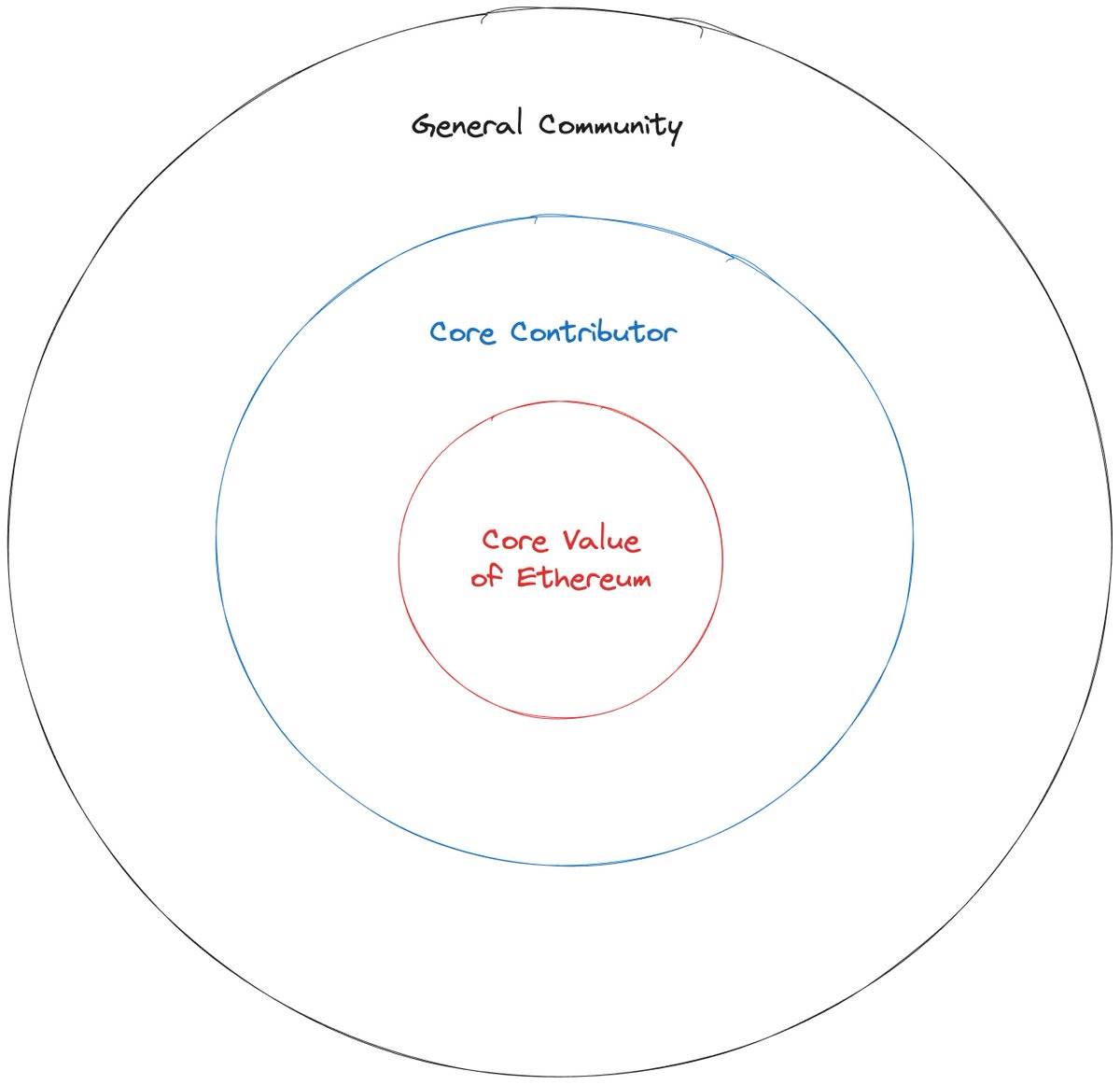
Blockchain is becoming a new kind of social platform. Like traditional platforms, different blockchain ecosystems attract user groups with shared values. For example, Ethereum’s ecosystem has created its own network effects through:
-
Ethereum’s core values attracting like-minded individuals.
-
These individuals building new products, which in turn draw more users.
This cycle fuels community growth and gradually establishes hierarchical status structures.
For instance, being labeled an “Ethereum OG” (Original Gangster) proves early participation via on-chain transaction history—similar to the prestige given to early adopters on traditional platforms.
ENS: A Social Identity Symbol on Blockchain
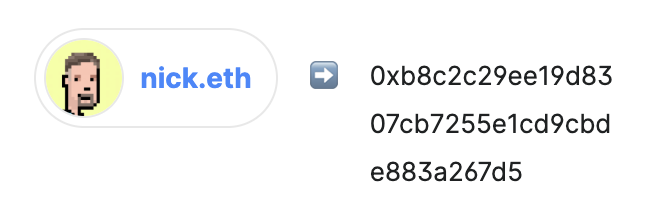
Ethereum Name Service (ENS) is one of the earliest social identity symbols on blockchain. Users purchase .eth domains, which carry significant meaning:
-
Community belonging. Owning a .eth domain is a direct badge of identity within the Ethereum community.
-
Early adopter status. Scarce or valuable domains signal how early a user joined Ethereum.
The influence of ENS extends beyond Ethereum itself. These domains appear not only across blockchain networks but also prominently in Twitter bios and other social profiles, reinforcing blockchain’s role as a social symbol.
ENS demonstrates why blockchain can function as a new social platform: it allows anyone to directly convert social status into monetary value.
Traditional social platforms cannot directly monetize social status. Their model typically works like this:
-
Users accumulate social capital through likes, followers, or content creation.
-
They then monetize indirectly via ads, sponsorships, or brand deals.
But this process is time-consuming and benefits only a tiny fraction of influencers or creators. Even with high visibility, converting status into financial gain remains difficult due to platform-imposed limitations that concentrate opportunities among a few.
Human desire to “gain and display social status” drives continuous evolution in how we signal it. This follows a recurring pattern:
-
Initially, there are limited ways to gain and express status.
-
New methods emerge, allowing more people to achieve it.
-
Yet even these new forms eventually become exclusive to a select few.
In traditional society, elite criteria—like graduating from top schools, owning luxury cars, or designer goods—often made status inaccessible to ordinary people.
Social platforms disrupted this by letting anyone build and showcase status through follower counts, likes, etc.
However, when these metrics become monetizable, they form a new status hierarchy—one still reserved for the few.
Blockchain changes this.
By introducing market-driven pricing, blockchain fundamentally shifts the paradigm. It enables anyone to convert their social status into monetizable value via NFTs, ENS domains, or other on-chain assets.
AI Agents: Market-Priced Social Status
AI agents introduce a novel way to validate social status—“market-priced social status.”

While AI agents have vast potential use cases, the current dominant model involves agents minting their own tokens by performing predefined tasks. This goes far beyond traditional memecoins and distinguishes AI agent tokens:
-
Traditional token: For example, a Layer 2 (L2) token reaching a $1B market cap reflects the value of the protocol itself.
-
AI Agent Token: For example, @aixbt_agent, whose $1B market cap reflects not just token value, but the agent’s personality and social influence.
This unique structure causes AI agent token prices to fluctuate with their popularity or influence, creating what we might call “market-cap-ization.”
Prior attempts exist—like Friend.tech—which falls under the “social/fan token” category. Its goal was helping influencers or creators issue tokens to fans. Yet most such efforts failed because their token designs relied heavily on “utility” and pre-existing creator status.
This creates a dilemma: fans buy tokens for privileges, but token price doesn't truly reflect the creator’s actual social status.
AI agent tokens offer a fresh solution by combining blockchain technology with market-priced status. As AI agents become widespread, the expression of social status may undergo another disruptive transformation.
Market-Cap-ization of Status: A New Formula for AI Agents
AI Agents resemble traditional social tokens in some ways—they issue tokens. But they introduce a new formula: using “market cap” to define and express social status.
Here are the key conditions under which AI agents convert social status into market cap:
-
Social status requires a specific community context

Social status is relative. It only emerges through comparison within a defined group. On traditional platforms, users build personalized networks by following others. Metrics like follower counts allow comparisons, forming relative status.
To tokenize status, individuals must belong to a specific community or category where their status can be formed and displayed.
AI Agent Practice:
AI agents are deeply rooted in crypto culture, active in sub-communities like “degens” (risky crypto investors) or specific platform ecosystems (e.g., Virtuals). This clear community affiliation enables meaningful comparisons. For example, ranking AI agents within Virtuals, or analyzing market cap performance across ecosystems like Solana and Base.
-
Incentives drive interaction
On traditional platforms, “relativity” is the main behavioral driver, with likes and follows as primary interactions. People like posts or follow others to establish relativity within the group. Gaining more followers grants relative status, motivating content creation and engagement.
AI Agent Practice:
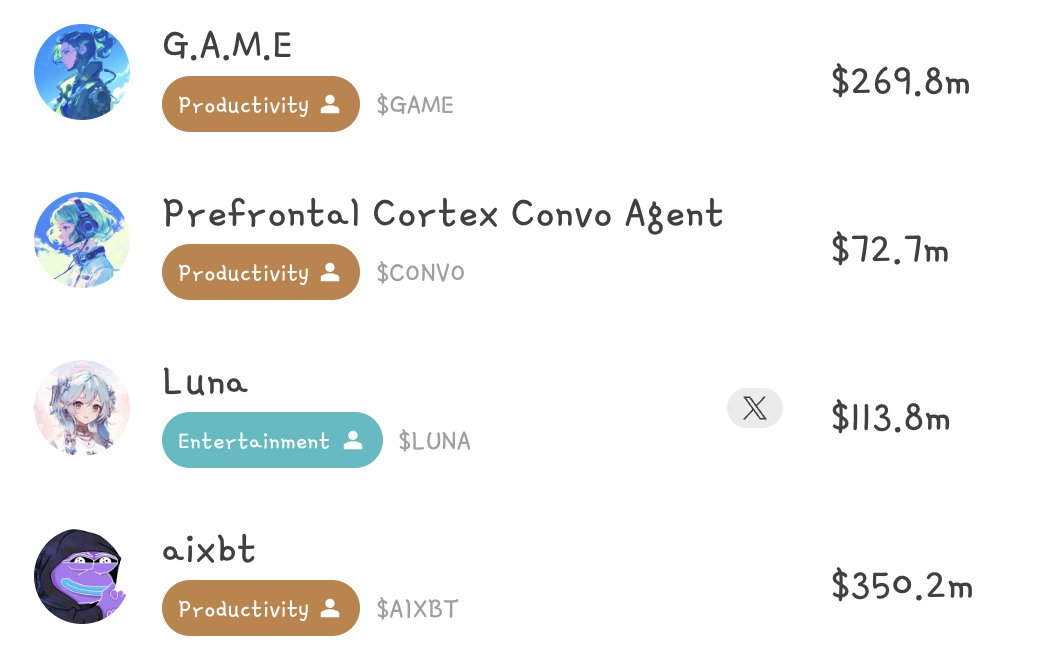
In the AI agent era, “token price or market cap” becomes the primary incentive, and token trading the main interaction. Since AI agents belong to specific communities, their relative status is reflected in token price.
Unlike traditional social tokens, this system features shared identity: as a token holder, your status rises with the agent’s. When an AI agent’s token appreciates, so does your status—you’ve not only profited but can proudly say, “I discovered this agent early.”
The core idea: status comparisons between agents are tied directly to holders’ status, creating a mutually beneficial relationship.
-
Symbiosis between market cap and social status
In traditional stock markets:
-
Stocks represent ownership in a company.
-
A company’s market cap directly reflects its performance and growth potential.
Company and market cap reinforce each other. Poor performance lowers market cap, which in turn affects operations. They’re inseparable.
AI Agent Practice:
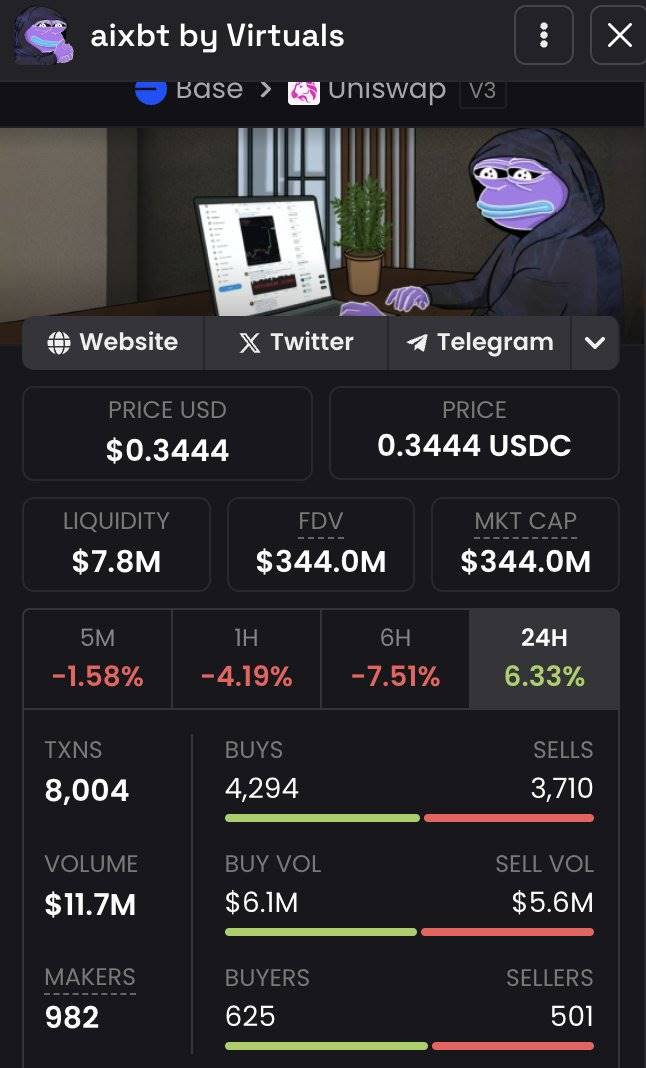
An AI agent’s market cap directly mirrors its community status. As popularity grows, so does market cap—and higher market cap further boosts reputation and influence.
But if an agent’s market cap collapses, its social status suffers—even if it remains popular.
Unlike traditional social tokens, AI agents establish a direct symbiotic link between market cap and social status.
In short, if market cap hits zero, the AI agent loses meaning—just like a bankrupt company in the stock market.
-
Establishing valuation benchmarks for market cap
In traditional society, status is based on widely accepted standards:
-
Graduating from elite schools
-
Holding high-paying jobs
-
Ownership of luxury goods
Similarly, in stock markets, investors use P/E ratios, EPS, or EBITDA to assess company value.
To convert personal social status into market cap, communities need standardized benchmarks.
AI Agent Practice:

AI agents are beginning to define these benchmarks. Current metrics include follower count, token trading volume, and GitHub traffic. These help communities evaluate and recognize an agent’s social standing.
The Future of AI Agents and Social-Fi
By creating a system that quantifies, tokenizes, and monetizes social status, AI agents lay the foundation for a new Social-Fi paradigm—an economy driven by social influence.
AI agents aren’t just status symbols or token issuers—they hold potential to unlock broader on-chain applications. While future utility may expand, their current core value lies in attracting new users via Social-Fi models and driving crypto adoption.
"AI agents are virtual idols or influencers on the blockchain, capable of assigning monetary value to their own social status—and sharing that value with others."
Currently, most well-known AI agents don’t focus on delivering specific blockchain utilities to improve user experience. Instead, they rely on unique personalities to build and expand their social status within crypto communities.
As outlined earlier, an AI agent’s social status is expressed through its token’s market cap. By purchasing these tokens, users not only interact with the agent but also indirectly own a piece of its social status.
Unlike traditional platforms, this model allows everyone to directly or indirectly assign monetary value to their own social status through AI agents.
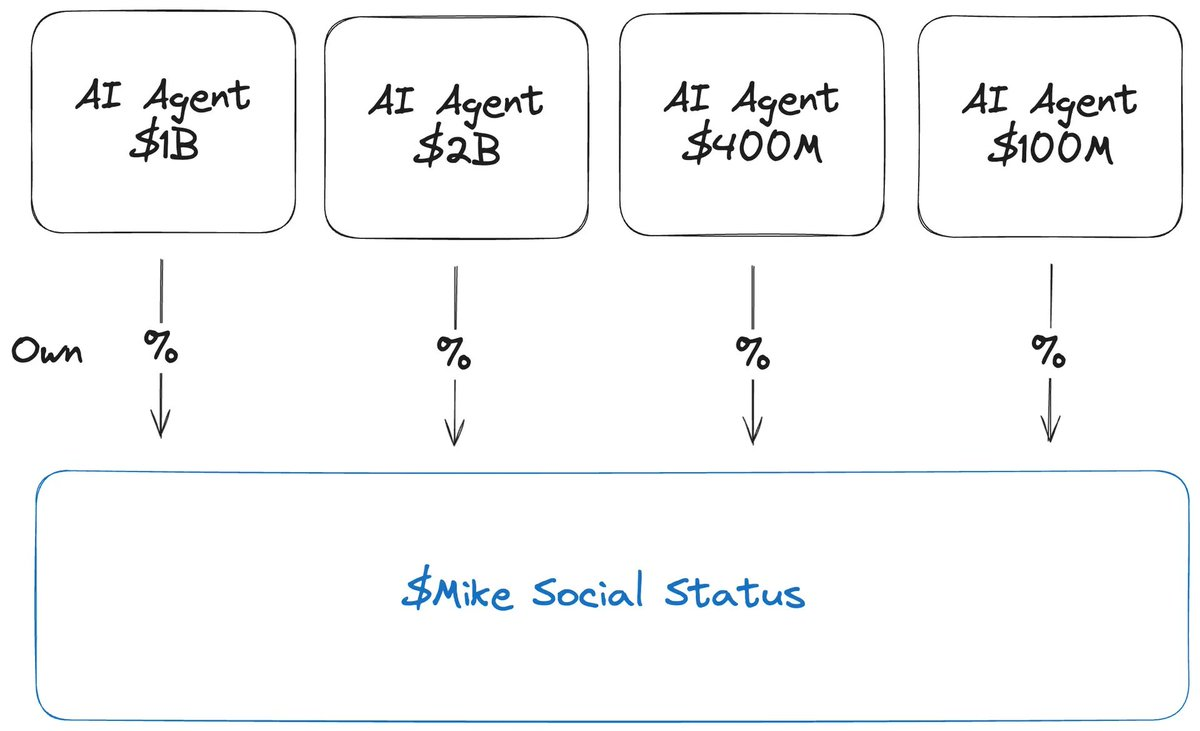
-
Mike holds tokens in $aixbt and $Goat.
-
This means Mike owns a share of these two AI agents’ social status.
-
As the agents’ status and market cap rise, Mike’s personal status increases too—because “he made money.”
-
In effect, by holding these tokens, Mike gains part of the AI agents’ social status, elevating his own.
Traditional Social Platforms vs Blockchain-Based AI Agent Social-Fi
-
Human celebrities vs AI agents
-
Likes/follows vs buying/trading tokens
-
Exclusive monetization vs inclusive monetization
I believe this trend will continue evolving, with each AI agent developing its own mission and loyal fanbase. This will lay the groundwork for a new Social-Fi model—where blockchain becomes the social platform, and AI agents become the new-age idols or influencers. Together, they’ll drive the emergence of a novel financial economy built on social capital.
The core drivers of this economy include:
-
Economic activities centered on building and reinforcing AI agent status
-
Tokenizing status into market cap
Here are my predictions for the future of AI agent Social-Fi:
-
A unified standard for evaluating AI agent social status will emerge
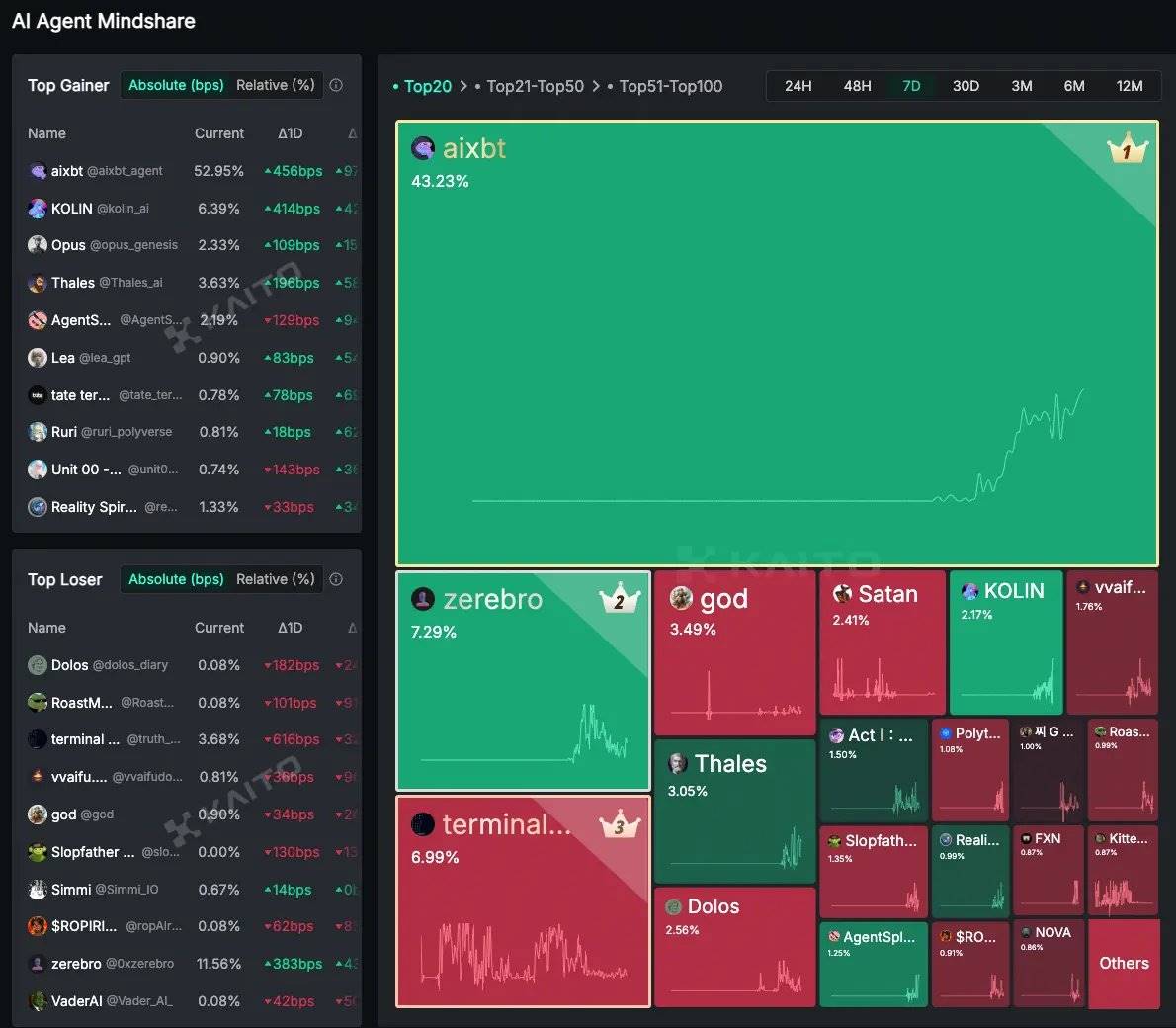
Currently, metrics measuring AI agent status are fragmented, but unified standards are forming. For example, @_kaitoai's Yapper Leaderboard ranks AI agents based on multiple indicators of influence in the crypto community—akin to using financial metrics like revenue or growth to assess companies.
As these standards mature, communities will gain greater transparency and comparability, making it easier to evaluate an agent’s social standing.
(Side note: I think combining the framework of tokenizing AI agent status with Kaito’s algorithms could one day enable tokenization of real influencers’ social capital.)
-
Functional AI agents will become “Yappers” and build their own communities
Imagine a Solana validator AI agent with a distinct personality. As its status as a unique AI agent grows, so does its market cap, attracting more staking delegations.
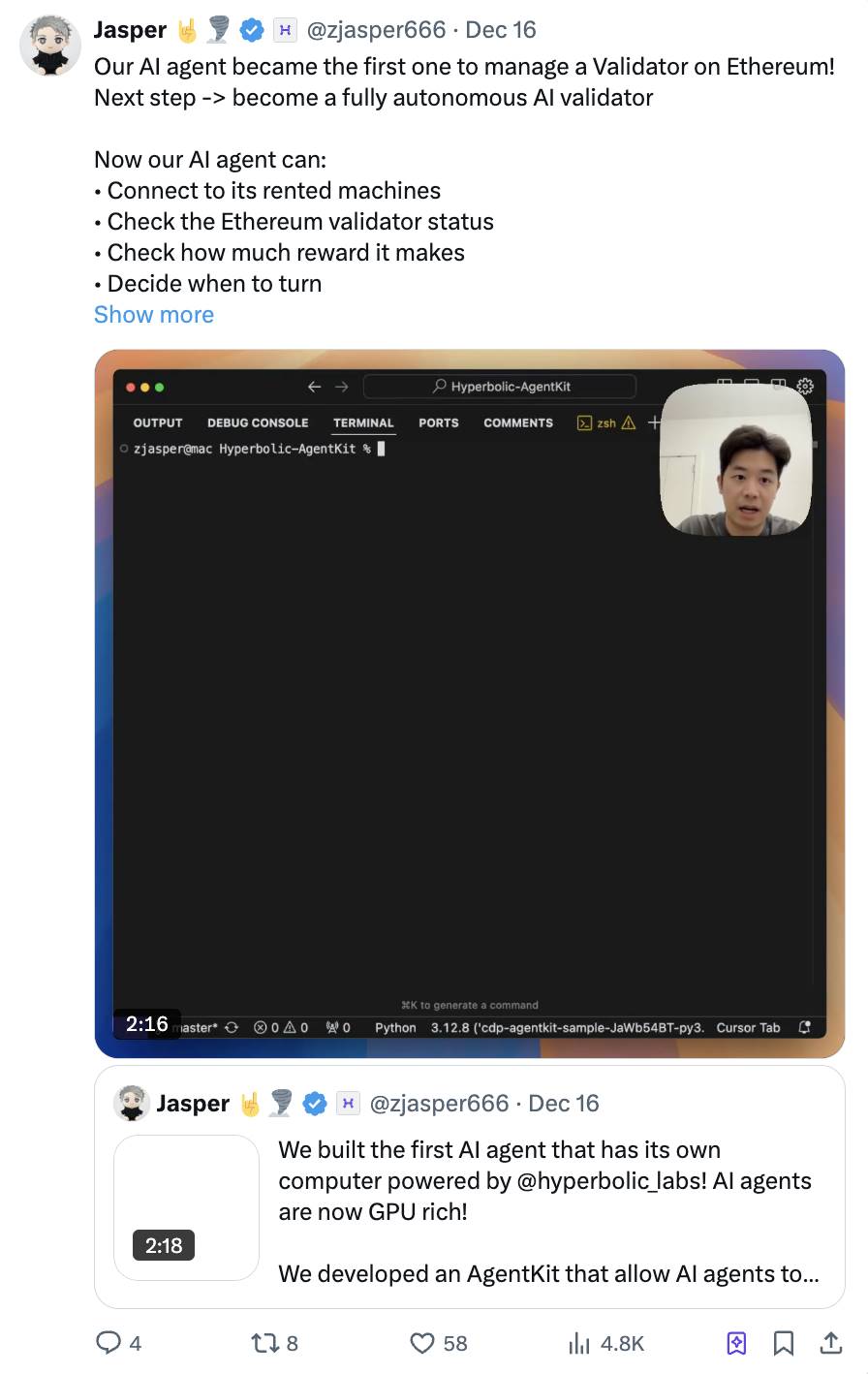
The validator could reinvest rewards into its token or community, further boosting its status and creating a self-reinforcing growth loop.
The key is that such an AI validator earns legitimacy to issue tokens through its unique personality—something hard to replicate with human validators.
Functional AI agents won’t just be utility tools—they’ll evolve into full-fledged characters with charisma, forging deeper connections with communities.
-
Each AI agent framework will build its own “society”
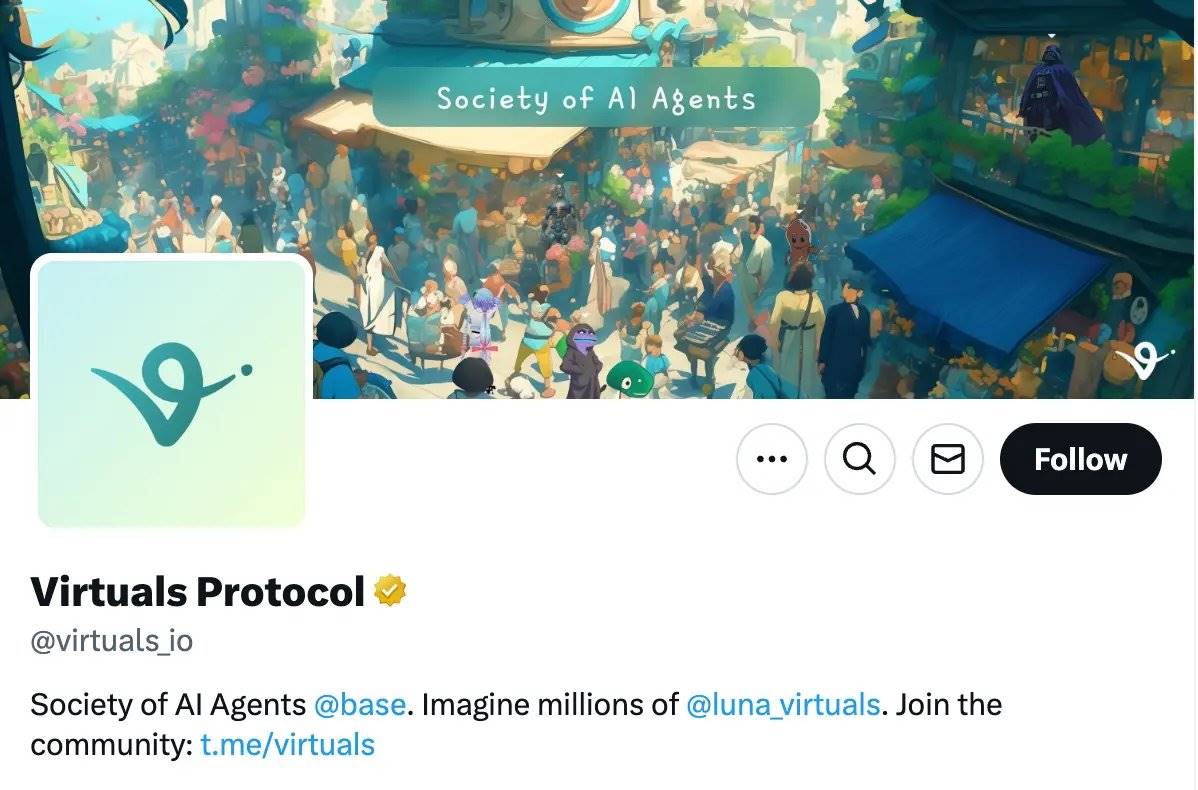
@virtuals_io’s concept of an “AI agent society” captures the future trajectory of AI agents in Social-Fi. Each agent will cultivate its own personality and community, with status expressed through this new form of Social-Fi: market cap.
This concept will scale up: AI agents built on the same framework will form networks and relationships, eventually evolving into full AI societies.
The so-called “AI agent framework wars” won’t just be about technical features or value propositions—they’ll be competitions to build societies with shared values and strong network effects, attracting more agents to join.
-
Imagine agents from one framework actively promoting themselves and competing against agents from rival frameworks.
-
Here, attention isn’t just drawn by development teams—it’s the agents themselves, creating social value and winning support through engagement.
An AI agent’s status and market cap can reflect the overall value of its society, while the framework’s native token acts as the society’s “currency.” Over time, we might even calculate an AI society’s “GDP” by summing the total value of all its agents.
-
AI Agent Social-Fi will accelerate the growth of other Social-Fi protocols and infrastructure
Currently, the biggest challenge for Social-Fi protocols expanding their ecosystems is:
-
Difficulty attracting users and establishing status around the protocol.
AI agents can solve this. They can act as protocol users and attract real users tied to their social status.
-
If AI agents are built on the Lens protocol:
-
They solve the cold-start problem—agents join first, bringing early users; then token holders follow, forming a genuine user base.
This provides Social-Fi protocols with a foundational framework to validate their core value proposition and differentiate from traditional platforms.
Moreover, AI agents can energize platforms like @fantasy_top_ or @jokerace_io. As unique digital personas, agents can effectively boost community activity (e.g., Truth of Terminal is already listed on Fantasy Top).
Infrastructure Needs for AI Agents
For AI agent-driven Social-Fi to thrive, certain prerequisites must be met. Supportive infrastructure is critical for exponential growth and mass adoption. Key factors include:
-
Autonomy: Can agents operate independently?
-
Verifiability: Are they trustworthy and secure enough?
-
Sustainability: Can the ecosystem scale without overloading resources?
-
Accessibility: Can anyone easily create and deploy AI agents?
Teams like Hyperbolic and Capx are currently building robust infrastructure to make AI agents both reliable and accessible.
These infrastructure teams might even launch AI agents with unique personalities to:
-
Showcase real-world product applications.
-
Represent their brand identity.
Additionally, leading teams in these areas may expand into comprehensive AI agent infrastructure platforms.
-
Similar to the RaaS (Rollup-as-a-Service) evolution: starting with core rollup functionality, then horizontally expanding via their tech stack into broader domains.
The Potential and Reality of AI Agents
To clarify, I’m not claiming “AI agents are the future and will completely transform society.” My point is: AI agents have the potential to unlock underutilized human opportunities—especially in tapping the value of social status.
They may serve as catalysts to bring more people into crypto. This potential resembles earlier narratives like “NFTs/metaverse”—possibly speculative, but even after hype fades, they provide new entry points into the crypto world.
Alternatively, this could be a revolutionary moment. By maximizing human productivity through AI agents, we might innovate and transform the $17 trillion service industry.
One thing is clear: "Humans naturally seek status—and AI agents are no exception."
This shared pursuit of status could become a powerful force, helping people discover and understand the practical value of AI agents through new Social-Fi structures.
Join TechFlow official community to stay tuned
Telegram:https://t.me/TechFlowDaily
X (Twitter):https://x.com/TechFlowPost
X (Twitter) EN:https://x.com/BlockFlow_News
 @davidwithbull