10 Ways to Find the Leading AI Agent
TechFlow Selected TechFlow Selected
10 Ways to Find the Leading AI Agent
In the crypto industry, it's essential to always have a practical AI Agent methodology on hand.
 Navigating Web3 tides with focused insights
Author: Zhou Zhou, Foresight News
In the past month, AI Agents have sparked a new wave of enthusiasm in the crypto industry.
Within less than a month, the total market capitalization of projects in the entire AI Agent sector once reached tens of billions of U.S. dollars. Virtuals briefly achieved a market cap of $3 billion, while ai16z and Fartcoin each reached $1 billion. According to incomplete statistics from Foresight News, there are at least 14 AI Agent-related cryptocurrencies with market caps exceeding $100 million.

Many Web3 practitioners suggest that AI Agent could be one of the biggest narratives of this cycle—just like DeFi, NFTs, and the metaverse in previous cycles. So when a brand-new crypto narrative is still in its early stages, how can we use a solid methodology to identify the leading AI Agent crypto projects? The author attempts to outline ten methods for readers.
1. On-Chain Revenue Method
This method works well for evaluating platform-type AI Agents such as Clanker, vvaifu.fun, and Virtuals. If on-chain revenue or transaction volume shows unusual activity—such as several consecutive days of rapid growth—it may indicate strong development potential. Conversely, stagnation may signal slowing momentum.
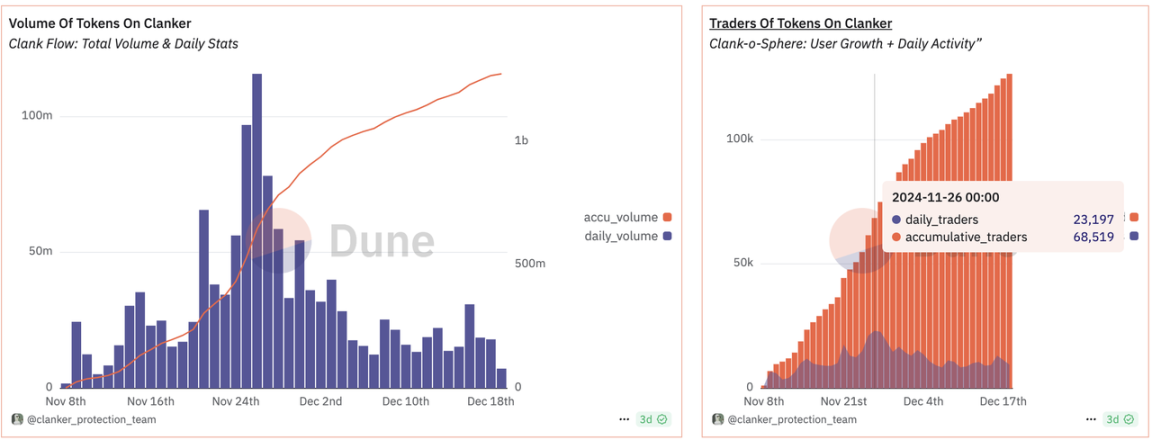
Image Source: Dune
Take Clanker, a star AI Agent project on Base. On-chain data shows that after November 26, metrics such as token issuance, number of traders, and on-chain revenue began declining—and this trend was quickly reflected in its token price.
2. Developer Engagement Method
A high number of stars on GitHub may indicate strong developer interest and recognition of a framework. This method is particularly useful for evaluating framework-based AI Agents like Eliza.
Search GitHub to check developer engagement (i.e., number of stars) for framework-type AI Agents. For example, ai16z/Eliza gained 5,300 stars in less than a month—an astonishing figure.
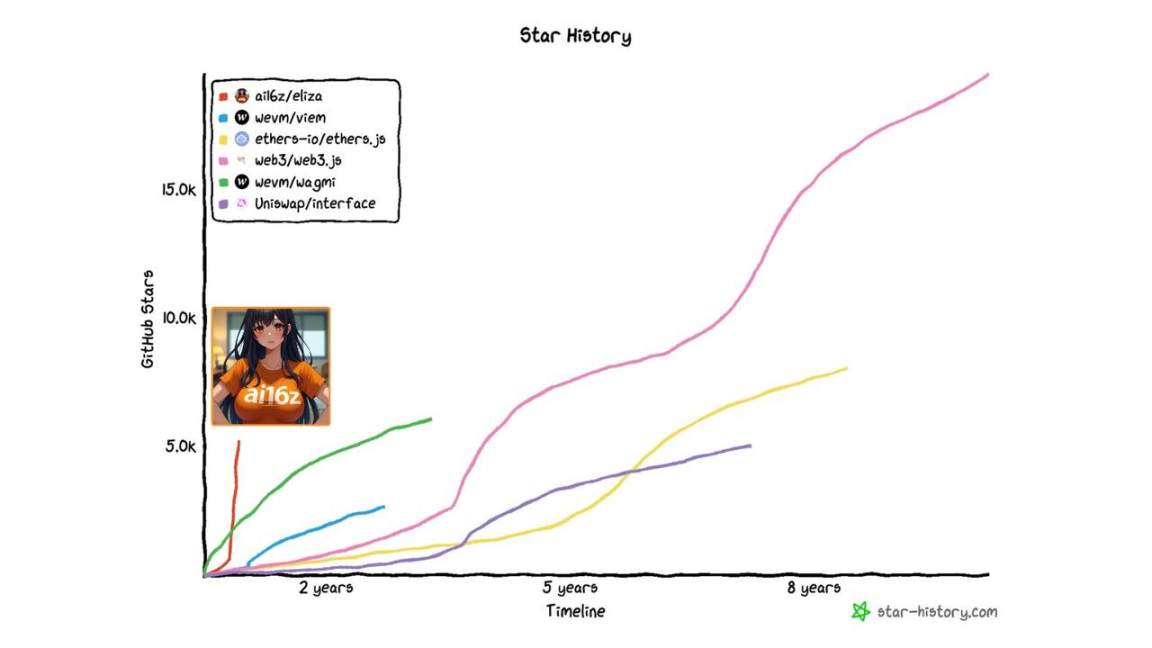
Data Source: GitHub
As shown above, ai16z/Eliza surpassed Uniswap in developer engagement within just one month, demonstrating significant developer interest. For comparison: Sui currently has 6,400 stars, Solana 13,000, Ethereum 50,000, and Base 70,000.
However, note that GitHub stars can be manipulated, though such behavior is not widespread. Therefore, this metric should serve only as a supplementary reference.
3. KOL Follower Count Method
One relatively clear-cut category within AI Agents is KOLs (Key Opinion Leaders).
Currently notable AI Agent-style KOLs include: Terminal of Truths (210k followers), aixbt (160k followers), Zerebro (60k followers), Eliza (14k followers), and LUNA (30k on Twitter, 500k on TikTok).
A key difference in this AI revolution lies in semantic shifts. The author anticipates an AI Agent KOL leader will emerge, whose token market cap could exceed $5 billion. Changes in follower counts may become a critical metric.
4. Influential Figure Impact Method
Prominent figures from the AI world are increasingly entering crypto. Examples include Marc Andreessen (co-founder of a16z, backing ai16z), Sam Altman (supporting Worldcoin), both of whom have already brought multiple billion-dollar crypto projects into existence. More are likely to follow—such as Elon Musk and his Grok project.
Others with lower certainty include companies like Apple, Meta, and TikTok, or AI models such as Claude, Copilot, and Gemini, which might also bring something unique to crypto.
Particularly worth watching are tech giants actively researching both AI and crypto—like Musk, Marc Andreessen, Sam Altman, and Jensen Huang. Their leadership in tech often translates directly into influence within the crypto space.
5. Cross-Over into Mainstream Awareness Method
If AI Agent is truly one of the biggest narratives of this cycle, its impact beyond the crypto world deserves close attention. For instance, if Web2 developers begin showing interest in Web3 AI Agent frameworks and products, it signals broader appeal. To the author’s knowledge, Eliza has already attracted attention from some AI professionals outside the crypto bubble.
KOL-focused products like Terminal of Truths and LUNA have also drawn external audiences, amassing over 200,000 followers each, with growing influence. It's important to assess whether this trend will break through further into mainstream awareness.
6. Top Exchange Listing Effect Method
Those who participated early in Sandbox may recall how certain metaverse concepts skyrocketed after listings on Binance. Why are exchanges considered "top-tier"? Because they must ensure their listed tokens lead market trends. If another exchange starts setting the pace, they risk losing their dominant status.
Pay close attention to listing announcements and Launchpad updates from Binance, Upbit, Coinbase, Bitget, and Hype. These five exchanges are fiercely competing over the “listing effect” this cycle.
Coinbase and Hype, in particular, hold an edge in the broader AI Agent space. Americans do appear to have a faster information advantage in this domain.
7. Blockchain Platform Method
Certain blockchains naturally foster the emergence of AI Agent projects by lowering entry barriers. Identifying promising blockchains and searching for strong AI Agent projects within them can greatly improve efficiency.
Base, for example, has 70,000 GitHub stars among its developers—more than Ethereum and far surpassing Solana and Sui—making it a standout latecomer.
Coinbase itself places significant emphasis on AI Agents and entered the space early, giving it a major first-mover advantage in future competition.
Solana’s strength lies in its strong meme platforms, and since AI Agents heavily rely on memes for virality, this gives Solana a significant edge.
8. AI Agent Community Method
Everyone has blind spots, but collective intelligence covers all angles.
Building your own AI Agent discussion group or joining one or two high-quality communities is crucial. Opportunities in AI Agents often arise in overlooked corners—precisely where community insight becomes invaluable.
9. Subsector Specialization Method
The AI Agent space includes various subsectors: KOLs, virtual female streamers, research analysts, meme platforms, VC-themed agents, platforms, development frameworks, etc.
Not all subsectors will withstand scrutiny. It's essential to identify those with real potential to survive and thrive long-term.
10. Origin Principle Method
Where did it all begin? Which AI Agent started the entire narrative? That pioneer may well be the sector’s leader.
In the NFT space, CryptoPunks holds a transcendent status; Ape introduced a new narrative paradigm, and Fat Penguin became one of the best Web2-integrated NFTs. In the metaverse, Sandbox and Decentraland were early listings on top exchanges, securing leadership positions. Uniswap pioneered automated market-making in decentralized exchanges (DEXs), becoming a market trailblazer. Projects that achieve systemic innovation typically capture the largest share of sectoral gains.
It will feel expensive at first—like BTC once did—but looking back, you’ll realize it was incredibly cheap.
Join TechFlow official community to stay tuned
Telegram:https://t.me/TechFlowDaily
X (Twitter):https://x.com/TechFlowPost
X (Twitter) EN:https://x.com/BlockFlow_News
 Foresight News