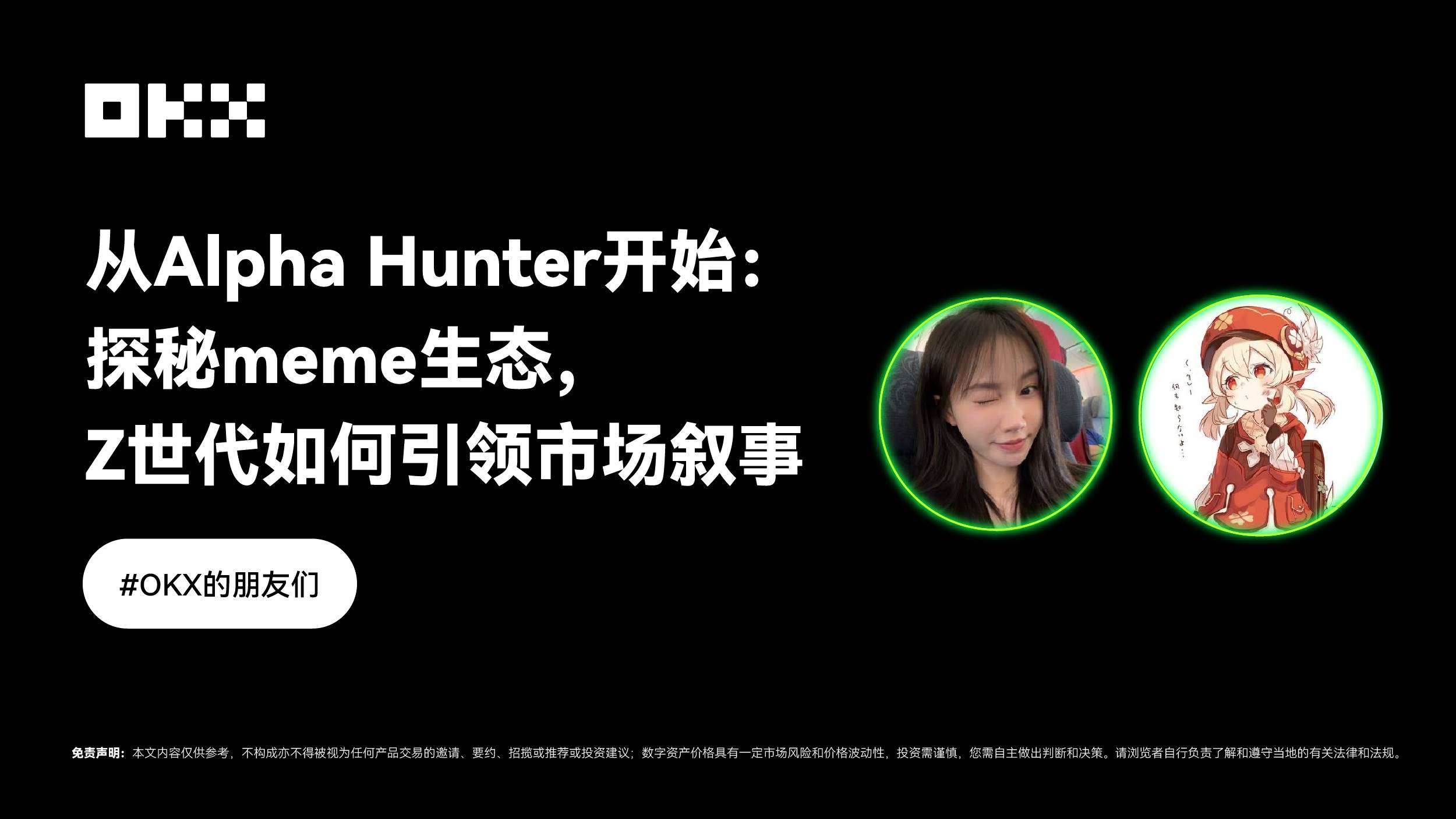
Interview with Yuyue, starting from Alpha Hunter: Exploring the meme ecosystem—how Gen Z is leading market narratives?
TechFlow Selected TechFlow Selected
Interview with Yuyue, starting from Alpha Hunter: Exploring the meme ecosystem—how Gen Z is leading market narratives?
Guest message: Reflect on what scarcity means and what your moat is. Making money isn't rare—there are too many people doing it. What's scarce is consistently reviewing why you make money, systematically analyzing it with logic and methodology, and continuously replicating that success.
 Navigating Web3 tides with focused insights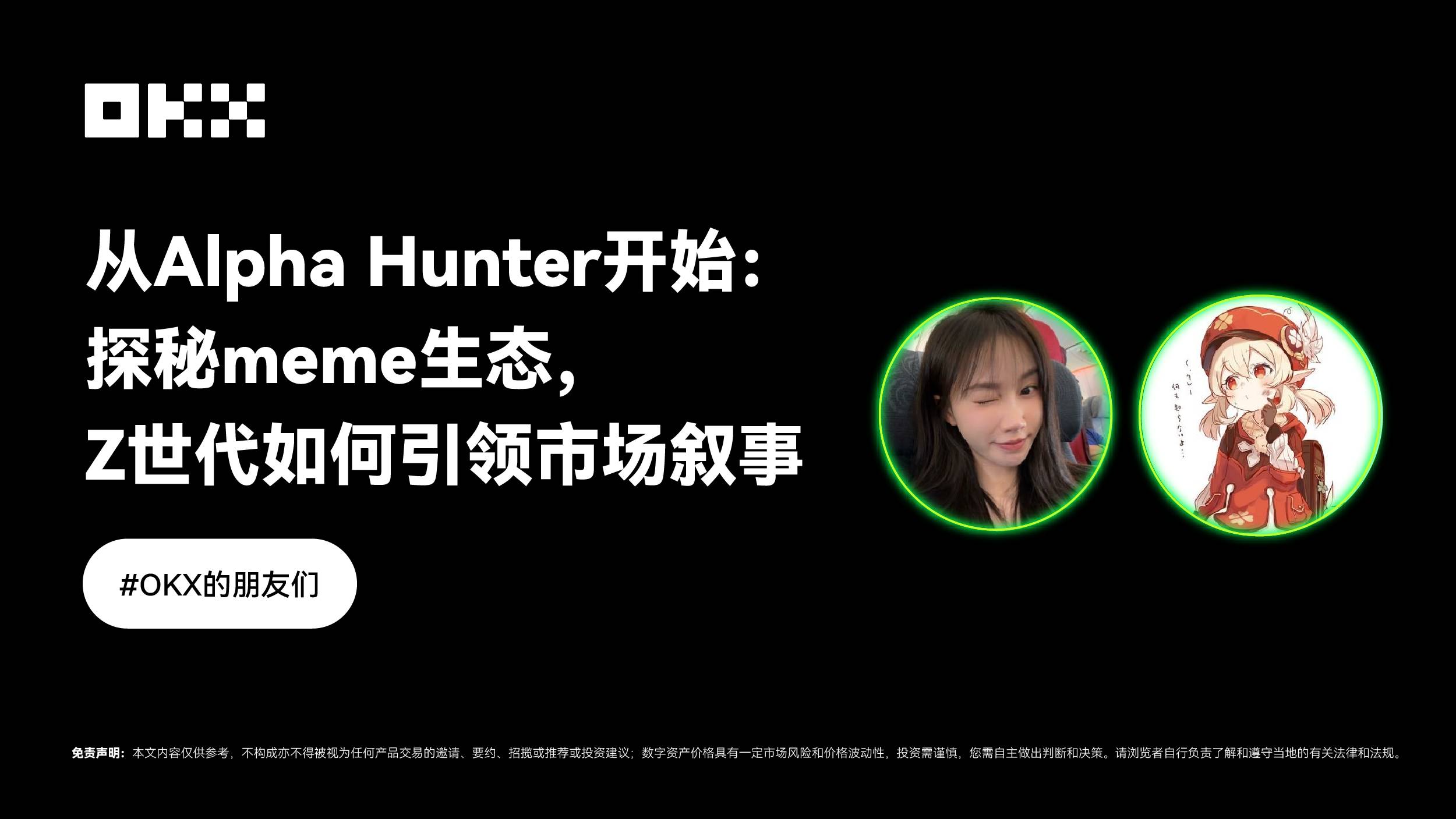
@yuyue_chris is a Gen-Z investor and trader active in the Web3 space. Starting with just 3,000 RMB in 2022, she has since evolved into a professional trader through sharp market insights and a commitment to continuous learning—achieving in just two years the transformation from novice to OG. She is now a key member of several top-tier Chinese communities and also runs her own community.
OKX has specially invited her as a guest speaker for the "Friends of OKX" series, where she shares her trading insights and deep reflections on the Meme sector, hoping to inspire readers.
The "Friends of OKX" series is a special column curated by OKX, hosted by official community ambassador Mercy (@Mercy_okx), aiming to uncover the career stories, industry perspectives, and lessons learned from KOLs of diverse backgrounds, offering valuable references for new users.
1. A Crypto Journey from Zero
Mercy (@Mercy_okx): Can you share how you first entered the cryptocurrency space?
Yuyue (@yuyue_chris): I joined the space in March 2022, right during the bear-to-bull transition. As a business student, I was initially looking for an internship and started writing Web3 investment research. My real entry came when I saw someone sharing a futures trade screenshot from an exchange on social media. I asked, "What app is this?" and got a referral link back. At that time, I only had a few thousand RMB in capital. Unfortunately, I was quickly wiped out by a 20x leverage futures position, leaving only a small amount of ETH on-chain. Too afraid to tell my parents I'd lost all my living expenses, I had to find another way forward.
Mercy: What kept you going? Which communities influenced you the most?
Yuyue: The turning point came with the Nation3 airdrop. I saw many influencers tweeting about it, asking people to leave their ENS addresses. I followed along and submitted a few—and actually received the airdrop. That experience taught me the importance of getting positive feedback; without it, it's hard to persist through continuous losses. After that, I constantly refined my information sources, joined more communities, met more people, and actively reviewed every opportunity.
In terms of communities, one was scriptdotmoney’s Robot DAO—the "Whampoa Military Academy" of top Chinese communities, which has nurtured many current community leaders like Laser Cat. Another was Zishi’s 321 DAO, also a Whampoa-style training ground for Chinese KOLs, where I learned a great deal. Lastly, Fengmi Teacher’s 33 DAO, which evolved from an airdrop-focused group into an elite organization combining research, execution, and investment. One quote from Fengmi deeply impacted me: "The most important thing for an organization is internal cohesion and external influence."
Mercy: How did your transition from an early Alpha Hunter to an investor and professional trader happen?
Yuyue: In the early days as an Alpha Hunter, I mainly shared arbitrage and airdrop opportunities. Understanding rules is crucial—like studying law, you must read all the terms to spot loopholes, and those often hold the best profit potential. For example, a couple of days ago during the Penguin airdrop, I was among the few Chinese-language influencers who publicly recommended completing Penguin’s LayerZero cross-chain tasks half a year ago. Each account earned nearly $10,000 with minimal capital cost. Back then, I was constantly monitoring new projects, so many people remember me as “someone who noticed this project when it had barely any followers.”
But as my capital grew, my trading strategies evolved too. Now, when taking offensive positions, I use large allocations in BTC and ETH as base holdings, using them as collateral for futures—but keeping leverage under 3x. On investing: I previously worked at IDG, so I’m familiar with the primary market, and I continue to invest in early-stage projects.
2. Deep Insights into the Meme Sector
Mercy: How do you view the explosive rise of Memecoins in this bull market?
Yuyue: This needs to be understood through the evolution of crypto narratives. I see two main logic lines now: the asset track and the speculation track. The asset track revolves around BTC, stablecoins, and other assets with real, stable value. The speculation track is dominated by Memes, representing a mass speculative frenzy. When BTC hits new highs, these two tracks intertwine, creating today’s boom.
From early blockchains to DeFi, GameFi, and NFTs, we’re now in the pump.fun era. Cryptocurrency doesn’t need complex DeFi formulas to go mainstream—it needs more accessible, relatable formats. Memes perfectly fulfill this role. And on the asset side, BTC itself, as a zero-yield asset with strong consensus, can arguably be seen as a kind of "meme." Yet, many new holders choose BTC not just to join the consensus, but to preserve—or even grow—their wealth amid real-world inflation.
Mercy: Why do Memes resonate so deeply with Gen Z culture?
Yuyue: This relates to human cognitive traits. People naturally seek novelty and develop higher thresholds for similar stimuli over time. Memes deliver simple, fast, rich stimulation while dismantling the seriousness of finance, fostering a “play” mindset. It’s financial entertainment, gamified finance. Between a 10,000-word project research report and a short, catchy slogan—which has broader reach and is more addictive? The latter has already been proven by billions of users in the short-video era.
Mercy: The emergence of pump.fun seems to have become the infrastructure for the Meme supercycle. Now, beyond Solana, nearly every major ecosystem has launched its own version of pump.fun. What changes do you think this fast-paced model will bring?
Yuyue: I think the key isn’t pump.fun as infrastructure, but broader structural shifts. With looser regulations, we’re seeing fragmentation between centralized exchanges, ETFs, U.S. stocks, and on-chain dynamics. In the future, more people may buy major coins via ETFs, while on-chain activity becomes primarily speculative trading centered on Memes.
Moreover, I believe the current regulatory environment is actually favorable for Memes. Look at how frequently major exchanges are listing Meme coins lately—it suggests that compliance risks for Memes are relatively low. That said, novelty always fades, so sector rotation will be extremely fast: between DeFi and Memes, value coins and Meme coins, and even within the Meme sector itself.
Mercy (@Mercy_okx): Compared to traditional VC projects, what unique advantages do Meme projects have?
Yuyue (@yuyue_chris): That’s a fascinating question. Even for VC-backed new projects, if they want to launch a serious product or protocol, the team must still understand the value and importance of Memes. Without skillfully leveraging Memes, from an external buyer perspective, any niche altcoin (except perhaps Trump-themed ones) would struggle to compete long-term against BTC ETFs, ETH ETFs, and major cryptocurrencies. From an internal buyer perspective, failing to use Memes effectively means struggling to compete even within the Meme space.
Let me give a few examples of teams doing this well:
• $AVA used a cute white-haired girl character to organically build a community for AI Agent, promoting @HoloworldAI
• $MOVE leveraged various memes to promote @movementlabsxyz, with a founder who embodies Gen-Z appeal and legendary status
• $BERA’s “whimsical” meme vibe—every event feels extravagant, embracing fakechain culture, etc.
Mercy: When evaluating Meme projects, what dimensions do you consider?
Yuyue: I mainly assess across three levels:
First, narrative tier: grand narratives (politics, economy, AI), niche cults (specific characters or subcultures), and short-term trends.
Second, token distribution. For large-cap projects, watch token dispersion—it reflects consensus strength. But for early-stage projects, excessive dispersion is bad, as it creates constant selling pressure.
Third, community building. You need high-quality community leaders, ideally long-term diamond hands who continuously reinforce faith in the project. If the early community is full of flippers, long-term value is hard to establish.
3. Advice for Beginners
Mercy: What advice do you have for newcomers?
Yuyue: First, build your own information channels, but beware of echo chambers. I recommend actively scrolling Twitter and researching the early movers behind every trend. Second, avoid over-relying on copy-trading tools—you can’t fully replicate someone else’s position size or timing.
On continuous learning and growth, the key is to gain positive feedback—even small wins help. From my experience, very few achieve massive returns from a single project; most growth is linear. Explosive wealth gains are often survivorship bias, while linear growth lays the foundation for exponential breakthroughs. Traders must realize the market is always changing. The only constant is maintaining a learning mindset and finding your own rhythm and community. Going solo is tough—real growth happens through mutual learning and progress within quality communities.
4. Impressions and Suggestions for OKX
Mercy (@Mercy_okx): Please share your impressions of OKX, including product experience and interactions with the team.
Yuyue (@yuyue_chris): OKX’s standout trait for me is its rapid product iteration. This shows in several ways: First, the CEX system—take the Finance section’s UI redesign. Though I wasn’t used to it at first, the updated version made product logic much clearer. Second, the Web3 wallet segment is iterating quickly and becoming increasingly feature-rich.
Another strength is OKX’s focus on user experience and needs, with the team deeply embedded in communities. You’re often present in various groups collecting feedback and responding quickly—that left a strong impression on me.
Mercy: What suggestions do you have for OKX’s future development, especially regarding CEX-DEX integration?
Yuyue: On CeDeFi, it depends on the definition. For instance, allowing interest-bearing stablecoins as futures margin is a feature exchange modules could explore.
One thing OKX does exceptionally well is clearly distinguishing between on-chain and exchange-based functions. The Web3 wallet operates independently from the exchange ecosystem and excels in functionality tailored to real user needs. As a professional Meme user, I’d love to see faster mechanisms for adding new features. While it’s already good, for highly time-sensitive projects, quicker support would be even better.
Kudos especially to OKX’s leading performance in multi-chain products. Many blockchains lack strong native wallets, yet OKX Wallet delivers excellent experiences across them—including chains like Aptos. I suggest doubling down on this advantage and providing even stronger wallet support for emerging blockchains.
Mercy: We’re exploring a new feature allowing CEX users to trade DEX tokens and DEX users to trade CEX tokens. What do you think of this direction?
Yuyue: This idea sounds innovative. It wouldn’t just give centralized exchange users more options, but also bring more liquidity to DEXs, making on-chain trading smoother. I look forward to seeing how this feature rolls out.
This article is for reference only. The views expressed are those of the author and do not necessarily represent the views or positions of OKX. This article is not intended to provide (i) investment advice or recommendations; (ii) an offer or solicitation to buy, sell, or hold digital assets; or (iii) financial, accounting, legal, or tax advice. We do not guarantee the accuracy, completeness, or usefulness of the information provided. Holding digital assets (including stablecoins and NFTs) involves high risk and may experience significant price volatility. You should carefully consider whether trading or holding digital assets is suitable for you based on your financial situation. For your specific circumstances, please consult your legal/tax/investment professionals. You are solely responsible for understanding and complying with local applicable laws and regulations.
Join TechFlow official community to stay tuned
Telegram:https://t.me/TechFlowDaily
X (Twitter):https://x.com/TechFlowPost
X (Twitter) EN:https://x.com/BlockFlow_News
 OKX
OKX