When Meme Coins Meet Social Trends: LUIGI Enacts a "Crypto Robin Hood" Drama
TechFlow Selected TechFlow Selected
When Meme Coins Meet Social Trends: LUIGI Enacts a "Crypto Robin Hood" Drama
Behind the Shooting of the CEO of a U.S. Health Insurance Giant, a Man Named LUIGI Decides to Die
 Navigating Web3 tides with focused insights
Author: Wenser, Odaily Planet Daily
At around 2 a.m. on December 10, a meme coin named LUIGI launched on pupm.fun and rose rapidly to the top of popular coin-picking platform Moonshot within about 30 minutes. Amid market speculation over whether it was a "scam project" or the next "big dog," its market cap quickly soared to nearly $80 million. Soon after, news spread widely that "America's largest insurance company CEO was shot dead by digital nomad Luigi Nicholas Mangione." Thus, another "news-driven meme coin" captured massive market attention, while more details behind this token—tied to sensitive issues like U.S. healthcare, social justice, and illegal sanctions—gradually emerged, evoking deep sorrow.
On the third day since the incident, let us revisit this "tragedy of the commons in America’s health insurance industry" and examine from another angle the complicated relationship between meme coins and breaking news.
When a Man Named Luigi Decided to Commit Murder: The Assassination of a CEO
December 4—a date designated as Constitution Day in China—was just an ordinary day in the United States.
But for UnitedHealthcare, the largest insurer in the U.S. and the second-highest revenue-generating insurance company globally, this day was far from ordinary. It marked the beginning of the annual investor conference for this healthcare giant.
The helmsman of this industrial behemoth, CEO Brian Thompson, was set to present the company's impressive achievements to stakeholders and the public. In 2024’s Fortune 500 list, UnitedHealth Group—the parent company of UnitedHealthcare—ranked 8th globally with annual revenues reaching $371.62 billion, surpassing even Berkshire Hathaway by $7.14 billion and trailing only Apple among global tech giants. At one point, its market capitalization reached $560 billion, serving nearly 50 million Americans. He had every reason and right to be proud of his personal and corporate accomplishments.
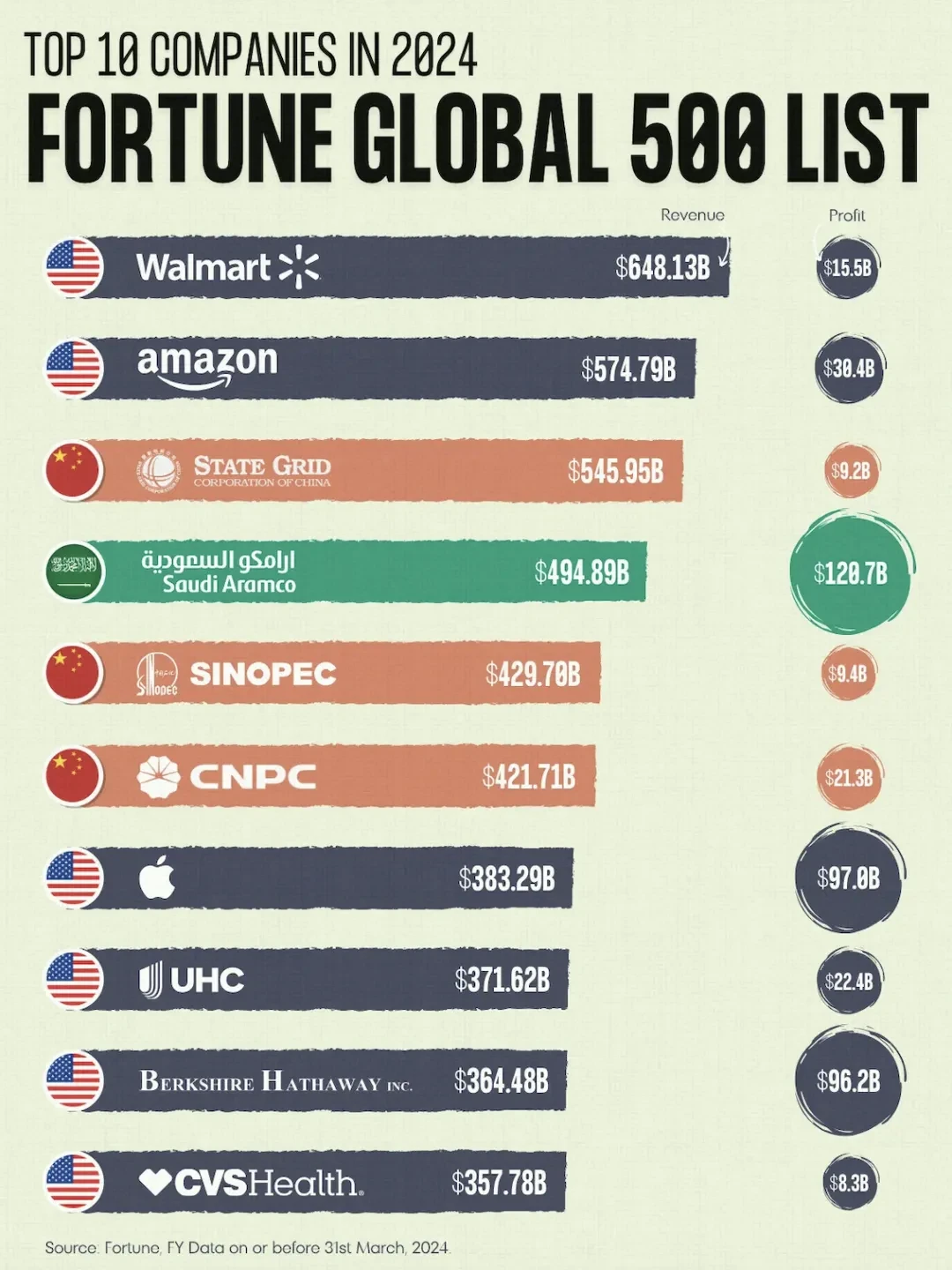
Fortune Magazine Ranking - UnitedHealth Group Ranked No. 8
At 6:45 a.m., braving the chilly morning air of Manhattan, New York, Brian Thompson began walking toward the Hilton Hotel where the event was held. Since the hotel wasn’t far from where he stayed, he chose to walk and did not arrange security protection. Although he had previously received several death threats, such warnings were routine during his 20 years at UnitedHealth, so he never took them seriously.
As he walked casually along the sidewalk as usual, tragedy struck—an individual dressed in a black hooded jacket and carrying a gray backpack suddenly appeared behind him like a ghost, pulling out a silenced 9mm handgun and firing multiple shots into Thompson’s back and lower legs. Midway through, the gun jammed briefly, but the assailant quickly cleared it before approaching the fallen Thompson and firing a final shot. Then, the man fled through a side alley; witnesses reported seeing him ride an electric bicycle into Central Park.
Three minutes later, at 6:48 a.m., police arrived at the scene and found several spent shell casings on the ground. Engraved on them were the words “Deny,” “Defend,” “Depose” (some sources say Delay, Deny, Depose)—three D-words that coincidentally reflect unwritten rules long practiced in the American insurance industry when handling claims: Delay—prolong claim processing time; Deny—refuse payment outright; Depose—interrogate policyholders aggressively to dissuade litigation.
At 7:04 a.m., surveillance footage showed the suspect boarding a taxi to the central bus terminal, after which he disappeared from all video records and left New York City.
At 7:12 a.m., less than 30 minutes after being rushed to the hospital, Brian Thompson was pronounced dead. A leader of a trillion-dollar business empire had become a lone soul claimed by gunfire.
As news of the event spread, American society erupted into heated debate.
Some labeled the killer an “openly brazen murderer,” given how calmly and deliberately he carried out the shooting and escape—hard to imagine anything more ruthless or cold-blooded. Others speculated there might be deeper motives behind the assassination of the head of America’s biggest insurer. The precision of the planning and specificity of the target suggested possible personal vendettas or other hidden factors. Still others viewed the incident as merely another repetition of America's all-too-common gun violence—except this time, the victim wasn't an ordinary citizen but the CEO of a corporate titan.
As time passed, more information gradually came to light:
On December 5, police investigations revealed that the gunman had checked into HI New York City Hostel in Manhattan’s Upper West Side. During registration, he briefly conversed with a female staff member. As quoted by CBS News citing a source connected to the NYPD: “They were flirting, and then he removed his mask or covering and flashed a bright smile.”
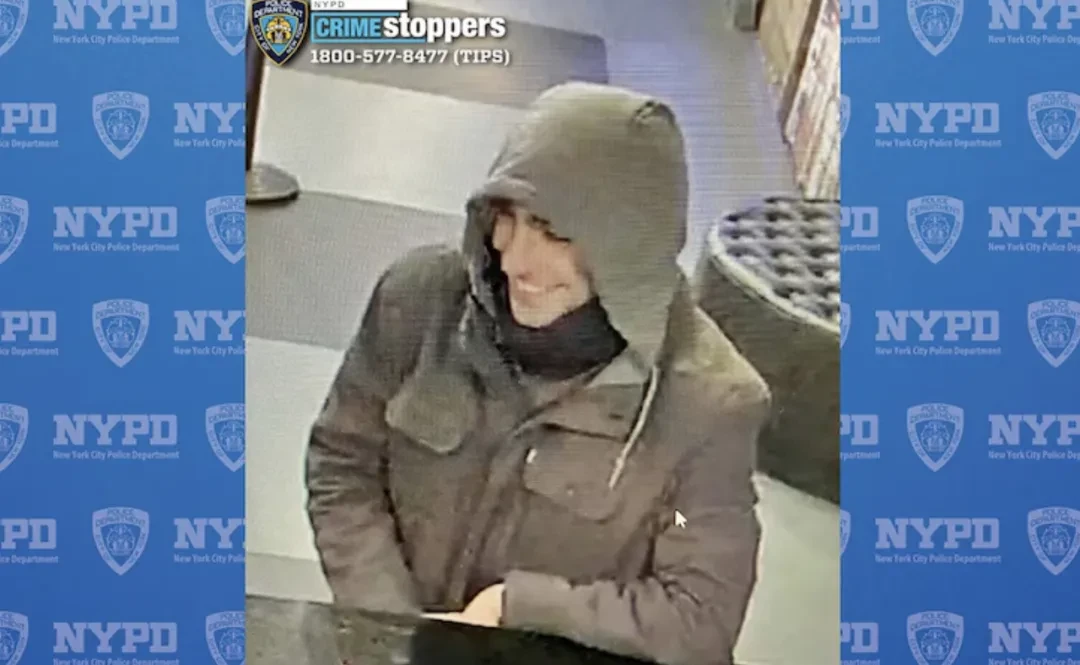
Footage of the shooter talking with front desk staff
On December 9, approximately 450 kilometers away from New York, at a McDonald’s located at 407 Plank Road, Altoona, Pennsylvania, an employee filed a report after being alerted by a customer who noticed a man wearing a medical mask and a flat cap, matching the description of the “New York street shooter.” Police responded and confirmed his identity as the suspect in the “12·4 CEO assassination case,” leading to his arrest.
The man was identified as Luigi Nicholas Mangione, aged 26. He possessed a firearm believed to have been used in the fatal shooting of Brian Thompson on the 4th (later confirmed to be 3D-printed, explaining earlier reports of a misfire). Authorities also discovered a three-page handwritten manifesto among his belongings. In it, Luigi wrote: “To the FBI, I’ll keep it short because I genuinely respect everything you do for the nation. To save you lengthy investigation efforts, I clearly state that I did not collaborate with anyone.” He added: “I apologize for any conflict or trauma caused, but this was necessary. Frankly speaking, these parasites deserved exactly what they got.”

The 3D-printed murder weapon
With Luigi’s arrest, details about his background and motivations began surfacing—and people realized this story could not simply be dismissed as a “routine shooting.”
When Justice Clashes with Morality: U.S. Healthcare Industry Ills vs. Patients’ Claims Needs
The case intensified as Luigi Nicholas Mangione’s identity became clearer, pointing directly at systemic flaws in America’s distorted healthcare system.
According to online revelations, Luigi Nicholas Mangione is an Italian-American born in Maryland. He graduated in 2016 from Gilman School, a prestigious private high school in Baltimore charging $37,000 annually, and delivered a valedictorian speech. In May 2020, he earned both bachelor’s and master’s degrees in engineering from the University of Pennsylvania—one of America’s Ivy League institutions—majoring in computer science with a minor in mathematics. He served as lead counselor in Stanford’s preparatory research program and founded a video game development club in college that was recognized by the Computer Science Honor Society. He interned at the studio behind the famous Civilization series and worked as a data engineer at TrueCar, a California-based car shopping website. In 2023, he moved to Hawaii and began living as a digital nomad.
Later, users uncovered his Goodreads reading list, which included Tim Ferriss’s bestseller *The 4-Hour Workweek*, a bible for digital nomads. Notably, in January of this year, he posted a lengthy review of *Industrial Society and Its Future*, written by Ted Kaczynski—the infamous “Unabomber,” a radical mathematician. In the review, he wrote: “It’s easy to dismiss this as the rantings of a madman without much thought. But one cannot ignore how prescient many of his predictions about modern society were… When all other forms of communication fail, violence becomes a necessity for survival… These corporations don’t care about you, your children, or your grandchildren… ‘Violence never solves anything’—that’s a statement made by cowards and predators.” After his arrest, U.S. law enforcement swiftly removed or blocked access to all of Luigi’s social media accounts (though his X account @PepMangione remained accessible due to inactivity), including his Goodreads reviews.
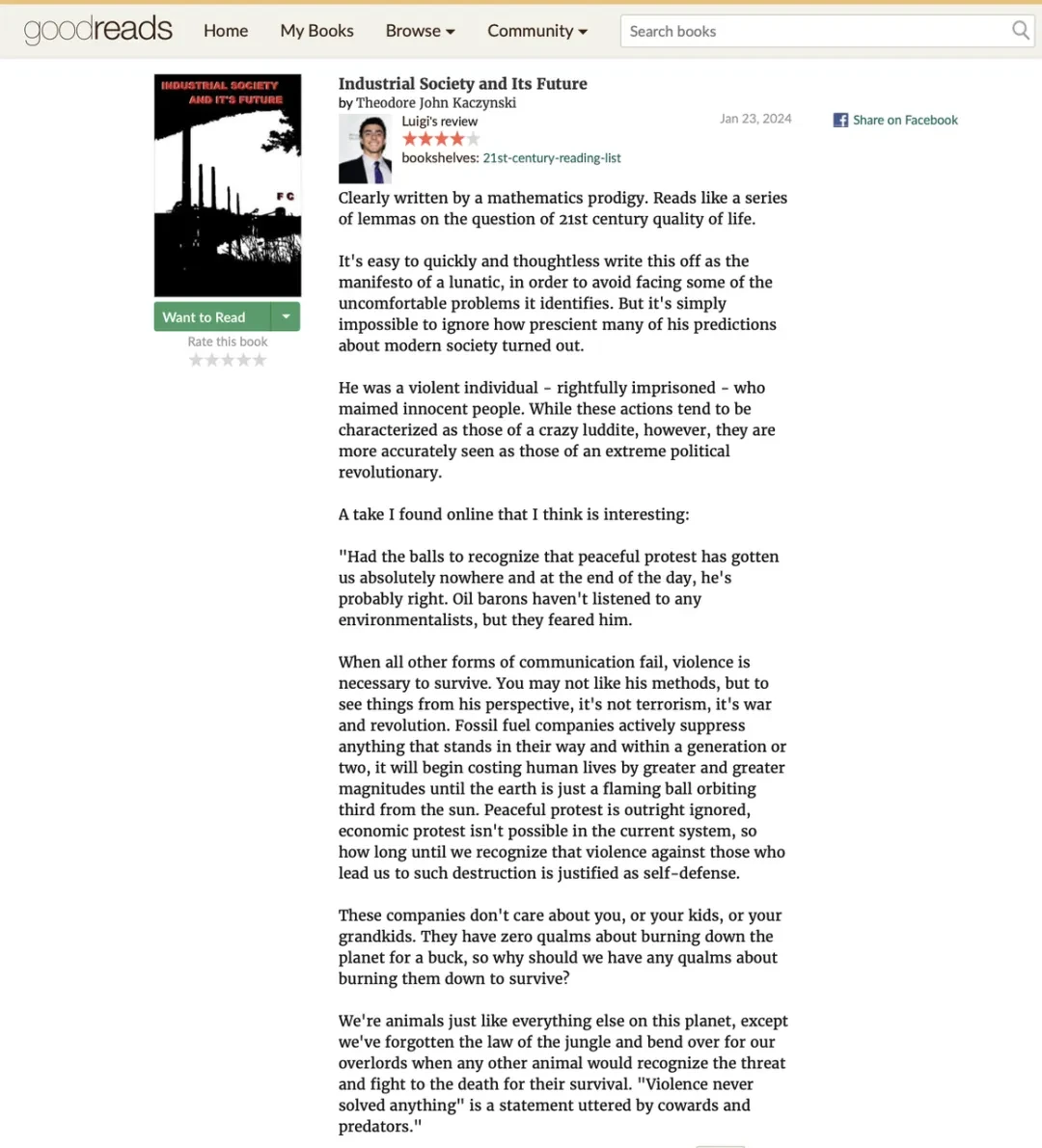
Luigi’s long-form Goodreads review
Beyond his personal history, his family background also drew intense scrutiny. His grandparents were real estate developers owning numerous properties in Maryland and operating multiple senior rehabilitation centers and two country clubs. His cousin, Nino Mangione, serves as a Republican state delegate in Maryland and co-chair of Trump’s campaign committee in Baltimore County. Following Luigi’s arrest, Nino posted on social media: “Our entire family is shocked and heartbroken by Luigi’s arrest. We pray for Brian Thompson’s family and ask everyone to pray for all those affected.”
Several weeks before the shooting, Luigi had cut off contact with his family. Friends said he underwent back surgery months prior, which failed to relieve chronic pain that severely disrupted his daily life. Online sleuths speculate based on his Goodreads shelf that he may suffer from spondylolisthesis.
Based on information leaked by law enforcement officials to *The New York Times* and other sources, the handwritten manifesto found on Luigi may read as follows:
To the FBI: I will try to be brief, as I respect everything you do for our country. To save you from a long investigation, let me make one thing clear—I acted alone. This was fairly straightforward: some basic social engineering, fundamental computer-aided design, and a great deal of patience.
If you find my spiral notebook, it contains scattered notes and to-do items that should clarify things. My electronic devices are heavily protected, as I work in engineering, so you likely won’t find much there.
I am deeply sorry for any conflict or trauma caused, but this was necessary. To be honest, these parasites fully deserved their fate. Just a reminder: the U.S. has the most expensive healthcare system in the world, yet our life expectancy ranks around 42nd globally. UnitedHealth is now the [xxx] largest company in America, behind only Apple, Google, and Walmart. It keeps growing richer, but what about our average lifespan? No improvement. The truth is, these [xxx] have grown too powerful, exploiting our nation for massive profits, enabled by the American public’s tolerance of their impunity.
The issue is clearly far more complex, but I lack space here to elaborate, nor am I necessarily the most qualified person to explain it fully. Yet decades ago, figures like Rosenthal and Moore already exposed this corruption and greed—and nothing changed. This is no longer about awareness—it’s clearly a game of power. Clearly, I am the first to confront it so directly.
Paired with his elite resume, this statement evokes sympathy akin to a “tragic hero”—a sentiment standing in stark contrast to the brutal reality of America’s healthcare system today.
U.S. healthcare spending as a share of GDP consistently exceeds that of other nations. Data aggregation shows the average hospital stay costs $22,500; a common appendectomy runs about $30,000; complex surgeries can reach hundreds of thousands of dollars. Without insurance, ordinary citizens cannot afford treatment. Meanwhile, obtaining health insurance itself remains difficult.
A Gallup poll from 2023 found that roughly 81% of Americans expressed dissatisfaction with healthcare costs—the highest level in 16 years. According to KFF, in 2024, the average annual premium for family coverage reached $25,572, while single adult premiums averaged $8,951—up 6% and 7% respectively from the previous year. Since 2000, health insurance premiums have generally risen faster than inflation, except for a few isolated years.
Additionally, a 2023 survey by the American Medical Association found that 1/3 of physicians reported the insurance industry’s “prior authorization” model—requiring approval before treatment—led to severe patient deterioration. Ninety-four percent of essential treatments were delayed, 80% of patients abandoned care altogether, resulting in disability or death for 9%. Insurers routinely use bureaucratic hurdles, paperwork, and claims processes to minimize payouts or deny coverage entirely. No wonder Jay M. Feinman, professor at Rutgers University, saw widespread popularity for his 2010 book *Delay, Deny, Defend: Why Insurance Companies Don’t Pay Claims and What You Can Do About It.*
For UnitedHealthcare, employing 140,000 people, financial site Value Penguin estimates its denial rate may reach as high as 32%—nearly double the industry average of 16%. On average, one in every three claim requests gets rejected. Much of this stems from policies implemented under CEO Brian Thompson, who took office in 2021.
Data indicates UnitedHealthcare’s denial rates have steadily increased since 2021: 10.9% in 2020, doubling to 22.7% in 2022. Correspondingly, corporate profits surged: $12 billion in 2021, rising to $16 billion in 2023—even amid the pandemic. During the same period, Thompson’s personal compensation stood at $10.2 million, $9.8 million, and $9.6 million annually from 2021 to 2023.
Under Thompson’s leadership, UnitedHealthcare proposed in 2021 to stop paying emergency room visits at hospitals deemed “non-critical,” though public backlash forced cancellation. At the 2023 investor meeting, he outlined a strategy favoring reimbursement for “value-based care”—specifically post-acute care rather than acute treatment phases.
Even more troubling, a October 2024 report from the U.S. Senate Permanent Subcommittee on Investigations revealed UnitedHealthcare uses AI tools and an algorithm called nH Predict to screen claims. Post-acute care services are the most frequently denied, with denial rates approximately triple the overall average. Last year, families of two deceased patients sued the insurer, alleging deliberate use of a flawed algorithm to deny elderly patients medically necessary extended care—allegedly with a 90% error rate. An investigation by ProPublica previously found UnitedHealth leveraged algorithms to effectively cut or restrict certain mental health treatments, endangering many Americans' access to psychological care. Such practices have been ruled illegal in California, Massachusetts, and New York.
Insurance companies in the U.S. have long been seen as “invincible profit machines,” shielded by labyrinthine policies and formidable legal teams. After claim denials, most people accept defeat—only 0.1% appeal.
When harsh societal realities collide with seemingly righteous acts of retribution, Robin Hood-style narratives naturally resonate more deeply. That explains why many—including segments of American media—have focused attention on UnitedHealthcare and the broader healthcare system, rather than solely on “Luigi murdering a CEO.” Social platforms like X, Reddit, and TikTok have recently flooded with slogans like “FreeLuigi” and “Free the man.” Some users even fabricated alibis for him in comment sections. Worse still, backlash extended to the McDonald’s employee who reported Luigi—leading netizens to collectively attack the restaurant by flooding mapping apps with one-star reviews.
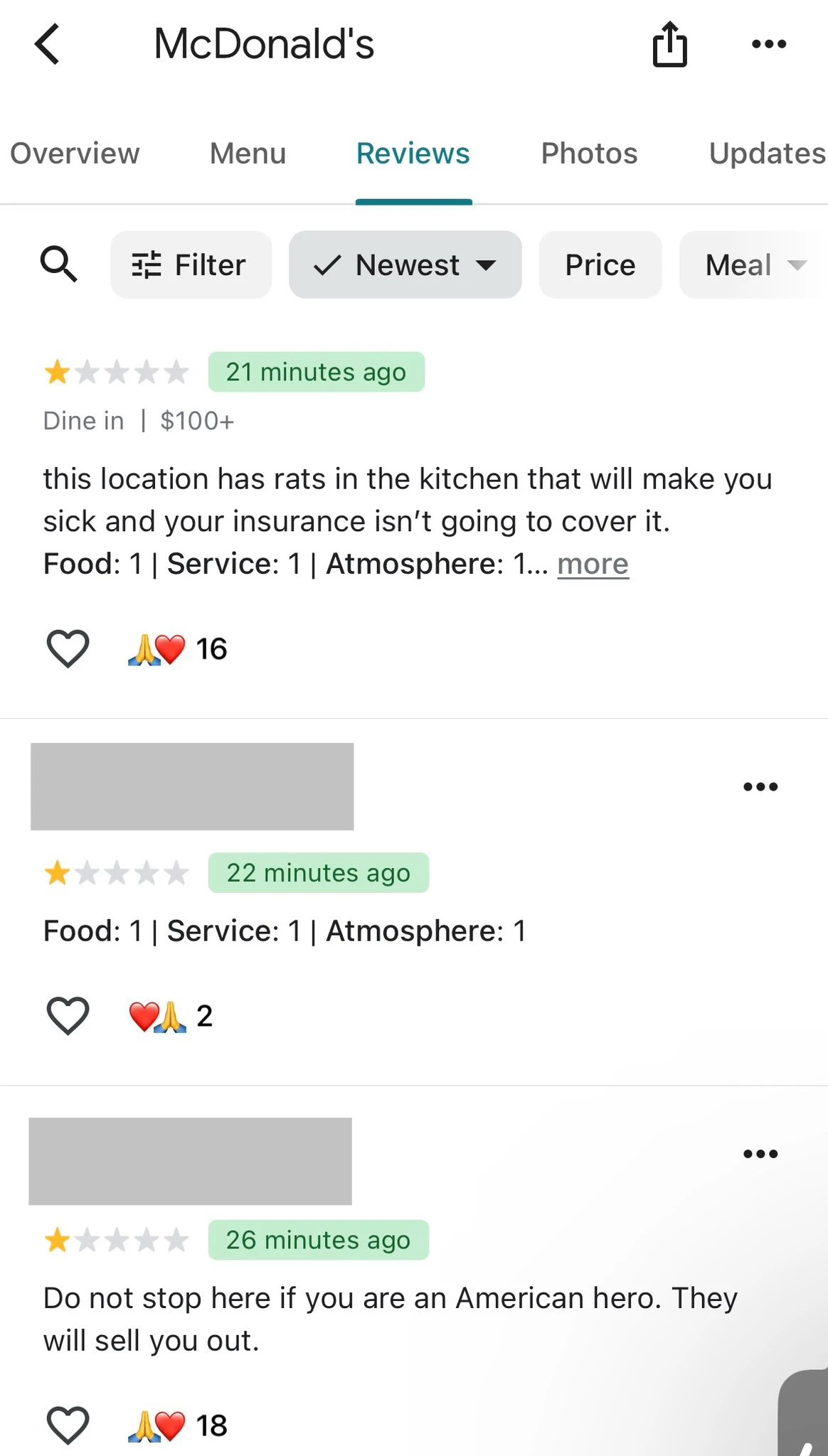
This McDonald’s received a wave of one-star reviews after angering the public
Of course, not everyone has been swept up in this romanticized view of vigilante justice.
On December 10, Pennsylvania Democratic Governor Josh Shapiro publicly condemned Luigi Nicholas Mangione: “In some dark corners, this killer is celebrated as a hero. Let me be clear—he is not a hero. The real heroes are people like the one who called 911 at McDonald’s.”
In addition, screenshots circulated online showing Elon Musk commenting on the incident on December 7: “So disgusting—everyone is turning that guy into some kind of folk hero. Insurance companies, like any corporation, have a duty to maximize shareholder returns, regardless of how ruthless the methods. The radical left needs to grow up.” However, this tweet does not appear in Musk’s current feed, suggesting possible deletion or fabrication via image editing.
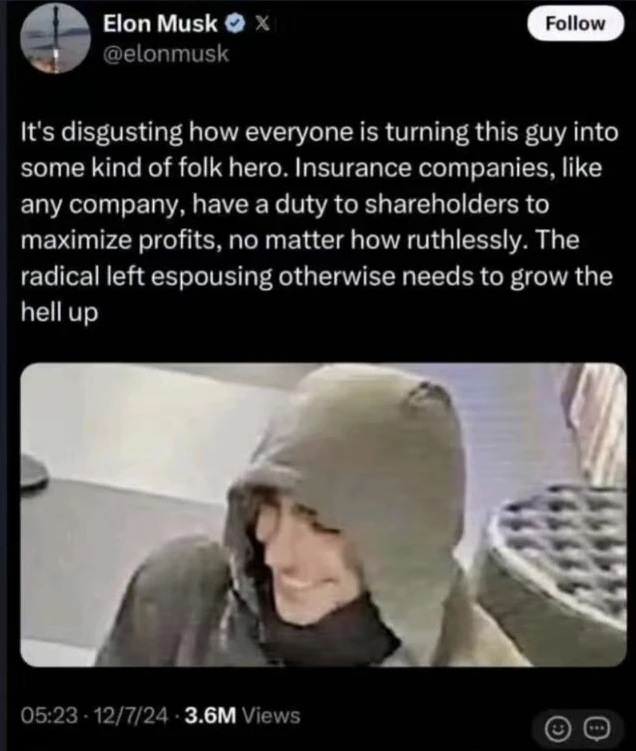
Online screenshot
Subsequent rumors suggest Luigi may have committed the act due to denied insurance claims related to his mother’s chronic back pain or his grandparents’ healthcare benefits. Final confirmation awaits further investigation by U.S. authorities. On December 10, New York police charged him with second-degree murder in connection with the CEO’s death, plus five additional charges including forgery, false identification, and illegal possession of firearms. However, due to differences in state laws and judicial systems across the U.S., transferring fugitives between states may take days or even weeks.
When Cryptocurrency Becomes the News 'Fire Zone': Can Speculation Sustain a Moment in the Spotlight?
According to GMGN data, at the time of writing, the namesake token LUIGI associated with this incident trades at approximately $0.015, with a market cap of around $15 million—down about 80% from its peak of $78 million.
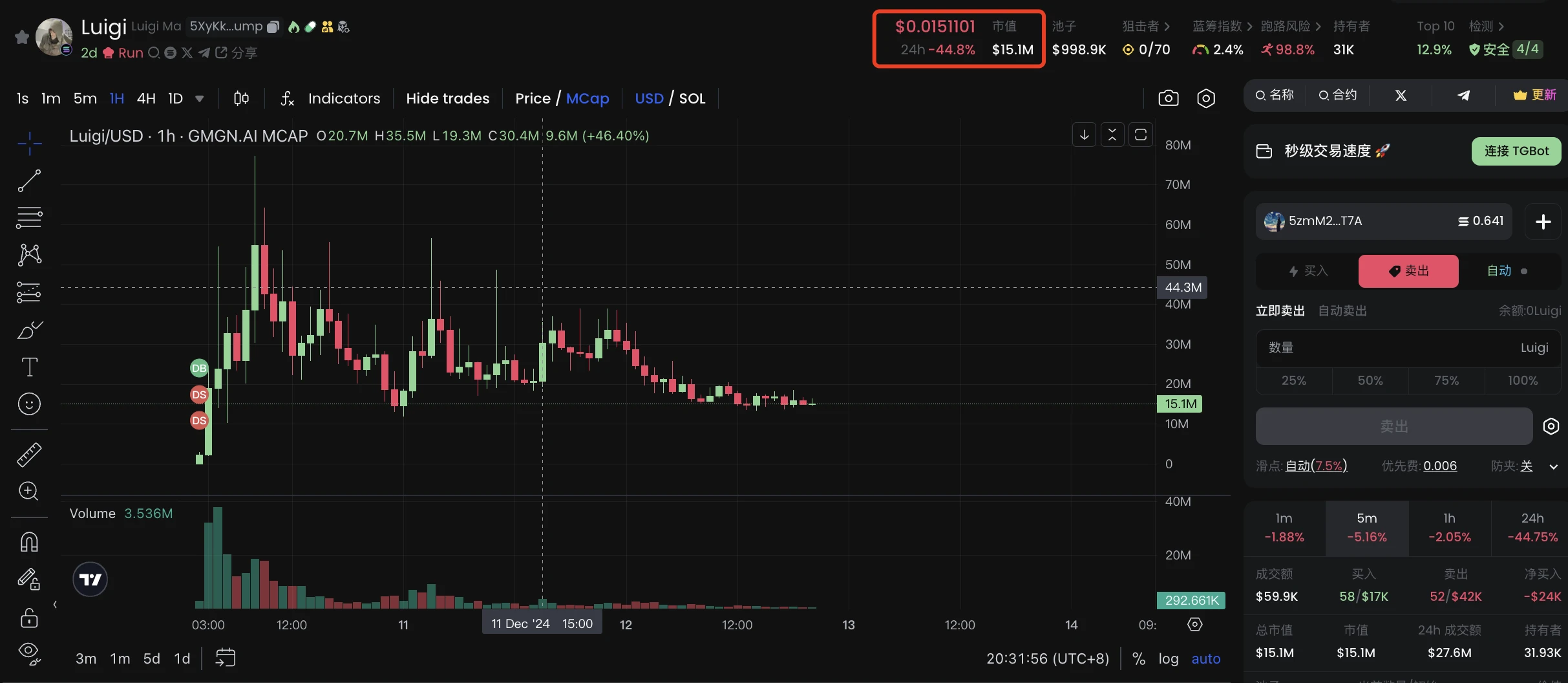
LUIGI Token Information
Much like Polymarket—the crypto prediction market that successfully forecast Trump’s victory earlier this year—meme coins today function in some sense as “barometers of social sentiment.” Previously, the squirrel meme coin PUNT, inspired by a tragic squirrel incident, even earned praise from Musk, who said, “A squirrel and a meme coin saved America”—an exaggeration perhaps, but still a nod to meme coins’ social relevance. Similarly, MOODENG, an Ethereum-based meme coin derived from a viral hippo on TikTok, went on to support charitable causes through token donations, becoming a rare example of “mass adoption” experimentation within the crypto space.
Moreover, the热度of breaking news directly impacts the market performance of various cryptocurrencies, especially meme coins. Yet for many projects, pure speculation often amounts to little more than a fleeting zero-sum game. Whether such tokens can breathe lasting significance into transient headlines depends largely on the enduring strength of their narrative.
LUIGI is merely one intersection of meme coins and breaking news. More such projects will inevitably emerge. Will future meme coins help shape different outcomes for similar events? Only time will tell.
Join TechFlow official community to stay tuned
Telegram:https://t.me/TechFlowDaily
X (Twitter):https://x.com/TechFlowPost
X (Twitter) EN:https://x.com/BlockFlow_News
 Odaily