Delphi Researcher: The Evolution Path and Value Capture of AI Agent Economy
TechFlow Selected TechFlow Selected
Delphi Researcher: The Evolution Path and Value Capture of AI Agent Economy
In the future, AI agents will be everywhere.
 Navigating Web3 tides with focused insights
Author: Robbie Petersen, Researcher at Delphi Digital
Translation: Luffy, Foresight News
A useful framework for understanding the success of the internet is to view it through the lens of coordination. At a fundamental level, we can attribute the success of the most valuable internet applications to their ability to more precisely coordinate human intent. Amazon coordinates commercial intent, Facebook, Instagram, and Twitter coordinate social intent, Uber and DoorDash coordinate ride-hailing and delivery intent, while Google coordinates information-seeking intent by matching queries with relevant web content.
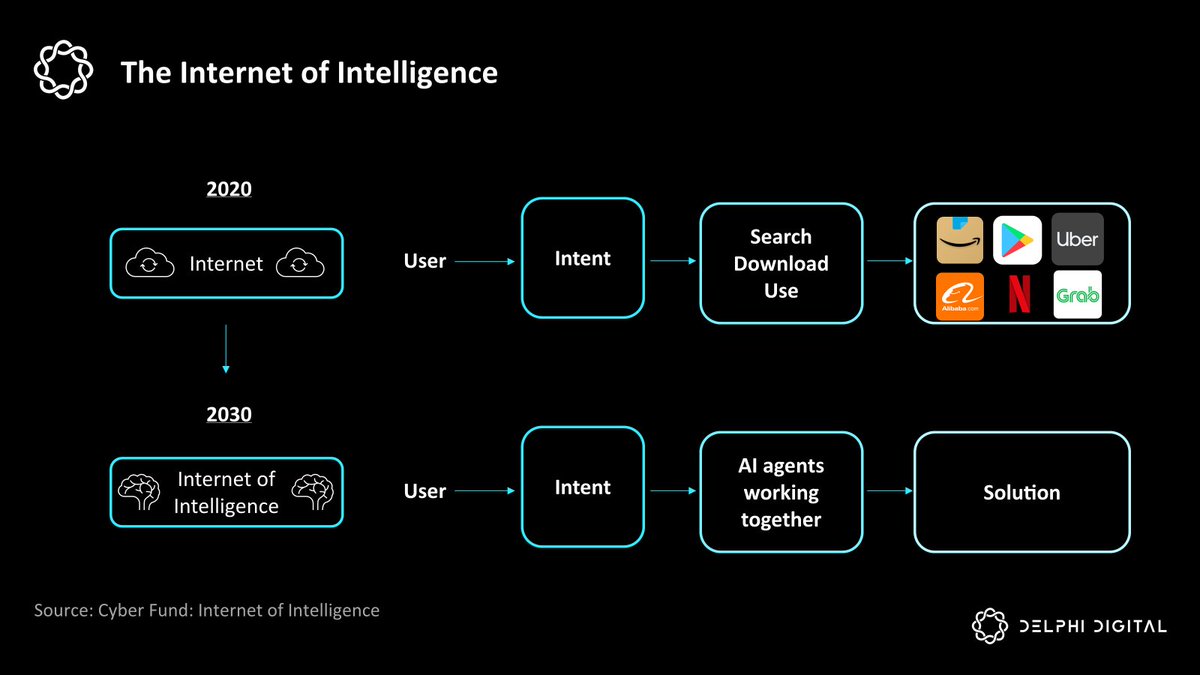
A clear trend is that AI agents represent the next logical evolution in large-scale coordination. While today our "intentions" are fulfilled by searching the web, downloading apps, and interacting with interfaces, it's reasonable to assume that in the near future, our "intentions" will be executed by a network of AI agents working on our behalf.
Critically, this shift toward an agent-based coordination economy raises a foundational question: what kind of infrastructure will ultimately underpin this evolution?
In this article, we will (1) explore the bull and bear cases for AI agents transacting via cryptocurrency; (2) outline the logical path of agent adoption; and (3) examine value capture within this emerging agent economy.
The Role of Cryptocurrency
There’s been much speculation about why blockchains could serve as the economic foundation for the agent economy. However, as with most emerging crypto verticals, the bull case has been reduced to a simplistic and uncritical narrative. Today’s popular argument — “agents can’t have bank accounts, so they’ll use crypto wallets instead” — appears to miss the core value proposition of cryptocurrency. Access isn't the issue: agents could technically hold bank accounts under an FBO (For Benefit Of) structure. For example, companies like PayPal already manage millions of sub-accounts under a single FBO umbrella. They could similarly manage AI agents — each with its own virtual sub-account tracked by the platform but pooled at the banking level. Notably, Stripe recently announced support for agent transactions under a similar model.
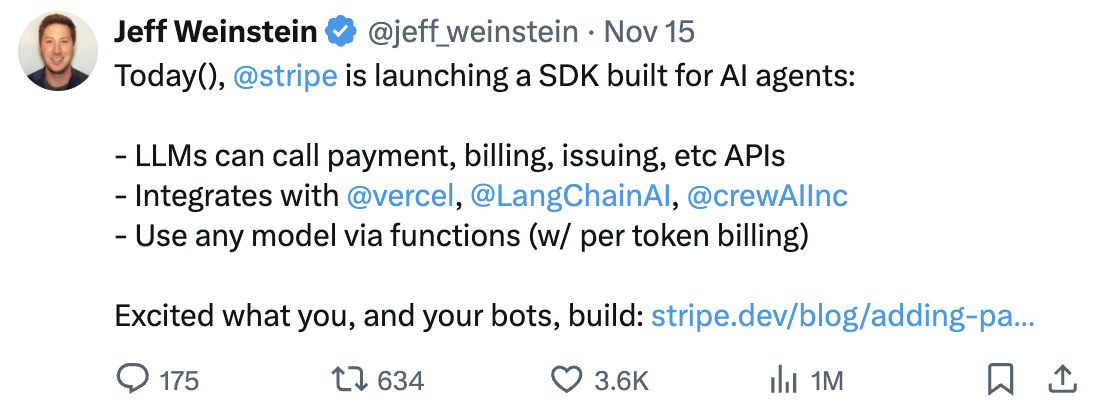
https://twitter.com/jeff_weinstein/status/1857161398943642029
Additionally, the argument that “this undermines agent autonomy” is somewhat oversimplified. Ultimately, someone must manage the private keys of AI agents, meaning they aren’t fully autonomous anyway. While it's theoretically possible to store agent private keys in Trusted Execution Environments (TEEs), doing so is operationally expensive and impractical. Moreover, even if agents were 100% autonomous, it wouldn't fundamentally change the reality — they exist to serve humans.
Instead, the real pain points driving agent transactions on traditional systems versus blockchains are as follows:
-
Settlement Time: Traditional payments face delays of days and batch processing limitations, especially across borders. This lack of instant settlement severely hampers AI agents, which require real-time responsiveness to operate efficiently. Blockchain Solution: Public blockchains offer near-instant settlement finality via atomic transactions, enabling real-time agent-to-agent interactions without counterparty risk. These transactions settle 24/7,不受 geographical boundaries or banking hours.
-
Global Accessibility: Traditional banking infrastructure creates significant barriers for global developers, with 70% of non-U.S. developers facing challenges when using payment channels. Blockchain Solution: Public blockchain infrastructure is inherently borderless and permissionless, enabling global deployment of agents without reliance on traditional banks. Anyone with internet access can participate, regardless of location.
-
Unit Economics: The fee structures of traditional payment systems (3% + fixed fees) make microtransactions economically unviable, creating obstacles for AI agents that need to conduct frequent, low-value transactions. Blockchain Solution: High-performance blockchains enable microtransactions at minimal cost, allowing agents to execute high-frequency, low-value transactions efficiently.
-
Technical Accessibility: Traditional payment infrastructure lacks programmable APIs and imposes strict PCI compliance requirements. Systems designed for human interaction via web forms and manual input create major barriers for automated agent operations. Blockchain Solution: Blockchain infrastructure offers native programmatic access through standardized APIs and smart contracts, eliminating the need for forms or manual inputs. This enables reliable automation and avoids PCI compliance overhead.
-
Multi-Agent Scalability: Traditional systems struggle to manage multiple AI agents requiring independent funds and accounts, leading to costly bank relationships and complex accounting. Blockchain Solution: Blockchain addresses can be programmatically generated, enabling efficient fund isolation and scalable multi-agent architectures. Smart contracts allow flexible, programmable fund management without the administrative costs of traditional banking.
The Path to Adoption
While the technical advantages of cryptocurrency are compelling, they are not necessarily prerequisites for the wave of agent-mediated commerce. Despite their limitations, traditional payment systems benefit from massive network effects. Any new infrastructure must offer compelling advantages — not just marginal improvements — to drive adoption.
Looking ahead, we expect agent adoption to unfold in three distinct phases, each marked by increasing levels of agent autonomy:
Phase One: Human-to-Agent Transactions (Now)
We are currently in Phase One. Perplexity’s recent launch of “Buy with Pro” offers a glimpse into how humans will increasingly transact with AI agents. Their system allows AI bots to integrate with traditional credit cards and digital wallets like Apple Pay, research products, compare options, and execute purchases on behalf of users.
While this process could theoretically use cryptocurrency, there appears to be no clear benefit. As Luke Saunders pointed out, the necessity of cryptocurrency depends on the degree of autonomy required by the agent. Currently, these agents aren’t autonomous enough. They don’t independently manage resources, take on risk, or pay for other services — they’re more like research assistants helping you before you decide to buy. It’s only in later stages of agent adoption that the limitations of traditional channels become apparent.
Phase Two: Agent-to-Human Transactions (Emerging)
The next phase involves agents initiating transactions with humans autonomously. This is already happening at a small scale: AI trading systems executing trades, smart home systems purchasing electricity at optimal times via time-of-use pricing, and automated inventory systems placing restocking orders based on demand forecasts.
Over time, we may see more sophisticated human-agent commerce use cases emerge, potentially including:
-
Payments & Banking: AI agents optimizing bill payments and cash flow, detecting fraud and disputed charges, automatically categorizing expenses, and maximizing interest while minimizing fees through intelligent account management.
-
Shopping & Consumer: Price monitoring and automated procurement, subscription optimization, automatic refund claims, and smart inventory management for household supplies.
-
Travel & Transportation: Flight price tracking and rebooking, smart parking management, ride-sharing optimization, and automated travel insurance claims processing.
-
Home Management: Smart temperature control, predictive maintenance scheduling, and automatic replenishment of consumables based on usage patterns.
-
Personal Finance: Automated tax optimization, portfolio rebalancing, and bill negotiation with service providers.
Importantly, while these use cases will begin to expose the shortcomings of traditional pathways as agents start managing resources and making autonomous decisions on behalf of humans, most of these transactions could still theoretically be executed under architectures like Stripe’s Agent SDK.
However, this phase will mark the beginning of a more fundamental shift: as agents optimize spending in real time, we’ll see a move toward granular, usage-based pricing instead of fixed monthly or annual service fees. In other words, in a world of increasingly autonomous agents, they will need to pay for computational resources, API query costs, LLM inference, transaction fees, and other externally priced, usage-based services.
As the unit economics flaws of card payments become increasingly evident, cryptocurrency evolves from a marginal improvement into a leapfrog functionality superior to traditional channels.
Phase Three: Agent-to-Agent Transactions (Future)
The final phase represents a transformation in how value flows through the digital economy. Agents will transact directly with other agents, forming complex autonomous commercial networks. While early attempts have appeared in corners of crypto market speculation, we’ll soon see far more sophisticated use cases emerge:
-
Resource Markets: Compute agents negotiating optimal data placement with storage agents, energy agents trading grid capacity in real time with consumption agents, bandwidth agents auctioning network capacity to content delivery agents, and cloud resource agents engaging in real-time arbitrage across providers.
-
Service Optimization: Database agents negotiating query optimization services with compute agents, security agents purchasing threat intelligence from monitoring agents, cache agents exchanging space with content prediction agents, and load-balancing agents coordinating with scaling agents.
-
Content & Data: Content creation agents licensing assets from media management agents, training data agents negotiating with model optimization agents, knowledge graph agents trading verified information, and analytics agents purchasing raw data from collection agents.
-
Business Operations: Supply chain agents coordinating with logistics agents, inventory agents negotiating with procurement agents, and customer service agents contracting specialized support agents.
-
Financial Services: Risk assessment agents trading insurance with underwriting agents, financial agents optimizing returns with investment agents, credit scoring agents selling verified credentials to lending agents, and liquidity agents coordinating with market-making agents.
This phase demands infrastructure fundamentally designed for machine-to-machine commerce. Traditional financial systems are built on human identity verification and oversight — a model inherently incompatible with an agent-to-agent dominant economy. In contrast, stablecoins — with their programmability, borderlessness, instant settlement, and support for microtransactions — become essential infrastructure.
Value Capture in the Agent Economy
The evolution toward an agent economy will inevitably create winners and losers. Within this new paradigm, several layers of the technology stack emerge as key points for value capture:
-
Interface Layer: Similar to competition for end-users in traditional payments, participants here may compete for control over the interface layer where users express “agent intent.” These frontends will evolve from simple payment tools into integrated platforms combining identity, authentication, and transaction capabilities. Several players could capture value here: (1) device manufacturers like Apple, due to hardware security and identity integration; (2) consumer fintech super-apps like PayPal and Block’s Cash App, thanks to large user bases and existing closed-loop payment networks; (3) AI-native interfaces like ChatGPT, Claude, Gemini, and Perplexity, as agent transactions are a natural extension of their existing chatbots; and (4) existing crypto wallets, which could leverage their crypto-native edge (though less likely).
-
Identity Layer: A key challenge in the agent economy is distinguishing between human and machine participants. This becomes especially critical as agents begin disproportionately managing valuable resources and making autonomous decisions. While Apple holds an advantage here, Worldcoin is pioneering interesting solutions through its Orb hardware and World ID protocol. By offering verifiable proof of personhood, Worldcoin could indirectly become one of the biggest beneficiaries of this trend, providing developers with a platform to ensure all users are human. While the value may not be obvious today, it will become increasingly clear in the future.
-
Settlement Layer (Blockchain): If blockchains replace traditional systems as the standard settlement layer for AI agents, then blockchains facilitating agent transactions will capture massive value.
-
Stablecoin Issuance Layer: Given liquidity network effects, it’s reasonable to assume that whichever stablecoin agents adopt will capture significant value. USDC currently appears best positioned, as Circle is launching developer-controlled wallets and stablecoin infrastructure tailored for agent transactions.
Ultimately, the biggest losers may be applications unable to adapt quickly to the agent economy. In a world where transactions are driven by agents rather than humans, traditional moats will erode. Humans make decisions based on subjective preferences, brand loyalty, and user experience, whereas agents make purely performance- and economics-driven choices. This means that as the line between applications and agents blurs, value will shift toward companies offering the most efficient and highest-performing services — not those with the best UI or strongest brand.
As competition shifts from subjective differentiation to objective performance metrics, users — both human and agent — will benefit the most.
Join TechFlow official community to stay tuned
Telegram:https://t.me/TechFlowDaily
X (Twitter):https://x.com/TechFlowPost
X (Twitter) EN:https://x.com/BlockFlow_News
 Delphi Digital