Devcon Reflections: The Tangible "Infinite Garden"
TechFlow Selected TechFlow Selected
Devcon Reflections: The Tangible "Infinite Garden"
Ethereum may not be an ecosystem that rewards the brave, but truly valuable things will eventually pay off.
 Navigating Web3 tides with focused insights
Author: CHUNZHEN
"Finite games are played to win; infinite games are played to continue the play." Inspired by American scholar James P. Carse, Aya Miyaguchi, Executive Director of the Ethereum Foundation, introduced the vision of Ethereum as an "infinite garden." Ethereum is not just a technology, but also a diverse garden composed of individuals and organizations. The Ethereum Foundation acts as a gardener in this garden—nurturing and facilitating growth without seeking control—enabling people to build and grow within an open, infinite space, allowing the garden to thrive organically over time.
Over the four-day journey at Devcon SEA (Devcon 7), I witnessed the tangible realization of Ethereum’s “infinite garden” vision.
When We Talk About Public Goods
During Devcon, I mainly interviewed several representative public goods projects, including Gitcoin, Protocol Guild, and Octant.遗憾的是没找到 Optimism 团队。Below is a summary of key insights:
Gitcoin co-founder Kevin Owocki mentioned that technologies like account abstraction are making Web3 user experiences closer to those of Web2 products—a capability Gitcoin currently lacks. Gitcoin remains fundamentally a platform built for Web3 developers, assuming every user already has a wallet and understands how to transact. However, if it aims to provide solutions for non-blockchain use cases, improving user experience becomes essential.
Previously, Gitcoin launched an experimental Layer2 Public Goods Network (PGN), designed to redirect sequencing fees toward building and funding public goods. However, PGN ceased operations in June this year. Regarding its shutdown, Owocki stated that while PGN was a valuable experiment, adoption during actual operation remained too low—nobody was truly using it—making closure inevitable. Nevertheless, he strongly supports the original idea behind PGN and welcomes any team interested in restarting or forking the project.
Protocol Guild, a relatively mysterious group, was represented at Devcon by one of its members, Cheeky. Here are several interesting takeaways:
1) On diversity within Protocol Guild: there are only about two Asian members and six female members. While this reflects broader challenges beyond just the Ethereum ecosystem, Protocol Guild remains committed to supporting greater participation from women;
2) Protocol Guild has no marketing team. Instead, they directly ask Layer2s for tokens (though most Layer2 teams usually reject these requests). Starting next year’s first quarter, Protocol Guild plans to strengthen branding efforts, with the ideal scenario being that projects will donate proactively without needing direct outreach;
3) The core purpose of Protocol Guild is enabling Layer2s to fund talented developers so they can remain active on Layer1 development. This may sound paradoxical, but Cheeky emphasized that Ethereum still has a long way to go, and since Ethereum Layer2s inherit Ethereum's security, strengthening Layer1 ultimately benefits all Layer2 ecosystems. This logic is widely accepted, and the hope is that more Layer2s will contribute meaningfully in the future;
4) On legitimacy: could Protocol Guild evolve into another EF (Ethereum Foundation), where project donations serve as symbolic allegiance (i.e., legitimacy)? It’s clear Protocol Guild harbors such ambitions, though specifics on execution remain undefined. Ultimately, Protocol Guild welcomes all contributions—even meme coins donating tokens purely for PR purposes.
Octant, an emerging public goods funding platform, sources funding from the staking yield generated by Golem Foundation’s 100,000 ETH stake. Wlodek Gogloza, Octant’s PR lead, explained that Octant operates as a sustainable funding mechanism. As a solo staker, Golem Foundation stakes its own ETH and allocates part of the returns to support public goods—not limited to Web3-specific initiatives. For security reasons, Octant does not consider liquid staking solutions, even though they might offer higher yields.
I noticed that in Octant’s recently completed Epoch 5 funding round, large contributors like Protocol Guild and Revoke still dominated the top of the funding leaderboard. This raises questions about potential drawbacks of quadratic funding—whether donors tend to favor already-popular, high-profile projects. Wlodek acknowledged this phenomenon: large-scale projects naturally require significantly more funding than small indie projects led by one or two developers, whose needs might be as simple as hosting an offline event. Still, he admitted there is indeed a “popularity contest” dynamic, which warrants further consideration and mitigation.
Wlodek also highlighted an interesting observation: although many current funding programs adopt quadratic funding, the original quadratic funding paper did not assume a fixed matching pool. Instead, the size of the matching fund would scale dynamically based on actual individual donations. In practice, however, most implementations use a pre-determined matching pool, potentially distorting true community preferences. Therefore, Octant is exploring a return to the original quadratic funding formula—without fixing the size of the matching pool upfront.
Local Thai Projects
Thai-native projects had relatively low visibility, with only a few encountered during side events. Some Thai meme/GameFi/metaverse communities were present on MemeWonder, though none were particularly large. An unexpected discovery was TokenUnlocks, a tool I personally use frequently for tracking token unlocks—it turned out to be developed entirely by a Thai team. They’ve now officially rebranded to Tokenomist, expanding into richer on-chain analytics features. Other local projects include Rubie, a wallet app enabling USDC-to-electronic Thai Baht (DTHB) conversion for QR code payments; and Analog, a cross-chain communication protocol. Overall, Thailand’s Web3 scene feels like it's in a wild growth phase. Yet the necessary builders, capital, and ecosystem momentum are already forming, making it a promising emerging market worth watching.
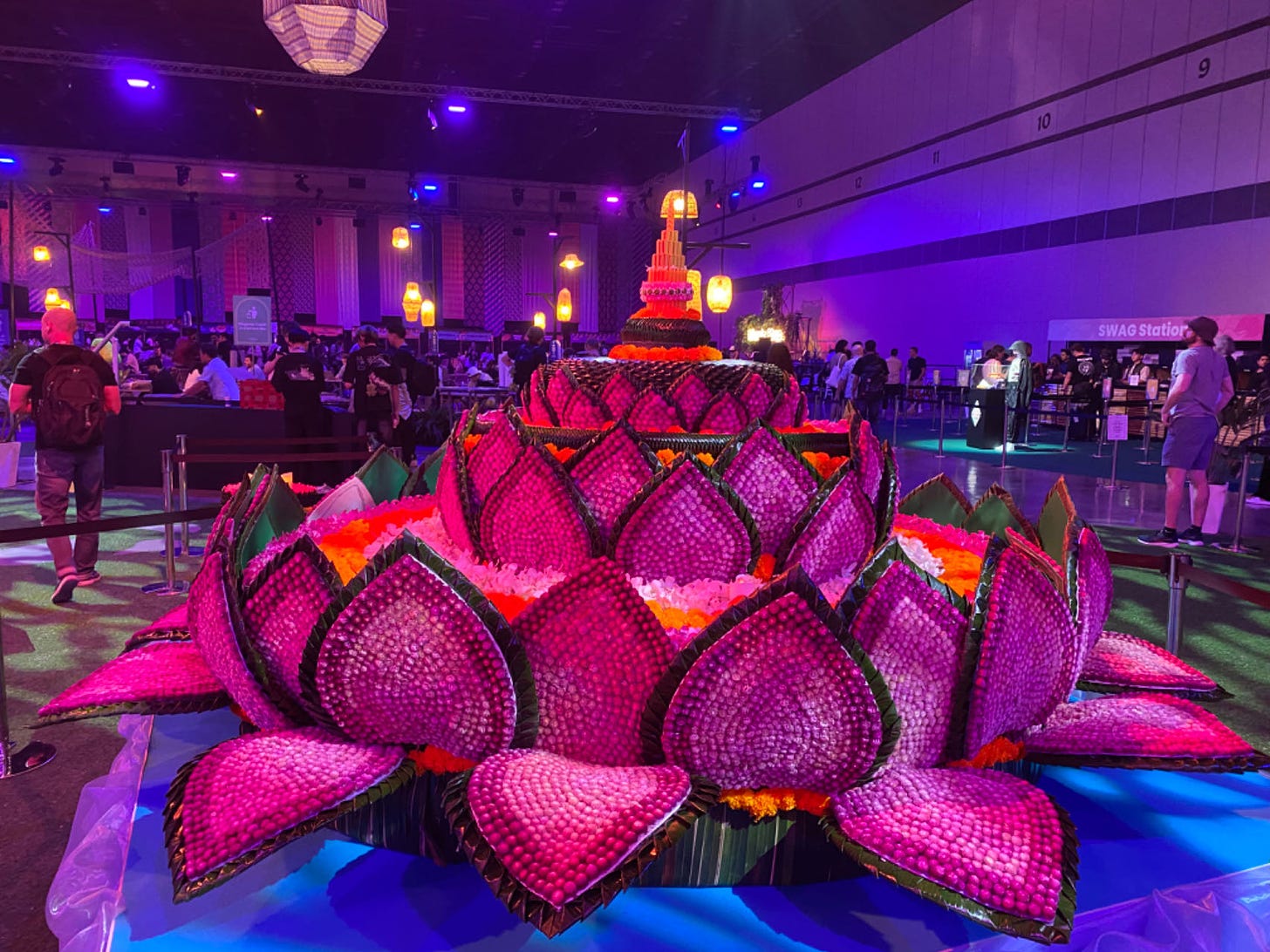
The closing ceremony coincided with Thailand’s Loy Krathong festival, with lantern decorations displayed throughout the venue
Ultimately, my biggest takeaway from Devcon is that Ethereum is an open and inclusive ecosystem. Here, people from any background can find meaningful topics to engage with and connect with like-minded collaborators to build something new. The Ethereum Foundation truly embodies the role of a gardener—low-key in presence, yet reliably available whenever needed. At the same time, given Ethereum’s vast scale, resistance to change is inevitable, especially when multiple stakeholders and interests are involved. Overall, Ethereum may not be an ecosystem that rewards boldness immediately—but truly valuable contributions will eventually pay off.
Join TechFlow official community to stay tuned
Telegram:https://t.me/TechFlowDaily
X (Twitter):https://x.com/TechFlowPost
X (Twitter) EN:https://x.com/BlockFlow_News
 @ChainFeedsxyz