Thoughts and Observations from Devcon: Ethereum Shows Signs of a Nascent Nation, Abundant in Technology but Lacking in Applications
TechFlow Selected TechFlow Selected
Thoughts and Observations from Devcon: Ethereum Shows Signs of a Nascent Nation, Abundant in Technology but Lacking in Applications
The narrative cycle has passed, and there is currently a lack of innovation.
 Navigating Web3 tides with focused insights
Author: kirinparadise.eth, Co-founder of y2z Ventures
This is my second time visiting Bogotá this year, and the first time attending Devcon—though sadly, things are no longer what they once were.
My colleague Da Zhuang kept saying that this year’s Devcon marks the first in-person event after a three-year hiatus. The 2019 Osaka Devcon saw the emergence of DeFi projects like Compound and Uniswap—the dawn of DeFi Summer, which later evolved into the bull market through the end of 2021. So from the beginning of this year, I felt this Devcon would be significant, especially given the current lack of innovation and fading narratives.
Some scattered thoughts and reflections:
1. Ethereum Shows Early Signs of a Network Nation
During the closing ceremony, it was announced that 6,000 people attended Devcon from 113 countries. Right after the ceremony ended, when the dance troupe “encore” entered and raised flags from around the world, dancing with uniquely Latin American rhythms and energy, the entire venue erupted. They danced all the way from the 5th floor down to the 1st, turning the atmosphere into something far beyond a tech conference—it felt like a carnival, Spring Festival Gala, or even the Olympics.
Every attendee likely felt a strong sense of identity—not tied to nationality, but rooted in shared participation in the Ethereum or cryptocurrency revolution.
Holding Devcon in Bogotá reflects the Ethereum Foundation’s (EF) ambition to expand into developing countries, especially considering key themes this year such as Global Impact and Public Goods.
All over Devcon, various organizations were actively promoting their visions and testing real-world applications.
It's fair to say that Ethereum already functions much like a "network state," actively projecting values and influence beyond just being an organization.
In the coming years, Devcon might become symbolic of global peace and unity, akin to the Olympics. Given rising geopolitical tensions, the emergence of a new beacon of civilization is truly worth anticipating.
2. Technological Abundance vs. Application Scarcity
The key technical themes at this year’s Devcon were ZK, L2, the ever-popular MEV, and emerging topics like Danksharding and AA (account abstraction).
Not being a hardcore technologist, here are some personal impressions:
1) ZK: Most hard-core technical talks went over my head. Clearly, progress has accelerated given the scale of attention, but actual deployment still feels distant. From on-site vibes, compared to other popular ZK infra projects, Scroll stood out as more impressive and grounded. Check out this ZK application showcase, though the video hasn’t been uploaded yet—and lines were too long to get in during the event.
2) MEV: Though not formally categorized this year, MEV and validators dominated the Cryptoeconomics track. Beyond pure tech, I’m more interested in how the size and distribution of the MEV “pie” will shift as the Ethereum ecosystem evolves—what opportunities may arise.
3) Danksharding: A newly hot topic this year. Using DAS to solve Ethereum’s scalability issues—complex stuff, unlikely to launch fully for another two years. However, Proto-danksharding (aka EIP-4844) is expected next year and will benefit both OP Rollups.
4) Account abstraction and ERC-4337 were another major highlight. Likely the closest-to-reality technology at this conference for achieving mass adoption. One team that placed second in the AA-themed hackathon said what excites them most about AA is that users can control their accounts with private keys and switch wallets anytime if dissatisfied. With smart contract wallets, users won't rely solely on private key management anymore. This opens up many new business models and experiments.
See this thread by the Unipass team:
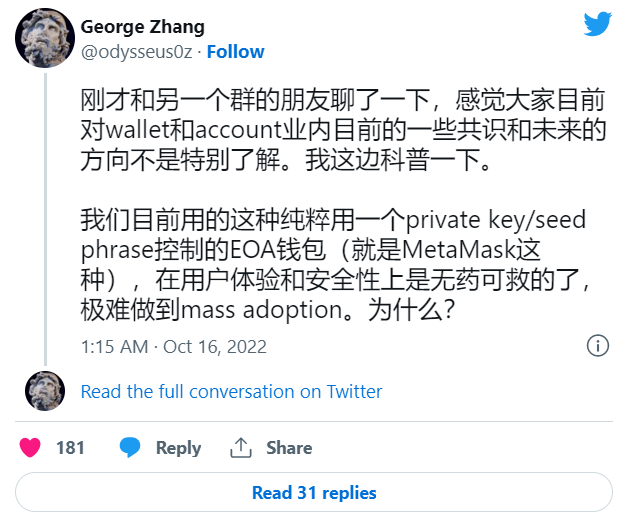
In summary, next year’s Proto-danksharding + L2 will patch together partial scaling solutions, while AA tackles user onboarding—with hope that applications can leverage these to deliver broad consumer experiences.
Yet I didn’t see any projects with the potential to replicate the likes of Comp or Uni in 2019—the kind that signaled the dawn of a bull market. This suggests the current innovation cycle may last longer than expected.
The most memorable application was the physical card collaboration between ENS and POAP. Register your swag on ENS, pick up a physical POAP badge—tap your phone’s NFT to receive proof like “Met xxx at Devcon6.” For two days, the line for physical POAPs was the longest. This use case was marketing genius—even featuring leaderboards. Many people approached me just to scan my POAP. It was the ultimate icebreaker. The social consensus around ENS and POAP is immense—I’m excited to see what else grows from this foundation.
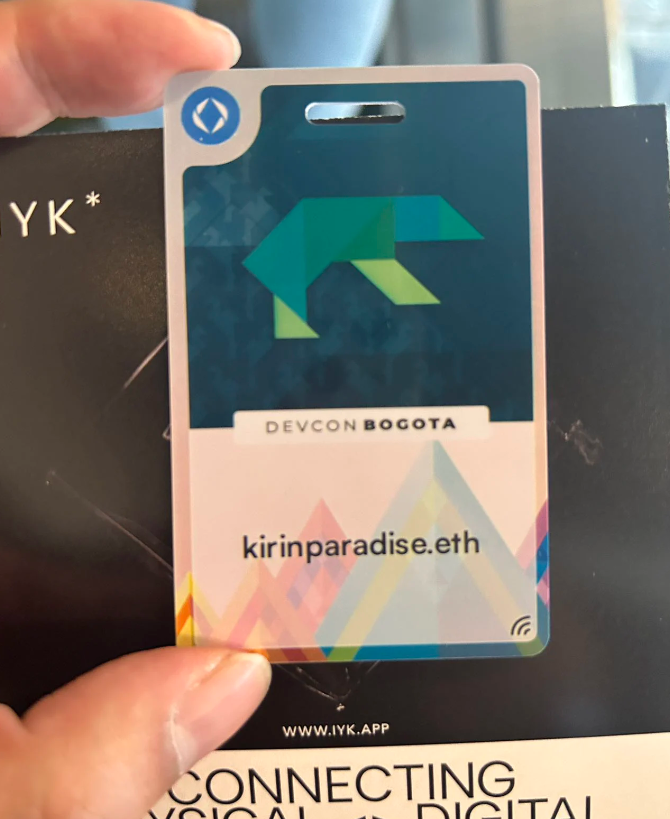
Physical POAP card
Most impressive to me was 0xparc’s onchain gaming engine, mud.dev, built using first principles, along with two games built atop it—one RTS and one Minecraft-like chain game.
For two consecutive afternoons, there were Dark Forest 4-player group battles and demos of both games held in the cyberpunk-lit basement of the venue. The team was nuts, the vibe was electric.
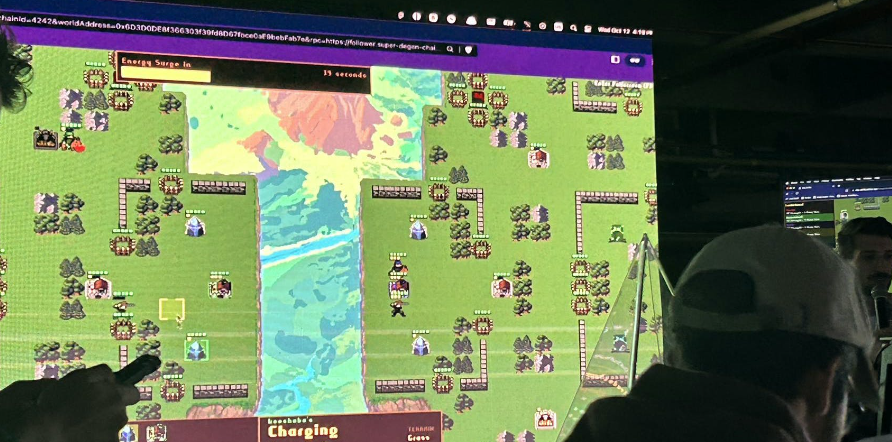
Public beta on site—unfortunately network conditions were poor
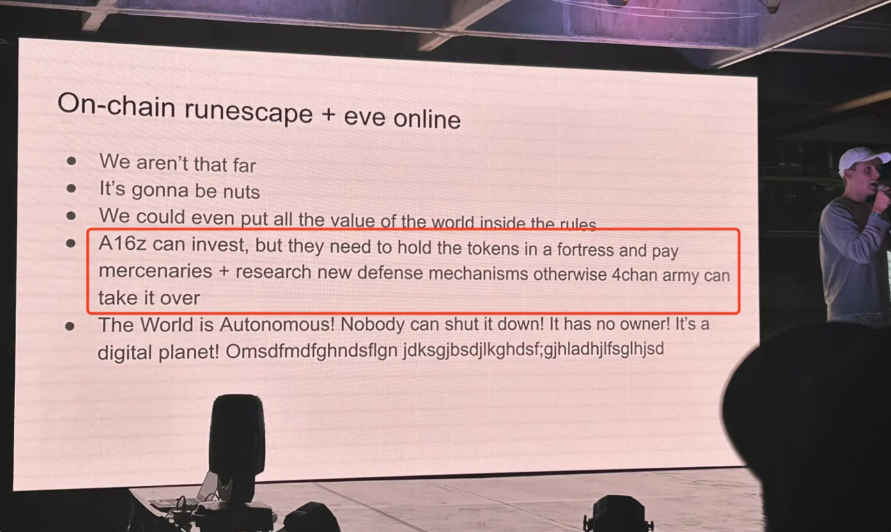
(From now on, investment firms must personally participate in “vegetable-stealing games” to earn tokens lol)
Compared to technological abundance, applications remain scarce. Onchain gaming may be the best illustration of this. As shown in the slide above: “It’s gonna be nuts.” While I believe onchain games represent the future, they’re still long-term plays lacking commercialization. For now, teams like nuts focus on building foundational tech and pushing innovation. Widespread adoption will depend on external catalysts and organizations—which haven’t emerged yet at this Devcon. Without them, Ethereum’s goal of impacting humanity and reaching people in developing nations remains difficult to achieve.
“I’ll stay beautiful, you go make money”—decentralized, composable, modular, everyone doing their part to create win-win-win outcomes.
Before Devcon officially opened, I visited the venue early and found that right across the street, Colombia’s Coffee Expo was underway. I got lucky and became a temporary “taster,” sampling six different coffees at once. Only then could I clearly taste the differences I normally couldn’t detect. But most casual enthusiasts wouldn’t sample six coffees side-by-side. This reminded me of a metaphor chess recently used during a Twitter Space—it perfectly captures the current state of technology versus applications.
The current architecture resembles a recipe. Different technologies are like ingredients. Take tomato scrambled eggs. Vitalik has laid out the ideal recipe for delicious tomato scrambled eggs, so now various teams focus on growing better tomatoes and raising better chickens. If we compare ZK tech to tomato farmers, some say they want sour tomatoes, others sweet ones. If L2s are egg suppliers, projects claim theirs are free-range eggs, sterile eggs, etc. Annoyingly, despite fierce competition among ingredient suppliers, they all say it’ll take another one or two years before they can deliver—still planting seeds today.
But not every diner cares about 100 ways to grow tomatoes and eggs—just as not everyone gets to taste six coffees to discern subtle differences.
Users simply want a tasty plate of tomato scrambled eggs. They might eat other dishes, but isn’t tomato scrambled eggs supposed to be good? We should at least serve users a hot, satisfying plate. That’s where chefs come in—to work with limited available ingredients and figure out how to make delicious tomato scrambled eggs that people are willing to pay for. This is exactly what application builders need to do: experiment under existing tech constraints, create dishes users enjoy, gradually upgrade ingredients, and eventually influence how ingredients are sourced.
Speaking of cooking—guess which country’s chefs make the best dishes?
3. Balancing “Legitimacy” and EF’s Philosophy of Restraint
“Legitimacy” is a magic word in crypto—a panacea that instantly brings patience and bright smiles to people’s faces. Arriving at its spiritual home felt refreshing.
After Rollup Day, I discussed MEV with Lin (@blankerlin). He noted many discussions are hard because they require too much background knowledge—like the Marvel Cinematic Universe, with increasingly complex branches and sequels. Newcomers who haven’t watched all previous films or Lore’s condensed summaries simply can’t join in. This is natural—but also fertile ground for so-called authorities. When highly technical and academic topics meet capital and media, combined influence becomes enormous.
Ethereum keeps upgrading, each bringing new project opportunities (e.g., danksharding, account abstraction), meaning new interests. And “legitimacy” becomes the universal term to capture these interests—will Ethereum risk becoming insular and nepotistic?
In categories lacking sufficient competition, legitimacy matters. But in highly competitive fields, perhaps “legitimacy” shouldn’t be overly mythologized—as in the case of Arbitrum vs. Optimism.
Conversely, when legitimacy defines赛道 and valuations, valuation inversions caused by bias against challengers may present investment opportunities. As chess said: religion is sacred, but high-productivity, cross-dimensional disruption is very real.
EF’s CEO Aya mentioned during the opening that senior management should embody “restraint”—minimal governance, distributing opportunities, giving peripheral groups more chances to participate. This philosophy may be the real antidote to the legitimacy trap—at least in theory.
Let’s hope balance can be achieved.
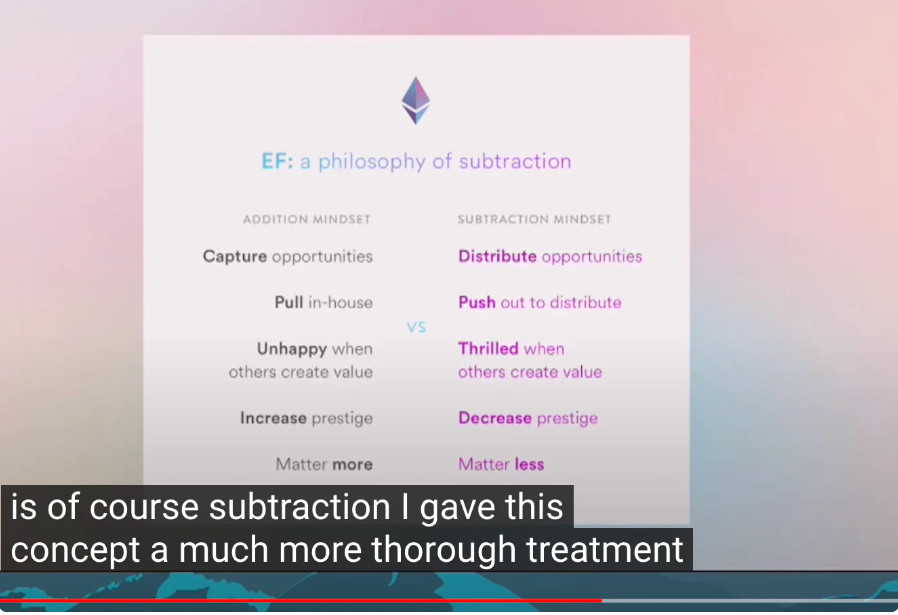
Philosophy of restraint
4. Collision Between Decentralization and Regulation
Another major theme at this Devcon was regulation.
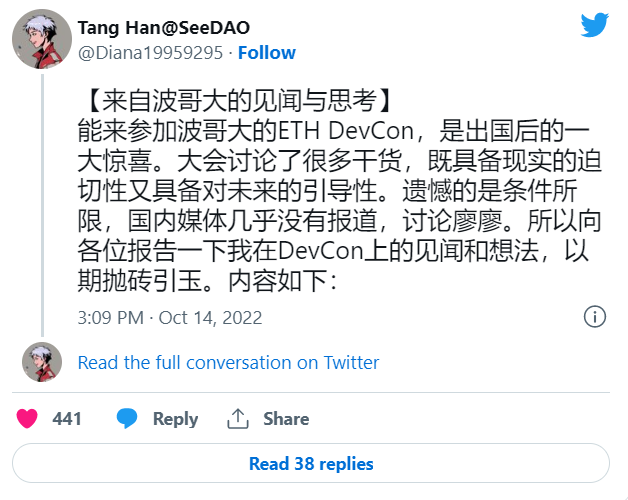
As Ethereum and the broader crypto space grow larger, more governments recognize their value—or perceived “threat.” Conflict with centralized systems is inevitable. For example, Europe has begun implementing foreign exchange controls and caps on dollar-pegged stablecoins similar to China’s approach. There are also questions about regulating Ethereum nodes—though I didn’t attend those sessions. However, Tang Han’s thread on regulation offered deep insights (PS. In Tang Han’s writing, I sensed the same passionate cry I’ve seen in tt’s work—the power of rarity! Moving!).
Starting next year, we’ll enter a period of direct, head-on clashes between decentralized worlds and centralized regulatory regimes.
At the opening ceremony, instead of V God awkwardly dancing again with the Ethereum Foundation, they invited a professional Afro-Colombian dance troupe from Bogotá—much better received. But looking ahead, external environments may not be friendly toward crypto. For a true network state to materialize and for crypto to sustain the spirit of globalization, it must confront many harsh realities head-on. There may be no time to appreciate professional dancers then—but nothing can stop crypto punks from throwing their own awkward dance party right where they stand.
Join TechFlow official community to stay tuned
Telegram:https://t.me/TechFlowDaily
X (Twitter):https://x.com/TechFlowPost
X (Twitter) EN:https://x.com/BlockFlow_News
 y2z Ventures