Devcon Recap | Buidl with OS: A Talkshow for Web3 Developers
TechFlow Selected TechFlow Selected
Devcon Recap | Buidl with OS: A Talkshow for Web3 Developers
During the panel session, Simon, Product Director at OKLink, initiated a discussion on the theme "What is the new gold mine of blockchain data?" from the perspective of data infrastructure.
 Navigating Web3 tides with focused insights
Can you build at the speed of__? On November 15, during Devcon, we brought this question to Bangkok’s Workshop and kicked off our #Buidl with OS journey together.

In the opening keynote, Chief Innovative Officer Jason delivered a talk on "Build onchain, any chain," highlighting OS Platform's multi-chain capabilities. With extensive ecosystem coverage, OS supports developers across more than 100 blockchain networks—including Ethereum, Bitcoin, and Solana—helping them seize emerging opportunities and accelerate time-to-market.
Diving into product details, OS BD lead Shen introduced the platform’s four powerful API types, including Marketplace and Explorer APIs. Taking the OKLink Browser API as an example, Explorer and EaaS offer rich developer tools, on-chain data from 50+ major blockchains (including EVM, UTXO chains, and Solana), and token data across 200+ networks. Developers can access real-time on-chain data, aggregated statistics, and seamless contract verification via browser APIs. Integrating the EVM RPC module is effortless, enabling smooth migration and high compatibility.
EaaS services further empower development teams to unlock the full potential of blockchain exploration. Whether it’s a new L1, established chain, rollup, or appchain, our zero-cost service is customizable to your specific needs.
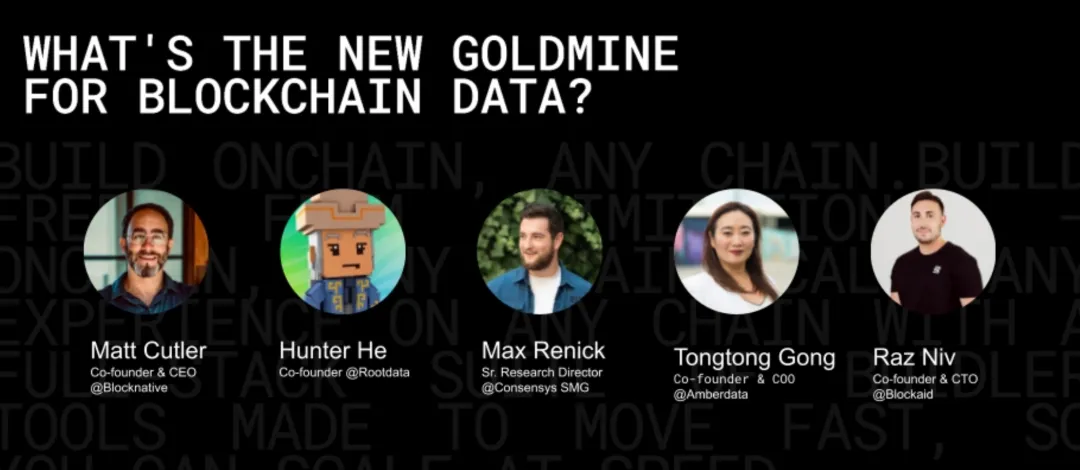
During the panel session, OKLink Product Director Simon led a discussion titled “What is the New Gold Mine of Blockchain Data?” from the perspective of data infrastructure. Guests from Blocknative, Rootdata, Consensys SMG, Amberdata, and Blockaid shared insights from both theoretical and practical standpoints.

Q
Simon@OKLink: What is the most urgent issue or challenge in bringing Web2 users into Web3? Is it security, trust, difficulty identifying ‘gems’ among countless new projects, or the technical complexity of existing tools? How can blockchain data address these issues? Are there any initiatives/projects aiming to solve (or already solving) these problems?
A
Raz@Blockaid: In my view, user experience and security are top priorities. For instance, could your grandmother immediately use the product you're building? You need to ensure users fully understand what you’re doing and the benefits they’ll gain. We’re already seeing many projects and applications in the industry doing this well. When a Web2 user logs into a Web3 app and can instantly understand the interface without spending extra time, and when your UI prompts make them feel secure and lower their guard, that boundary naturally disappears. Bringing in Web2 users then becomes far less of a bottleneck.
A
Matt@Blocknative: My answer might differ. I believe users need a strong reason to come onchain. Let me ask each of you: do you remember the last time you solved a payment issue on your phone—and why you did it? For me, two weeks ago when I first arrived in Thailand, I needed to use Grab, so I downloaded it. Later in Chiang Mai, I couldn’t use my credit card, so I downloaded another payment app. These were clear signals telling me, “Hey, you really need cash.” These are highly persuasive scenarios. Under such circumstances, it’s no surprise when users make deliberate choices.
Do you remember your first time going online? There was just one internet. But entering the onchain world, you face multiple networks—complexity increases significantly. User experience, fees, latency—all become factors. The most convincing scenario I’ve experienced was using a Telegram bot. It wasn’t free, but it was convenient and simple to set up—just a few clicks to get results. That kind of satisfying experience is what matters. So my point is: minimize complexity as much as possible and focus on doing something useful. Useful could mean entertaining, engaging, or practical—but above all, it must be something people actually need.
Q
Simon@OKLink: For institutions or enterprises interested in entering Web3, what challenges hinder their adoption of Web3 technology? How can blockchain data help accelerate their adoption? Examples are welcome.
A
Hunter@Rootdata: Let me take Rootdata, the project I work on, as an example—perhaps different from other guests. We focus on off-chain data, serving as a Web3 asset data platform. We’ve become an essential data tool for millions of Web3 users making investment decisions and aim to be a productivity-level tool for Web3 enthusiasts and investors. By presenting refined data—including entity addresses, funding rounds, etc.—we help project teams and professionals make better-informed decisions. The fast-evolving industry drives us to continuously move forward through data-driven methods.
Q
Simon@OKLink: Change seems to be the norm in Web3—new chains emerge every week. For Web3 builders, iterating the right use cases while managing an ever-evolving chain infrastructure (which now appears to be multi-chain coexistence) is extremely challenging. What innovative data tools can decouple infrastructure from user experience, allowing Web3 builders to rapidly test ideas and incubate the next killer application?
A
Tongtong@Amberdata: I’ve been working in data for seven years and have lived through several cycles. For a long time, it felt like nobody cared much about data itself. Now, things are different. At recent events I’ve attended, attendees are actively discussing which data metrics they care about, and letting data “enthusiasts” and “wizards” share insights within communities. This shows we’re all trying to understand data and connect the dots. Thus, market offerings—especially API-based data tools—can solve developers’ pain points. Powerful APIs make data access easy and provide one-stop, aggregated solutions.
A
Max@Consensys SMG: During our process of building new chains, we may face a situation where, as integration grows, the chain’s intrinsic value gradually diminishes, leading to developer attrition—while maintenance costs remain high. Developers naturally need a suite of toolkits. From my perspective, there should be plenty of efficient, easy-to-use toolkits available onchain, enabling developers to quickly onboard and integrate seamlessly. This helps maintain a new chain’s competitive edge over time.
We also engaged in conversations with multiple developers on-site about data productivity tools. Cui Mian, opinion leader in the developer community and research fellow at Sci-Tech Innovation Institute (@MasterCui), shared his insights from the perspective of an experienced developer and technical educator: “Onchain data and analytics platforms help developers build smart. First, they can handle part of the backend workload—using their data saves the cost of developing your own backend to fetch data. Another possibility is that the onchain data platform itself can be repackaged into a new application. For instance, you can directly apply ready-made data outputs into your own applications.”
He added that communication and efficiency during development are crucial. Mature onchain tools can greatly reduce the time developers spend searching for open-source code. Equipping teams with solid tools for data collection and analysis means developers should fully leverage available APIs and other data tools, and employ AI to continuously optimize collaboration, boost efficiency, and sustain innovation and competitiveness in the Web3 space.
Speaking about challenges in development, developer Panda (@CodeMorePanda) said: “The current public chain ecosystem is highly diverse and heterogeneous—for example, Solana and the EVM ecosystem are completely different. If we had to integrate each one manually, it would waste a lot of time. Instead, we can choose aggregated data APIs like the OKLink API we’re using, which significantly reduces development time, frees us to focus on creativity, and conserves energy.” 👉 https://www.oklink.com/zh-hans/api-plans
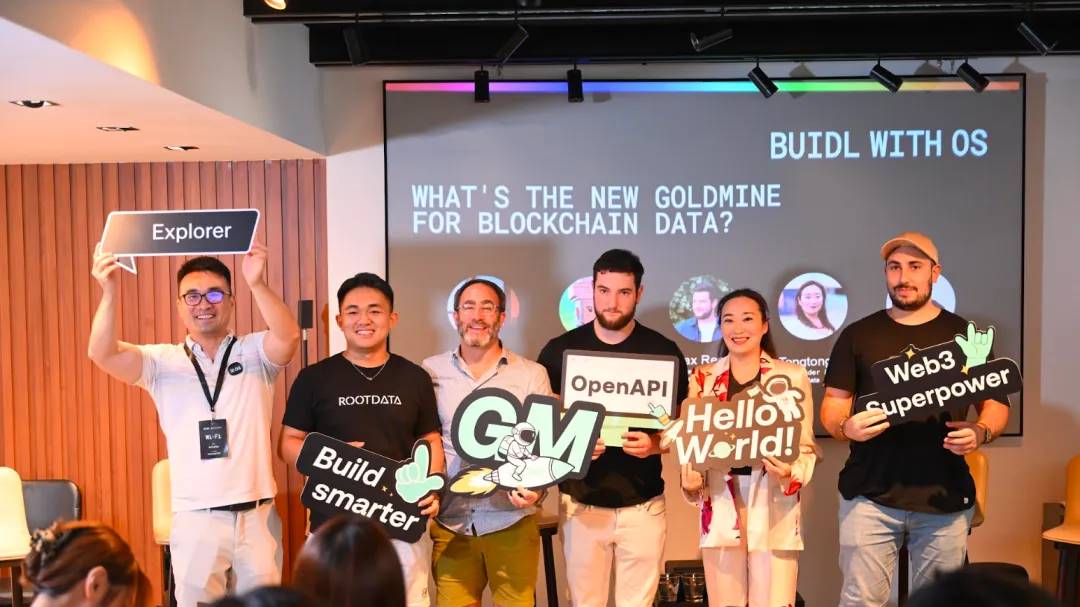
Build Onchain, Any Chain. We exchanged freely and openly with developers during the relaxed Workshop, enjoying a delightful afternoon together. The pace of onchain ecosystem building never stops. As data tools become increasingly sophisticated and AI grows smarter, more creativity and inspiration will continue to emerge, driving Web3 to deliver unexpected wonders with greater intelligence and agility.
Official website: https://www.oklink.com/zh-hans?channelId=118cto
Join TechFlow official community to stay tuned
Telegram:https://t.me/TechFlowDaily
X (Twitter):https://x.com/TechFlowPost
X (Twitter) EN:https://x.com/BlockFlow_News
 @OKLink