Bitcoin pulls back as altcoin ETFs surge
TechFlow Selected TechFlow Selected
Bitcoin pulls back as altcoin ETFs surge
Wall Street has started copying too.
 Navigating Web3 tides with focused insights
Author: Tuoluo Finance
The bull market fever continues to spread. Despite Bitcoin's pullback after a surge, Ethereum has reversed its downtrend and broken through $3,600. Multiple sectors including DeFi and Layer2 have seen broad gains, and the altcoin market is finally showing faint signs of revival. However, just days ago, the situation was vastly different—while Bitcoin approached $100,000, altcoins were suffering widespread losses, with the market in survival mode.
While altcoins languished, Wall Street began taking interest. Thanks to unprecedented regulatory tailwinds, Wall Street has set its sights on altcoin ETFs, delivering a much-needed dose of warmth to the long-dormant altcoin market.
Just one week ago, Bitcoin surged toward $99,000, dominating headlines across media outlets. Yet the usually active crypto community remained unusually silent. In this institution-led bull run, most market participants haven't benefited from liquidity spillovers. Instead, their altcoin holdings have been continuously drained by Bitcoin’s dominance, experiencing a slow, persistent decline. Compared to the fanfare surrounding the bull market narrative, many investors are left feeling frustrated and unable to voice their struggles.
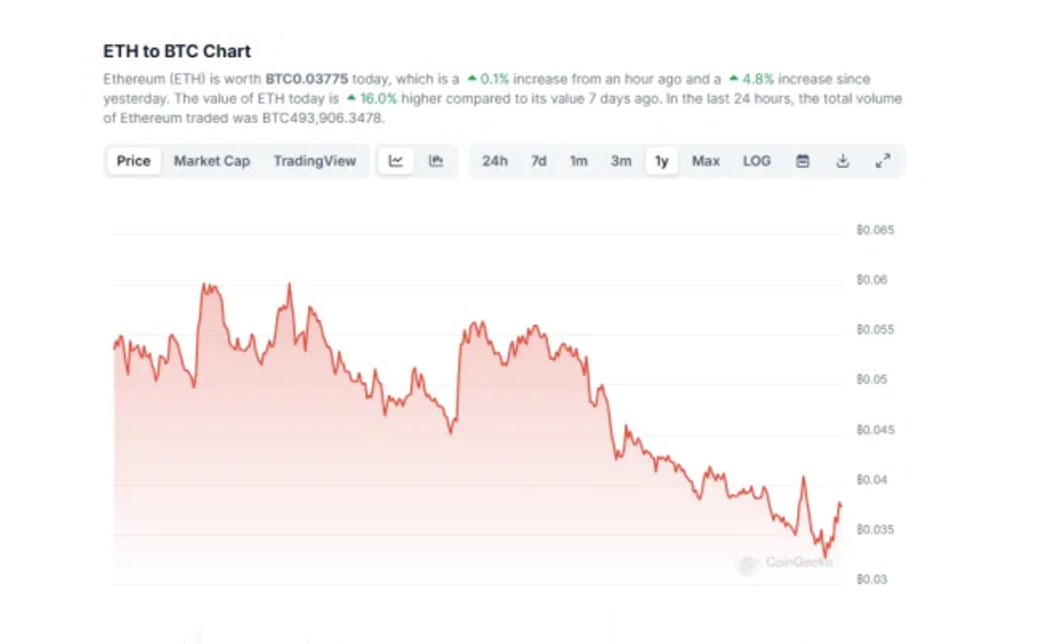
A typical example is Ethereum. While ETH is widely recognized as a mainstream cryptocurrency compared to other altcoins, its relative price performance has significantly lagged behind Bitcoin’s. The ETH/BTC exchange rate has steadily declined throughout the year, falling from 0.053 to a low of 0.032, only recently beginning to recover. If even Ethereum is struggling like this, other altcoins fare even worse.
But recently, the previously dormant altcoin market appears to be awakening. SoL, XRP, LTC, and Link led the charge over the weekend. Solana’s DEX daily trading volume surpassed $6 billion, while XRP spiked to $1.63. This morning, Ethereum surged strongly past $3,600, triggering broad gains across altcoins. The DeFi sector rose 8.47% within 24 hours.
Aside from bullish sentiment, the recent altcoin rally owes much to Wall Street—and ETFs are the most direct manifestation.
Looking back at the start of this bull cycle, the launch of 11 spot Bitcoin ETFs ignited the boom. The entry of Wall Street giants like BlackRock and Fidelity accelerated Bitcoin's path into the mainstream and dramatically lowered the barrier for market participation. At that time, with both Bitcoin and Ethereum spot ETFs approved, speculation grew over which token would next capture Wall Street’s interest. Based on market cap and capital considerations, Solana emerged as the top contender.
On June 27, asset manager VanEck took the first step by filing an S-1 form with the SEC for the "VanEck Solana Trust." The next day, 21Shares followed with its own S-1 submission. On July 8, the Chicago Board Options Exchange (Cboe) officially filed 19b-4 applications for VanEck and 21Shares’ Solana ETFs, bringing the Solana ETF speculation to a fever pitch.
However, the excitement didn’t last. The SEC’s firm stance quickly cooled altcoin ETF hopes. In August, reports indicated that CBOE had removed the 19b-4 filings for two potential Solana ETFs from its “Proposed Rule Changes” webpage. Analysts bluntly stated, “Approval is hopeless.”
Now, the landscape has shifted. On November 22, a Cboe BZX Exchange filing revealed proposals to list and trade four Solana-related ETFs. These ETFs, initiated by Bitwise, VanEck, 21Shares, and Canary Funds, are categorized as “commodity-based trust shares” and submitted under Rule 14.11(e)(4). If formally accepted by the SEC, the final approval deadline is expected around early August 2025.
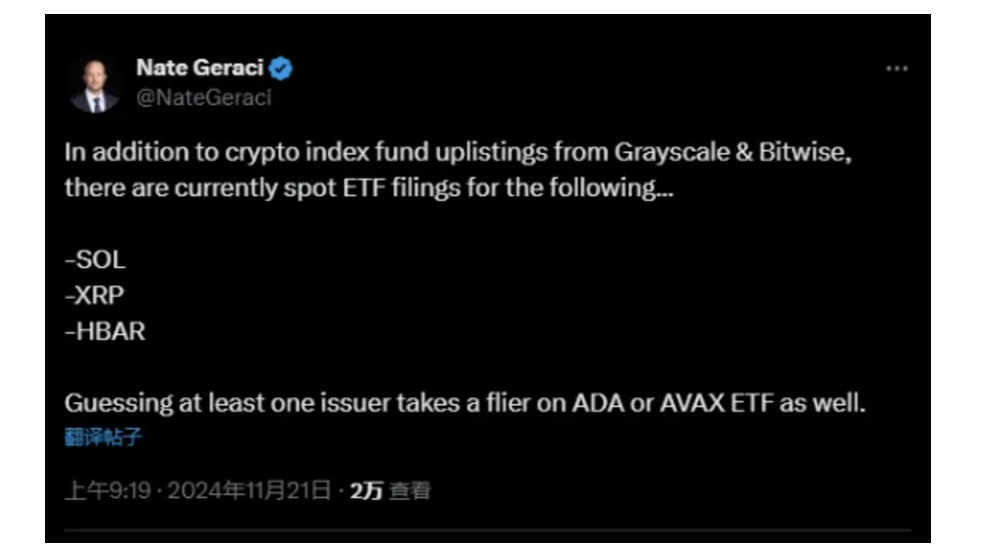
Solana isn’t alone—more altcoin ETFs are on the way. Over the past month, crypto investment firm Canary Capital has filed spot ETF applications with the U.S. SEC for XRP, Litecoin, and HBAR. According to Nate Geraci, president of ETF Store, at least one issuer is reportedly working on ETF applications for ADA (Cardano) or AVAX (Avalanche).
The emergence of altcoin ETFs has sparked widespread discussion. Even distant prospects of institutional capital inflows have electrified the market. Is the wild west of crypto ETFs truly arriving?
Objectively speaking, reviewing the prior approval processes for Bitcoin and Ethereum, two implicit criteria appear necessary for a cryptocurrency to gain spot ETF approval: First, it must not be explicitly classified as a security by the SEC; second, there must be prior evidence of market stability and resistance to manipulation—typically demonstrated by futures trading on the Chicago Mercantile Exchange (CME). By these standards, aside from Bitcoin and Ethereum, few cryptocurrencies currently qualify. Approval for more centralized coins faces even greater hurdles—especially Solana, which not only exhibits high centralization but was also explicitly labeled a security in the SEC’s lawsuit against Binance.
Nevertheless, market sentiment toward SOL, XRP, LTC, and HBAR ETF approvals remains positive. James Seyffart, a respected ETF analyst at Bloomberg, believes decisions on these ETFs may stretch into late 2025, with the SEC potentially approving a Solana-related ETF within two years. Nate Geraci of ETF Store is even more optimistic, stating outright that a Solana ETF will likely be approved by the end of next year.
This optimism stems largely from the upcoming presidency of Donald Trump. His pro-crypto commitments are actively materializing, and shifting internal and external regulatory environments are boosting confidence across the crypto industry.
From a regulatory standpoint, the SEC—the primary crypto regulator—is poised for leadership changes. Current SEC Chair Gary Gensler has announced he will step down automatically on January 20, 2025, the day Trump takes office, effectively pausing the SEC’s stringent enforcement era. During his tenure, Gensler pursued legal actions against Coinbase, Kraken, Robinhood, OpenSea, Uniswap, MetaMask, and others, resulting in thousands of enforcement cases and approximately $21 billion in penalties—earning him a reputation as a well-known crypto skeptic.
Although the next SEC chair hasn’t been confirmed, insiders suggest former SEC commissioner Paul Atkins may succeed Gensler. Amid growing debate over whether crypto should be regulated as securities or commodities, rumors indicate the Trump administration may seek to expand the authority of the Commodity Futures Trading Commission (CFTC), strengthening its oversight of digital assets. If realized, this could weaken the classification of crypto assets as securities.
Broadly speaking, the incoming Trump administration looks like a gathering of crypto enthusiasts. Among all cabinet nominees for Trump’s new government, beyond well-known figures like Musk and Howard Lutnick, five key members—including Treasury Secretary Scott Bessent, National Security Advisor Michael Waltz, Director of National Intelligence Tulsi Gabbard, Commerce Secretary Howard Lutnick, and HHS Secretary Robert F. Kennedy Jr.—are known crypto supporters. Waltz, Lutnick, and Gabbard personally hold crypto assets, with Lutnick being a die-hard Bitcoin fan who owns hundreds of millions in BTC and whose company, Cantor Fitzgerald, has provided custodial services for Tether for years.
Clearly, this administration marks a sharp departure from previous ones. With top-level support for crypto, regulation is inevitably trending toward leniency. If a comprehensive regulatory framework for digital assets is established during this administration, future regulatory direction for the industry will become clearer.
Beyond policy, Trump-affiliated businesses have already moved to seize opportunities. Recently, Trump Media & Technology Group has taken multiple steps to expand its footprint in the crypto space through investments and partnerships. Reports suggest the company is negotiating with Intercontinental Exchange (ICE) over a potential acquisition of Bakkt, a crypto exchange. Just recently, Trump Media filed an application for a crypto payment service called Truth Fi, signaling plans to enter the crypto payments arena. These corporate moves further reflect the president’s strong personal enthusiasm for crypto.
It is precisely due to these factors that market hopes for altcoin ETFs have reignited. With the exit of SEC Chair Gensler, the long-standing argument classifying altcoins as securities may finally subside—laying the initial groundwork for ETF approvals.
Moreover, even if the path forward for altcoin ETFs remains uncertain, Wall Street is unwilling to ignore this massive market exceeding $3 trillion. Traditional institutions are actively developing new investment products and derivatives around crypto assets, making it easier for investors to include digital assets in their portfolios.
Sui Chung, CEO of CF Benchmarks—a provider of crypto indices—notes that mainstream investors will increasingly use spot Bitcoin ETFs for direct exposure, while also adopting specialized products to customize their risk and return profiles. The most popular offerings include commodity futures linked to cryptocurrencies that generate yield, and options-based products offering downside protection. The company is currently planning to launch options based on the Nasdaq Bitcoin Index.
John Davi, Chief Investment Officer at Astoria Portfolio Advisors, mentioned he is currently considering adding Bitcoin exposure to his ETF model portfolio.
In summary, while current regulatory conditions still pose challenges for altcoin ETF approvals, in the long term, regulatory liberalization and rising investor demand will make institutional engagement with crypto assets an inevitable reality. On the product side, institutions will move beyond just Bitcoin and Ethereum. The productization and standardization of crypto assets will deepen further, and derivatives are likely to explode in number—removing barriers for investor participation. Clearly, investors will soon have far more ways to access crypto-related investment products.
Beyond yet-to-launch products, existing ETFs stand to benefit from this trend. Take spot Ethereum ETFs as an example: their capital inflows have consistently trailed behind Bitcoin’s. Data shows that as of November 27, net inflows into spot Ethereum ETFs totaled approximately $240 million, while Bitcoin ETFs attracted a staggering $30.384 billion—highlighting a vast disparity.
The reasons are clear. Ethereum inherently lags behind Bitcoin in terms of perceived value stability and positioning. More critically, the core staking functionality has been restricted under SEC rules, further dampening investor enthusiasm. From a cost perspective, directly holding ETH yields nearly 3.5% in staking rewards. In contrast, holding an institutional ETF offers no such risk-free return and instead incurs management fees ranging from 0.15% to 2.5%.
However, with the changing regulatory landscape, spot Ethereum ETFs may no longer be barred from staking. After all, the SEC’s previously firm opposition is softening, and precedents exist elsewhere—just recently, European ETP issuer 21Shares AG announced the addition of staking functionality to its core Ethereum ETP product.
Of course, while ETFs are promising, actual capital inflows remain uncertain. Even Ethereum struggles to attract traditional capital—Grayscale’s Solana Trust holds only $70 million in assets. The purchasing power of institutional investors in altcoins appears less robust than anticipated. As a result, Robert Mitchnick, head of BlackRock’s digital assets division, once noted the firm has little interest in crypto products beyond Bitcoin and Ethereum.
Regardless of how future approvals unfold, speculation around altcoin ETFs has already begun. For a long-suffering altcoin market, this shot in the arm couldn’t have come at a more timely moment.
Join TechFlow official community to stay tuned
Telegram:https://t.me/TechFlowDaily
X (Twitter):https://x.com/TechFlowPost
X (Twitter) EN:https://x.com/BlockFlow_News