Annualized Return of 133%: Unveiling exSat—The Interoperability Layer Breaking Bitcoin's Boundaries
TechFlow Selected TechFlow Selected
Annualized Return of 133%: Unveiling exSat—The Interoperability Layer Breaking Bitcoin's Boundaries
exSat is a significant part of the Bitcoin ecosystem, with institutions participating in the initial staking to secure early allocations.
 Navigating Web3 tides with focused insights
Author: Jesse, Core Contributor at Biteye
Editor: Viee, Core Contributor at Biteye
With Trump's victory in the election, investors anticipate a pro-crypto administration that may introduce policies favorable to the cryptocurrency industry. Bitcoin has responded with its largest monthly gain on record, approaching $100,000. Bitcoin’s significance in traditional finance continues to grow, as capital flows steadily into Bitcoin ETFs, pushing its total market cap to $2.6 trillion—ranking it the seventh-largest asset globally. If Trump fulfills his promise to adopt Bitcoin as a national reserve asset, we could witness a global scramble for Bitcoin holdings. In such a scenario, Bitcoin’s market capitalization might surpass Apple—the world’s most valuable company—and challenge gold’s status as a reserve asset.
On the other hand, due to scalability limitations, Bitcoin has long been confined to a store of value, with native BTC unable to earn yield in DeFi protocols like Ethereum. Currently, Bitcoin’s TVL stands at just 6.56% of Ethereum’s. If Bitcoin were to reach Ethereum’s level of TVL, it would represent a 15x increase—an incremental market opportunity exceeding $60 billion. This is especially significant given that Bitcoin’s total market cap is already 4.5 times larger than Ethereum’s. As a result, Layer 2 solutions built around Bitcoin have experienced explosive growth this year.
The Bitcoin ecosystem is undergoing a profound paradigm shift, marked by multidimensional development. It is expanding from a single-asset economy to a multi-asset economy (by tokenizing diverse assets such as NFTs, stablecoins, and protocol tokens); transforming from a store of value into an engine for value creation (enabling Bitcoin’s use in DeFi and leveraging NFTs to market digital and physical assets); and evolving from a payment intermediary into a decentralized value network (using on-chain data and scaling technologies like the Lightning Network and cross-chain protocols to become core infrastructure for the Internet of Value, enabling more efficient and secure value exchange). This transformation redefines Bitcoin not merely as a vessel of value but as a cornerstone of innovation and economic growth, creating unprecedented opportunities for the blockchain industry.
However, Bitcoin’s inherent limitations—such as lack of smart contract functionality, trustless cross-chain interoperability, high transaction fees, network congestion, and confirmation delays—have historically constrained the development of its ecosystem. The proliferation of Bitcoin L2s has also fragmented liquidity. Furthermore, the security of new Bitcoin L2s remains unproven in the market.
Against this backdrop of strong demand and acute pain points, exSat—backed by EOS Network—has emerged as an innovative solution. exSat aims to overcome Bitcoin’s limitations by serving as a connectivity layer for Bitcoin scalability, bridging isolated blockchain silos and building a more interconnected, efficient, and multifunctional blockchain ecosystem. By offering decentralized data indexing and trustless Bitcoin bridging, standardizing integration across most Bitcoin L2s, and supporting EVM, Antelope, ZK, and other technologies, exSat seeks to maximize the possibility, security, and stability of the BTC ecosystem, unlocking Bitcoin’s full potential.
This article introduces exSat’s innovative features, architecture, participation methods, and tokenomics, helping readers quickly understand this emerging Bitcoin scaling solution.
1. Innovative Features
Let’s first examine how exSat brings innovation to the Bitcoin ecosystem:
-
Improved Data Synchronization: Combines Proof-of-Work (PoW) and Proof-of-Stake (PoS) mechanisms, using BTC staking to securely import Bitcoin data.
-
Convenient Data Management: Developed a decentralized data indexing system to support smooth execution of smart contracts, capable of handling multiple assets including BTC, Ordinals, and Runes.
-
Secure Asset Management: Established a decentralized asset management system between BTC and exSat, ensuring secure and seamless asset transfers, allowing exSat to inherit Bitcoin’s trust foundation and create more innovation opportunities for developers.
-
Enhanced Smart Contract Capabilities: Fully supports Ethereum Virtual Machine (EVM) application development, enabling richer dApp creation within the Bitcoin ecosystem.
-
Flexible Scalability Solutions: Provides developers with a secure and efficient toolkit to easily build Bitcoin Layer 2 solutions—such as zero-knowledge rollups or sidechains using the latest Antelope protocol—simplifying the development process.
exSat not only enhances Bitcoin’s scalability but also adds smart contract functionality, moving Bitcoin beyond a mere store of value. Compared to similar projects, exSat emphasizes extending Bitcoin’s trust model to broader application scenarios, enabling more decentralized applications and Layer 2 networks to benefit from this shared trust base. With a modular design, exSat achieves both security and scalability. It is foreseeable that exSat will play a pivotal role in this technological revolution, fostering the flourishing of diverse applications on Bitcoin.
2. Protocol Architecture
How does exSat achieve these advantages? Unlike typical L2 solutions focused on faster transactions or lower costs, exSat innovatively introduces a connectivity layer to comprehensively scale the Bitcoin ecosystem. This section provides an in-depth analysis of exSat’s architecture.
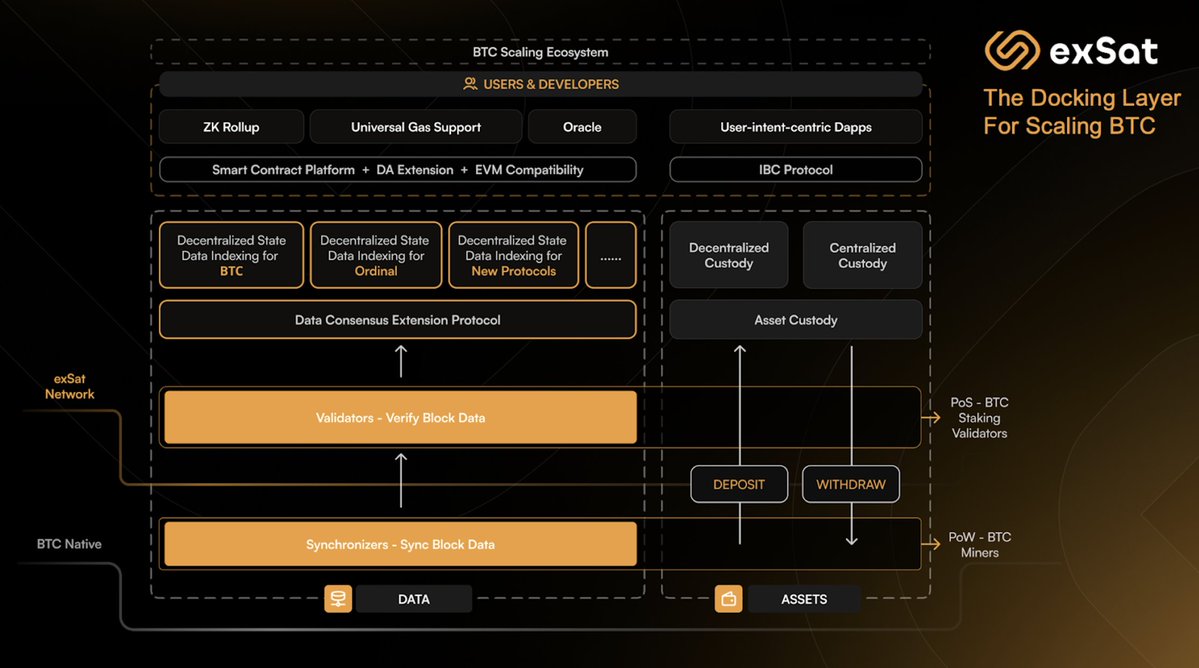
Data Consensus Extension Protocol
exSat employs a decentralized hybrid consensus mechanism combining Proof-of-Work (PoW) and Proof-of-Stake (PoS) to ensure accurate synchronization of Bitcoin blocks within exSat.
By integrating Bitcoin miners into the exSat ecosystem, the platform leverages Bitcoin’s mature PoW security framework to guarantee the integrity and reliability of block data synchronization across the network. Mining pools can act as synchronizer nodes in the exSat network, responsible for syncing raw block data from the Bitcoin blockchain and submitting it to exSat. Submitted block data undergoes strict validation via smart contracts; only when the block hash matches the validator consensus is the data deemed valid. The first synchronizer to upload correct block data receives an XSAT reward.
The PoS validation mechanism adds an additional verification layer, where validators participate in network governance and block validation by staking crypto assets. This strengthens the network’s resilience and aligns incentives among participants. The hybrid consensus ensures high security and decentralization for exSat, directly supports smart contracts, and enables one-second transaction finality. Validators stake BTC and XSAT to provide trust and security, and use the PoS model to verify data submitted by synchronizers.
Through collaboration between synchronizers and validators, exSat achieves reliable upload and verification of Bitcoin block data. This mechanism establishes a trustworthy data foundation for all subsequent operations on the exSat network.
Decentralized State Data Indexing
exSat provides decentralized state data indexing by synchronizing Bitcoin’s UTXO data in two steps:
-
Historical UTXO Data: For Bitcoin blocks prior to height 840,000, exSat constructs historical UTXO data via snapshots, uploaded in an open-source, verifiable manner.
-
Real-time UTXO Data: For blocks after height 840,000, exSat performs on-chain synchronization, validation, and parsing through synchronizers and validators, ultimately creating a real-time on-chain UTXO index.
This two-step process establishes a reliable UTXO data index, making on-chain smart contract operations more efficient and trustworthy, laying the foundation for exSat’s applications and expansion.
In the exSat system, Bitcoin block data is parsed via smart contracts and stored in a decentralized database (RAM), ensuring high credibility under consensus. Asset data can only be accessed in read-only mode by DApps, while only block parsing contracts are allowed to update it. Applications can retrieve all data via smart contracts or RPC interfaces from off-chain services without relying on external oracles, achieving higher security and smoother user experience. Combined with decentralized asset custody, this model opens new opportunities for Bitcoin-based decentralized applications, further driving the prosperity of the Bitcoin ecosystem.
Currently, other Layer 2 networks lack their own indexing infrastructure. exSat’s decentralized data indexing can serve these L2s, acting as a central hub. In positioning, exSat resembles Taobao, with other L2s as merchants who leverage exSat’s platform (data) to deliver services (sell products) to users.
Smart Contract Platform + EVM Compatibility
Full compatibility with the Ethereum Virtual Machine (EVM) facilitates diverse smart contract development, enhancing exSat’s utility and functionality.
Leveraging EVM compatibility and account abstraction, exSat allows flexible gas payments using multiple assets (e.g., BTC, Ordinals, and other Bitcoin ecosystem assets). The platform also supports gas sponsorship, simplifying operations for developers and users.
Validators manage a multi-sig custodial wallet using threshold signature schemes to handle deposits and withdrawals on the Bitcoin network. Deposits are completed by transferring funds into the custodial wallet. When exSat imports original Bitcoin blocks into the system, it detects and processes deposit transactions accordingly. Withdrawal requests are sent to exSat’s smart contract, which validates them and generates corresponding Bitcoin transactions. Validators responsible for the multi-sig wallet then sign and broadcast these transactions to the Bitcoin network.
Expanding Possibilities Through Rollups
exSat provides data availability and settlement layers for Bitcoin, supporting all rollup solutions—including Optimism (OP) and zero-knowledge rollups. Since both data availability and settlement occur on exSat, there is no need to use data availability sampling for data publication. Zero-knowledge proofs from Bitcoin L2 rollups will be verified on exSat.
This modular approach empowers developers to customize Bitcoin L2 solutions based on specific needs, expected to catalyze the growth of the Bitcoin DApp ecosystem.
3. Participation Methods
exSat received over $20 million in funding from the EOS Foundation as startup capital. exSat’s founder, Yves La Rose, is also the founder and CEO of the EOS Foundation.
exSat launched its mainnet on October 23 and introduced its cross-chain bridge on November 5. The exSat bridge was co-developed with Ceffu, ChainUp, Cobo, and Cactus, and audited by Blocksec.
Key industry partners include Matrixport, Spiderpool, Antpool, viaBTC, Everstake, HashKey Cloud, OKX, BitTrade, and Bitget.
exSat Network has attracted over $690 million (7,318 BTC) in TVL. Individual users can now stake Bitcoin on the exSat network to earn XSAT token rewards.
TVL tracking link: https://defillama.com/protocol/exsat-credit-staking
exSat has launched its Pioneer 2.0 campaign. Users who complete staking tasks (minimum 0.005 BTC staked) and accumulate 100 points can participate in prize pool distributions. In addition to XSAT token rewards, exSat will distribute community incentives worth $100,000 during this event.
Event link: https://x.com/exSatNetwork/status/1854217085569937590
According to official information, staking BTC yields approximately 3x the amount in XSAT token rewards. Staking a minimum of 0.005 BTC earns about 0.015 XSAT per day. With the current off-market price of XSAT around $110, a small staker earns roughly $1.65 daily. At a Bitcoin price of $90,000, this represents an estimated annualized return of approximately 133%.
Given these attractive returns, 41 institutions have already joined the initial mining phase, while retail participation remains limited. By staking Bitcoin on exSat, individuals can immediately earn XSAT alongside institutions—without needing to accumulate points or wait for future airdrops. While retail investors compete for popular Bitcoin projects, participating in emerging initiatives like exSat may offer greater rewards.
Staking guide: https://medium.com/exsat-network/exsat-bitcoin-staking-guide-4bca438eea5e
4. Token Economics
The total supply of XSAT tokens is capped at 21 million, following a halving mechanism similar to Bitcoin. Each halving cycle consists of 210,000 blocks, starting after the initial synchronization of the first 840,000 Bitcoin blocks (N > 840,000).
Initial Supply and Halving Mechanism
At network launch, the initial block reward is set at 50 XSAT. Rewards are halved at the end of each halving cycle to control inflation and maintain economic viability for mining incentives.
Phased Network Launch Plan
1. Initialization Phase
The exSat Foundation is responsible for synchronizing the historical data of the first 840,000 Bitcoin blocks via snapshot. No rewards are distributed during this phase, which aims to establish the foundational infrastructure for network operations.
2. Network Launch Phase
After completing historical data sync, the exSat network officially launches, beginning real-time synchronization of raw Bitcoin blockchain data. This enables continuous receipt and processing of the latest blocks, detection and validation of UTXOs and other crypto assets. Simultaneously, the XSAT mining reward mechanism becomes active. Prior to the XSAT staking phase, validators only need to meet a minimum 100 BTC staking requirement, with no additional XSAT staking needed. This phase is expected to last approximately six months, with validator rewards proportional to the amount of BTC staked.
3. XSAT Staking Phase
About 3–4 months after the first halving event, the XSAT staking phase will begin. Only users who meet the minimum 100 BTC staking threshold and rank highly in XSAT staking (at least 21,000 XSAT) can become official validators, participate in signing, and earn rewards.
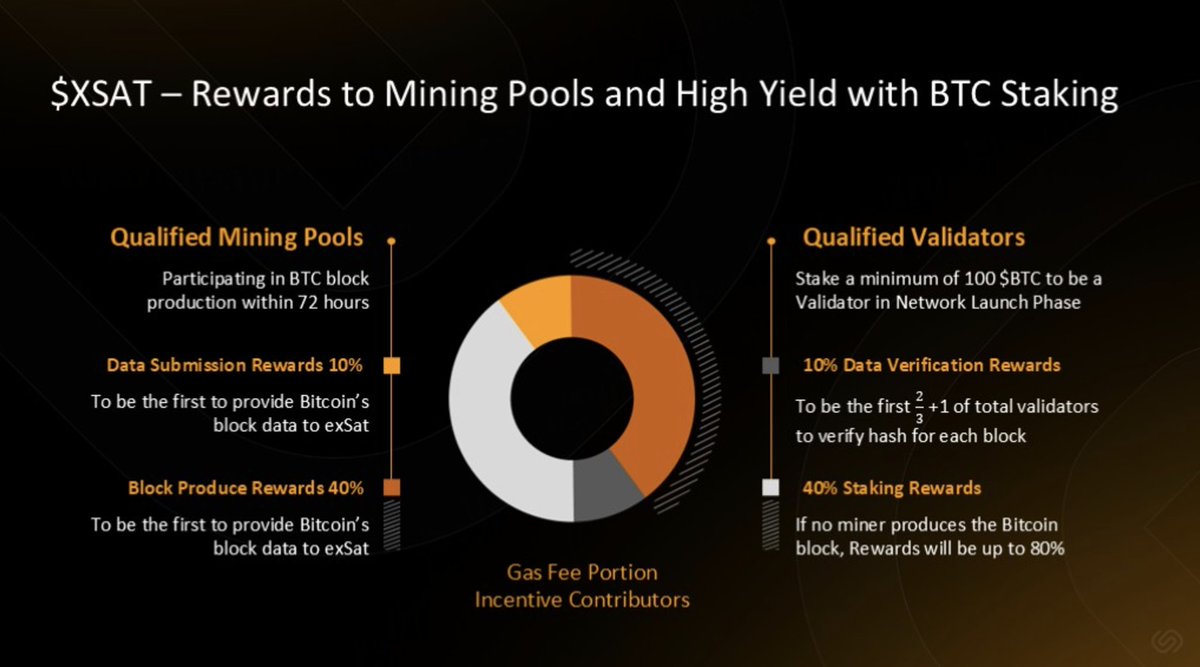
exSat allows users to earn token incentives through both PoW and PoS mechanisms.
Mining pools must participate in Bitcoin block production within 72 hours. Pools that successfully submit Bitcoin block data receive a data submission reward (10%) and a block production reward (40%).
Validators qualify by staking at least 100 BTC. The first validator to complete verification of block data receives a data validation reward (10%). Additionally, validators earn staking rewards (40%), which can increase up to 80% when no miners produce blocks.
This design enhances efficiency and security in block data processing while offering users high-yield opportunities to contribute to the Bitcoin ecosystem.
5. Conclusion
exSat is a project supported by the EOS Foundation, launched through a fair launch and deeply collaborating with leading custodians and mining pools. As a connectivity layer dedicated to expanding the Bitcoin ecosystem, exSat extends Bitcoin’s data consensus to enhance interoperability, scalability, and security within the ecosystem. By enabling direct queries of Bitcoin and ecosystem token balances, exSat facilitates seamless movement of assets and information across networks and Bitcoin L2s, positioning itself as a crucial component in the future landscape of the Bitcoin ecosystem.
Join TechFlow official community to stay tuned
Telegram:https://t.me/TechFlowDaily
X (Twitter):https://x.com/TechFlowPost
X (Twitter) EN:https://x.com/BlockFlow_News
 @BiteyeCN