Solana ETF Approval Prospects: From "Almost Hopeless" to "Achievable by End of 2025"—What Are the Current Challenges?
TechFlow Selected TechFlow Selected
Solana ETF Approval Prospects: From "Almost Hopeless" to "Achievable by End of 2025"—What Are the Current Challenges?
Despite lacking support from a mature futures market and facing potential hurdles from being classified as a security, Solana's ETF application is steadily advancing amid expectations of a new regulatory environment.
 Navigating Web3 tides with focused insights
By Weilin, PANews
The Chicago Board Options Exchange (Cboe)'s BZX Exchange recently filed four Solana ETF applications. With the conclusion of the U.S. general election and Donald Trump set to return to office, Securities and Exchange Commission (SEC) Chair Gary Gensler has announced his resignation effective January next year. This shift signals a potential transformation in the regulatory landscape for crypto ETFs, creating new opportunities for the approval of Solana ETFs.
Analysts believe the SEC may revert from an enforcement-driven approach back to its traditional disclosure-based regulatory model. If approved, a Solana ETF could unlock significant demand across the crypto ETF market. Despite lacking support from a mature futures market and facing potential classification as a security, Solana—currently the fourth-largest cryptocurrency by market capitalization—is advancing steadily amid expectations of a more favorable regulatory environment.
Four Firms Rush to File Solana ETF Applications, Once Considered "Nearly Impossible"
On November 22, documents from Cboe BZX Exchange revealed proposals to list and trade four Solana ETFs on its platform. These ETFs are sponsored by Bitwise, VanEck, 21Shares, and Canary Funds, categorized as "commodity-based trust shares," filed under Rule 14.11(e)(4). If formally accepted by the SEC, the final decision is expected by early August 2025.
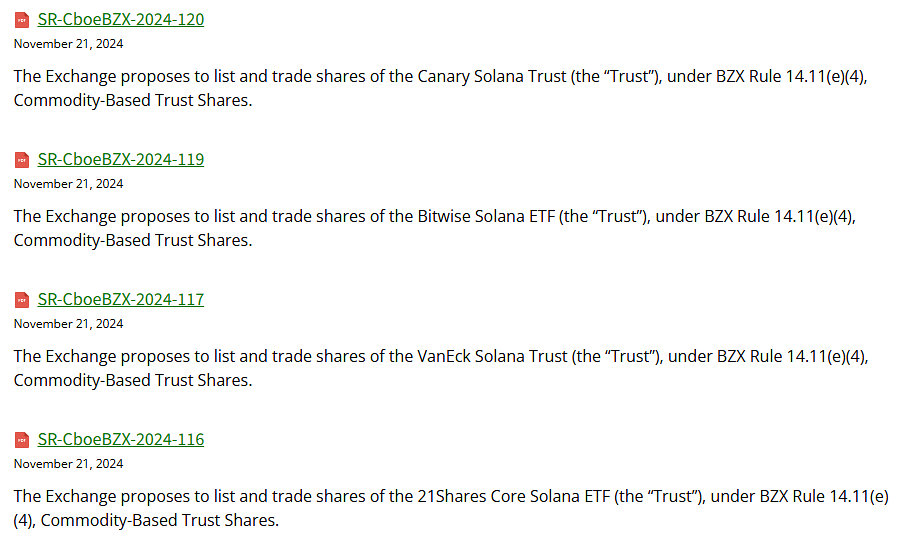
In addition to Bitcoin and Ethereum, the following cryptocurrencies are also awaiting ETF approvals:
-
XRP ETF: Applications submitted by Canary Capital, Bitwise, and 21Shares.
-
Solana ETF: Sponsors seeking approval include Canary Capital, 21Shares, Bitwise, and VanEck.
-
Litecoin ETF: Application filed by Canary Capital.
-
HBAR ETF: Application filed by Canary Capital.
Nate Geraci, president of ETF Store, said on November 21 that at least one issuer had reportedly attempted an ETF application for either ADA (Cardano) or AVAX (Avalanche).
Currently, some industry insiders believe the chances of a Solana ETF approval rank higher than other pending crypto ETFs.
However, just three months ago, public reports indicated that Cboe had removed two potential Solana ETF 19b-4 filings from its website’s “pending rule changes” page. At the time, Bloomberg ETF analyst Eric Balchunas commented that after this removal, the likelihood of a Solana ETF being approved was “almost zero.” Now, however, the changing regulatory outlook may bring significant shifts.
Expected Regulatory Shift: SEC May Return to Disclosure-Based Oversight
Following the U.S. election, President-elect Trump and what may be the most crypto-friendly Congress in history are poised to take office. Meanwhile, SEC Chair Gary Gensler—who has been heavily criticized by the crypto industry—is set to step down on January 20, 2025, fueling optimism among crypto advocates.
Nate Geraci of ETF Store believes it is highly likely that a Solana ETF will be approved by the end of next year. “It appears the SEC is already communicating with issuers about this product, which is clearly a positive signal,” he said.
Alexander Blume, CEO of Two Prime Digital Assets, echoed this sentiment, noting that issuers would not invest time and resources unless they had strong confidence in success.
Matthew Sigel, head of digital asset research at VanEck—the first firm to file for a Solana ETF—said, “It was under Gary Gensler’s leadership that the SEC broke from its long-standing rules-based process, opting instead for regulation through enforcement. A return to a disclosure-based system opens the door for greater innovation. I believe the chances of launching a Solana ETF by the end of next year are very high.”
However, in contrast to VanEck’s optimism, Robert Mitchnick, head of BlackRock’s digital assets division—the largest provider of Bitcoin ETFs—said the company has little interest in crypto products beyond Bitcoin and Ethereum.
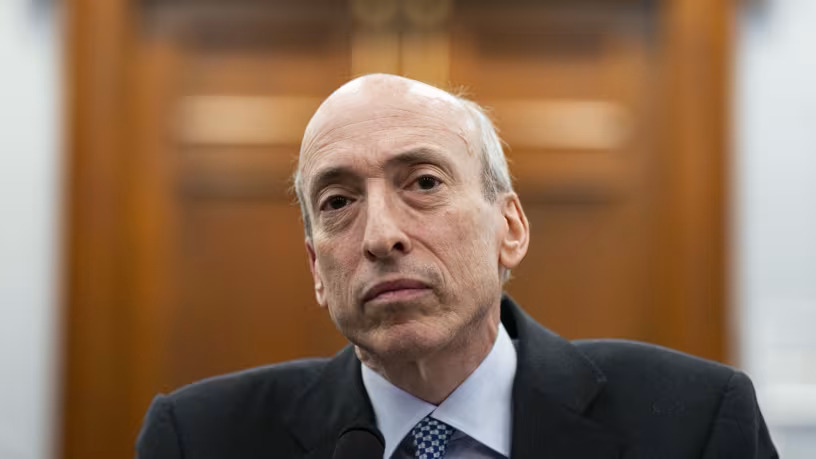
SEC Chair Gary Gensler will depart in January 2025
Gensler’s departure on January 20 coincides with Trump’s inauguration. Recent developments have buoyed the crypto market, with Bitcoin continuing to hit record highs while approaching the $100,000 mark.
Data shows the SEC set a historical record in fiscal year 2024, initiating 583 enforcement actions and securing $8.2 billion in financial remedies—the highest amount in the agency’s history. Compared to 2023, enforcement actions increased by 14%. Cases involving cryptocurrencies, private funds, and other high-risk financial misconduct were top priorities. Gensler’s exit could now reverse the current crypto regulatory climate.
Alexander Blume noted, “Allowing institutional and retail investors access to crypto via ETFs through regulated traditional financial channels like banks and exchanges unlocks funding pools that previously didn’t exist. It’s like replacing a garden hose with a firehose—meaning stronger market momentum and potentially amplified speculative impacts.”
Solana Shows Strong Growth Momentum—But What Challenges Remain?
Fueled by meme-driven trading activity, Solana has seen remarkable growth this year. On November 23, Solana’s native token SOL surpassed its previous all-time high of $259.96 set in late 2021, reaching $263.83, with a market cap of $121.1 billion, making it the fourth-largest cryptocurrency.
What obstacles might a Solana ETF face? Looking back at the approval process for Ethereum ETFs, the SEC adopted a framework known as the “Ark Analysis Test,” provided and accepted from Ark Invest. Key factors enabling Ethereum ETF approval included: first, the existence of futures trading—spot ETF approval requires a mature futures market, especially on officially recognized exchanges like CME (Chicago Mercantile Exchange); second, minimal price deviation between futures and spot prices, demonstrating the spot market cannot be easily manipulated; and third, sufficient market maturity, evidenced by stable performance of futures ETFs over time, reinforcing the stability of the underlying spot market.
Rob Marrocco, CBOE vice president and global head of ETF listings, stated that the only viable path to bring a Solana ETF to market is to first launch a Solana futures ETF, paving the way for a spot ETF. He added that even after launching a futures ETF, it would need time to establish a track record—a process that could take quite a while.
While Bitcoin and Ethereum ETFs have been approved, there is a key difference: both have futures traded on the regulated Chicago Mercantile Exchange (CME), allowing SEC oversight. In contrast, Solana was listed as one of 19 unregistered securities in the SEC’s 2023 lawsuits against Binance and Coinbase Global Inc., presenting a legal hurdle for ETF approval.
Nonetheless, Matthew Sigel of VanEck emphasized that VanEck views Solana (SOL) as a commodity, similar to Bitcoin (BTC) and Ethereum (ETH). This perspective aligns with evolving legal interpretations, where courts and regulators increasingly recognize that certain crypto assets may function as securities in primary offerings but behave more like commodities in secondary markets.
Sigel further pointed out that over the past year, Solana has made significant strides in decentralization: the top 100 holders now control around 27% of supply—down sharply from a year earlier—while the top 10 addresses hold less than 9%. Solana operates over 1,500 validator nodes across 41 countries and more than 300 data centers, with a Nakamoto coefficient of 18—higher than most networks monitored. The upcoming Firedancer client will further strengthen decentralization, ensuring no single entity can dominate the blockchain. These developments, he argues, make Solana’s decentralized nature more comparable to digital commodities like Bitcoin and Ethereum.
Sigel also referenced a key legal precedent—the 2018 U.S. Commodity Futures Trading Commission (CFTC) v. My Big Coin case. In that case, the defense argued the token wasn't a commodity because no futures contracts existed. However, the U.S. District Court rejected this, ruling that under the Commodity Exchange Act (CEA), the definition of a commodity is broad, encompassing all goods, items, services, rights, and interests—including those that may have futures contracts in the future.
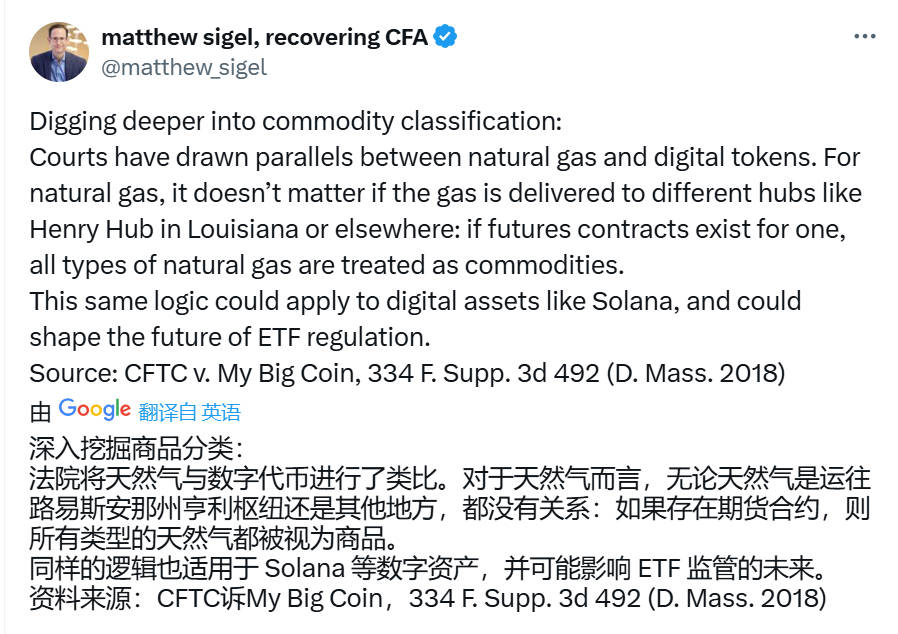
Sigel believes this precedent could apply to Solana, suggesting that even without existing futures contracts, Solana can still be classified as a commodity. Such classification is crucial for ETF approval, as it provides a legal basis for treating Solana as a commodity and qualifying it for commodity-based ETF review.
Therefore, he argues, ETF approval does not necessarily require an active futures market. Existing ETFs for shipping, energy, and uranium have launched despite limited futures volume. “We believe it can be approved even without a CME futures contract,” he said, adding that cross-exchange market surveillance sharing agreements could serve as an alternative oversight mechanism.
If approved, the next question is how much demand a spot Solana ETF might generate. Grayscale Investments already operates the Grayscale Solana Trust, currently managing approximately $70 million in assets. Bloomberg analyst James Seyffart estimates that given Solana’s market cap is roughly 6% of Bitcoin’s, ETF demand could scale proportionally, potentially reaching around $3 billion in total assets over time.
Join TechFlow official community to stay tuned
Telegram:https://t.me/TechFlowDaily
X (Twitter):https://x.com/TechFlowPost
X (Twitter) EN:https://x.com/BlockFlow_News
 PANews