Another profit strategy for meme markets: enhancing returns by being a passive LP
TechFlow Selected TechFlow Selected
Another profit strategy for meme markets: enhancing returns by being a passive LP
In the Meme market, trading volatility demand is extremely high and price sensitivity is extremely low, making positioning oneself as a passive LP an excellent strategy to maximize returns.
 Navigating Web3 tides with focused insights
Author: jackmelnick_, Head of Berachain DeFi
Translation: Felix, PANews
Eight months ago, I wrote a post about LP costs. It didn't attract much attention at the time, but yesterday its views tripled. So here’s an updated validation of this method with fresh examples.
Premise: For this strategy to work well, you need early exposure to a Memecoin, belief in its medium- to long-term advantages, and high trading volume. This article uses the BUCK token as an example.
As mentioned in the previous post, you should set up a v3 range where the lower bound is slightly below the current token price (typically around 25% lower), and the upper bound significantly higher (in this case, approximately 100 BUCK/SOL or ~$2.5/BUCK). This setup minimizes the amount of SOL you need to deposit into the LP and enables a dollar-cost averaging (DCA) effect that gradually shifts your position from the Memecoin to SOL as the price rises.
Now let's discuss impermanent loss (IL): paraphrasing @AbishekFi:
"IL is a tool, not a loss... Measuring LP returns is a hot topic, but it ultimately depends on your preferences as a liquidity provider. Do you want asset A or asset B? Or would you prefer a higher-valued position?
The only way IL occurs is when one or both assets in your pair appreciate, causing impermanent loss. However, if you're indifferent about holding either asset, then providing liquidity simply creates an on-chain DCA that also generates fees."
As @shawmakesmagic pointed out, this could be a powerful tool for token developers—especially for AI agents with ongoing costs. Providing v3 ranged liquidity allows developers to earn fees (or offset expenses) while participating in token appreciation. Over time, it directly adjusts value depending on how the range is configured.
To demonstrate the effectiveness of this approach, consider the following simple example using BUCK. The analysis breaks down initial reserves, ongoing impermanent loss, generated fees, and return on investment.
Yesterday, I created a BUCK/SOL LP with 17 SOL and 892,000 BUCK. The rationale was Gamestop’s broad appeal, rapid token rotation, extreme volatility, and exceptionally high trading volume.
The range was set from an upper limit of 100 BUCK/SOL (~$2.5) to a lower limit of 8,500 BUCK/SOL ($0.029), roughly 20% below the market price of ~6,900 BUCK/SOL—ensuring the pair stays within range even if BUCK dips short-term.
This represents approximately $4,000 worth of SOL and $30,000 worth of BUCK (relevant for later IL calculations).
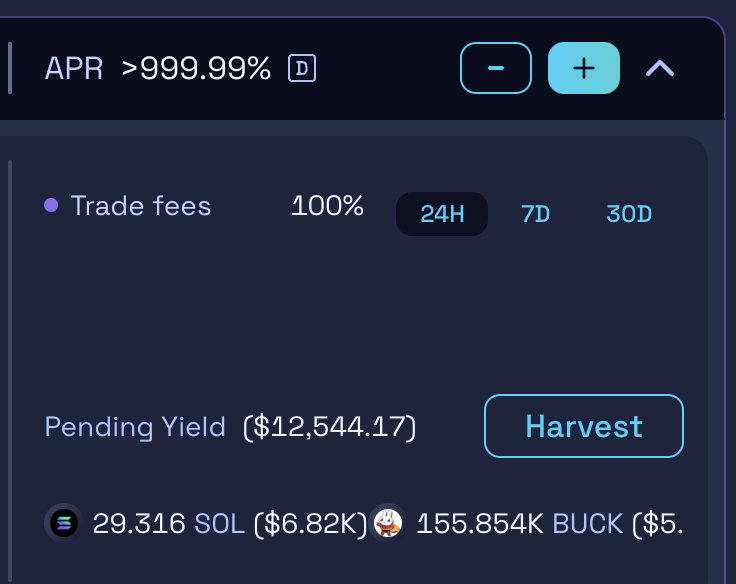
After 10 hours, I withdrew the LP, which had generated:
-
29.3 SOL and 156,000 BUCK (fees)
-
25.1 SOL and 841,456 BUCK (LP holdings)
A $34,000 deposit generating $12,500 in fees over 10 hours equates to roughly 88% of daily fees. This is an absolutely incredible figure—yielding an APY of 32,120% even without compounding.
In this scenario, impermanent loss amounted to losing ~50,000 BUCK tokens, replaced by an additional 8 SOL—negligible from an IL perspective.
To clarify further:
-
Total deposited = 17 SOL and 892,000 BUCK
-
Total withdrawn = 54.4 SOL and 997,000 BUCK
-
Total LP profit = 37.4 SOL and 105,000 BUCK
Clearly, the impermanent loss was overwhelmingly offset by fees generated from trading volume. This works best in pairs with stable pricing and extremely high trading volumes.
Even more excitingly, this can be further optimized:
-
Increase the LP fee tier from 1% to 2%, given deeper liquidity and higher volume
-
Tighten the upper bound of the initial range to concentrate liquidity more aggressively; rebalance the range over time as prices rise
-
If you want to lock in gains after a price surge (avoiding round-trip trades), pull your LP and readjust the lower bound to again sit ~20% below the current price, securing the SOL you've already DCA'd into.
In the Meme market, where demand for trading volatility is extremely high and price sensitivity is very low, positioning yourself as a passive LP is an excellent strategy for maximizing returns—especially for long-held, high-volume pairs—and particularly suitable for users uncertain whether they'd rather hold SOL or Memecoins.
Join TechFlow official community to stay tuned
Telegram:https://t.me/TechFlowDaily
X (Twitter):https://x.com/TechFlowPost
X (Twitter) EN:https://x.com/BlockFlow_News
 @jackmelnick_