Bitcoin Surpasses $90,000: How Far Can the "Trump Effect" Go?
TechFlow Selected TechFlow Selected
Bitcoin Surpasses $90,000: How Far Can the "Trump Effect" Go?
Is Bitcoin going to the moon?
 Navigating Web3 tides with focused insights
Author: Tuoluo Finance

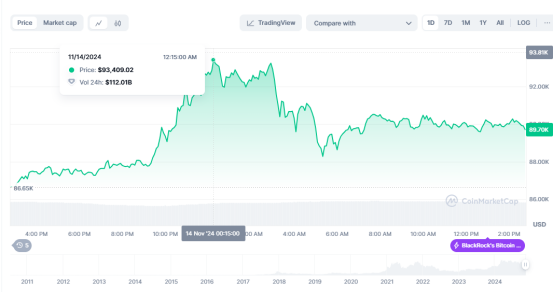
From $70,000 to $90,000—Bitcoin achieved this in just one week. Early this morning, Bitcoin hit a new all-time high, surging past the $90,000 mark and briefly exceeding $93,000, bringing it within striking distance of analysts' projected $100,000 target.
A raging bull market is emerging. The crypto world is on fire, and so are headlines. Can this rally sustain? How far can the "Trump effect" go? Opinions across the market remain divided.
Prior to the U.S. election, Bitcoin had already climbed to $74,000. At that time, skepticism remained, with many voices still bearish or cautious. But reality has proven the Trump effect to be even more promising than expected.
This morning, Bitcoin rose nearly 6% intraday, officially breaking above $90,000 and peaking at $93,462. Though it later pulled back to around $90,000, since the election, Bitcoin has gained over 33%. After surpassing $93,000, Bitcoin’s market cap briefly reached $1.84 trillion—surpassing Saudi Aramco and rising to seventh place among major global assets.
The broader crypto market surged alongside. USDT’s market cap exceeded $127.84 billion, setting a new record. Most major sectors rallied, and meme coins like PUNT saw continuous gains. Pre-market U.S. equities linked to crypto rose collectively: MicroStrategy up over 4%, Coinbase by 3.7%, Riot Blockchain by 2%. Hong Kong-listed crypto stocks also extended gains, with OKLink climbing over 10%.
The same volatility brought the same recipe for liquidations. According to Coinglass, total futures liquidations across the crypto market reached $659 million in the past 24 hours, including $374 million in longs and $284 million in shorts. BTC liquidations totaled $161 million, while ETH liquidations amounted to $87.14 million.
As for the drivers behind the surge, the Trump agenda and Federal Reserve policy outlook form the primary tailwinds. However, institutional bullishness and the growing trend of national Bitcoin reserves have also become critical factors.
On the Fed side, after cutting rates by 25 basis points in November—bringing the federal funds rate to 4.5%-4.75%—market sentiment toward future cuts has been cautious, particularly given Trump's policies carry clear inflationary risks. However, yesterday’s CPI data made further easing more feasible. Data released Wednesday showed U.S. October CPI rose 2.6% year-over-year and 0.2% month-on-month. Core CPI (excluding food and energy) increased 3.3% YoY and 0.3% MoM, reflecting weaker-than-expected nonfarm payrolls due to hurricane disruptions, paired with inflation in line with expectations.
Against this backdrop, traders have increased bets on another Fed rate cut next month. According to the CME FedWatch Tool, there is a 17.5% chance the Fed holds rates steady in December and an 82.5% probability of a 25-basis-point cut. By January, the odds of unchanged rates drop to 11.9%, with a 61.7% chance of a 25-bp cut and a 26.5% chance of a 50-bp cumulative reduction.
Loose monetary conditions appear set to continue, pushing up risk asset prices. Yet more significantly, the current crypto rally heavily hinges on anticipated regulatory relief under Trump. The new administration has begun rolling out its post-election agenda and personnel appointments.
As President, Trump must nominate 15 cabinet members. Of particular relevance to crypto are Elon Musk and Robert F. Kennedy Jr. While Kennedy has not yet taken office, the announcement regarding the Department of Government Efficiency has already landed. Trump announced that Elon Musk and Vivek Ramaswamy will jointly lead the newly proposed “Department of Government Efficiency,” stating the agency will streamline bureaucratic institutions, eliminate redundant regulations and wasteful spending, and restructure federal agencies.

Musk shared the appointment on social media, emphasizing that the Department of Government Efficiency threatens bureaucracy—not democracy. The department moved swiftly: its official X account launched today. Musk’s pro-crypto stance was evident as he posted a logo featuring "DOGE" and tagged DOGE on the official account, further fueling excitement in the Dogecoin community.
Regarding the SEC—the area most watched by the market—a president cannot remove Chair Gary Gensler without cause, and Gensler himself shows no sign of resigning voluntarily. However, Trump has strongly hinted he will bypass Senate confirmation procedures when appointing government officials. If true, Gensler’s position would face significant jeopardy. On another front, Senator John Thune, a supporter of crypto legislation, will become Senate Majority Leader next year—laying a solid foundation for favorable policy shifts.
While Trump’s initial agenda—as currently outlined—begins with relatively straightforward actions such as mass deportation of undocumented immigrants, cryptocurrency is not an immediate priority. Nevertheless, as pro-crypto figures join his administration, long-term positive outcomes appear increasingly certain. For example, Ripple’s legal team believes the new administration may drop ongoing digital asset cases, sending shockwaves through market sentiment.
Beyond expectations, large institutions are backing Bitcoin with real capital. MicroStrategy leads the charge. On the evening of November 11, the company announced it purchased 27,200 Bitcoin between October 31 and November 10 for approximately $2.03 billion, averaging about $74,463 per coin. Funding came from its ATM stock offering program. MicroStrategy now holds a total of 279,420 Bitcoin, acquired at an average price of ~$42,692 per coin, with a total cost basis of around $11.9 billion.
Wall Street isn’t lagging. Since the U.S. election, net inflows into Bitcoin and Ethereum ETFs have skyrocketed. U.S. spot Bitcoin ETFs recorded six consecutive days of net inflows totaling $4.705 billion. Total assets under management reached $56.475 billion, with a combined market value of $95.688 billion. Spot Ethereum ETFs lagged slightly but still attracted over $759 million in net inflows over the past six days.
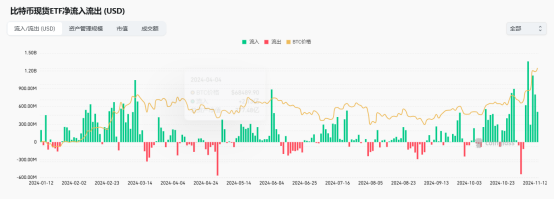
Clearly, institutional bullishness toward Bitcoin is evident—so much so that major purchases are occurring even at what many consider elevated price levels. Notably, these institutional buys provide strong price support. Analysts point out that the current cost basis for new or short-term investors stands at approximately $66,800.
Moreover, Trump’s earlier proposal to make Bitcoin a U.S. reserve asset is gradually materializing elsewhere. Pioneering nations like El Salvador and Bhutan have already reaped substantial benefits. Take Bhutan: the kingdom, with a population under 800,000, holds 12,576 Bitcoin worth over $1.1 billion—ranking fourth globally in government-held Bitcoin—and its Bitcoin holdings now exceed 25% of its national GDP. Legislators in Venezuela and Germany have also proposed adding Bitcoin to national reserves. Recently, Bitcoin Magazine CEO David Bailey revealed on social media that at least one sovereign nation is actively accumulating Bitcoin and has entered the top five holders. The country hasn’t been named, though speculation centers on wealthy Gulf states like Qatar and Saudi Arabia—regions better positioned financially to execute such large-scale acquisitions compared to economically weaker nations.
Amid this confluence of positive catalysts, Bitcoin’s relentless ascent comes as no surprise. In a bull market, every favorable factor feeds into a self-reinforcing upward spiral—just as negative ones could trigger sharp declines. Clearly, Trump remains the central driver of this cycle, making his future policy moves critically important—and a source of market uncertainty.
Despite holding Congress, upon taking office, Trump’s focus will likely center first on macroeconomic and fiscal matters, pushing crypto-related priorities further down the list. More direct impacts may come via SEC leadership changes. Trump previously stated he would fire Gensler immediately upon inauguration and establish a Presidential Advisory Committee on Bitcoin and Cryptocurrency. These actions could serve as near-term indicators, potentially becoming clear shortly after January 20.
As for the widely discussed idea of Bitcoin as a U.S. reserve asset, the vision may be bold, but practical hurdles remain steep. First, Bitcoin’s high volatility contradicts the stability required for strategic reserves. Second, implementation faces legal, security, and institutional resistance. Legally, regulatory frameworks for Bitcoin—covering classification, custody, and taxation—remain undefined and would require sweeping legislative changes. There are also security concerns. Even if laws were updated, decentralized cryptocurrencies could undermine the Federal Reserve’s monetary independence, provoking strong opposition from central banks and entrenched financial institutions. Some speculate Trump’s real intent isn't Bitcoin itself, but using stablecoins in tandem with Bitcoin for risk-free arbitrage—though this remains unproven and purely conjectural for now.
Of course, if successfully implemented, the upside would be enormous. Prominent crypto investor Novogratz predicts Bitcoin could soar to $500,000 if such policies take shape, while Arthur Hayes forecasts a staggering $1 million.
In any case, given Bitcoin’s current momentum, the $100,000 target predicted by many analysts seems within reach. JPMorgan expects Bitcoin to continue benefiting from the Trump effect over the next eight weeks. CNBC and Copper both believe Bitcoin could hit $100,000 before the presidential inauguration ceremony.
Notably, for short-term investors, pullbacks following sharp rallies are normal. Glassnode analysts suggest Bitcoin has entered a price discovery phase. Historically, such phases last about 22 days on average before a major correction occurs—during which roughly 5% of circulating supply may fall below original purchase prices. Bitcoin has already remained in high-profit territory for 12 consecutive days.
Still, given current supportive sentiment, any pullback prior to Trump’s formal inauguration is likely to be limited in magnitude.
Join TechFlow official community to stay tuned
Telegram:https://t.me/TechFlowDaily
X (Twitter):https://x.com/TechFlowPost
X (Twitter) EN:https://x.com/BlockFlow_News