Why Do Bitcoin Bigwigs Like Zhao Changpeng Face Persistently High Risk of Imprisonment?
TechFlow Selected TechFlow Selected
Why Do Bitcoin Bigwigs Like Zhao Changpeng Face Persistently High Risk of Imprisonment?
The crypto entrepreneurs walking the tightrope are finally about to breathe a sigh of relief.
 Navigating Web3 tides with focused insights
Author: Mu Mu, Baigua Blockchain

Not long ago, former Binance CEO Changpeng Zhao (CZ) was released from prison in the United States and reappeared publicly in Dubai at an industry event, dispelling speculation that he would be indefinitely detained by the U.S. Recently, CZ was also included in the Hurun Rich List as the founder of the world's largest cryptocurrency exchange platform. While people marvel at how even billionaires can "get into trouble," looking back at the history of crypto development, numerous founders and executives of leading crypto companies have been arrested or imprisoned. Some have even compiled a lengthy “risk list” for crypto entrepreneurship. This raises the question: Why is the risk of imprisonment so high for these crypto leaders?
01 Crypto Leaders Walking on a Tightrope
Since Bitcoin’s inception, the crypto industry has spanned over a decade—during which many entrepreneurs have ended up behind bars, including several once-celebrated "giants."
In the annals of crypto entrepreneurial risks, earlier cases include the infamous Mt. Gox incident. In 2014, the then-largest Bitcoin exchange, Mt. Gox, was hacked, losing hundreds of thousands of BTC. Former CEO Mark Karpeles ("Fatman") was convicted on charges of "tampering with financial records" (some suspect insider theft, though no conclusive evidence has emerged; the hack remains unsolved).

Former Mt. Gox CEO Mark Karpeles
More recent examples, aside from CZ, include Do Kwon, founder of Luna, and SBF, founder of FTX. One is still awaiting judgment on securities fraud charges, while the other received a 25-year sentence and $11 billion fine for financial fraud.

Luna founder Do Kwon after arrest
In comparison, CZ's four-month imprisonment was relatively mild. His charge was "failure to implement an effective anti-money laundering program, violating the U.S. Bank Secrecy Act." More precisely, his company (Binance) failed to fulfill its anti-money laundering obligations and did not comply with U.S. sanctions policies. Although Binance is not a bank, regardless of whether this was fair or not, getting caught in such a situation was indeed unfortunate.
They say crypto entrepreneurship is risky—but few expected it to be *this* risky. Describing top figures’ ventures as "walking on a tightrope" is no exaggeration.
02 Five Reasons Why Crypto Leaders Face High Imprisonment Risks — The Last One Is Key
The charges against these prominent figures vary widely. Before their downfall, each was a brilliant, accomplished individual. To claim they simply lacked legal awareness clearly doesn’t hold water. By analyzing and comparing these incidents, we can identify common patterns and underlying logic. Ultimately, there are at least five key reasons why crypto leaders face such high imprisonment risks:
1) Tempted by Greed, Acting Recklessly
Typically, major platforms and projects in the crypto space manage user assets worth tens or even hundreds of billions of dollars. In an era where liquidity equals money, simply holding vast sums generates massive passive income. Yet, many ultimately succumb to temptation. Driven by human nature, they adopt aggressive strategies—diverting user funds into high-risk markets. As losses grow, they spiral out of control until everything collapses.
2) Innovation and Illegality Are Separated by a Thin Line
Often, innovation involves breaking existing rules. Cryptocurrency projects were initially seen as decentralized innovations in internet finance. At that time, old regulatory frameworks were inadequate, laws were unclear, and regulations hadn't caught up. Most of the time, innovative companies had to self-regulate—but often unintentionally crossed into territory akin to P2P financial schemes that spiraled beyond recovery.

While some jurisdictions remain highly accommodating toward financial innovation like crypto, certain activities fundamentally challenge established systems. With no clear guidelines defining what is permissible or prohibited, or where the red lines lie, the boundary between innovation and illegality becomes perilously thin—an unavoidable dilemma for every entrepreneur.
3) The "Original Sin" of "Crypto"
To this day, despite Bitcoin and other digital assets entering mainstream awareness, a significant portion of the public still views the industry as "dark," believing it facilitates illegal activities and enables crime, compounded by resentment stemming from early adopters' rapid wealth accumulation, which some perceive as exacerbating wealth inequality.
Due to differing perceptions, skeptics view the crypto industry through a biased lens—including within judicial systems. When these individuals scrutinize crypto entrepreneurs and projects, they readily bring forth allegations rooted in crypto’s so-called “original sin,” launching repeated legal challenges.
Of course, as digital assets become more mainstream, increasing numbers are overcoming their biases upon deeper understanding. But don’t expect overnight acceptance—this takes time.
4) Global Compliance Is Extremely Costly and Challenging
Take crypto exchanges as an example: since they typically serve global users and conduct international financial operations, just like traditional financial institutions, they must comply with diverse legal and regulatory regimes—including countries exercising long-arm jurisdiction. They also face additional hurdles created by regulators who approach the sector with prejudice.
Take PayPal, a traditional cross-border financial institution: deploying services in any country requires obtaining various local licenses, navigating distinct regulatory policies, and engaging with regional authorities. If any step falls short, the entity could face penalties amounting to hundreds of millions—or even billions—of dollars, with immense human and operational costs involved.
As early as 2022, CZ stated on social media that Binance had already spent over $1 billion globally on compliance efforts—a figure undoubtedly rising since then. Add to that the multi-billion-dollar settlement fines paid during negotiations with U.S. regulators this year, and the total cost becomes astronomical.
5) The Battle for International Influence Over Crypto Markets
Ever since El Salvador announced its full commitment to Bitcoin, it’s clear that nation-states have entered the arena. Cryptocurrencies like Bitcoin represent not only innovations in financial payments but also future technologies underpinning Web3 and the next generation of the internet. On matters of technological leadership, most nations—even acknowledging inherent risks—are unwilling to fall behind.
Consider the previous examples: the U.S. handling of FTX and penalties imposed on Binance led to their founders being jailed. FTX disappeared entirely from the market, while Binance paid billions to settle with regulators. Moreover, the settlement mandates that the U.S. Treasury retain access to Binance accounts and systems for five years.
The intent behind U.S. regulatory actions goes far beyond maintaining financial stability. It also serves to discipline dominant platforms, enforcing compliance with U.S. extraterritorial jurisdiction and preferred rulebooks—and setting a precedent for the entire crypto industry. There are already signs of countries using blockchain and digital assets to conduct international trade bypassing dollar dominance. From America’s perspective, cryptocurrencies like Bitcoin are a double-edged sword. If they cannot be dismantled, the next best option is to gain control—shaping them to serve U.S. interests and ensuring America emerges as the biggest beneficiary.
Following strict oversight of influential players like Binance, previously stalled spot Bitcoin ETFs were suddenly approved in the U.S., followed by spot Ethereum ETFs. Only then did American capital confidently pour into the crypto market via these regulated channels. In doing so, the U.S. brought the crypto market under partial control while securing a degree of “pricing power.”
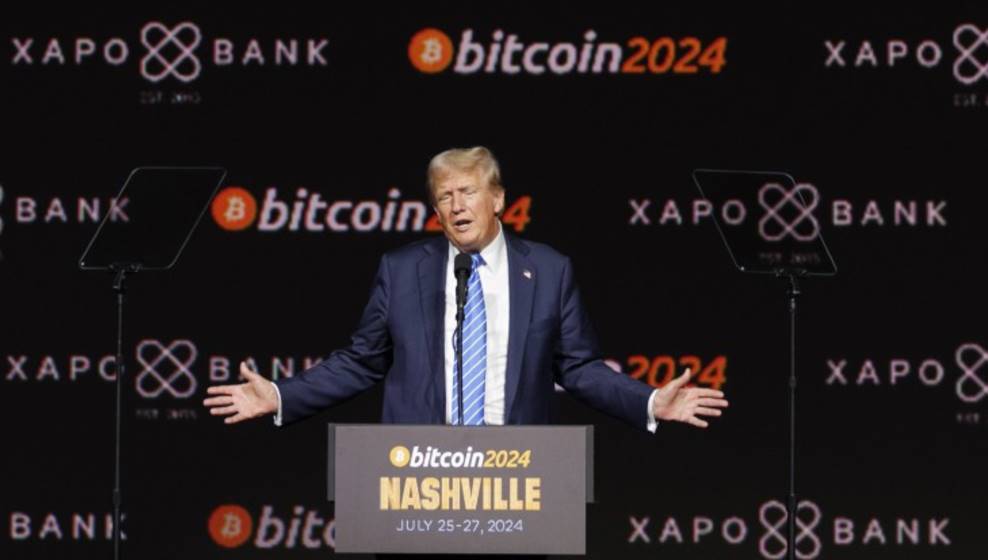
Donald Trump, recently elected as the 47th President of the United States, previously spoke at a Bitcoin conference, stating that Bitcoin is not merely a technological marvel but, as he put it, “a miracle of cooperation and human achievement.” He addressed the Bitcoin community because he adheres to the principle of 'America First.' His vision is for America to dominate the future—to become the trendsetter. He wants to ensure the United States becomes the global capital of crypto and the world's leading Bitcoin superpower.
03 Summary
For centralized platforms and project teams, regulation is an unavoidable reality. Jurisdictions that successfully balance regulation with innovation will become the greatest beneficiaries of this technology. With the recent conclusion of the U.S. presidential election and the incoming pro-crypto president Donald Trump taking office, a more favorable regulatory environment is expected. It is believed that going forward, crypto entrepreneurs—including figures like CZ—can finally breathe easier, focusing on accelerating the development and real-world adoption of crypto and Web3 applications.
Join TechFlow official community to stay tuned
Telegram:https://t.me/TechFlowDaily
X (Twitter):https://x.com/TechFlowPost
X (Twitter) EN:https://x.com/BlockFlow_News
 白话区块链
白话区块链