Crypto Startup Insights: Chase Trendy Buzzwords or Slow Down and Go Deep?
TechFlow Selected TechFlow Selected
Crypto Startup Insights: Chase Trendy Buzzwords or Slow Down and Go Deep?
For early-stage startups, substantive content is the most important.
 Navigating Web3 tides with focused insights
Author: @mattigags
Translation: TechFlow
The Hidden Truth
"Fast learns, slow remembers. Fast proposes, slow disposes. Fast is discontinuous, slow is continuous. Small and fast systems guide large and slow systems through accumulated innovation and by occasional revolution, while large and slow systems control small and fast ones through constraint and stability. Fast captures our attention, but slow holds real power."
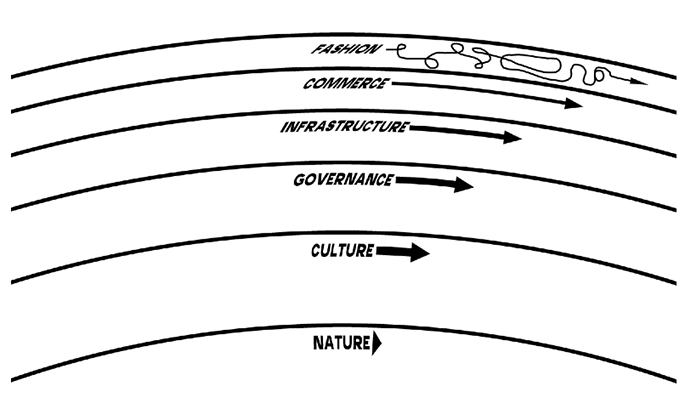
Excerpt from "Pace Layers: How Complex Systems Learn and Keep Learning"
Narratives aren't designed for investors or founders—they're aimed at consumers and traders. For long-term investors, focusing on narratives is rarely the best strategy. Either get in early when a potential narrative begins to form, or wait until clarity emerges before acting.
As crypto gained fame for creating massive wealth in short periods, many entrepreneurs flooded into the space between 2017 and 2021. Founders in this industry gradually shifted focus away from solving real problems, turning instead to pitching venture capitalists (like us) to ride waves of attention. And we were captivated.
Crypto founder culture evolved from substance-driven to process-obsessed. Everyone began copying the same playbook and recycling once-effective buzzwords. But when everyone uses the same tactics, their effectiveness diminishes.
We don’t believe relying solely on process leads to strong outcomes. Imagine if everyone runs KOL marketing—how do you stand out among those using identical strategies? Fierce competition quickly erodes growth opportunities.
In our conversations with crypto founders, genuine curiosity has become increasingly rare. Many start from buzzwords and narratives, trying to build products around them—or simply raise funds based on them. As a result, their pitch decks effectively become their "product."
People often mistake fashion for culture. They rely on fleeting narratives rather than building from first principles. As imitation spreads, many products end up looking the same. Founders and investors frequently forget how to think independently, because in crypto, noise and trends seem like the fastest path to riches.
No one builds monopolies in crypto because everyone is competing through narratives. To build a monopoly, you need inspiration and drive that come from the ground up.
Hence, answering the question "What are we looking for?" has grown simpler over time, despite past detours. We seek authentic curiosity and unique beliefs that remain unaffected by fashion (the fast). We believe that to create something great, you must be able to deeply embed your ideas and products within cultural layers.
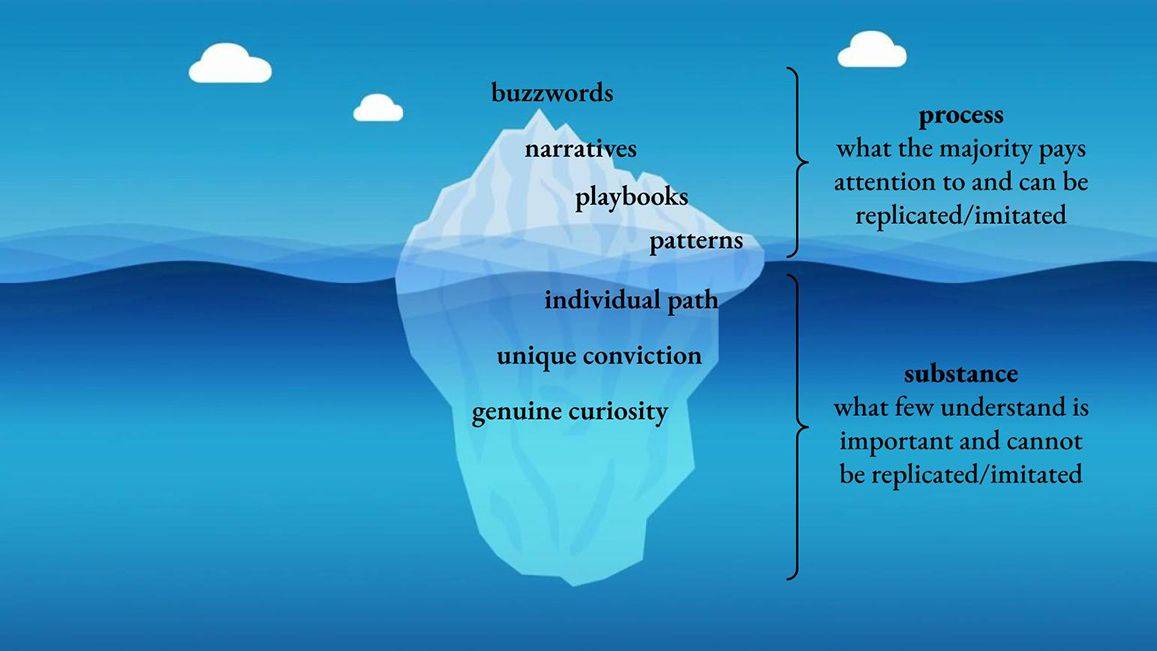
Buzzwords and narratives are like fashion—easily copied and imitated. Notice how, during frenzied periods, everyone ends up doing the same thing because they only focus on surface-level signals. Founders often think, "I'm discovering X," where X is the latest buzzword or narrative-compliant concept.
Most real innovation comes from founders experimenting by accident. At its core, it almost always stems from genuine curiosity. Their mindset is: "I'm exploring this problem—let's see what we find." This forms a solid foundation for meaningful creation. Ideally, it also uncovers a hidden truth.
You Go Against the Tide
This may simply be a rephrasing of Peter Thiel’s concept of "secrets", but here's our take. If you listen to current discussions and narratives, which truths seem clearly obvious, and which lies are obviously false? Which truths are non-obvious, and which falsehoods are hard to detect?
The distinction between obvious and non-obvious can be reframed as popular versus unpopular, or knowable versus unknowable based on existing data. Take crypto between 2021–2023 as an example:
Obvious Truths:
Crypto will be impacted by rising interest rates DeFi yields are unsustainable Conflict is bad for crypto
Non-Obvious Truths:
FTX was a criminal organization L2s lead to liquidity fragmentation Stablecoins represent product-market fit in crypto
Non-obvious truths require unique insight. Obvious truths can be seen from afar, yet still lack absolute certainty—because nothing ever truly is certain. The boundary between the two isn’t necessarily binary; more likely, it's a spectrum.
Here’s an example of placing these concepts into a 2x2 framework:
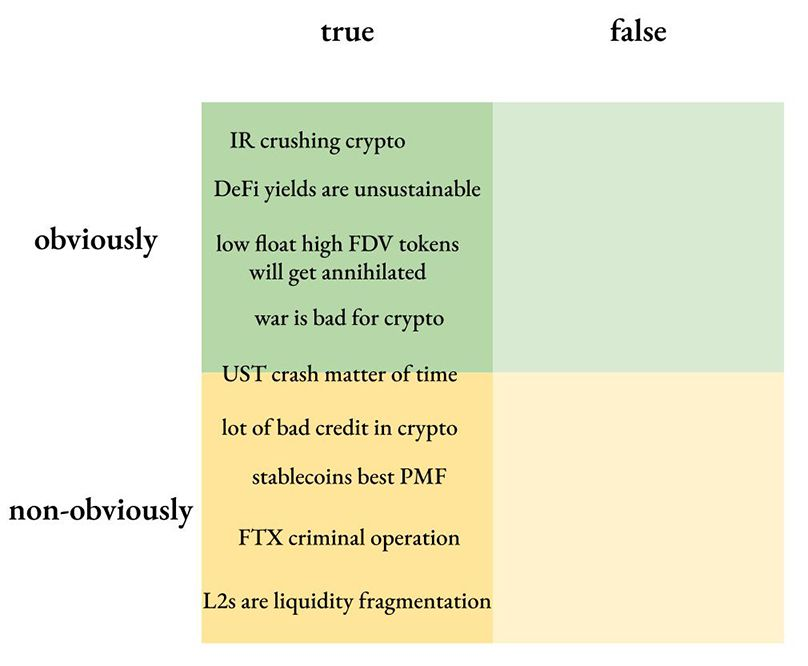
So, among the false narratives and claims circulating during that period, what things clearly wouldn’t happen, and which were harder to predict?
This is what we came up with:
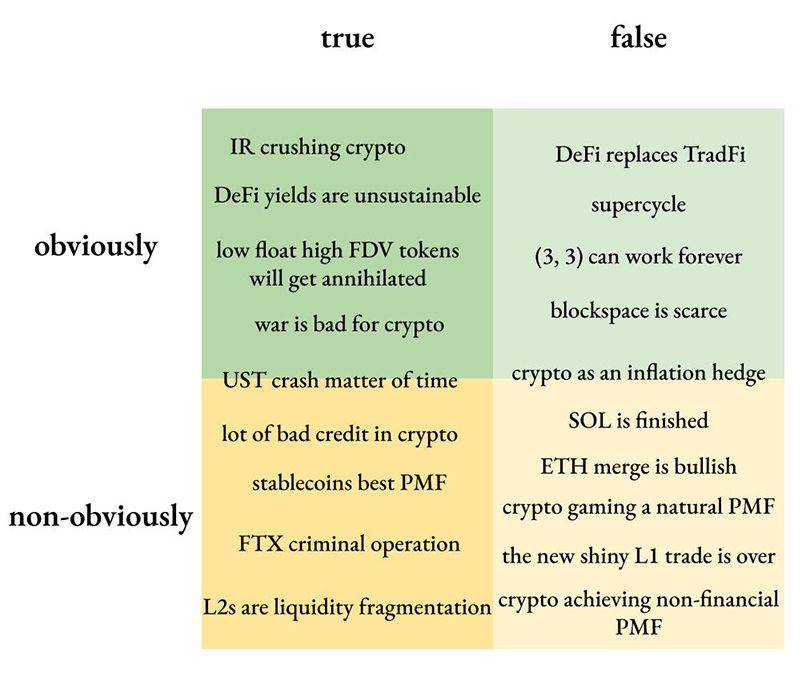
In hindsight, these ideas seem clear. Looking forward, everything remains uncertain—but evaluating founders’ beliefs behind their products reveals the independence of their thinking. Because if a founder forms views only from obvious facts, and their product isn’t grounded in any non-obvious truth or fallacy, how could it ever grow into a great company, project, or asset?
Some talk about contrarian thinking, but that’s not an ideal mental model. A hypothesis might appear to contradict consensus, but it shouldn’t be formed merely by observing consensus and then flipping it. Hypotheses should emerge from first-principles analysis, independent of prevailing opinion.
The above examples are macro-level. Now let’s examine a concrete success story from recent years in crypto. If you’d received Solana’s pitch materials in 2019, you could analyze it through the 2x2 framework like this:
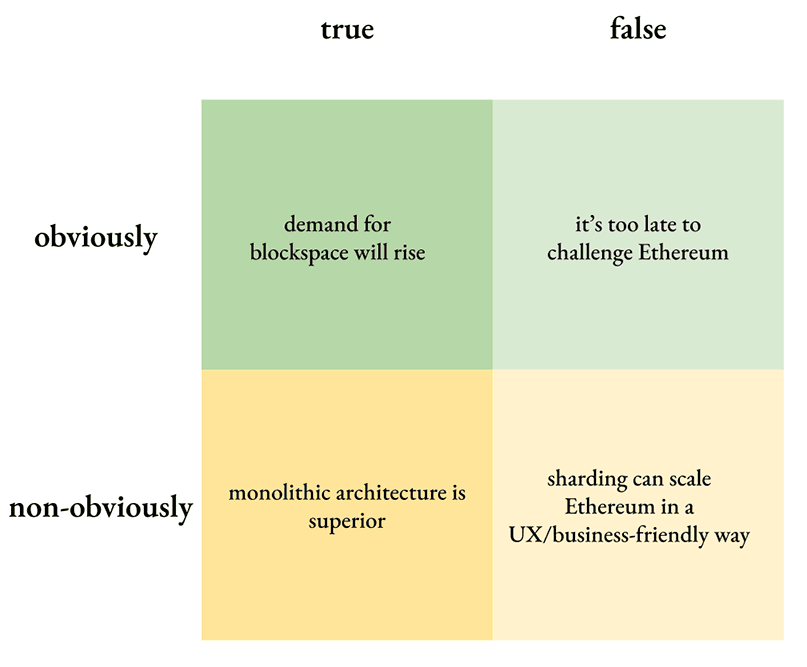
The non-obvious truth assumptions played a positive role in Solana’s development. They brought debates around modularity versus monolithic architecture into focus—something previously uncommon. Most people had grown accustomed to modular thinking. Solana uniquely saw sharding as a dead end.
In entrepreneurship, being able to identify content within each quadrant is helpful. If your insights remain only in the obvious domain, you likely offer no unique value—just competing with many others for market share.
If your beliefs rely entirely on non-obvious elements, you may be isolated, possibly without market demand, or just guessing (which is fine, as long as you know it).
If you build only on truths, you might fail to spot flaws in existing products or models. If you build only on false assumptions, you risk inventing non-existent problems—such as believing creator income inequality or platform fees are major issues.
Ideas Worth Exploring
Those who innovate from genuine curiosity are usually best at solving real problems. Using our 2x2 framework to analyze your unique insights can help clarify your positioning and the value you provide.
How you execute on unique beliefs matters just as much as maintaining curiosity. While brilliant ideas are rare, exceptional execution is equally scarce. The ability to rapidly ship and iterate is uncommon. Often, avoiding standard playbooks at the beginning—and choosing personalized paths that are temporarily unsustainable at scale—can be a worthwhile approach.
Best practices and operating manuals are indeed useful when the time is right, but shouldn’t be overused early on. Only when timing aligns should you adopt them—this allows narratives and buzzwords to naturally form around your product organically.
Too many founders get things backward—focusing first on buzzwords. Perhaps most do. But for early-stage startups, substance is paramount. Process is merely a tool to amplify substance.
Rather than saying "I'm discovering X," a better mindset is: "I'm solving this problem—let's see what happens." This is almost an aesthetic pursuit. In other words:
"No support, nothing to lose... In this state, one does only what is genuinely reasonable: no hidden fears, no moral constraints, no rules, no latent limitations, no subtle regard for the forms of those around—most importantly, no self-regard... There is no guiding image in his actions, no concealed force; he is simply free...
...It is precisely in those moments when we are completely defenseless—that our most essential qualities emerge... Any conscious effort to achieve this state, to pursue freedom, or to become anything—this very striving destroys it." — Excerpt from *The Timeless Way of Building* by Christopher Alexander
Join TechFlow official community to stay tuned
Telegram:https://t.me/TechFlowDaily
X (Twitter):https://x.com/TechFlowPost
X (Twitter) EN:https://x.com/BlockFlow_News
 @ZeePrimeCap