Xiao Feng's graduation speech for entrepreneurs: Crossing the chasm, returning to the origin
TechFlow Selected TechFlow Selected
Xiao Feng's graduation speech for entrepreneurs: Crossing the chasm, returning to the origin
"The blockchain industry has transitioned from the infrastructure phase into the second growth curve—the application phase."
 Navigating Web3 tides with focused insights
Speech: Xiao Feng
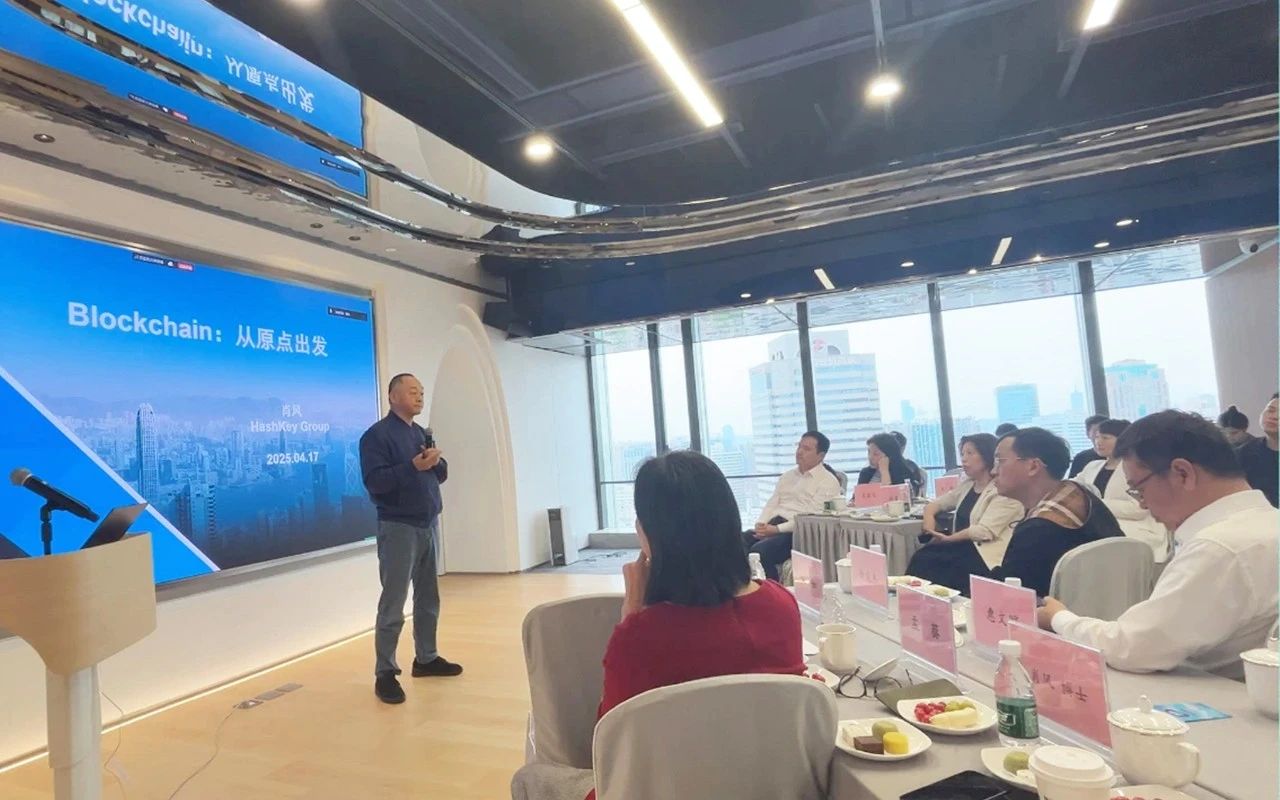
Recently, at the Wanwu Creation Camp S4 graduation session, Dr. Xiao Feng, founder of Wanxiang Blockchain, Chairman of HashKey Group, and initiator of Wanwu Island, delivered a powerful talk—“Blockchain: Back to the Origin.” He discussed emerging trends like RWA and PayFi, shared insights from his face-to-face conversation with Vitalik, and refrained from fear-mongering or technical jargon. Instead, he invited the audience to revisit blockchain’s original purpose and reflect on whether this industry still holds promise—and if so, how we should move forward. This article has undergone minor edits that do not alter its meaning. If you're feeling lost about this space, it's worth reading repeatedly and saving—it may help you rediscover direction.
Hello everyone. Yingmu told me that due to market cycles and unfavorable conditions, many are wondering, “Should I switch careers?” She hopes to recharge our collective “faith.” I think that’s absolutely possible. I’ve believed in this industry since 2014, and now, after all these years, I’m utterly captivated by it.
Before we begin, let me express my joy—I’m visiting Dongyin Center for the second time. Last year, during Wanwu Creation Camp S3, I gave a talk right here. Returning to familiar ground and seeing familiar faces feels especially warm. A special welcome to our leaders from Changning District.
I just returned from Hong Kong yesterday, where I attended a four-day Blockchain summit. For the first time, a mainland delegation participated in the Hong Kong summit—a signal of profound significance. The biggest difference this year was that the Shanghai government organized two official delegations totaling nearly 50 people to attend. This marks the first time a local government from mainland China has sent a group to such a crypto-focused event.
We’ve hosted a blockchain summit in Shanghai for ten consecutive years, while Hong Kong is only on its third. Why separate them? Because topics like “public chains,” “crypto,” and “token economy” are difficult to openly discuss on the mainland. We worried speakers wouldn’t feel comfortable addressing them, so we moved core content to Hong Kong. This year, QR code tracking showed over 8,000 unique attendees across the four days, with attendance numbers reaching tens of thousands.
The Application Boom Is Coming
Many ask: Is the industry in crisis? I don’t think so. I believe blockchain has transitioned from the infrastructure phase into its second growth curve—the application phase. At this year’s summit, it was clear: discussions around protocols and infrastructure have declined, while application-focused topics like RWA, PayFi, and USDT payments became central. This isn’t a crisis—it’s a turning point, a period of accumulation before the next explosion. The era of “building frameworks” and “talking protocols” is over. The new opportunity lies in who can build real-world applications on this distributed ledger system to solve actual problems.
On the final day of the summit, I had a dialogue with Ethereum co-founder Vitalik Buterin. We didn’t prepare an agenda, but I wanted him to talk about decentralization. He delivered a key insight: “The application layer cannot achieve full decentralization—Layer 1 must remain decentralized.”
Why? The essence of decentralization is “removing trust” and “removing intermediaries”—that is, reducing costs and increasing efficiency. If Web3 is more expensive and less efficient than Web2, why rebuild everything? So when we say “everything deserves to be rebuilt in Web3,” it only makes sense if trust costs are lowered and system efficiency improved—only then can new business models succeed.
Don’t treat blockchain as mysticism—it’s already entering the real world. Why? Because cross-border e-commerce is shifting from B2B and B2C to C2C. Customers are no longer foreign trade companies, but individual U.S. consumers buying a $50 T-shirt on your website and expecting delivery within a week. You need fast payment and fulfillment. The best solution? Scanning a USDT QR code—funds arrive instantly, inventory is prepared immediately, and air freight delivers within a week. This method bypasses banks and clearing systems, solving trust and efficiency in one second. In 2023 alone, China shipped 18 billion international packages.
Without a USDT-based blockchain settlement system, China would be the biggest loser. That’s why Hong Kong is pushing stablecoin legislation—it recognizes that failing to embrace new payment systems means losing its position in the global trade settlement race.
Are you still fixated on “Can I launch a protocol, issue a token, and get rich”? Let me tell you—that era is over. The public chain era has ended. I keep advising founders still dreaming of launching public chains: it’s not that your tech is bad, but the window has closed. The real question now is: Can you use this system to build real applications that meet real-world needs? That’s the spirit behind my talk’s title—“Blockchain: Back to the Origin.” What was blockchain’s original purpose? To make system trust computable, verifiable, and low-cost.
Let me share where my “faith” comes from. Nobel laureate John Hicks once said: “The Industrial Revolution had to wait for a financial revolution.” Human progress depends on changes in three elements: matter, energy, and information. Every industrial revolution involves synchronized revolutions in all three. And financial revolutions often lead the way.
-
First Industrial Revolution: Steam engine, accompanied by the rise of banking and credit systems;
-
Second: Electrification, supported by capital markets and joint-stock companies;
-
Third: Internet revolution, where China entered midstream;
-
Fourth: AI + Blockchain, where China and the U.S. are now co-leading.
What you’re seeing in blockchain today is precisely the next-generation financial system built for the Fourth Industrial Revolution.
In an interview, I bluntly told the Ethereum Foundation: “Ethereum has fallen to this state because you lost China.” From 2014 to 2016, China was Ethereum’s strongest base of developers and users. Vitalik attended every one of the first seven blockchain conferences in Shanghai. But after China’s seven regulatory bodies issued rules in 2017, the Ethereum Foundation’s lawyers cited “compliance risks” and banned staff from traveling to China. So Vitalik stopped coming—not because he didn’t want to, but because he was afraid to.
Even in 2023, when we held our first conference in Hong Kong, he didn’t show up. Only last year did he finally agree to come. I’ve been inviting him every year. I told him: It’s time to return to China. Wanxiang Blockchain Lab is ready to support workshops, hackathons, and tech outreach across China. Losing China means losing a massive pool of global developers. Blockchain developers are primarily concentrated in two language communities: English and Chinese.
I asked him: How many developers does the Ethereum Foundation have in Europe? He thought and said, “A small team in Berlin working on core tech.” But even he admitted that Ethereum’s core tech is largely mature, with only optimization left—no room for reinvention. If you expect an app boom, can you rely solely on Berlin’s tiny team? On European developers alone? Of course not.
So I suggested the Ethereum Foundation set up an office in Hong Kong—and half-jokingly added: “We’ll host our 11th Blockchain Summit in Shanghai this October. If you come and get arrested, I’ll go to jail with you.” Of course, that’s a joke. In reality, China’s tech sector, government agencies, and developer community deeply respect Ethereum’s technology. Your foundation shouldn’t stay away from China. Your legal team in Europe doesn’t understand China, yet they make arbitrary rules—that’s leading you further off course. This was a private exchange between me and Vitalik.
Behind Every Industrial Revolution Lies a Financial Revolution
Now let’s zoom out: the financial revolution accompanying the Fourth Industrial Revolution is underway.
First Industrial Revolution: Bank-dominated, funded by credit and bonds—capital markets didn’t exist yet.
Second Industrial Revolution: Led by U.S. capital markets, investment banks like Wall Street, Morgan Stanley, and Goldman Sachs powered the electrification wave.
Third Industrial Revolution: Venture capital (VC) emerged in the 1960s, fueling Silicon Valley’s rise. As one Nobel economist put it: “Every industrial revolution is preceded by a financial revolution.”
Today, in the Fourth Industrial Revolution, if you dismiss tokens and crypto, you miss the new financial paradigm—and possibly the entire revolution.
In the past year, I’ve discussed Web3 and AI with four top AI experts: Shen Xiangyang, Li Kai-Fu, Zhou Ming, and the Dean of Hong Kong Polytechnic University’s AI Institute. Without exception, they see Web3 and AI as two sides of the same coin—they will inevitably converge. In the U.S., two figures exemplify this:
1) Sam Altman: Leading Worldcoin, now with 10 million users globally, distributing three coins per quarter—even at under $1 each, it’s a huge expense. He represents the “AI + Crypto + Software” path.
2) Elon Musk: Supporting Dogecoin while advancing self-driving and Optimus robots, representing “AI + Hardware + Crypto.”
Both paths embody “left hand AI, right hand Crypto.” This isn’t coincidence—it’s historical inevitability. Even President Trump responded. He initially planned separate AI and Crypto councils, but on advisor recommendations, merged them into a single “AI + Crypto Presidential Council.” I learned from one of his crypto advisors: AI and Crypto shouldn’t be governed separately—they must be integrated.
The digital age’s financial revolution is built on distributed ledgers and cryptographic capital. Deny this, and you’ll fall behind America in the digital era. Why? Because blockchain is a new accounting, payment, clearing, and global ledger system. The digital world knows no borders—it transcends space, time, organizations, and nations. It demands new registration, accounting, and settlement systems. Traditional finance can’t meet this.
Humanity has seen only three major shifts in accounting:
1) Ancient single-entry bookkeeping
2) Double-entry bookkeeping after the Renaissance (still used today)
3) Bitcoin’s distributed ledger system, created in 2009
This third revolution moves us from bank accounts to crypto accounts. Why do merchants in Yiwu accept USDT? Because they don’t need bank accounts—just crypto wallets. In 2023, USD stablecoins settled $16 trillion—surpassing Visa and Mastercard combined. Banks are nervous, governments are paying attention. Today, CEOs and chairmen of major global banks admit: Blockchain is revolutionary—it represents a leap in efficiency.
Back in 2012, I debated famous bankers at a conference about “whether blockchain could change finance.” They said, “The essence of finance won’t change.” I agreed—the essence is always: wanting to borrow money, wanting to receive money quickly. That demand hasn’t changed in 3,000 years. Do you think banks are the final form of finance? Banking is barely a century old; central banks only 400 years. China once had piaohao and silver shops, earlier still, security escorts carrying silver. These evolved—why can’t banks?
Now look: CeFi (Centralized Finance) is the old system, DeFi (Decentralized Finance) the new. When I first talked about DeFi, banks saw high risk. But I asked them: “In lending, who’s riskier—banks or DeFi?” Banks’ capital adequacy is about 12%, meaning leverage of 7–8x. Profits depend on high leverage—when models fail (like the 2008 subprime crisis), the whole system collapses. DeFi, in contrast, has transparent, quantifiable, on-chain traceable risk.
What is DeFi? DeFi doesn’t lend via leverage; it generates returns by boosting capital turnover. For example, you deposit a $100,000 BTC into a DeFi protocol. With a ~50% collateral ratio, you can borrow up to $50,000. So DeFi uses over-collateralization, not high leverage.
The most efficient form of capital turnover in DeFi is the “flash loan,” which borrows and repays within one block—completed in seconds. Not all use cases apply, but it demonstrates DeFi’s efficiency. Overall, DeFi’s annual capital turnover is 10 times faster than traditional banks. Its returns come from frequent small profits, not leveraged gains. This is a more advanced, resilient financial system. The “new financial infrastructure” is already more than halfway built—it’s time to accelerate real-world applications.
Applications and Impact of the New Financial Infrastructure
With this infrastructure spreading, applications like PayFi have emerged. In 2024, stablecoin-based payments and settlements totaled $16.16 trillion, completely bypassing traditional banks and SWIFT. China is among the biggest beneficiaries. More and more of our cross-border payments now use this new system, helping goods reach global markets.
Financial infrastructure refers to a complete institutional framework—including laws and accounting standards—designed to maintain financial stability and serve the public interest. Technically, it involves hardware and system security. “Financial Market Infrastructure” is a subset, focusing on payment, clearing, and settlement.
-
Payment: Like swiping a card—first verify account balance.
-
Clearing: If funds exist, freeze the amount pending transfer.
-
Settlement: Actually move funds between banks or accounts.
Ethereum’s 2016 security incident occurred because a smart contract failed to properly handle clearing, allowing repeated withdrawals and a $60 million loss. This highlights clearing’s importance. China’s Foreign Exchange Trading Center, Clearing House, and Settlement Center represent traditional financial market infrastructure, ensuring smooth payment and settlement.
Compared to traditional finance, the new infrastructure has transformed in architecture, participants, and settlement units. Built on blockchain, it uses Bitcoin, ETH, and stablecoins as mediums, eliminating intermediaries and enabling trustless, peer-to-peer transactions.
In the old system, sending money from Shanghai to the U.S. could take days or weeks. With blockchain stablecoins, it takes seconds. For example, I recently tried wiring money from Hong Kong to Shanghai—it failed after a month. With stablecoins, it would’ve taken ten seconds.
Faced with such efficiency and cost gaps, shouldn’t we rethink the future of finance? While decentralized blockchain bypasses SWIFT, the U.S. government supports USD stablecoins. Trump has explicitly demanded Congress pass USD stablecoin legislation by August 2025. America’s底线: You can bypass SWIFT, but not the dollar. If the new system bypasses the dollar too, the U.S. loses global financial dominance.
A Trump advisor revealed the administration’s top priority isn’t Bitcoin strategic reserves—though that matters too. The urgent goal is passing USD stablecoin legislation. The U.S. must ensure the dollar remains the primary payment and settlement tool in next-gen financial infrastructure. Losing that status poses existential risks.
Historically, to make the world adopt the dollar, the U.S. tied it to gold via Bretton Woods after WWII, then linked other currencies to the dollar—establishing dollar supremacy. After the system collapsed, the U.S. created the Eurodollar market and “petrodollar” system, making commodities settle in dollars—securing global dollar usage. Now, the dollar enters its third phase: tokenization. The U.S. aims to secure “tokenized dollars” as the core of future global finance—far more critical than Bitcoin reserves.
Today, digital currency systems are rapidly evolving: native cryptos (like Bitcoin), digital twin stablecoins (USDT, USDC)—marking the evolution from precious metals to paper, electronic money, and now crypto assets.
Cryptocurrencies fall into two categories: 1) CBDCs (Central Bank Digital Currencies) driven by national central banks—these are M0 (base money); 2) market-led stablecoins—these are M2 (broad money), credit-expanded money created by institutions based on central bank base money. Our daily bank deposits, wealth management products, and money funds are all M2—bank liabilities, not central bank assets. In China, only deposits under 500,000 RMB are guaranteed; in the U.S., under $500,000. Beyond that, if a bank fails, deposits aren’t protected.
In finance, M0, M1, and M2 serve different roles—none replaceable. Central bank digital currency is unlikely to replace M2-level money or fit all spending scenarios. The U.S. understands this, hence its clear stance against issuing CBDC. Trump promised during his campaign not to allow the Fed to issue a central bank digital currency during his term. The Fed has also publicly stated it won’t consider such a move.
The reason is clear: CBDC could enable total state control over payment data, threatening user privacy. For instance, if a dollar digital currency were used in Hong Kong, Singapore, or Japan, the Fed might access transaction records—an internationally unacceptable scenario. Unless forced, it won’t gain traction. The U.S. sees its limitations and instead backs market-issued, dollar-pegged stablecoins.
RWA (Real World Assets) tokenization also falls under M2—such as USD money market fund tokens issued in Hong Kong. These are credit creations based on sovereign currency, issued by banks and financial institutions, still counted as bank liabilities.
The core of the new payment and settlement system isn’t just monetary innovation—it’s also the evolution of asset issuance. From “gold-backed dollars” to “oil-backed dollars” to today’s “tokenized dollars,” each phase strengthens the dollar’s global reach.
Notably, China once controlled 70% of global Bitcoin mining—meaning Bitcoin was effectively “Made in China.” But due to regulation, China voluntarily relinquished this strategic resource, ceding ground to the U.S. Industry-wise, maybe not a total loss—but from a national interest perspective, it was a major setback.
AI’s development also creates clear demand for the new financial system. If hundreds of billions of devices autonomously generate GDP in the future, their payments and settlements require programmable money. Traditional banking can’t support machine-to-machine automated payments. Only blockchain and smart contracts offer a viable solution—for now, there’s no better alternative. On this foundation, new asset issuance systems are forming. The next industrial revolution demands a matching financial revolution—upgraded payment/settlement systems and asset tokenization. Currently, five main types of tokenized assets dominate:
-
Payment Tokens: Such as USDT, USDC—fiat-pegged, used for daily payments. Future stablecoins may include HKD, JPY, EUR.
-
Reserve Tokens: Such as Bitcoin—shifting from risk asset to strategic reserve. Multiple U.S. states have passed laws to include Bitcoin in state reserves, evolving from household and corporate cash management to national strategic holdings.
The book *The Monetary Pyramid* predicted Bitcoin would become central bank reserves. The reason is simple: for digital-native generations under 30, Bitcoin is more attractive than gold. The book directly tells today’s 70- and 80-year-old central bankers and finance ministers: You will eventually exit history, and those raised in the digital world will take your place—and they’re far more likely to include Bitcoin in national reserves. This trend is unstoppable; personal will cannot resist the tide of history.
Surprisingly, this shift wasn’t initiated by digital natives, but by an 80-year-old man—Trump. Reality confirms the saying: circumstances overpower individuals. We assumed only youth would drive change, but an elder took the first step.
Bitcoin’s trend as a reserve asset is already visible. During recent market volatility, most crypto assets plummeted, but Bitcoin fell relatively less. Why? Most altcoins are still seen as “risk assets,” while Bitcoin is gradually transforming into a “credit asset.”
The core role of credit assets is hedging against fiat over-issuance. Gold, long seen as a store of value, has risen despite broader market declines. U.S. stocks and bonds fell, but gold and Bitcoin held strong—indicating Bitcoin is gaining credit asset traits. Within the next year, Bitcoin is expected to fully transition from risk to credit asset.
Bitcoin’s current market cap is under $2 trillion, while gold exceeds $20 trillion. If Bitcoin ever reaches gold’s valuation—whether in five or ten years—it presents a massive opportunity for investors.
As for Ethereum (ETH), it remains a utility token. Its value depends on real-world applications in its ecosystem. Only when apps explode in scale will ETH see significant upside. Unlike Bitcoin’s potential as “digital gold,” ETH cannot become a credit asset. But as a utility asset, its prospects remain bright.
For utility assets’ growth path, refer to the classic Silicon Valley book *Crossing the Chasm*. It outlines five stages in high-tech adoption:
Technology Enthusiasts: Tech geeks create the product. Satoshi and Vitalik created Bitcoin and Ethereum from scratch.
Early Adopters: Early users don’t seek immediate utility—they love the tech itself. In 2015, even before Ethereum’s mainnet launched, Wanxiang Blockchain invested $500,000 when Vitalik visited Shanghai.
Pragmatists: Mainstream users care whether the tech delivers real value and solves real problems. This is the “chasm”—80% of projects fail here.
Late Majority: They join only after seeing others benefit. They form the majority but can’t cross the chasm alone.
Skeptics: Traditionalists who reject new tech, preferring stability and nostalgia. No need to convert them.
Projects that attract and monetize users from stages three and four have sustainable foundations. Two other asset types are also worth noting:
-
Security Tokens: Such as RWA (real-world asset tokenization)—essentially digitized securities, subject to securities regulations. Ignoring compliance leads to legal risks.
-
Meme Coins: Like Trump’s meme coin, targeting entertainment-driven speculators—akin to Las Vegas casinos. Though “playful,” they serve real users and demand, forming a distinct asset class.
In summary, the new asset ecosystem features five main token types: reserve, utility, credit, security, and entertainment. Knowing which category your project fits helps clarify its path and regulatory needs.
The Essence and Direction of the New Financial Market System
Finance’s essence is intertemporal mispricing of value across time and space. For example, a startup borrows from a bank to expand, and the bank lends based on its projected growth over two years—this is advancing future value with present funds, a classic time-value mismatch. Finance’s core mission is enabling such transfers efficiently and cheaply. Everything else is secondary.
DeFi (decentralized finance) and CeFi (centralized finance) aren’t opposites—they can combine to optimize risk-return structures. The new asset trading market is global and 24/7—assets issued on public chains are inherently globally accessible, tradable anytime, anywhere.
Traditional exchanges like Nasdaq and NYSE are extending hours—from 5 days/5 hours weekly toward “5×23 hours,” approaching near-continuous trading. New tech already supports “7×24” trading, covering all time zones and ending the “anti-human” trading schedules. With the tech ready, embracing change is natural.
AI and blockchain together form the infrastructure of the next wealth distribution system. In the AGI era, blockchain-based finance will become the optimal global wealth distribution mechanism.
Blockchain isn’t just financial infrastructure—it’s a new governance tool. On-chain data is real-time disclosed (per block), tamper-proof, traceable, and auditable, enabling efficient, transparent disclosure without relying on semiannual or annual reports. Compared to traditional accounting, blockchain offers superior efficiency and credibility. DAOs (decentralized autonomous organizations) represent a new governance model, enabling global strangers to collaborate on complex tasks using transparent on-chain data.
The AI era is one of large-scale collaboration among global strangers. Traditional contracts and bank transfers can’t support this. On-chain protocols, smart contracts, and token incentives will become the new commercial infrastructure.
RWA: The Tokenization of Real-World Assets
RWA (Real World Assets) is essentially asset tokenization—converting off-chain assets into standardized, fractional, securitized on-chain forms. As early as a decade ago, stablecoins like USDT and USDC tokenized fiat currencies—marking the start of RWA.
In terms of development stages, RWA has three phases:
-
Phase One (2015): Fiat tokenization, represented by USDT. Sovereign currencies have strong backing, requiring minimal oracle reliance—banks simply provide proof of receipt, and trust follows.
-
Phase Two (2024): Financial assets like short-term treasury funds going on-chain, led by firms like BlackRock’s BUIDL. These use licensed institutions, securities regulators, custodian banks, and law firm audits for credibility.
-
Phase Three (Future): Tokenization of physical assets. This is the hardest phase—key challenges include verifying authenticity and ownership of off-chain assets, making oracles the critical bottleneck.
Currently, three main oracle solutions exist:
1) Crypto-native oracles like Chainlink: Already bring crypto market prices and data on-chain.
2) DePIN (Decentralized Physical Infrastructure Networks): Key oracles for future machine data—such as real-world data from self-driving cars and humanoid robots. As AI and hardware advance, their importance grows.
3) Financial institution oracles: Regulated institutions provide on-chain data validation through custody. For example, a bank as custodian confirms token quantity changes, ensuring on-chain asset trustworthiness.
Mapping physical assets on-chain remains highly challenging. There’s no mature, reliable trust mechanism yet, but ongoing oracle development may solve this in the future.
When discussing RWA, believing “everything can be RWA” is overly idealistic. To do RWA, two core issues must be solved:
First, how to get on-chain—ensuring data is real, tamper-proof, and traceable. This usually relies on oracles, but oracles themselves face trust and accuracy issues.
Second, compliance. Some financial products require securities regulator approval before tokenization. For example, tokenizing a money market fund in Hong Kong requires SFC approval.
Beyond that, tokenization shouldn’t be done just for the sake of it. For ordinary investors, earning 4.5% from a dollar money fund vs. its tokenized version is the same—but the latter adds complexity: wallet management, private key security. Meanwhile, real-world funds are easily accessible.
Therefore, RWA must offer unique utility or added value. Otherwise, traditional asset securitization is already mature—there’s no need for another tokenization layer. In short, tokenization must solve problems traditional finance can’t.
A typical use case combines RWA with DeFi. Current dollar money funds yield 4.5%-4.9% annually. If tokenized and used in DeFi lending, they could earn an additional ~5%—a risk-free value-add. This return comes from improved capital efficiency, not leverage—a valid innovation. We’re currently negotiating with regulators, but haven’t received approval to use tokenized funds in DeFi lending.
Take gold RWA: Many assume gold is naturally suited for ETFs or RWA, but it depends on the issuer. If a miner or refiner claims daily output and wants to tokenize it, it’s unfeasible—no way to verify gold’s ownership, purity, or safety. But if a licensed institution issues a gold ETF, approved by securities regulators and held in bank custody—say, storing gold in HSBC’s vault in Hong Kong, with HSBC as custodian—then converting that ETF into an RWA token becomes credible. The market trusts not the miner, but HSBC.
In short, not all assets are suitable for direct RWA. Usually, they must first become compliant financial products, then be tokenized. This is the reality the industry must face today.
AGI (Artificial General Intelligence) and Blockchain Integration
When discussing AGI and blockchain integration, let me share a brief story. Three weeks ago, I met Shen Xiangyang in Hong Kong. He also believes AI and crypto are naturally aligned, and we’re jointly exploring their convergence.
Over the past year, I’ve searched for truly valuable AI+Crypto projects—not just launching a chain, issuing a token, slapping on an AI label—but solving real problems, doing real engineering. For example, distributed inference networks are a long-term focus. We aim to build a system supporting 200, 2,000, or even 20,000 devices collaborating on AI inference. This isn’t hype—it’s deep engineering at the hardware and network levels. Our system is expected to launch its TGE (Token Generation Event) within two months.
We firmly believe deep integration of AI and blockchain will happen, and we’re actively seeking capable startups. I know many entrepreneurs in Wanwu Creation Camp S5 are exploring similar ideas—feel free to connect.
Last February, I approached the CSDN team, hoping to mobilize developers to run large models in a distributed way. The project has progressed for over a year—everyone involved is serious and grounded, which we find worthwhile.
We’re also collaborating with Shen Xiangyang’s team, HKUST, and Hong Kong Polytechnic University. They’ve already compressed AI models to run on smartphones. We’re discussing: if pre-installing models isn’t possible, can we partner with phone distributors to preload models and activate them with user consent? Testing shows 90% of users won’t uninstall—they’re happy to keep them.
Such a decentralized edge computing node network could reward users with tokens for sharing compute power, activating the entire ecosystem. It’s not easy—but precisely because it’s hard, it’s promising. Truly valuable innovation is never something “everyone’s doing.”
Regarding AGI, OpenAI proposed five stages: Chatbot, Reasoner, Agent, Innovator, Organizer.
Currently, ChatGPT has achieved stage one; Reasoners (like DeepMind’s Alpha series or OpenAI’s O1) are emerging. Stage three—Agent—is underway. Musk’s self-driving systems and humanoid robots fall here. Self-driving is expected to mature in two years; humanoid robots in factories are accelerating. Full home deployment may take five years or more. The final two stages—Innovator and Organizer—are harder. Innovator means creating from zero; Organizer means standardizing, systematizing, and scaling innovations. Once all five stages are unlocked, AGI will be realized. Optimistically by 2027, conservatively by 2030.
After AGI comes ASI (Artificial Superintelligence). Then arises a key question: How to distribute the immense wealth AI creates?
This revives an old but vital idea: Universal Basic Income (UBI). Economists have long proposed UBI to ensure fair distribution in the AI era. I read news where someone asked a tech leader what AGI’s ultimate destination is—he replied: “Socialism.” In a way, it’s true—AI doesn’t consume or waste; its wealth must be redistributed. UBI means not paying by labor, but by being human.
The next stage is UHI (Universal High Income), matching the exponential wealth of ASI. In the future, maybe planning trips to Antarctica, the North Pole, or space—AI-powered systems could make it possible. No longer fantasy.
Remember Yang Anzhe, who ran for U.S. president in 2020? His core platform was UBI—$2,000 monthly for every American. He spoke too early about an inevitable AI-era trend. Why is OpenAI’s Sam Altman building Worldcoin? To create a global identity system (World ID) and a supranational currency—laying the foundation for future UBI. Because AGI’s wealth belongs to no single nation—it must be fairly distributed via supranational currencies and cross-border platforms.
Musk is on a similar path. AI machines’ identity and economic activity must be based on blockchain. Otherwise, we can’t verify interactions between devices. Machine-to-machine payments and settlements naturally require smart contracts—and thus programmable money and decentralized ledgers.
Thus, AGI and blockchain integration will manifest in two layers:
1) Decentralized collaboration networks for compute and tasks—like distributed inference;
2) Global identity and settlement systems for wealth distribution—like Worldcoin’s UBI architecture.
This is a future-facing challenge—when intelligent agents fully control production, our value systems, distribution mechanisms, and incentive models must be rebuilt. And blockchain may be the closest thing we have to the foundational infrastructure for that future.
That’s all for my talk today. Thank you, everyone!
Join TechFlow official community to stay tuned
Telegram:https://t.me/TechFlowDaily
X (Twitter):https://x.com/TechFlowPost
X (Twitter) EN:https://x.com/BlockFlow_News