Top Donor's Political Venture Capital: 5 Billion Gains in 5 Days
TechFlow Selected TechFlow Selected
Top Donor's Political Venture Capital: 5 Billion Gains in 5 Days
If Zhang Juzheng is the epitome of skillful statecraft but poor self-preservation, then Musk is the embodiment of Lü Buwei—making more from political venture capital than from business itself.
 Navigating Web3 tides with focused insights
By: Zuo Ye
The golden boy became a little girl. Elon Musk, awakened and furious, switched to the Republican Party. "Today I know who I truly am." After beating Elden Ring, on October 28, 2022, Musk acquired Twitter for $44 billion.

No one really knows what Musk was thinking at the time. Silicon Valley has been aligned with the Democratic Party for over 30 years. Even those occasionally dissatisfied with the Democrats usually just balance their donations between both parties. For a businessman like Musk to go all-in on Trump is extremely unusual.
But his longtime friend Peter Thiel would understand. Thiel is a backer of Vance, while Musk went all-in on Trump. One operates in the open, the other behind the scenes—one the lead, the other the understudy. Rather than calling this election a victory for Trumpism, it might be more accurate to call it the comeback of the Musk-Thiel alliance.
At the end of the day, Musk is a businessman. He expects every cost to generate greater profit. Especially when betting on politics—the consequence is often cyclical reckoning. Win this election, but what about four years from now? Eight years? Only by becoming a true power holder can one remain invincible. Musk’s strategy is simple: become the new voice of America’s high-tech industry, the new provider of livelihoods for hundreds of thousands, thereby weathering any political storm.
This article attempts to roughly estimate how much Musk actually spent on this election, and what direct and expected returns he may achieve.
"How many times does farming multiply profit?" "Tenfold." "How about pearls and jewels?" "A hundredfold." "How about installing a ruler of a nation?" "Beyond calculation."
-
$44 billion for Twitter—not paid in cash, but using Tesla stock as collateral for loans. For example, Sequoia contributed $800 million.
-
America PAC—Political Action Committees allow Musk to exceed individual donation limits. Other contributions bring his personal donations to between $110 million and $177 million.
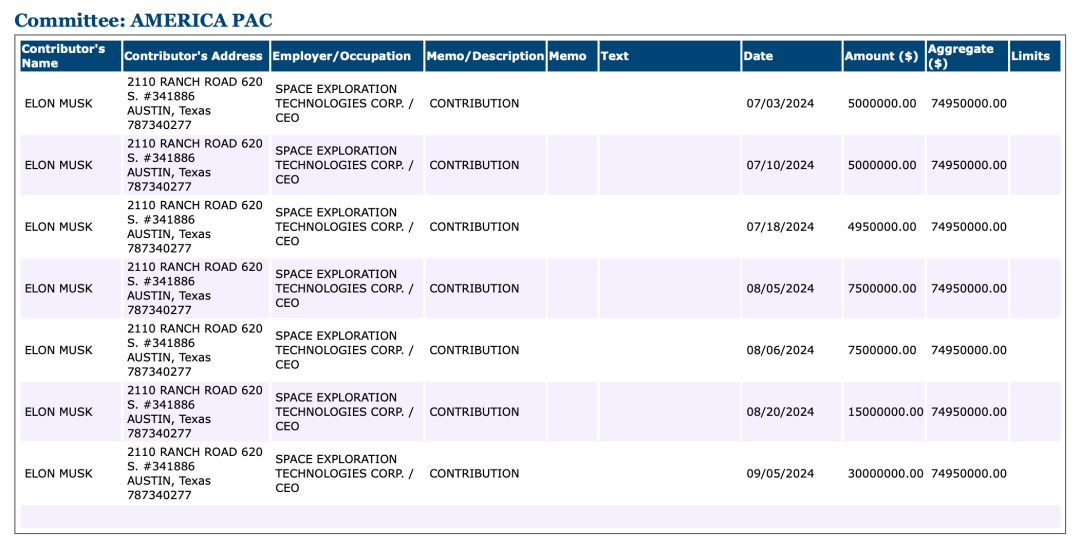
The above are the two largest expenses. Direct donations amount to around $100 million. But buying Twitter was clearly intended to support Trump's campaign, so it's included in the total cost.
Next, let’s look at Musk’s potential gains. First, the surge in Tesla stock thrilled everyone—his personal wealth jumped 10% in a single day. Musk owns 20.5% of Tesla (down from about 22% before the Twitter acquisition). He did sell shares after the Twitter deal, which markets generally treat as part of his personal debt burden.
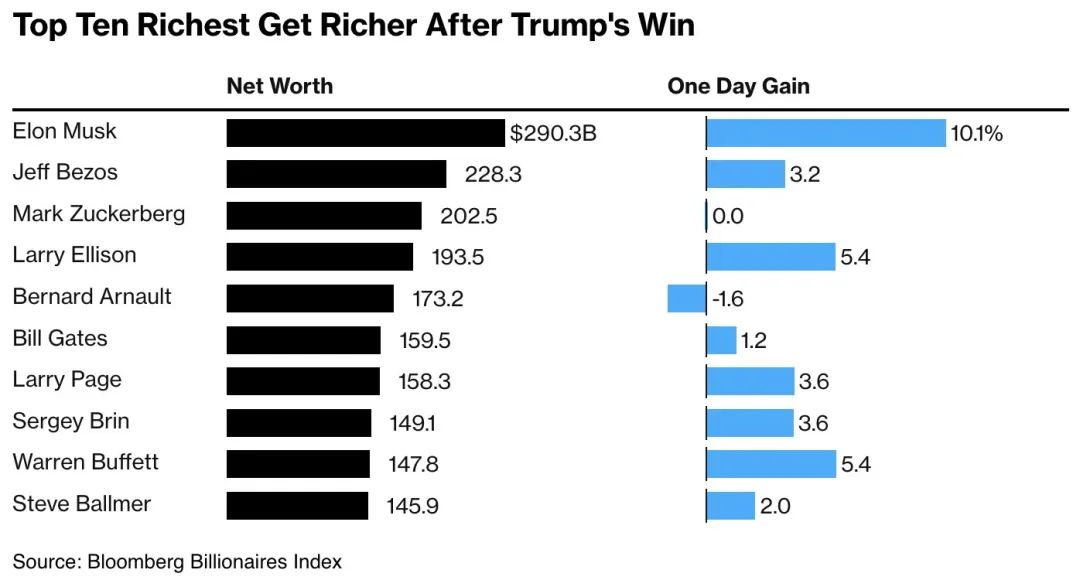
Let’s do another calculation: Of the $44 billion used to acquire Twitter, $13 billion represented Twitter’s existing debt. Around the time of acquisition, Musk sold approximately $23.08 billion worth of Tesla stock. Considering the Twitter purchase was purely a political speculation, the real cost Musk incurred for this election is $23.08 + $1.77 = $23.257 billion, especially since Twitter’s commercial value is clearly far lower than social platforms like Facebook, Instagram, or WhatsApp.
Based on a cost of $23.257 billion, Musk’s return cannot reasonably be calculated as (2900 - 2620)/1.77 = 158x within five days. If such an opportunity existed, every financial speculator would rush in. A more reasonable estimate of Musk’s actual gain is (2900 - 2620) - 23.257 = $4.743 billion.
Of course, all these numbers are speculative fun—don’t take them too seriously. What’s interesting, though, are Musk’s additional gains: primarily Bitcoin, Dogecoin, and anticipated government contracts. Compared to short-term investment returns, these could be the real jackpot.
Human wisdom lies in two words: hope and patience.
Musk prepared for two years for the Republican–Trump victory, but he’s been securing orders for SpaceX for over a decade—mostly government contracts. It’s similar to Tesla’s early days surviving on carbon credit sales. Once a business grows large enough, engagement with governments and corporations becomes inevitable. Let’s factor these in and estimate theoretically how much Musk could earn post-election.
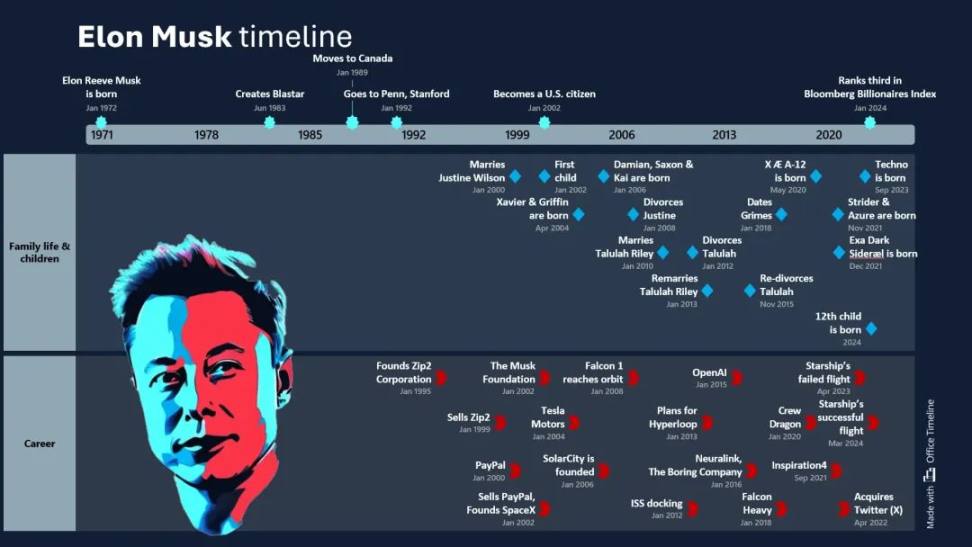
Image caption: Elon Musk personal timeline. Source: https://www.officetimeline.com/blog/elon-musk-timeline
First, Bitcoin held under Tesla: 11,509 BTC remaining from the original 43,200 BTC purchased for $1.5 billion in 2021. The average purchase price was around $35,000. Although Tesla has sold portions—some at a loss, some at a gain—the current value stands at $860 million. Given frequent price fluctuations and its relatively small impact on Musk’s tens-of-billions net worth, we’ll round this up to an expected gain of $1 billion.
Second, Dogecoin gains: these are impossible to quantify. While Musk likely holds Dogecoin, there's no confirmation. We can only consider it part of the broader “Musk概念股 / 币” phenomenon—which defies calculation.
Finally, government contracts. Contrary to popular belief, U.S. government spending consistently accounts for 40–50% of GDP. Government contracts are vital for major corporations, especially in high-tech. Take Amazon founder Bezos, who declared neutrality. After clashing with Trump, Microsoft Azure won the multibillion-dollar government cloud contract that AWS lost. Side note: Though Gates donated $75 million to Harris, Microsoft also gave generously to Republicans and eliminated its DEI (Diversity, Equity, and Inclusion) department—showing political agility.
Companies under Musk include SpaceX, Twitter (X), Tesla, The Boring Company, Neuralink, and xAI. The main ones eligible for government contracts are rocket launches and Starlink communication services. By the end of Trump’s first term in 2020, Musk had secured around $8 billion in government launch contracts, mainly from NASA and the Air Force.
Now, with Boeing struggling (those two astronauts are still stranded in space), and Bezos’ Blue Origin lagging, rocket launch contracts will likely grow substantially during Trump’s second term. As early as June this year, NASA awarded SpaceX a $843 million contract.
Additionally, the U.S. government is increasing support for next-generation communication networks. Starlink has already received a $70 million contract from the U.S. Space Force, and such services are expected to expand further under Trump.
Conclusion
If Zhang Juzheng exemplifies brilliance in statecraft but failure in self-preservation, then Musk embodies Lü Buwei—a merchant who realized that political venture capital yields higher returns. With a $23 billion investment over two years, he recouped his costs within five days just from Tesla’s stock surge, earning nearly $5 billion in profit.
In the long run, government contracts and subsidies over the next four years will become even more tangible as D.O.G.E. (Department of Government Efficiency) takes shape. Though the top donor claims he'll cut $2 trillion in government spending, rest assured his own government contracts won't be on the chopping block.
Join TechFlow official community to stay tuned
Telegram:https://t.me/TechFlowDaily
X (Twitter):https://x.com/TechFlowPost
X (Twitter) EN:https://x.com/BlockFlow_News
 @zuoyeweb3