6% Annualized Interest Rate: Musk Declares War on Traditional Banks
TechFlow Selected TechFlow Selected
6% Annualized Interest Rate: Musk Declares War on Traditional Banks
Elon Musk declared war on traditional finance not through a technical white paper or regulatory public relations, but through a screenshot.
 Navigating Web3 tides with focused insights
By Cathy
In early March 2026, U.S. actor William Shatner—the original Captain Kirk from Star Trek—posted a screenshot on X.
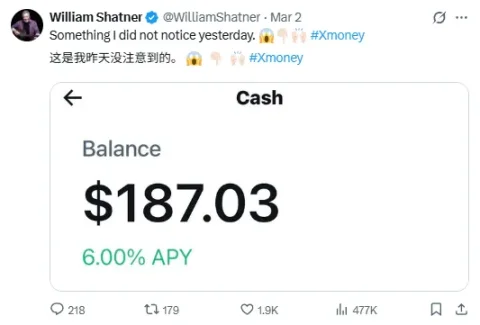
Nothing major—just him testing a new product called X Money.
The screenshot displayed one line of text: Annual Percentage Yield (APY): 6%.
The post didn’t spark widespread sharing—but quietly sent shockwaves through the financial industry.
Not because of William Shatner—but because of that “6%.”
At JPMorgan Chase, a standard savings account yields 0.01%. At Wells Fargo, it’s roughly the same. Deposit $100, and after one year, a major bank gives you one cent. X Money gives you $6.
That’s a 600-fold difference.
This is how Musk declares war on traditional finance—not with technical white papers or regulatory lobbying, but with a single screenshot.
A Black Metal Card
X Money’s design is straightforward: a digital wallet for sending, receiving, and holding money—and it comes with a physical debit card.
Yet every detail signals ambition.
That debit card is made of black metal, laser-engraved with your X username (Handle)—not your legal name, not your account number, but your social identity on the X platform.
This design is no accident. It fuses your social identity with purchasing power: each time you pull out the card to pay, you’re not just presenting a payment tool—you’re showcasing your digital identity. X’s ecosystem stickiness accumulates layer by layer in this way.
On the settlement side, X Money integrates with Visa Direct. Traditional banks’ ACH transfers take one to three business days; Visa Direct enables near-instant settlement. For gig workers and content creators, this speed differential translates into tangible user experience improvements.
Deposits are held by Cross River Bank—a member of the U.S. Federal Deposit Insurance Corporation (FDIC)—with up to $250,000 in FDIC insurance coverage per user.
In one sentence: 6% APY, laser-engraved black metal card, instant settlement, zero foreign transaction fees, and $250,000 insurance coverage.
Judged purely on specs, it’s hard to find fault.
Where Does the 6% Come From?
That’s the critical question.
Where does that 6% APY come from? X Money isn’t subsidizing users with cash burn—at least not under its current business logic. The answer lies in an unassuming cost-structure difference.
Traditional large banks maintain extensive physical infrastructure: branches, tellers, ATM networks, and decades-old IT systems. These represent massive fixed costs—expenses that remain constant regardless of deposit volume.
X Money, by contrast, is a cloud-native, API-first platform with no physical branches and no legacy burden. Front-end user experience is handled by X; banking compliance and fund custody are outsourced to Cross River Bank. This “front-end owned by a tech company, back-end powered by a licensed bank” embedded finance model drastically reduces operational costs—freeing up margin to pass on to users.
This logic itself isn’t novel. Robinhood, Ally Bank, and SoFi all follow similar paths.
But X Money possesses something most traditional fintech firms lack: over 500 million monthly active users—and a customer acquisition cost (CAC) approaching zero.
No need to spend on user acquisition—just keep existing X users’ money inside the X ecosystem.
Who’s Under Threat?
X Money’s competitive targets extend far beyond what’s immediately apparent.
First: the traditional deposit market.
Large banks rely on one foundational assumption: depositors either have no better alternatives—or simply don’t bother switching.
A 6% APY shatters that assumption. When over 500 million X users gain access to this rate, capital migration pressure becomes real. To retain depositors, banks will be forced to raise their own deposit rates—compressing net interest margins. Since approximately 60% of U.S. banking revenue derives from net interest income, this isn’t trivial—it’s a systemic threat to profit architecture.
Second: the payments middleware layer.
Social payment players like Venmo, PayPal, and Cash App have long assumed dominance in this space—but none commands a social platform with over 500 million users as its traffic gateway.
X Money’s core logic is building a “capital closed loop”: money flows in, circulates within the X ecosystem—for tipping, subscriptions, and merchandise purchases—and never needs to leave. Once established, this loop marginalizes PayPal-style intermediaries.
Third: cross-border remittances.
According to World Bank Q1 2025 data, global average cross-border remittance costs stand at ~6.49%, with typical settlement times spanning multiple days. Leveraging Visa Direct’s global network, X Money aims to slash those costs dramatically and achieve near-real-time settlement. Western Union and MoneyGram operations in X-heavy markets—including India, Indonesia, and Brazil—are among X Money’s most direct targets.
The Regulatory Battlefield
Still, whether these threats materialize hinges largely on regulation.
X Payments LLC has already secured money transmitter licenses (MTLs) in over 40 U.S. states and Washington, D.C. But one state remains a holdout: New York.
New York state legislators have publicly written to the state Department of Financial Services (DFS), urging denial of X’s license application. Their concerns include: Elon Musk’s historically adversarial stance toward regulators; gaps in X’s identity verification mechanisms; and—more sensitively—the reported contact between staff from Musk’s Department of Government Efficiency (DOGE) and consumer payment data held by the Consumer Financial Protection Bureau (CFPB), which allegedly included competitors’ commercially sensitive information.
If substantiated, the charge that a regulator simultaneously competes in the market would trigger a cascade of antitrust litigation.
Another variable is the GENIUS Act, signed into law in July 2025. This stablecoin legislation explicitly prohibits payment-focused stablecoin issuers from paying any form of yield or interest to holders.
Currently, X Money’s 6% APY on fiat deposits operates under conventional bank deposit agreements—and thus faces no direct conflict with existing frameworks. However, should X later convert account balances into stablecoin form—or deeply integrate crypto assets like Dogecoin or XRP—the GENIUS Act’s yield prohibition would directly block that path.
Musk must demonstrate to regulators that the “6%” represents compliant bank deposit interest—not disguised unregistered securities returns, nor prohibited stablecoin dividends.
Grok Enters the Ring
If the 6% APY is X Money’s entry ticket, Grok is its intended moat.
X’s AI model, Grok, is being deeply integrated with financial functions. Musk envisions Grok not merely as a chatbot—but as an “intelligent agent” capable of performing financial duties: recommending trades based on real-time platform sentiment, automatically allocating funds across risk tiers, and even triggering direct trading interfaces via “Smart Cashtags” while users scroll through feeds.
This defines a new product paradigm: consuming content and managing wealth within a single interface.
Traditional wealth managers charge fees built on information asymmetry and human service. When AI can process vast volumes of social data and market signals at millisecond speeds, that informational edge erodes.
For creators, the shift is even more immediate: tips, subscription revenue, and ad earnings flow directly into X wallets earning 6% APY—no intermediary bank accounts required. X is positioning itself as creators’ settlement hub—their de facto “bank.”
Summary
WeChat Pay and Alipay’s success in China once left countless U.S. tech companies envious—yet none succeeded in replicating it. Reasons were multifaceted: fragmented U.S. financial regulation, entrenched consumer habits favoring credit card rewards, and platform-specific silos.
X Money is, to date, the closest attempt at achieving that goal.
It brings user scale, AI capability, Visa’s global network, and a founder who disregards established rules—alongside a host of regulators and politicians eager to challenge it.
The outcome of this tug-of-war will crystallize over the next 18 months. If X Money secures its New York license, navigates the GENIUS Act’s compliance boundaries, and successfully deploys Grok’s AI-powered wealth management features—it may well complete the U.S. super-app experiment.
If not, all that remains is a sleek black metal card—and a fleeting 6% rate.
For traditional banks and payments giants, the difference between these two outcomes is existential.
Join TechFlow official community to stay tuned
Telegram:https://t.me/TechFlowDaily
X (Twitter):https://x.com/TechFlowPost
X (Twitter) EN:https://x.com/BlockFlow_News
 白话区块链
白话区块链