The Great Battle for the New Crypto Banking Era: The Ultimate Contest over Licenses, Stablecoins, and Super Apps
TechFlow Selected TechFlow Selected
The Great Battle for the New Crypto Banking Era: The Ultimate Contest over Licenses, Stablecoins, and Super Apps
When Everyone Wants to Be Your New Bank, Who Will Ultimately Win?
 Navigating Web3 tides with focused insights
By: Pink Brains
Translated by: Chopper, Foresight News
If you ask ten crypto users what a “neo-bank” is, you’ll likely get the same answer: a card enabling spending in stablecoins. But if you ask ten developers, answers will vary widely—some are building non-custodial wallets linked to Visa cards; others are forking Aave and calling it a savings account; still others are applying for full banking licenses.
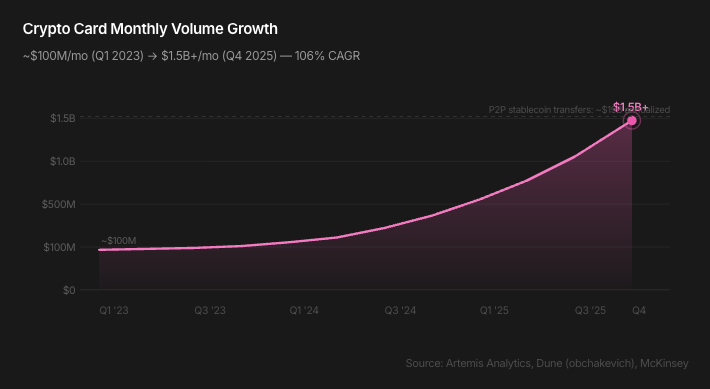
Monthly transaction volume on crypto debit cards surged from ~$100 million at the start of 2023 to over $1.5 billion by end-2025 (CAGR: 106%), pushing the market’s annualized size past $18 billion. In 2025, stablecoin-linked card spending reached $4.5 billion—a 673% year-on-year increase.
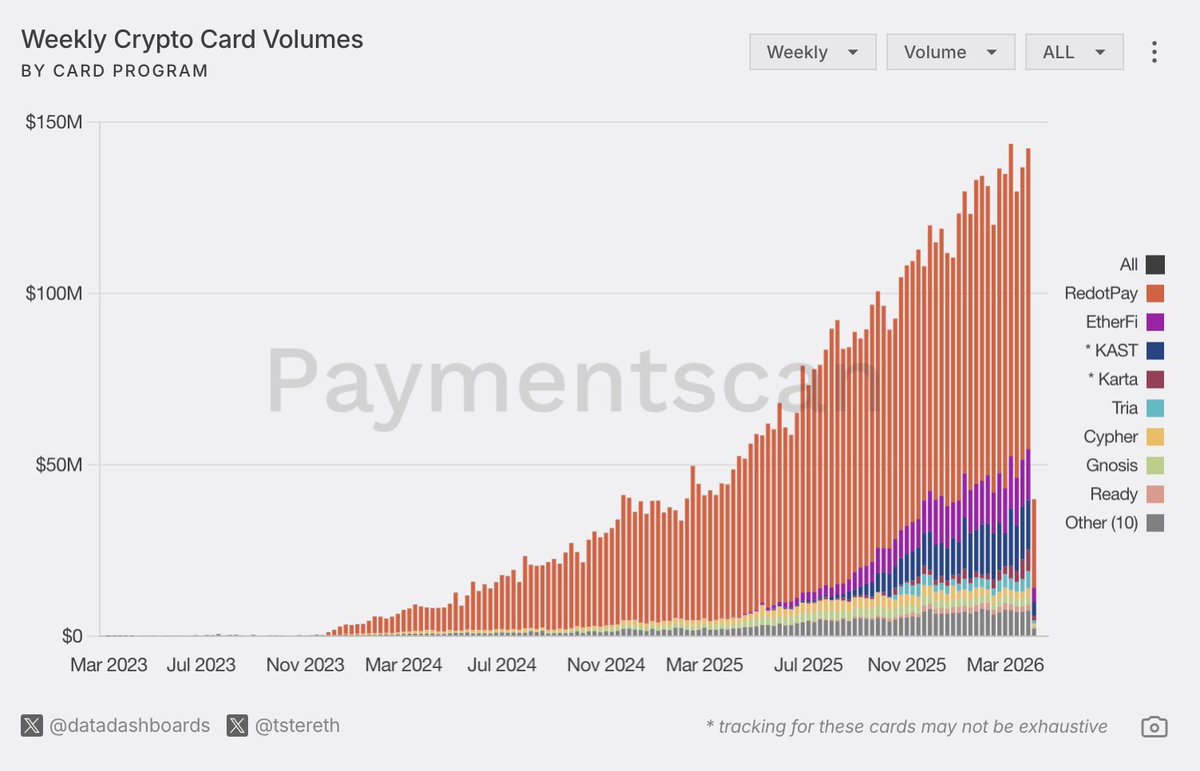
Yet the entities actually processing this volume are highly concentrated. Data shows RedotPay—an Asia-based custodial platform—holds 60% market share, with transaction volume roughly four times the combined total of the next 13 competitors. On the volume leaderboard, DeFi-native, self-custodial virtual banks lag far behind.
A deeper trend, however, is accelerating entry by crypto-friendly giants. Between December 2025 and March 2026:
- Coinbase applied for a U.S. national trust charter.
- Nubank received conditional approval from the U.S. Office of the Comptroller of the Currency (OCC) to establish a national bank.
- PayPal filed to form PayPal Bank.
- Revolut secured a full UK banking license and advanced its U.S. licensing application.
- Kraken became the first crypto firm to obtain a Federal Reserve master account.
Within 83 days, 11 firms—including Circle, Ripple, BitGo, Paxos, Fidelity, Bridge, Crypto.com, Morgan Stanley, Payoneer, Zerohash, and Protego—filed for OCC trust charters.
Over 50 crypto-native neo-banks have launched. Commercial research firms project the global neo-bank market will reach $552 billion in 2026. We aim to map this landscape—not just to identify who’s building what, but who has the capacity to survive.
A Tense Competitive Landscape
Two core tensions define the neo-bank battleground.
First, economics. 76% of traditional neo-banks remain unprofitable. The winners—Nubank, Revolut, SoFi—don’t profit from card swipes. Their earnings stem from credit products and net interest income. Transaction fees are merely the cost of entry; credit is the core business.
Today, crypto neo-banks compete fiercely on interchange fees and cashback—a flawed profitability model that doomed the prior generation of fintechs. Stablecoins further compress foreign exchange spreads, driving them near zero.
Second, user choice. Crypto communities champion DeFi yields and non-custodial wallets. Yet on-chain card transactions tell a different story: most crypto card spending flows through custodial platforms. This isn’t due to users’ ignorance of self-custody—it reflects a pragmatic trade-off. When buying coffee, seamless onboarding trumps asset sovereignty.
History repeats: webmail preceded encrypted email; Dropbox preceded self-hosted storage; centralized exchanges preceded DeFi. Will crypto neo-banks follow the same path—custodial convenience winning the mass market first, with non-custodial solutions catching up only as tooling matures? That remains unresolved.
Four Types of Neo-Banks
Rather than classifying by “Web2 vs. Web3”—a distinction reflecting technology, not business models—a more valuable lens examines moats, unit economics, and growth ceilings.
Crypto-Friendly & Banking-First
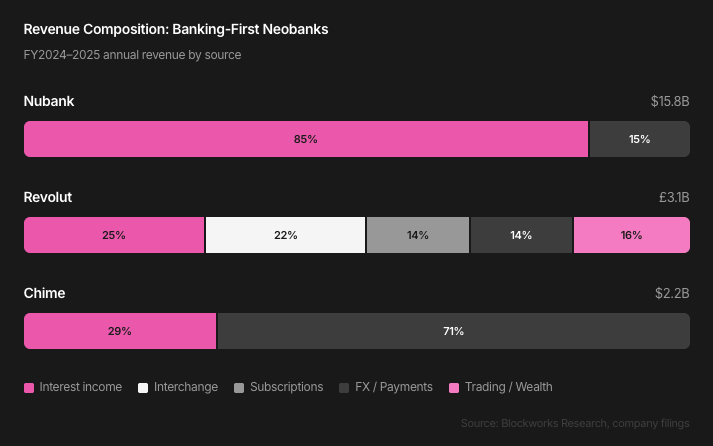
The strongest neo-bank economic model derives from credit and monetization—not payments alone.
- Nubank’s FY2025 revenue totaled $15.8 billion, with 85% from interest income: $4.6 billion from credit cards and $4.8 billion from loans. Per active user, monthly revenue stands at $15, while service cost is just $0.80—yielding a 19x return.
- SoFi obtained its banking charter in 2022. Over four years, quarterly net interest income rose from $94.9 million to $617 million. Its deposit funding costs are 181 bps lower than warehouse financing—saving ~$680 million annually.
- Revolut generated £3.1 billion in revenue in 2024 across five business lines, with no single line exceeding 30% share. Its transactions & wealth segment grew 298% YoY.
Licensed neo-banks deliberately restrict stablecoins to payment use cases, because profit lies in credit.
- Revolut offers no yield on stablecoin balances. Its proprietary stablecoin—tested in the UK Financial Conduct Authority (FCA) sandbox in February 2026—is positioned as payment infrastructure, not a savings product.
- SoFi’s stablecoin (SoFiUSD, launched December 2025) functions as a settlement instrument via Mastercard channels.
This strategy rests on current market conditions: on-chain yields lack competitiveness. Aave v3 USDC recently yielded just 2.6% APY—below SoFi’s 3.3% savings rate and Revolut Ultra’s 4.25%. But on-chain yields are cyclical. During DeFi booms, Aave USDC yields have hit 8–10%; Ethena’s funding-rate-based yields have far exceeded those levels. This gap is temporary—and once rewidened, the competitive landscape could shift entirely.
Commerce & Social Super-Apps
Mercado Pago, Grab, WeChat Pay, Alipay… None launched as banks. Instead, they embedded finance into commerce. Their moats lie not in products—but in distribution channels and behavioral data, granting superior risk assessment versus traditional banks.
- Mercado Pago’s credit revenue soared from $246 million in 2020 to $5.9 billion in 2025—a 24x jump in five years.
- Grab’s loan portfolio expanded from $185 million in 2022 to $1.3 billion by end-2025; its FY2025 financial services revenue hit $348 million.
Both have piloted stablecoins.
- Mercado Pago launched Meli Dólar (MUSD) in Brazil and expanded to Chile and Mexico—but its circulating supply stands at just $65 million, under 0.4% of its $19 billion in assets under management.
- Grab partnered with StraitsX for stablecoin settlements: tourists can spend XSGD stablecoins instantly at Singapore GrabPay merchants via Alipay and other gateways.
Neither offers stablecoin yield—leaving a severely undervalued opportunity for crypto-native players.
Whop merits attention. It’s not yet a neo-bank—but a creator marketplace. After securing a $200 million investment from Tether (valuing Whop at $1.6 billion), creators can receive USDT, hold stablecoins, and bypass bank settlements. Integrations with Plasma and Aave enable stablecoin yield—serving 18.4 million users and $3 billion in annual creator revenue.
Mercado Pago in 2003 wasn’t a neo-bank either—just a marketplace escrow service. Financial relationships evolved gradually alongside commerce. Whop starts from the same point—but is built on crypto from day one.
For card-centric neo-banks, the most enduring financial relationship may begin not with finance—but with e-commerce.
Transaction-First
Robinhood, Coinbase, Binance, Kraken, Bybit, OKX… All began as centralized crypto exchanges, now expanding into crypto banking. Every player in this cohort is constructing a banking layer—to generate revenue independent of crypto bull markets.
- Robinhood exemplifies this: total platform assets rose ~70% YoY to $324 billion; net deposits hit a record $68 billion.
- Coinbase is aggressively entering neo-banking: it owns Base (its custom L2), a wallet with card functionality, crypto-backed loans powered by Morpho, Bitcoin-collateralized mortgages via Better, and is pursuing a trust charter.
- Kraken already holds a trust charter and a Fed master account.
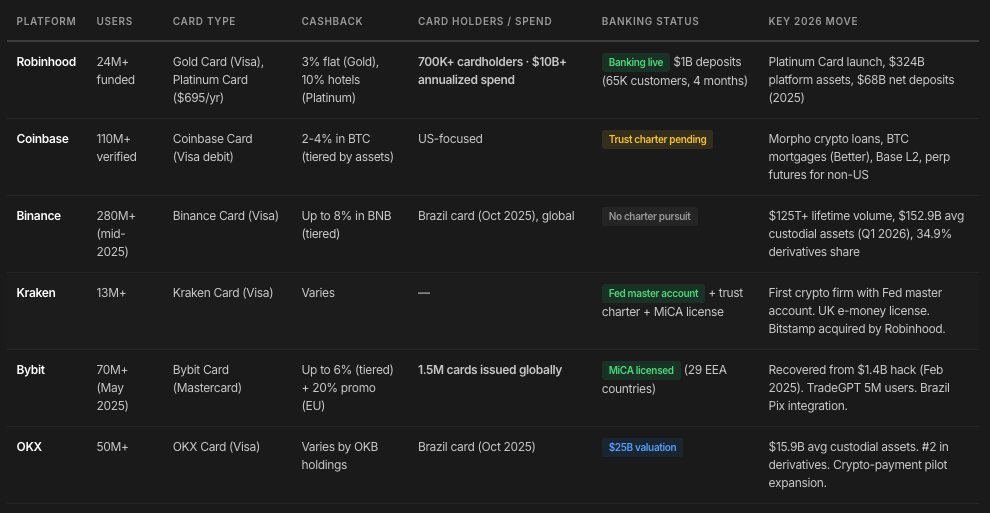
These platforms build banking atop established, scaled trading businesses. Stablecoin-first neo-banks take the reverse path—starting from thin interchange margins and layering on other services, a significantly harder climb.
Stablecoin-First
Dozens of platforms—including Ether.fi, Gnosis Pay, RedotPay, KAST, Holyheld, Bleap, Ready, Tria, Cypher, and Payy—leverage stablecoins’ lower operational costs and DeFi composability as backend infrastructure. Their value proposition is clear:
- Self-custodial model
- DeFi yields (5–15% APY in active markets, above traditional savings’ 3–4%)
- Near-instant cross-border payments via stablecoin rails, with ultra-low FX fees
- Global usability, no geographic restrictions
Stablecoin-first neo-banks hold the clearest structural advantage in emerging markets and cross-border scenarios. Yet their weaknesses are equally pronounced:
- None has yet launched large-scale unsecured lending
- They compete in the thinnest-margin fee segment—and subsidize customer acquisition with token rewards
- They compress FX spreads and settlement fees to near zero—eroding the very revenue stream early neo-banks relied on.
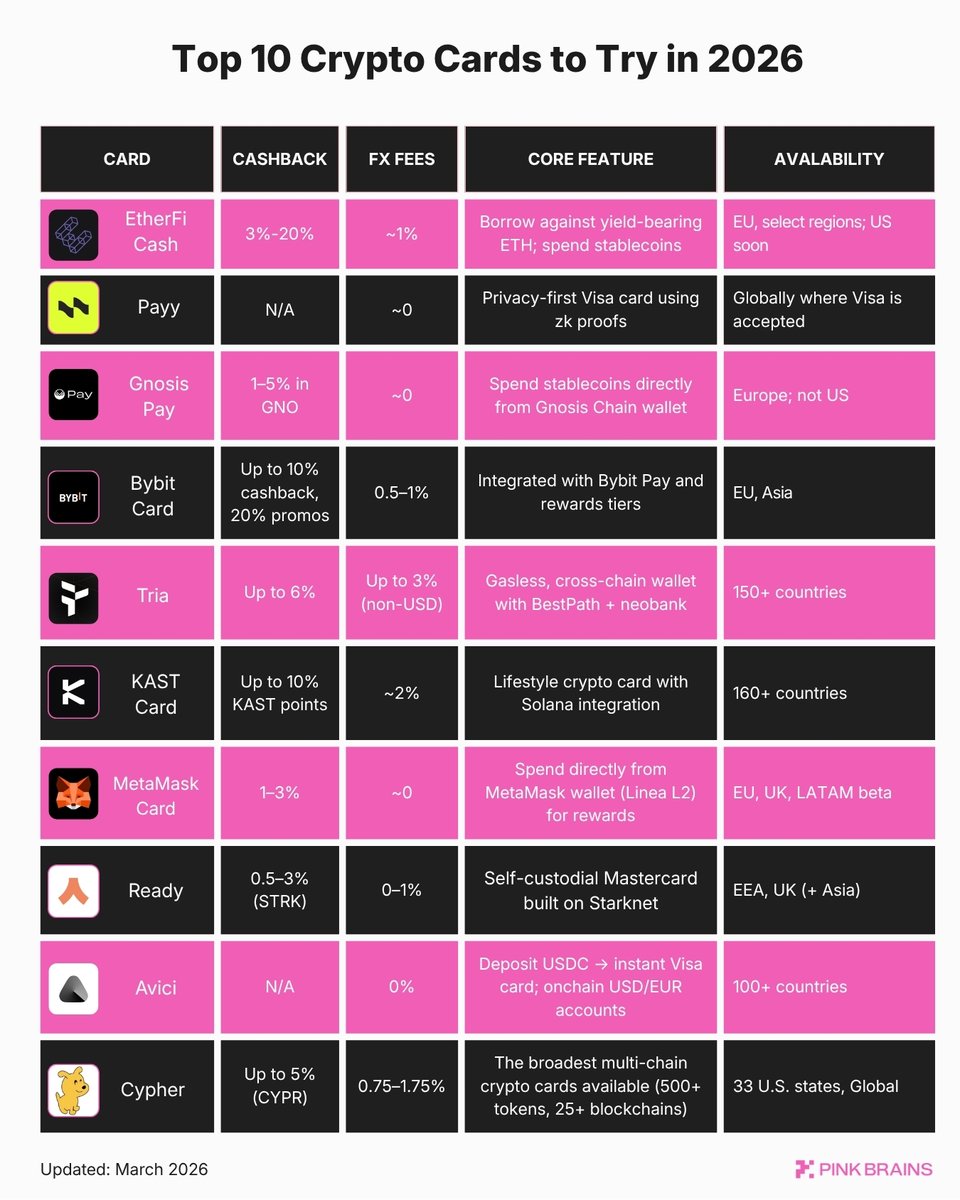
The Infrastructure Layer
Most crypto neo-banks are merely frontends built atop shared infrastructure. Understanding the underlying architecture is key to evaluating moats.
Concentration Risk
Card networks (Visa, Mastercard): Though both have nearly equal numbers of partnerships (~130 each), Visa captures >90% of on-chain card payment volume—thanks to early collaboration with crypto-native infrastructure providers. This is a single point of failure for the entire industry: any policy shift, expansion pause, or fee hike by Visa would instantly rewrite the sector’s economic model.
Issuing banks (Rain, Reap, Baanx, StraitsX): Regulated bridges connecting on-chain and traditional finance. The most significant structural shift is the emergence of full-stack issuers—those holding direct Visa/Mastercard core membership, integrating program management and card issuance while bypassing traditional sponsor banks.
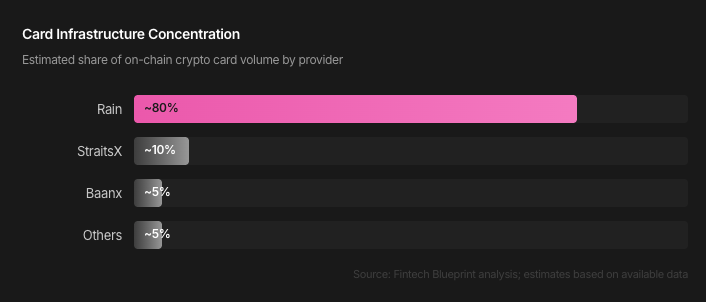
Most crypto neo-banks share identical backends. Rain powers Ether.fi, RedotPay, and Avalanche Card. Any technical outage, regulatory issue, or strategic pivot at Rain would ripple across the industry. A Solus Partners report covering 19 platforms lists infrastructure concentration and vendor dependency as systemic risks.
Wallet-Native Stablecoin Threat
An often-overlooked competitive variable: mainstream wallets are issuing proprietary stablecoins—designed specifically for card payments—to build closed-loop ecosystems and capture value previously flowing to independent neo-banks.
In Q3 2025, MetaMask launched mUSD; Phantom launched CASH—both serving as funding sources for their own debit card products. Wallets no longer rely on users holding USDC or USDT. Instead, they create closed loops: users convert assets into wallet-native stablecoins for card spending.
Early data shows divergent trajectories:
- Phantom’s CASH grew steadily from ~$25 million in September to ~$100 million by end-December.
- MetaMask’s mUSD peaked near $100 million in early October, then collapsed to ~$25 million—a 75% decline.
Through this model, wallets capture interchange fees, FX spreads, and reserve yields—value that would otherwise flow to stablecoin issuers. Independent crypto neo-banks risk losing substantial core value. MetaMask, Phantom, and Coinbase Wallet all own direct user relationships; adding banking features is merely a product-line extension—not an entirely new business.
Economic Model Challenges
76% of traditional neo-banks remain unprofitable—and crypto-native players are inheriting this flawed model, worsened by stablecoins.
Banking-first enterprises deliver a clear lesson: payments are distribution—not the business itself.
Nubank draws 85% of revenue from interest; SoFi leverages its charter to widen net interest margins—both proving this point. Crypto neo-banks treating card spending as their primary revenue engine stand on shifting sand.
A sustainable model treats the card as a user-acquisition channel—and profits from higher-margin on-chain finance: DeFi yields, swaps, structured products, and credit.
Five Game-Changing Developments
On-Chain Credit Scoring
In crypto, wallet transaction history—DeFi usage, loan repayment records, staking duration, trading frequency, protocol diversity—can serve as robust risk signals. No crypto neo-bank currently deploys this at scale. Whoever cracks it unlocks permissionless neo-banking operations.
Full Banking Licenses for Crypto-Natives
Not just limited custodial trust charters—but full-fledged licenses permitting deposit-taking and lending. This would allow crypto-native institutions to fund credit operations using stablecoin deposits—cheaper than warehouse financing.
Regulatory Clarity
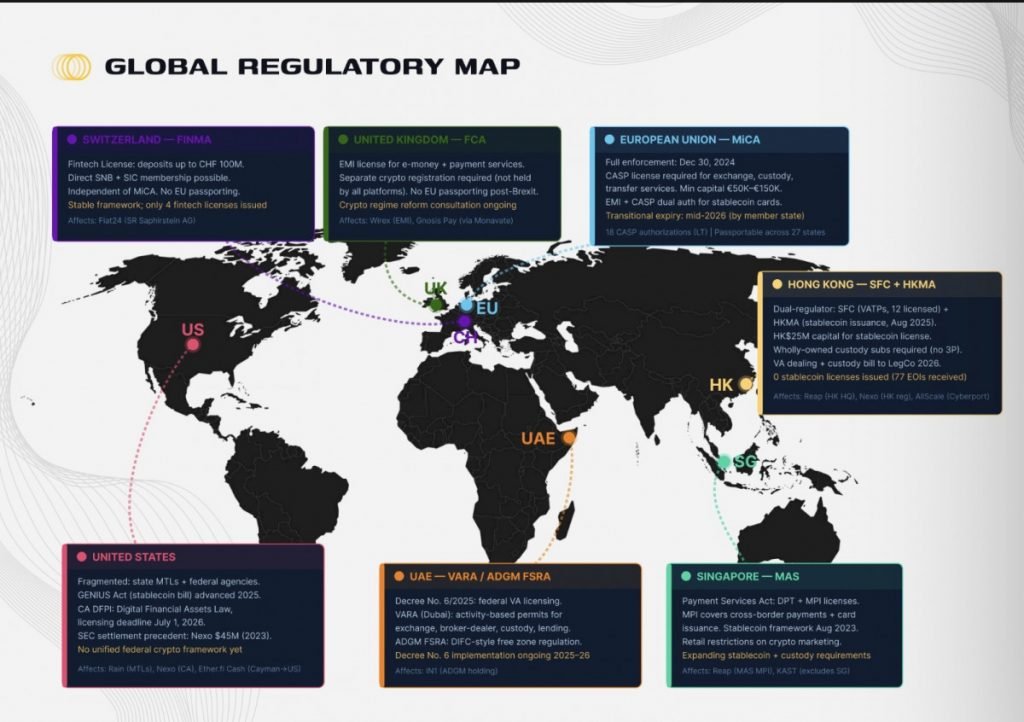
Major regulators are aligning: stablecoin issuers must not pay yield. The U.S. and EU have drawn clear lines; Japan, Singapore, and Hong Kong adopt similarly conservative stances.
Agent-Driven Finance
AI agents execute financial tasks on users’ behalf: portfolio rebalancing, yield optimization, payment management, cross-protocol strategy execution. Mastercard’s crypto partners grew from 6 in 2024 to >25 in 2025; Visa launched Smart Business Connect, enabling AI agents to transact globally on consumers’ behalf. Whoever builds the optimal agent infrastructure on stablecoin rails will capture the next wave of e-commerce distribution.
Self-Custody UX + On-Chain Abstraction
Crypto neo-banks still rely on card network rails—but terminal technologies bypassing them already exist: stablecoin-settled QR payments, NFC taps independent of Apple Pay/Google Pay, and physical card swipes settled directly on-chain. Projects like OpenPasskey (built on Base) have validated feasibility: ISO-assigned issuer identification numbers, P-256 encryption, fully non-custodial crypto cards.
Who Will Win?
The answer remains unknown—but critical inflection points are visible.
- Licensed neo-banks possess battle-tested economic models, giving them an edge in credit-driven developed markets.
- Stablecoin-first neo-banks offer globally usable dollars, local stablecoins for emerging markets, and DeFi yields—but data shows users still prioritize convenience over crypto-native ideals.
- Commerce-embedded players may possess the deepest moats—they already control distribution. Yet overlaying crypto onto mature infrastructure is costly, requires extensive user education, and hinges heavily on regulatory clarity.
- Infrastructure providers—issuers, custodians, fiat on/off-ramps, core banking systems, blockchain settlement layers, KYC/AML—will inevitably capture more value than any consumer-facing brand.
Over 40 stablecoin cards compete with token-subsidized cashback—lacking real commercial moats and sharing infrastructure. Most will vanish within two years.
The crypto neo-bank landscape sits at a pivotal inflection point.
Join TechFlow official community to stay tuned
Telegram:https://t.me/TechFlowDaily
X (Twitter):https://x.com/TechFlowPost
X (Twitter) EN:https://x.com/BlockFlow_News
 @PinkBrains_io