









Regardless of who wins the election, cryptocurrency has already emerged as the winner
TechFlow Selected TechFlow Selected
Regardless of who wins the election, cryptocurrency has already emerged as the winner
The impact of this election is merely a minor episode that won't halt the progress of cryptocurrency development.
 Navigating Web3 tides with focused insights
Author: Matt Hougan
Translation: TechFlow
I've been reflecting on how cryptocurrency has evolved during this election year.
There’s not much new to say about Tuesday’s election outcome.
If you haven’t seen my commentary, here’s the summary:
-
In the short term, a Trump victory is more favorable for crypto than a Harris victory.
-
In the long term, Bitcoin, Ethereum, and stablecoins will continue to thrive regardless of who wins.
-
Altcoins face higher regulatory risk under Harris than under Trump.
The only “bad” outcome for crypto would be a full Democratic sweep, which could empower the party’s anti-crypto extremist factions. But even then, I’d still buy the dip.
The past four years have taught me one thing: Washington cannot stop the progress of cryptocurrency. It can alter its trajectory, speed it up or slow it down, and perhaps bring more chaos—or newfound clarity.
But it cannot halt crypto’s forward momentum.
Crypto Today: November 2020 vs. November 2024
One thing I love about presidential elections is that they give us a chance to reflect on how much has changed over the past four years.
Is the situation better or worse compared to the last major election?
When reviewing progress in crypto, the answer is overwhelmingly clear. Despite an aggressive regulatory environment—including “Operation Choke Point 2.0”, numerous SEC lawsuits, and many conflicting or ambiguous statements—the progress we’ve made remains astonishing.
You can pick any metric to illustrate this point.
Crypto Progress: 2020 vs. 2024
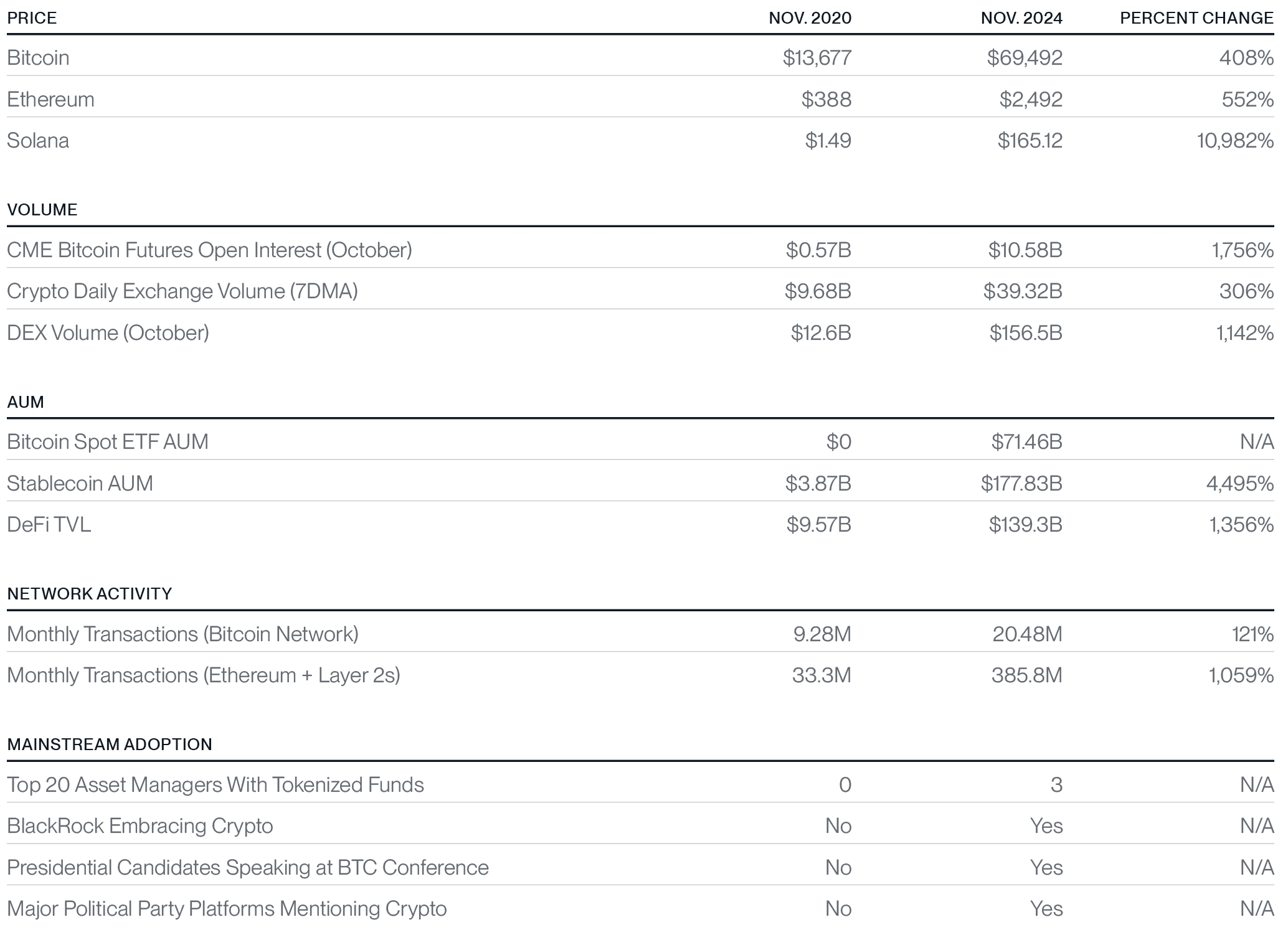
Source: Bitcoin, Ethereum, and Solana price data from Bitwise Asset Management, as of November 2, 2020, and November 2, 2024. CME Bitcoin futures open interest, decentralized exchange volume, and Bitcoin network monthly transaction volume from The Block, using full-month data for October 2020 and October 2024. Daily crypto trading volume (7-day moving average) from The Block, as of November 6, 2020, and November 3, 2024. Bitcoin spot ETF and stablecoin AUM from The Block, as of November 2, 2020, and November 2, 2024. Total value locked in decentralized finance from The Block, as of November 4, 2020, and November 2, 2024. Monthly transaction volume on Ethereum and its Layer 2 networks from The Block and GrowThePie, as of October 2020 and October 2024. Tokenized fund data for top 20 asset managers from RWA.XYZ, as of November 2, 2024. Other data from Bitwise Asset Management, as of November 4, 2024.
We often focus too much on short-term price volatility in crypto and lose sight of the long-term trends. Presidential elections offer a perfect opportunity to step back and review how far we’ve come.
Will These Trends Continue?
As you examine these statistics, consider whether these trends are likely to persist. In my view, the answer is yes.
Our outlook is that, regardless of who wins on Tuesday:
-
Inflows into spot crypto ETFs will continue to grow
-
Stablecoins will keep expanding rapidly
-
Institutions will continue increasing their exposure to crypto
-
Wall Street will embrace tokenization and real-world assets
-
Blockchain technology will become faster and more cost-efficient
-
Real-world applications like Polymarket will continue breaking through and gaining mainstream adoption
No doubt, Tuesday’s election result matters in the short term. But I believe that in the long run, it will amount to little more than a brief footnote—one that won’t stop crypto’s relentless march forward.
Risks and Important Information
Not investment advice; risk of loss: Before making any investment decision, investors must conduct their own independent review and research to assess the merits and risks of an investment and make investment decisions based on such review and research, including determining whether the investment is suitable for them.
Cryptographic assets are digital representations of value that may serve as a medium of exchange, unit of account, or store of value, but they do not have legal tender status. Although cryptographic assets may sometimes be exchanged for U.S. dollars or other national currencies, no government or central bank currently supports or guarantees them. Their value is entirely determined by market supply and demand, making them significantly more volatile than traditional currencies, stocks, or bonds.
Trading cryptographic assets involves significant risks, including sharp fluctuations or flash crashes in market prices, market manipulation, cybersecurity risks, and potential loss of principal or entire investment. Additionally, regulatory frameworks and investor protections in crypto markets and exchanges differ from those in equities, options, futures, or foreign exchange markets, with fewer controls and safeguards in place.
Join TechFlow official community to stay tuned
Telegram:https://t.me/TechFlowDaily
X (Twitter):https://x.com/TechFlowPost
X (Twitter) EN:https://x.com/BlockFlow_News
 @BitwiseInvest











