








WOO X Research: Enjoying Deterministic Returns in the PVP Arena — How to Play MEME Without Losing
TechFlow Selected TechFlow Selected
WOO X Research: Enjoying Deterministic Returns in the PVP Arena — How to Play MEME Without Losing
Keep a close eye on MEME trends and seek reliable returns.
 Navigating Web3 tides with focused insights
Background: Get-Rich-Quick Stories Only Exist on Social Media, Losing Money Is the Norm
In recent months, Solana has become tightly linked with Pump Fun and meme coins. In terms of trading volume, 36.8% of the entire chain's activity is related to Pump Fun, highlighting the central role meme coins play within the Solana ecosystem.
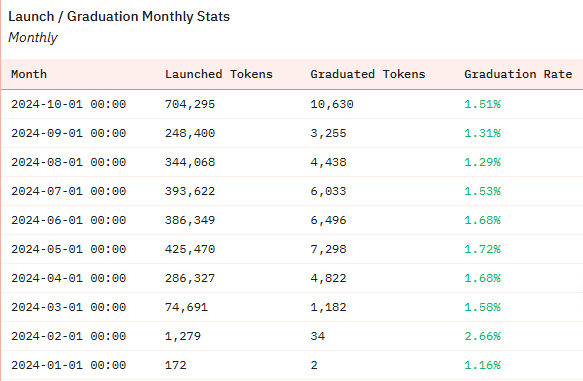
Meme coins create a wealth effect, but more often reflect zero-sum games where players compete against each other. According to a Dune dashboard created by @adam_tehc, only 1–2% of tokens on Pump Fun successfully list on Raydium. An even harsher statistic: merely 3% of addresses associated with Pump Fun tokens have achieved profits exceeding $1,000. This means that if you’ve made $1,000 trading Pump Fun memes, you’ve outperformed 96% of participants.
These figures reveal the true nature of the meme coin wealth effect: stories of overnight riches are largely confined to social media, while losses are the reality for most.
How can one find certainty in such a volatile meme market? Consider shifting perspective—instead of direct PVP participation, explore whether the rise of meme coins creates opportunities in adjacent sectors.
Jito: A Hidden Winner Amid the Meme Frenzy
Here’s the bottom line: the longer the meme craze persists on Solana, the higher the jitoSOL yield will climb.
Meme coins have now become part of Solana’s DNA. The number of new meme coins launched daily via Pump Fun continues to rise, with Pump Fun-related tokens accounting for over 40% of the chain’s total trading volume—and this share is growing.
What impact does this have on Solana’s ecosystem? For low-liquidity, low-market-cap meme coins, transaction speed is critical. If your buy order is slower than others, you risk buying at the top.
Under intense FOMO and surging trading volumes, MEV (Maximal Extractable Value) attacks on Solana become highly profitable, and their value capture increases accordingly.
MEV refers to profit gained by reordering, inserting, or censoring transactions within a block. Unlike Ethereum, Solana lacks a public mempool. Due to its consensus mechanism, the cost of participating in MEV activities is relatively low. MEV bots cannot manipulate transaction order based on fees; instead, competition centers entirely on latency and speed. Only those who read the state first can execute trades successfully.
Because of low transaction costs and a first-in-first-out processing model, Solana suffers from many spam transactions. These spam transactions consume significant block space and can lead to network outages.
Jito is an MEV infrastructure provider on Solana. They offer a client that runs an off-protocol mempool. Searchers submit transaction bundles they wish to include for profit, along with bids for inclusion, which are then submitted to validators running the Jito client. The highest bidder wins, and their bundle gets included on-chain, generating additional revenue for validators and their stakers. All tip payments go 100% to validators and their stakers.
Therefore, the higher Solana’s transaction volume, the greater the MEV revenue Jito captures—and ultimately, the more distributed to stakers.
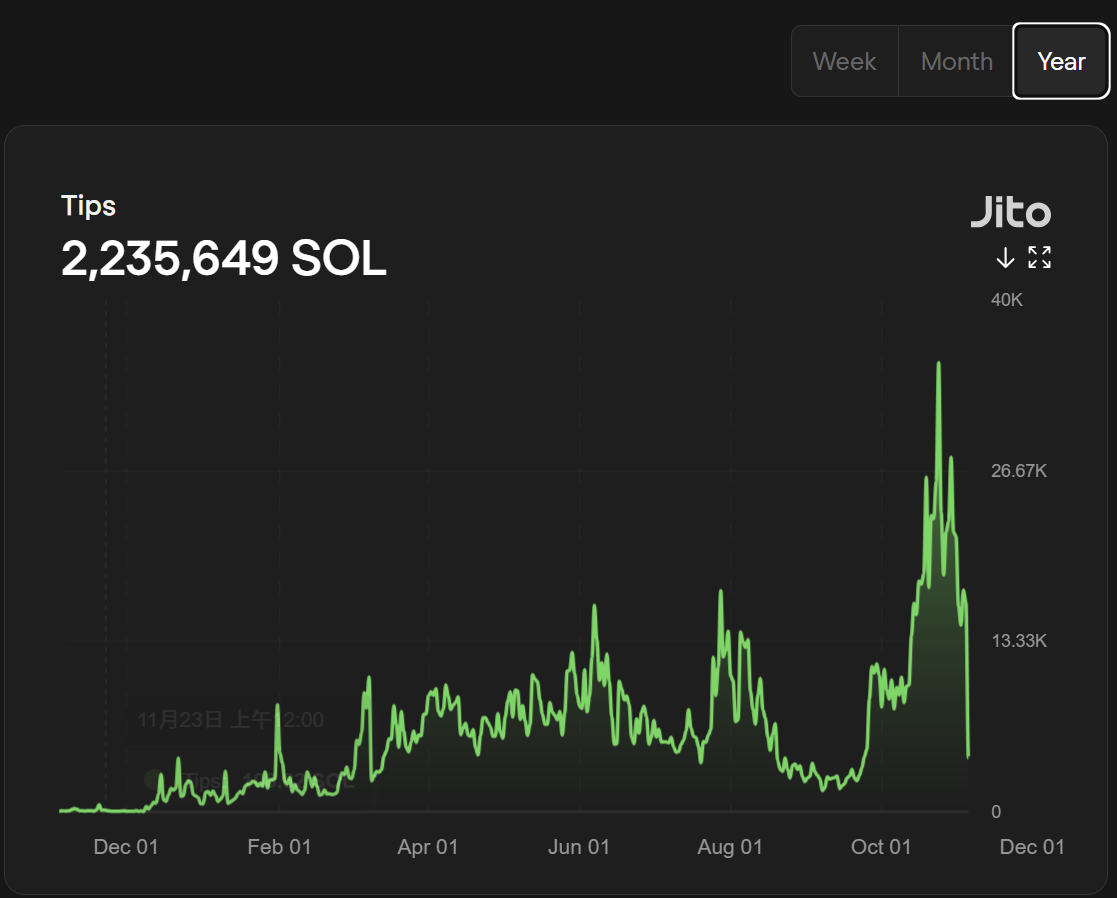
The yield on jitoSOL comes from staking rewards plus MEV bonuses. Thanks to surging MEV income, jitoSOL currently offers an ~8% annual percentage yield (APY), far exceeding stETH’s 3%, creating an arbitrage opportunity for users. So how do you execute this?
(Since the beginning of this year, Jito’s MEV tips have reached 2,235,649 SOL, worth approximately $357 million, with an upward trend clearly visible in the chart.)
Build Your Own Solana Version of Ethena: Yield Sources = Staking + Funding Rate
How to implement it?
Allocate three-quarters of your capital to buy SOL, then stake SOL into jitoSOL via Jito to earn 8% APY. Use the remaining quarter to deposit funds on a centralized exchange, open a 3x short leveraged position on an equivalent amount of SOL, and earn funding rate interest.
*Assume SOL funding rate is 0.01%
Suppose you have 120,000 USDT and want to earn stable returns. The profit calculation would be:
90,000 × 8% (jitoSOL APY) + 30,000 × 3 (3x short) × 0.01% × 3 × 365 = 7,200 + 9,855 = 17,055
17,055 / 120,000 = 14.2%
Annualized return ≈ 14%
If the Solana meme frenzy continues, market attention on SOL will drive funding rates higher, pushing them above the neutral 0.01% level. At the same time, Jito’s increasing MEV value capture could push jitoSOL APY even higher. Using this delta-neutral strategy, annualized returns could exceed 20%.
Conclusion: Monitor Meme Hype Closely to Capture Certain Returns
The above describes only the most basic delta-neutral strategy. Advanced versions can integrate Solana-based lending protocols like Kamino or leverage Jito’s recently introduced restaking features to further boost yields.
The advantages of this strategy lie in its security and high capacity:
-
jitoSOL is the largest liquid staking token (LST) on Solana, highly secure and unlikely to depeg
-
SOL is a major cryptocurrency, deeply supported across most centralized exchanges, enabling large-scale deployment of this strategy
On the flip side, if the crypto market moves unexpectedly and funding rates turn negative, the strategy’s profitability will be eroded. Therefore, this is not a passive “set-and-forget” method—it requires close monitoring of market conditions.
Join TechFlow official community to stay tuned
Telegram:https://t.me/TechFlowDaily
X (Twitter):https://x.com/TechFlowPost
X (Twitter) EN:https://x.com/BlockFlow_News
 @WOOXResearch






