








OKG Research: User Intent-Driven Transformation of Web3 Applications
TechFlow Selected TechFlow Selected
OKG Research: User Intent-Driven Transformation of Web3 Applications
In the rapidly evolving current cryptocurrency market, user growth has become the cornerstone of sustainable industry development.
 Navigating Web3 tides with focused insights
Produced by|OKG Research
Author|Samuel QIN
In the rapidly evolving cryptocurrency market, user growth has become the cornerstone of sustainable industry development. The prevailing trend in advancing the sector is shifting from purely technical exploration toward a greater focus on application value. Although the Web3 ecosystem has developed rapidly in recent years and the entry of traditional capital has brought new vitality, expansion at the application level still presents certain aspects worthy of attention in practice.
The ever-expanding public chain ecosystems are becoming overwhelming. The rapid development of the Web3 ecosystem has created demand for cross-chain interoperability, as leveraging advantageous resources across different chains can unlock greater value. This reflects the natural evolutionary pattern of an industry ecosystem—similar to how e-commerce platforms evolved from standalone systems into fully integrated supply chains.
From the perspective of public chain competition, ecological moats built around killer applications and users represent an absolute advantage in securing industry leadership. As such, higher compatibility barriers and migration costs are often deliberately introduced. From a technological standpoint, differing consensus mechanisms and programming languages pose significant challenges to cross-chain technology, creating technical obstacles for value transfer and information exchange between blockchains.
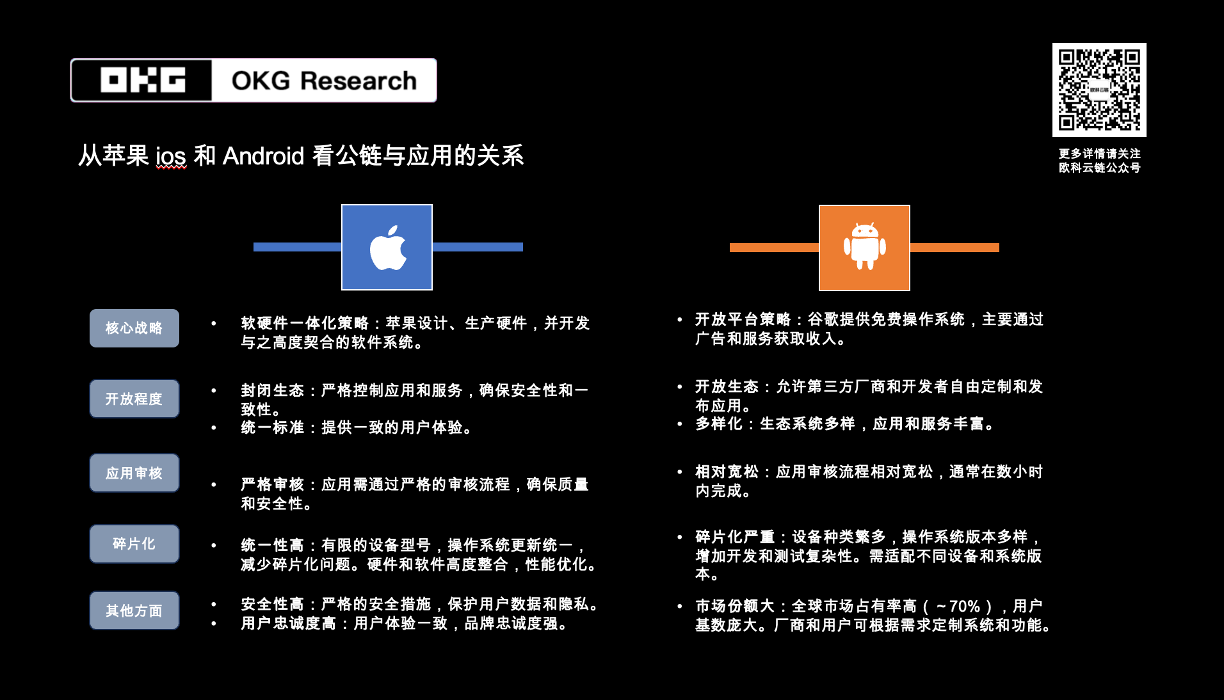
The relationship between public chains and applications can be better understood by drawing parallels with the contrasting smartphone ecosystems of Apple and Android.
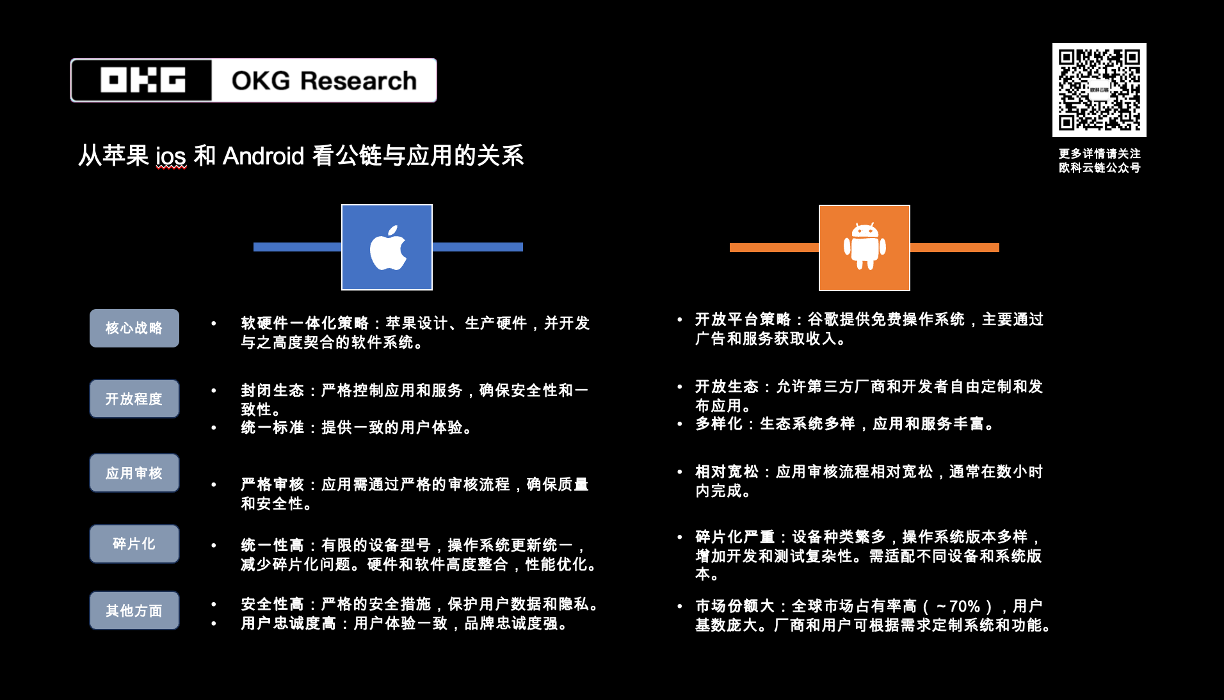
*Table Source: OKG Research
Apple employs a vertically integrated hardware-software strategy, ensuring tight alignment between hardware and software, delivering a smooth and consistent user experience. In contrast, Android allows multiple manufacturers to use its operating system, resulting in a diverse hardware ecosystem but also bringing device fragmentation and inconsistent app quality.
This perfectly illustrates two distinct approaches to ecosystem development. Vertical integration enables tighter control over a closed-loop ecosystem, where app onboarding and migration require higher costs. Open systems, on the other hand, must support numerous devices, making user experience highly dependent on hardware variations.
As open environments, public chains need to lower development barriers and enhance user experience to establish competitive advantages. Currently, common strategies include:
-
Modular Functional Components: Providing easily integrable modular development tools such as smart contract templates, SDKs, and APIs to help developers quickly build applications. For example, Ethereum’s Truffle framework and OpenZeppelin’s smart contract library offer abundant resources that streamline the development process.
-
Robust Underlying Infrastructure: Optimizing blockchain performance and security to ensure high throughput, low latency, and strong safeguards. Solana, for instance, achieves high TPS through its high-performance consensus mechanism, meeting the demands of large-scale applications.
-
Enhanced User Experience: Developing intuitive and secure wallets and user interfaces to lower entry barriers. OKX Web3 Wallet, compared to single-chain or limited multi-chain wallets, now supports over 100 public chains, offering one-stop user management, an integrated DApp ecosystem, and a comprehensive, convenient Web3 experience.
Although overall user-friendliness in Web3 has improved significantly, it remains quite challenging for newcomers to understand on-chain workflows—even though expressing their intent might take just a sentence. For example, if you need to transfer 1 ETH from the Ethereum network to the Polygon network, the process can be broken down as follows:
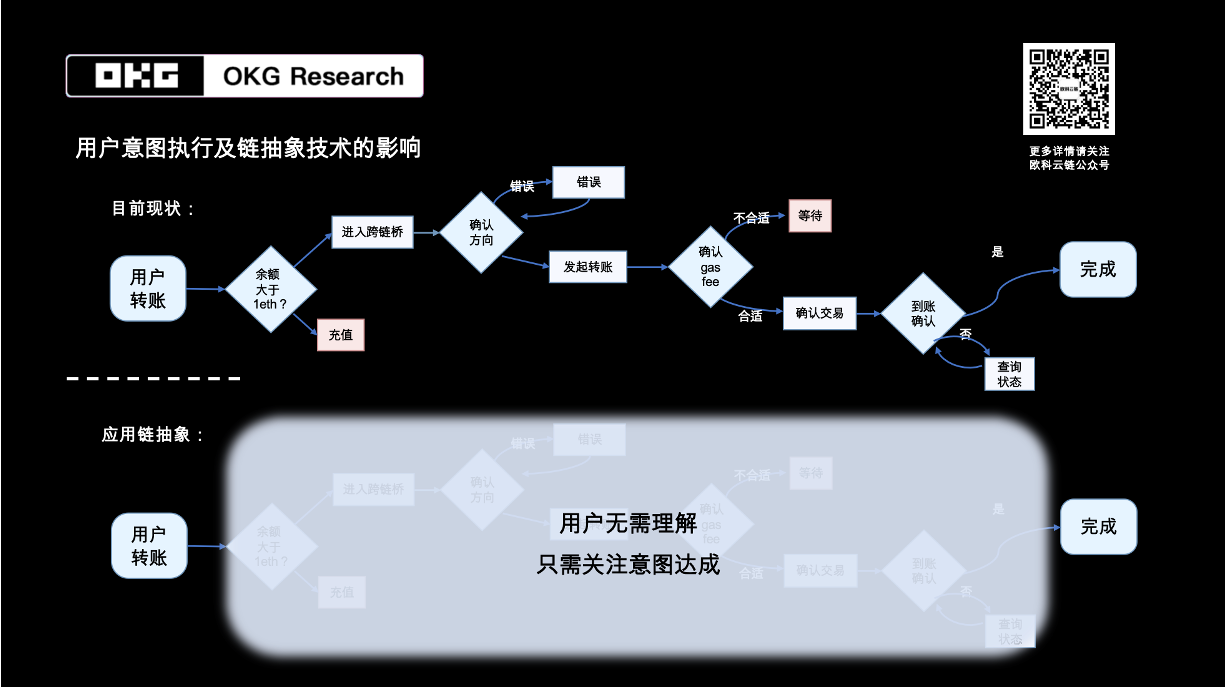
*Flow Chart Source: OKG Research
From this flowchart, we observe that:
-
Users must check account balances (and consolidate ETH from other wallets if insufficient)
-
Confirm transfer direction
-
Verify gas fees
-
Confirm receipt
If users only needed to specify whether their transfer request was ultimately fulfilled, delegating all cross-chain checks and actions to a specific network or application, interactions would be greatly simplified.
Imagine planning a trip to various countries and using an international credit card for purchases worldwide. As a user, you don’t need to worry about different national currencies, exchange rates, cross-border clearing processes, or disparate payment networks—you simply swipe your card, and the entire complex process is handled automatically in the background. This is an example of "abstraction"—hiding complexity behind a simple user experience.
Similarly, the previously mentioned “chain abstraction” operates on the same principle. Its core value lies in:
-
Simplifying complexity: Users only need to define the "origin" and destination
-
Unified interface: All underlying chains and bridging protocols are managed through a single, simple interface
-
Smart routing: Automatically selects optimal paths and best bridge protocols
-
Error handling: Automatically retries, handles exceptions, and provides unified error feedback
We can view chain abstraction as a technical approach aimed at solving issues of asset fragmentation, liquidity dispersion, and account silos in multi-chain ecosystems. By providing standardized interfaces, it enables intent-based cross-chain interactions, simplifies user experience, and allows users to perform cross-chain operations and value transfers without needing to understand underlying chain specifics—reducing complexity and enhancing interoperability in multi-chain environments.
However, current implementations of chain abstraction technology still face many challenges, including cross-chain message transmission delays, security risks, and cost inefficiencies. Some projects are attempting to address these through lightweight cross-chain protocols, decentralized gateways, or improved communication methods, but large-scale deployment remains limited.
Currently, mainstream thinking divides chain abstraction into four layers—the CAKE Framework: Composition, Abstraction, Kernel (or Execution), and Settlement—breaking down user intent step-by-step to derive optimal execution paths.
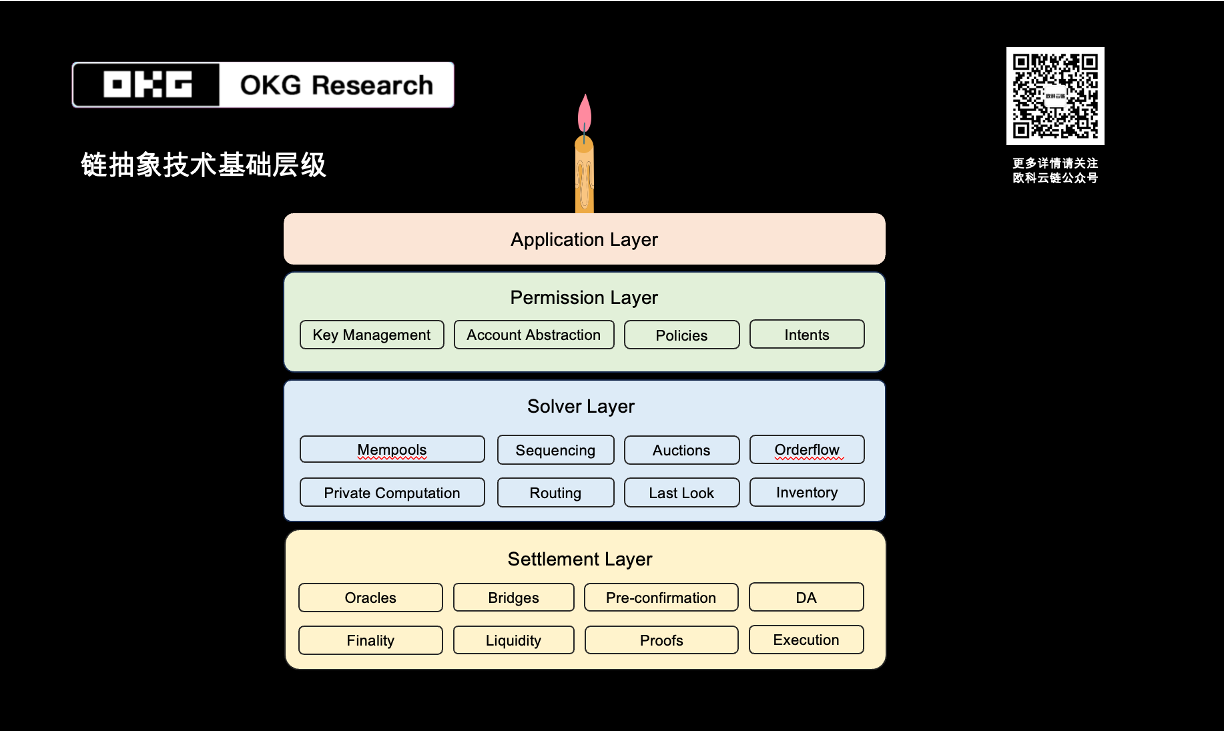
*Graph Source: OKG Research, https://frontier.tech/the-cake-framework
However, each layer involves complex issues such as intent decomposition, cross-chain and cross-DApp coordination, trusted execution environments, and state verification—each posing significant technical hurdles. Numerous projects are currently exploring practical implementations of chain abstraction based on real-world user needs, with the technology still in active development and iteration. Multi-chain wallet applications like OKX Web3 Wallet have emerged as key infrastructure in the chain abstraction space. Chain abstraction within OKX Web3 Wallet has already shown early success—simplifying multi-chain asset management and streamlining cross-chain interactions. Users can manage assets across different chains within a single interface, avoiding frequent network switching, and perform cross-chain transfers using one wallet, significantly reducing operational complexity. The newly launched smart contract wallet functionality further improves upon limitations of traditional EOA (externally owned account) wallets in areas like multi-chain consolidation, user authorization, and unified gas fee payments.
In past discussions, multi-chain wallets and chain abstraction are often compared, particularly regarding whether wallet applications that already offer improved UX over EOAs render chain abstraction unnecessary.
I’d like to explore this from two angles:
-
Whether user experience needs substantial improvement under current application contexts. While there is clear room for UX enhancement in today’s multi-chain environment, the urgency may not be universal. Take cross-chain transactions: even mainstream multi-chain wallets still require manual network switching and separate gas payments—these steps fail to truly resolve ecosystem fragmentation. However, in practice, capital flows on-chain tend to follow profit incentives, and users generally prefer known paths or well-optimized applications. Due to the Matthew effect among leading apps, many projects have proactively invested in optimizing cross-chain flows. For example, numerous DeFi protocols integrate native cross-chain bridges and liquidity aggregators to simplify user operations and improve convenience. For chain abstraction projects, relying solely on UX improvements is insufficient to build strong competitive moats. Therefore, the true value of chain abstraction lies in its role as foundational infrastructure—gradually enabling seamless multi-chain interoperability, re-integrating fragmented liquidity today, and laying the groundwork for future mass user migration and broader cross-chain application scenarios.
-
Liquidity integration is an unavoidable challenge for the industry, especially in facilitating the migration of Web2 users to Web3. Continuous influx of new users is crucial for future growth, and the key to this transition lies in delivering more seamless user experiences—particularly in integrating assets, transactions, and payments across multi-chain environments. To enable a smooth shift from Web2 to Web3, the initial interaction barrier must be lowered. Chain abstraction, through unified interfaces and cross-chain resource integration, reduces cumbersome steps in multi-chain environments, allowing Web2 users to enter the Web3 ecosystem seamlessly. For instance, chain abstraction can automatically manage multi-chain liquidity, streamline payment processes, and unify transaction experiences across chains, thereby addressing fragmentation in Web3. This integration not only enhances user experience but also lays a solid foundation for widespread Web3 adoption and large-scale user migration.
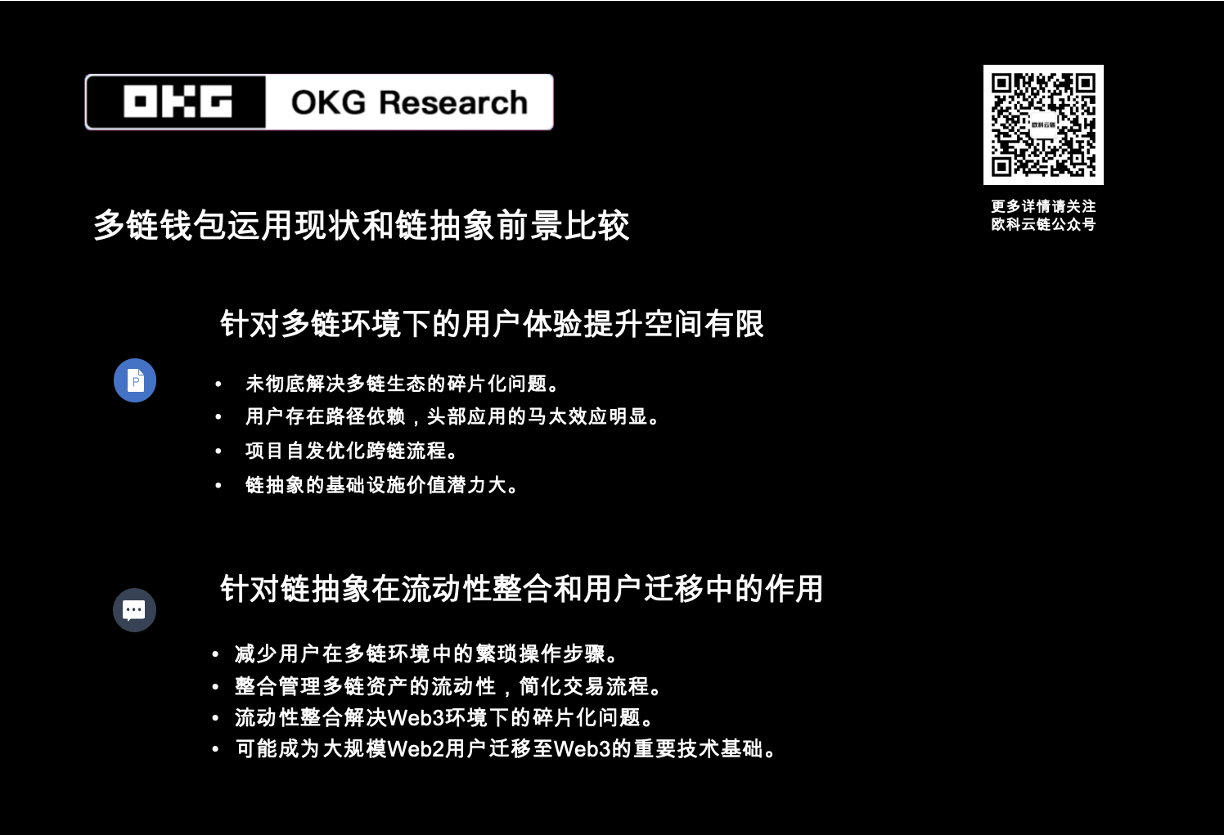
*Chart Source: OKG Research
It becomes evident that the application scenarios of chain abstraction are actually laying the groundwork for the true maturity of Web3. It not only aims to solve interoperability issues within the current blockchain ecosystem but also significantly reduces complex operations in multi-chain environments through cross-chain resource integration and liquidity management.
These improvements drive the Web3 ecosystem toward a more open and interconnected future. In the long run, chain abstraction is poised to become a critical pillar for the mass adoption of decentralized applications, offering efficient, seamless infrastructure that enables more users to effortlessly enter the Web3 world and achieve frictionless multi-chain interactions.
[Disclaimer] This article does not constitute investment advice. Readers should consider whether any opinions, views, or conclusions expressed herein are suitable for their individual circumstances.
Join TechFlow official community to stay tuned
Telegram:https://t.me/TechFlowDaily
X (Twitter):https://x.com/TechFlowPost
X (Twitter) EN:https://x.com/BlockFlow_News
 @OKGResearch











