








Interpretation: MAS's Commercialization Plan for Asset Tokenization
TechFlow Selected TechFlow Selected
Interpretation: MAS's Commercialization Plan for Asset Tokenization
Singapore's recent policy announcement sends an important signal: MAS is willing to provide an environment for experimentation and commercial application of tokenized assets, offering Web3 companies valuable opportunities to enter traditional financial networks.
 Navigating Web3 tides with focused insights
Author: Aiying Aiying
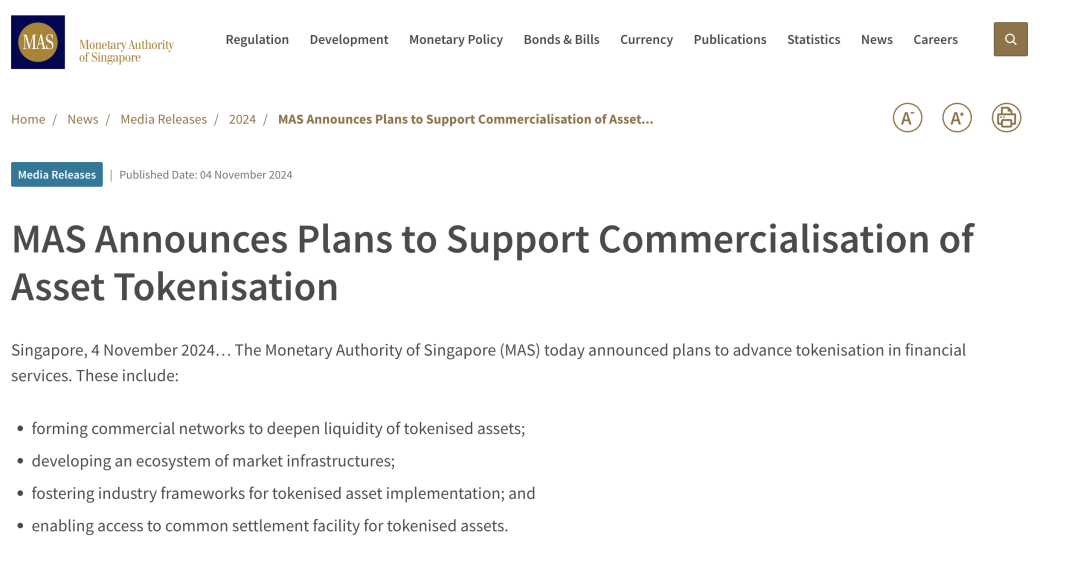
As the digital asset sector rapidly evolves, the Monetary Authority of Singapore (MAS) today announced a series of policies to advance the commercialization of asset tokenization. This initiative not only demonstrates strong support for financial technology innovation but also sets an important precedent for global financial regulation and the coordinated development of the Web3 industry. From Aiying's perspective, this article analyzes MAS’s new policies and their implications for the Web3 industry.
1. Global Tokenization Trends and MAS’s Strategic Intentions
Asset tokenization refers to the process of digitizing real-world assets using blockchain technology. In recent years, it has gained increasing attention worldwide due to its potential to enhance liquidity, reduce transaction costs, and improve transparency. However, lack of regulatory clarity and market uncertainty remain key barriers to large-scale adoption. Singapore aims to become a global leader in asset tokenization through strategic policy initiatives by MAS—a topic previously explored in depth in Aiying’s RWAs Series.
-
The Rise of Asset Tokenization: Exploring Trillion-Dollar Market Opportunities
-
[RWAs] Current State and Case Studies of Government Bond Tokenization
-
[RWAs] Tokenized Private Credit Markets and Use Cases[RWAs] Tokenized Commodities and Real Estate Case Studies
-
[RWAs] Intellectual Property Tokenization Market and Case Studies
-
[RWAs] Luxury and Collectibles Tokenization Market and Case Studies
MAS has launched “Project Guardian” and the “Global Layer One” (GL1) initiative, aiming to provide foundational support for the promotion and application of tokenized assets through international collaboration and digital infrastructure development.
The new MAS policies mainly consist of four aspects:
1. Building Commercial Networks to Enhance Liquidity
Through Project Guardian, MAS has brought together over 40 financial institutions from seven countries to conduct trials on capital markets applications of tokenized assets, leading to the formation of the "Guardian Wholesale Network" involving major banks such as Citibank and HSBC. This move aims to significantly boost market liquidity for tokenized assets—particularly in primary and secondary markets—and unlock new opportunities in financial markets. The creation of such a commercial network not only attracts more investors into the tokenized asset space but also enables greater efficiency in trading and price discovery through economies of scale. Through cross-institutional cooperation, the scope of tokenized assets can expand further, covering tokenized issuance and trading of bonds, funds, foreign exchange, and other financial products.
2. Digital Infrastructure Development to Support Cross-Border Transactions
Under the Global Layer One (GL1) initiative, MAS is building shared ledger-based digital infrastructure that allows seamless movement of tokenized assets across jurisdictions and markets. GL1’s “governance principles” and “compliance-by-design” approach will establish unified regulatory standards for cross-border transactions, enhancing market security and transparency. Robust digital infrastructure is essential for frictionless cross-border flows of tokenized assets. It helps address inefficiencies in current global financial systems related to payments and settlements, while reducing compliance costs caused by inconsistent regulatory frameworks across countries. By enabling interoperability between digital infrastructures, Singapore aims to position itself as a leading global hub for cross-border tokenized asset trading, allowing financial institutions worldwide to participate more easily in global capital markets.
3. Establishing Industry Standards
MAS has released two industry frameworks: the Global Framework for Tokenized Fixed Income (GFIF) and the Global Framework for Tokenized Funds (GFF), providing guidelines for the use of tokenized bonds and funds. These frameworks lay the groundwork for financial institutions to promote tokenized assets in debt capital markets and fund management, standardizing market practices. Such standards offer clear operational guidance for broader adoption of tokenized assets and help reduce uncertainties during product design and issuance. The introduction of GFIF and GFF fosters trust in tokenized assets—especially in fixed-income and fund sectors where safety and stability are paramount. Through these frameworks, MAS seeks to build a solid foundation for the integration of tokenized financial instruments into traditional markets.
4. Opening Access to Common Settlement Facilities
To improve settlement reliability for tokenized assets, MAS plans to leverage Singapore dollar wholesale central bank digital currency (CBDC) to facilitate settlement. The SGD Testnet will initially open to select major banks for payment and securities settlement, aiming to lower transaction risks while improving settlement efficiency. Opening access to common settlement facilities marks a critical step toward mainstream adoption of tokenized assets. By utilizing wholesale CBDCs, MAS aims to create an efficient, secure, and low-cost settlement mechanism. This system could significantly reduce counterparty risk among financial institutions and play a pivotal role in future cross-border transactions. As more banks and financial institutions join, this facility will gradually expand to include additional types of tokenized assets and use cases.
2. Opportunities and Challenges from a Compliance Perspective
Opportunities
Singapore’s latest policy signals a clear message: MAS is willing to provide an environment conducive to experimentation and commercialization of tokenized assets, offering Web3 companies valuable opportunities to integrate with traditional finance networks. Interconnection and sharing of tokenized products among financial institutions will help activate market liquidity and create fertile ground for widespread adoption of Web3 technologies. With MAS’s policy backing, Web3 firms can innovate within a highly transparent and regulated environment, greatly reducing technological and market uncertainties. Moreover, the expansion of tokenized assets opens up new business models and revenue streams for Web3 companies—including developing tokenization platforms, deploying smart contracts, and offering compliance-related services.
Challenges
However, compliance requirements are stringent. From GL1 to Project Guardian, every step taken by MAS emphasizes risk management, governance principles, and regulatory compliance. This means Web3 companies seeking to enter Singapore’s tokenized market must possess robust compliance and risk management capabilities—especially in KYC (Know Your Customer), AML (Anti-Money Laundering), and related technical and regulatory areas, which must meet higher benchmarks. This presents new challenges for Web3 firms, particularly in balancing compliance with innovation. Companies must ensure their products and services comply with regulations while maintaining agility in responding to market demands and technological advancements. Additionally, cross-border compliance remains a significant hurdle, as differing regulatory regimes across jurisdictions make compliance management complex and time-consuming, requiring effective solutions within a global compliance framework.
3. Case Studies and Data Support
In ongoing tokenization trials, several global banks—including Citibank and HSBC—have participated and achieved initial success in applying tokenization to bonds and funds. These cases indicate that the potential of tokenized assets is being progressively realized. By establishing a standardized and secure environment, MAS is helping mature the practical application of these assets. Trials conducted by Citibank and HSBC show that tokenization significantly improves the speed of financial product issuance and transaction efficiency. Furthermore, increased transparency throughout the tokenization process enhances investor confidence. These successful implementations not only serve as reference models for other financial institutions but also generate valuable operational and regulatory compliance data for the broader market.
4. Aiying’s View: Compliance Roadmap and Recommendations
Aiying believes that for Web3 companies looking to enter Singapore’s tokenized market, understanding and mastering the details of MAS policies is crucial. Compliance is the prerequisite for market entry. We recommend companies take the following steps:
-
Deeply understand governance principles and industry frameworks: Be fully aware of GL1’s governance requirements and the standards set by GFIF and GFF, ensuring internal compliance processes align accordingly. These frameworks provide clear guidance for participating in the tokenized asset market; companies should use them as benchmarks to review and adjust their operations and compliance strategies.
-
Establish a comprehensive risk management system: Implementing KYC, AML, and other risk controls is mandatory. Companies should prepare early to meet MAS’s high standards. A strong risk management framework not only reduces compliance risks but also enhances credibility when partnering with traditional financial institutions, creating more business development opportunities.
-
Engage in the ecosystem and seize CBDC opportunities: The SGD wholesale CBDC testnet offers participants new tools for payments and settlements. Web3 companies should actively explore compatible use cases, especially in payment and securities settlement domains. Participating in CBDC testing enables Web3 firms to understand how central bank digital currencies operate and prepare for future digital currency-based payment and settlement systems—positioning them advantageously in the evolving digital financial landscape.
Singapore is steadily emerging as a global innovation hub for asset tokenization. For Web3 enterprises, compliance is not just a gateway to mainstream markets—it is also key to building market trust and achieving sustainable growth. Going forward, while embracing innovation, Web3 companies must continuously strengthen their compliance frameworks to stand out in competitive markets. Aiying is committed to providing compliance guidance for Web3 companies, supporting industry development in Singapore and beyond, and jointly ushering in a new era of financial technology.
Join TechFlow official community to stay tuned
Telegram:https://t.me/TechFlowDaily
X (Twitter):https://x.com/TechFlowPost
X (Twitter) EN:https://x.com/BlockFlow_News
 Aiying Compliance






