Pantera Partner: A Comprehensive Analysis of Sahara AI
TechFlow Selected TechFlow Selected
Pantera Partner: A Comprehensive Analysis of Sahara AI
Sahara AI's mission is to create a more open, fair, and collaborative artificial intelligence economy, making it as easy as possible for people to participate.
 Navigating Web3 tides with focused insights
Author: Paul Veradittakit, Partner at Pantera Capital
Translation: xiaozou, Jinse Finance
Sahara AI's mission is to create a more open, fair, and collaborative artificial intelligence economy, making it as easy as possible for people to participate. Leveraging blockchain, Sahara ensures all contributors—data providers, labelers, model developers, and others—are fairly compensated, while data and models remain sovereign, AI assets are secure, and permissions can be created, shared, and traded.
1. Current State of the AI Stack
The current AI stack can be divided into the following layers:
Data Collection and Labeling
Data is collected from various sources (e.g., web scraping, public datasets, user-generated content) and must comply with licensing requirements to avoid legal issues. The data is then labeled according to the task at hand (e.g., classification, object recognition).
Model Training and Serving
Data is fed into models, which adjust their internal parameters (weights) to minimize error. This process requires significant, costly, and time-consuming computation.
Creation and Deployment of AI Agents
The user experience for creating AI agents typically involves tools like TensorFlow and requires technical expertise.
Computing Resources
Model training demands expensive processing power.
Each layer is highly competitive and diverse. For the most part, one approach has proven most effective. For example, data collection works best using large public datasets (such as books), fine-tuned with specialized data (like research papers). Model training is best done on dedicated hardware. AI agents should be easily built using plug-and-play resources to foster a developer community. Computing resources should be distributed to precisely reward providers. Together, these elements lead to better AI models and stronger communities.
Web2 companies are moving in this direction, but face serious limitations due to their centralized design. From both business and technical perspectives, these companies aim to restrict access and isolate different parts of the stack, resulting in inconsistent security standards, database designs, backend integrations, and monetization strategies. In practice, such designs are fundamentally flawed and unable to adapt to the shift toward an AI economic model.
For instance, OpenAI has built a powerful foundational model and started attracting community builders through its permissionless GPT wrapper marketplace, but only allows superficial prompt customization and does not support reconfiguration of the underlying model. All of the company’s computing resources were purchased with investor capital, and it is projected to lose $5 billion by the end of this year.
2. Collaborative AI Economy
The Sahara platform offers a one-stop solution for all AI development needs across the entire AI lifecycle: from data collection and labeling, model training and serving, creation and deployment of AI agents, multi-agent communication, trading of AI assets, to crowdsourcing of AI resources. By democratizing the AI development process and lowering entry barriers of existing systems, Sahara AI provides equal access to individuals, enterprises, and communities to collectively build the future of AI.
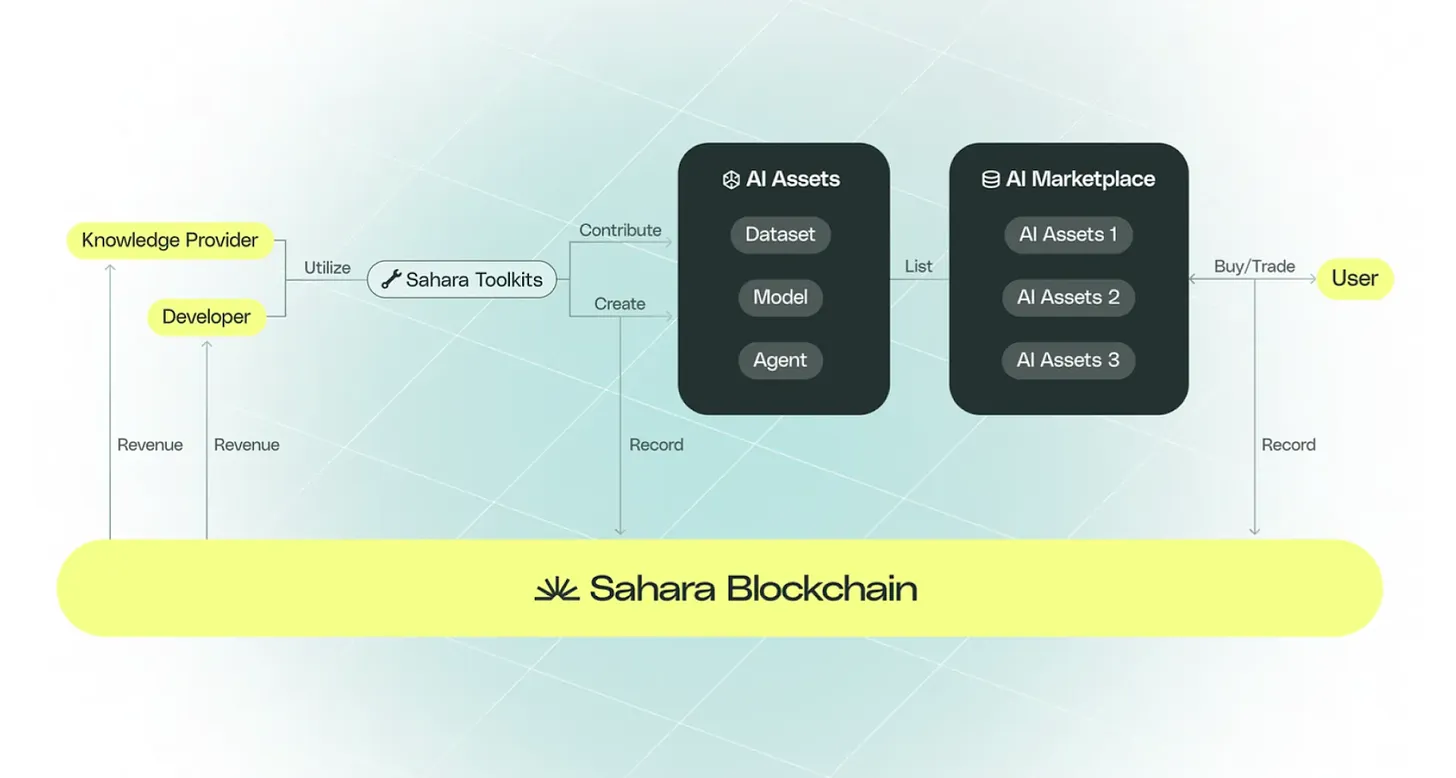
The diagram above summarizes the user journey, illustrating how AI assets are created, used, and drive user engagement within the Sahara AI ecosystem. Notably, all transactions within the platform are immutable and traceable, ownership is protected, and asset provenance is recorded. This enables transparent and fair revenue-sharing models, ensuring developers and data providers are properly rewarded for generating value.
Sahara aims to make participation in the AI economy significantly easier. Developers and users can engage with Sahara in the following ways:
Experienced AI Developers:
Developers can use the Sahara SDK and APIs to interact with any layer of the Sahara blockchain and its AI stack—customizing compute power, data storage, and incentive structures—to build their own Sahara AI agents, which can be licensed and monetized for others to use.
Beginner AI Developers:
Through a no-code/low-code environment, developers can create and deploy AI assets using intuitive interfaces and pre-built templates.
AI Training Participation:
To participate in AI model training, users simply visit a website where they complete AI training tasks and receive tradable tokens as compensation. Tasks range from solving basic math problems to describing short videos.
AI Users:
Users can easily interact with AI agents via an intuitive UI. They can flexibly purchase access and development rights, and even trade shares of AI assets.
Users will be able to create their own personalized data "knowledge base" and use their private data to train specialized AI models. Like other AIs, these can be made accessible to others, while the training data remains fully private and secure.
Enterprises:
Companies can also create AI agents (or “business agents”) and train them on proprietary data. Since the system runs on the Sahara blockchain, costs are significantly lower thanks to decentralized AI agent generation and servicing.
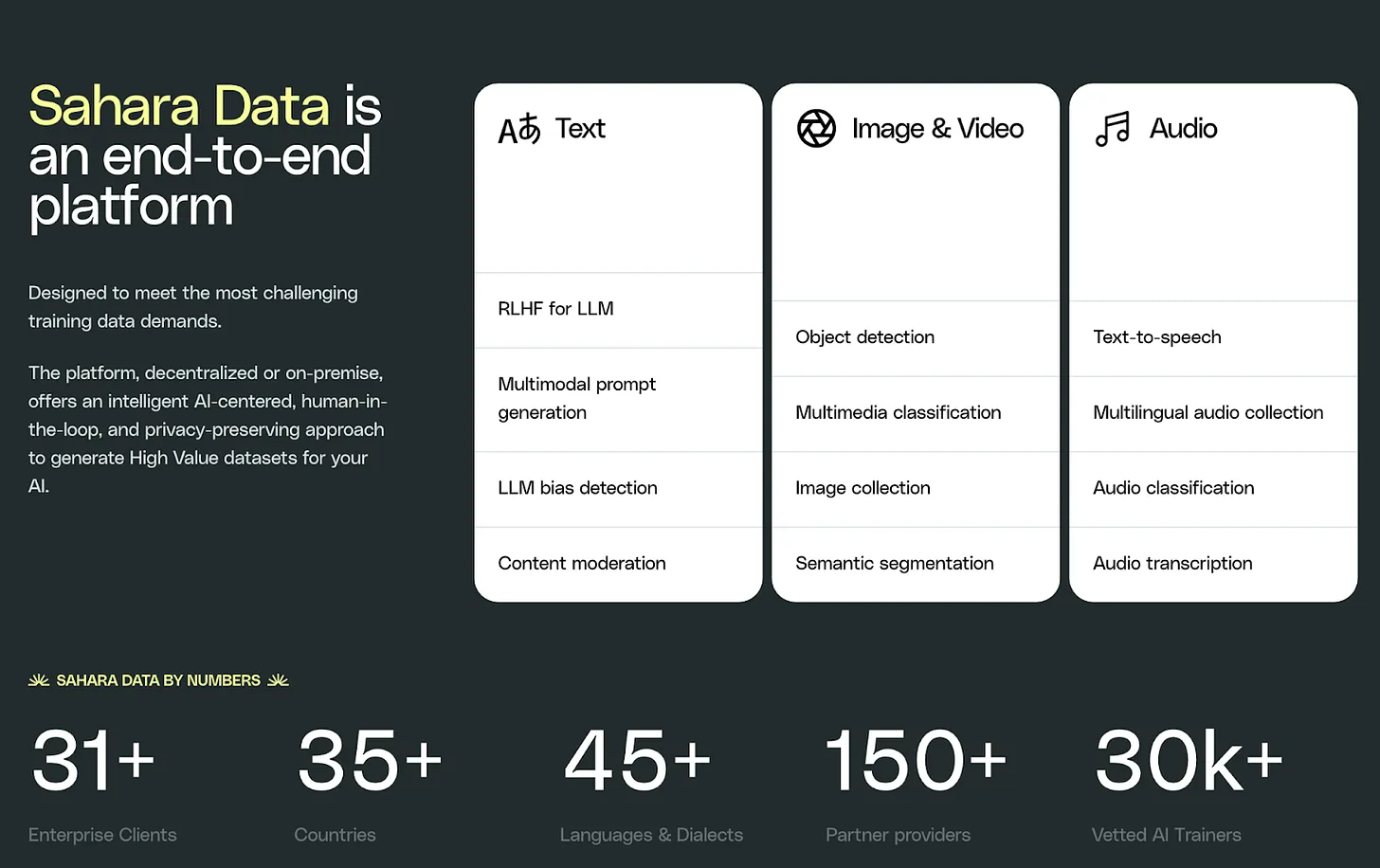
Enterprises can also pay to generate Sahara Data, which combines AI auto-labeling with human annotation to efficiently produce high-quality, privacy-preserving, multi-model datasets.
Besides enterprise-facing products already adopted by several well-known clients, all other features have yet to launch but are on a clear release roadmap.
3. Technical Overview
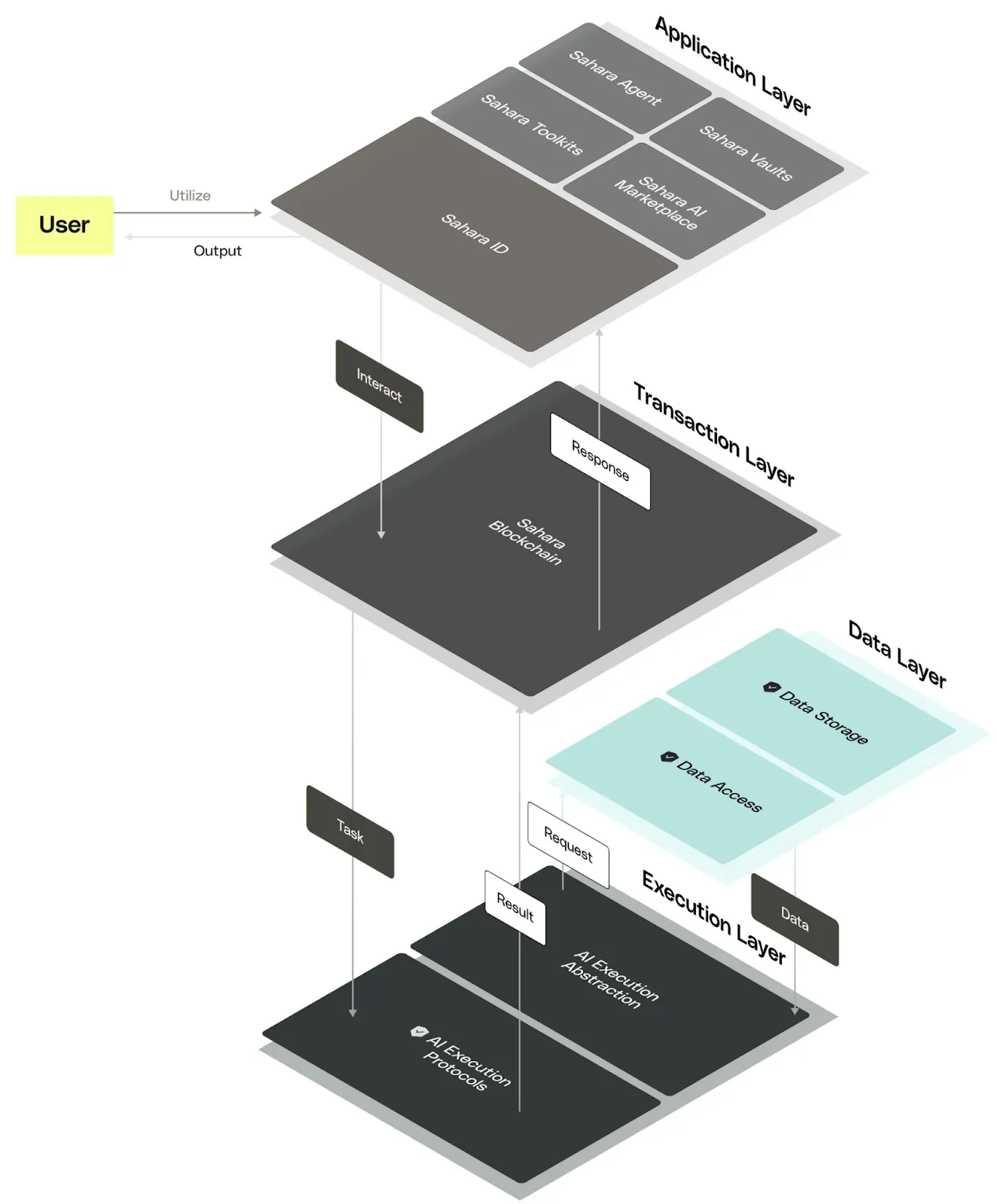
The Sahara team designed the system to be as simple and user-friendly as possible, abstracting away the complexity required to ensure compatibility, profitability, and security across the AI stack. Behind the scenes, the Sahara team developed numerous innovations to achieve this. A few examples:
-
The Sahara blockchain minimizes gas fees and is fully EVM-compatible. The Sahara Cross-Chain Communication (SCC) protocol enables secure, permissionless data transfer across blockchains, facilitating trustless interoperability.
-
Sahara AI-Native Precompiles (SAPs) are pre-compiled smart contracts optimized for AI tasks to reduce computational overhead, including SAPs for training execution and inference execution.
-
Sahara Blockchain Protocols (SBPs) manage AI assets to ensure accountability—for example, AI Attribution tracks contributions and distributes rewards, while the AI Asset Registry manages registration, licensing, and provenance of AI assets and ownership.
-
Data management occurs both on-chain and off-chain: AI asset metadata, commitments, and proofs are stored on-chain, while large datasets, AI models, and supplementary information are stored off-chain to optimize data retrieval, security, and availability.
-
Collaborative Execution Protocols support joint AI model development and deployment across training, aggregation, and serving. Other models like PEFT enable technical fine-tuning. Privacy-Preserving Compute supports differential privacy, homomorphic encryption, and secret sharing. Fraud Proofs work exactly as the name suggests.
4. Fully Integrated AI Stack
The team is led by Sean Ren, a tenured professor at the University of Southern California, recognized in the MIT Technology Review's Innovators Under 35 and honored as a Samsung Fellow in 2023, and Tyler Z, a UC Berkeley alumnus and former Investment Director at Binance Labs. Other team members bring valuable expertise from institutions and companies including Stanford, UC Berkeley, AI2, Toloka, Stability AI, Microsoft, Binance, Google, Chainlink, LinkedIn, and Avalanche.
Sahara also benefits from advisory support by top AI-native researchers and enterprise clients:
-
Laksh Vaaman Sehgal (Deputy Chairman, Motherson Group)
-
Rohan Taori (Human Research Scientist)
-
Teknium (Co-founder, Nous Research)
-
Vipul Prakash (CEO, Together AI)
-
Elvis Zhang (Founding Member, Midjourney)
Sahara AI is currently used by over 35 leading technology innovators and research institutions—including Microsoft, Amazon, MIT, Motherson Group, and Snap—for various AI services such as Shara Data for data collection/labeling and Sahara Agents for personalized domain-specific agents.
Generative AI is still in its early stages in terms of both technology and market scale. Today’s centralized chat and video tools have limited scope due to the difficulty of integrating the entire AI stack into a single product. Sahara AI is the only company addressing this bottleneck through a modular design that uses blockchain as the foundation for permissionless access, token distribution, and security. To ensure broad participation, the future of AI must be accessible and fair—and Sahara AI is the only company advancing toward this vision.
Join TechFlow official community to stay tuned
Telegram:https://t.me/TechFlowDaily
X (Twitter):https://x.com/TechFlowPost
X (Twitter) EN:https://x.com/BlockFlow_News
 Pantera Capital