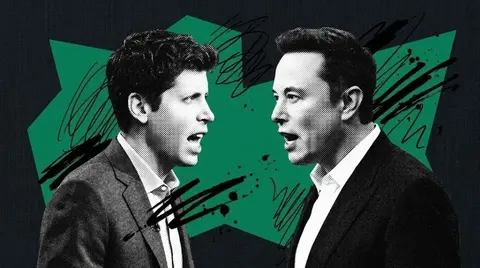
Elon Musk and His Business Playbook for the "U.S. Election"
TechFlow Selected TechFlow Selected
Elon Musk and His Business Playbook for the "U.S. Election"
Behind the Big Spending: The Tangled Rivalry and Alliance Between Musk and Trump
 Navigating Web3 tides with focused insights
Author: Tuoluo Finance
If asked how this U.S. election differs from previous ones, former President Trump—never short of words—might list numerous grievances: last-minute opponent changes, lack of fundraising advantage, and even a failed assassination attempt. Yet, if asked who he’s most grateful to in this election, Elon Musk would undoubtedly be among Trump’s top answers.
In this year's election, Musk has surprisingly and firmly backed Trump—not only spending $75 million in campaign funds during the third quarter to show his commitment but also vigorously campaigning on public platforms. Recently, he even launched a lottery-style initiative to mobilize grassroots support. Whether in manpower or financial resources, Musk’s efforts can truly be described as going all out.
For an entrepreneur of such immense influence and controversy, taking such a clear stance is far from wise. In an election where outcomes remain uncertain, missteps could capsize the entire political ship. Defeat brings not just political downfall but potentially serious personal risks.
Go back a few years, and Musk and Trump were clearly not close. Their public spats frequently played out on social media, with Trump once mocking that Musk could kneel at the White House begging for subsidies. What exactly prompted Musk to set aside past grievances and throw himself so passionately behind Trump?
Beneath the precarious undercurrents of this election, transactions of money and power are quietly unfolding.
01 Amplified Momentum: Musk Spends Millions for Trump
Not long ago, Trump declared during a speech: “I called Elon, and he gave me the best support.” For a presidential candidate to express such gratitude, Musk’s backing must indeed be extraordinary.
On direct financial support, since openly endorsing Trump in July, Musk’s spending has been nothing short of lavish. According to disclosures by the Federal Election Commission, during Q3, Musk donated $75 million to America PAC, a political action committee supporting Trump. While this figure was largely anticipated and slightly below earlier predictions of $45 million per month, in sheer scale, Musk has become the second-largest donor after Miriam Adelson (who contributed $95 million), solidifying his status as one of Trump’s most significant benefactors.
From a funding perspective alone, Musk’s contribution has been a lifeline—Trump has long struggled with fundraising.
Data shows Democrats have maintained their traditional edge, and with a mid-campaign leadership change, fundraising became even more focused. Since becoming Democratic leader at the end of July, Harris has raised $1 billion, with her campaign committee collecting $633 million in Q3 alone—four times the amount raised by Trump’s equivalent team during the same period.
Though Trump remains publicly unfazed, behind the scenes, he is deeply frustrated. As reported by The New York Times, at a donor dinner in September, Trump bluntly stated that supporters—including donors—needed to do more, offer greater appreciation, and provide increased help. At such an event, the message was unmistakable. To boost fundraising, Trump has resorted to every possible method: charging for convention access, raising capital through crypto projects, exploiting all channels while pressuring loyalists. In April, he demanded major oil and gas companies raise $1 billion for him; in July, he texted top supporter Adelson asking for a $250 million donation.
Yet for elections, money is only the most visible factor. While crucial, massive funding does not guarantee victory. Beyond finances, Musk’s other forms of “support” are equally significant.
First, Musk commands X, a major public platform with 200 million followers and immense global recognition. Simply announcing his endorsement carries powerful sway. In August, Musk took active steps, hosting an exclusive Space interview to amplify Trump’s voice, drawing over a million live viewers—an opening salvo in the campaign. Trump subsequently reconciled with X, reviving his signature strategy of direct public communication. Since then, their relationship has grown increasingly close, marked by strong coordination in public messaging.
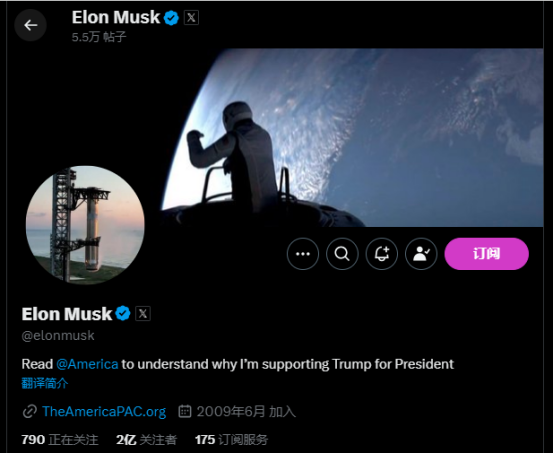
Musk has 200 million followers on X. Source: X
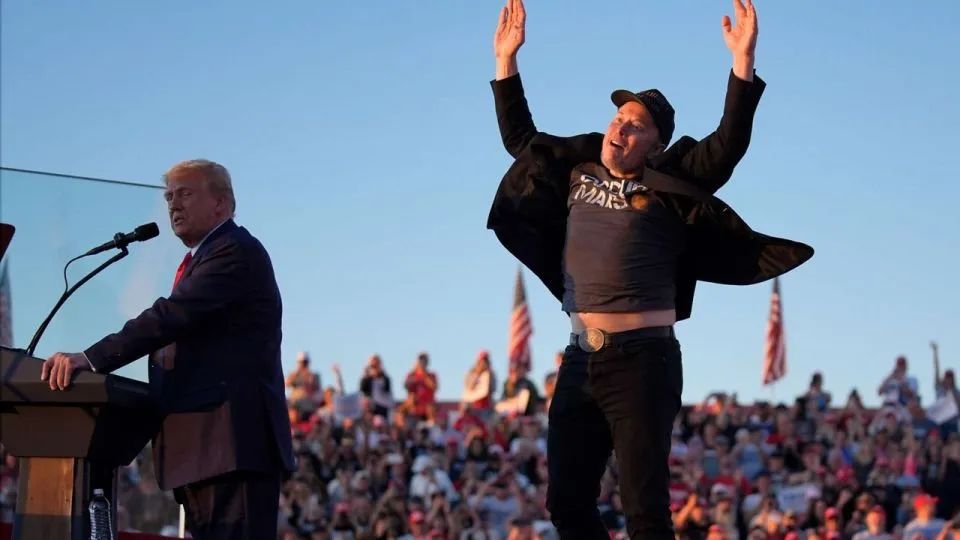
In October, Trump returned to Butler, Pennsylvania, holding a rally with Musk by his side—wearing a MEGA hat, baring his chest in support, and delivering a speech praising Trump’s masculinity. A scene of mutual prosperity unfolded before the public.
Recently, Musk escalated further: launching a daily lottery in Pennsylvania, randomly selecting one voter participating in a petition drive to receive $1 million. The petition, initiated online by Musk’s newly formed “America PAC,” advocates for free speech and gun rights. Under the rules, from October 19 until Election Day on November 5, voters in seven key swing states—Pennsylvania, Arizona, Georgia, Michigan, Nevada, North Carolina, and Wisconsin—who sign the petition will have a daily chance to win $1 million. The first three days’ eligibility was limited to Pennsylvania voters; afterward, it expanded to all seven states.
Previously, Musk offered Pennsylvania voters “$100 for signing the petition, another $100 for each referral,” while other swing states received $47. With both user acquisition and viral growth mechanisms, one cannot help but admire Musk’s mastery of internet operations. Though framed as promoting free speech and gun rights, the real intent is clearly to attract supporters aligned with Trump’s rhetoric—with the ultimate goal being votes for Trump.
No need to elaborate—buying votes carries compliance risks in any country. Even disguised as a lottery, offering incentives directly to voters clearly violates election laws. Pennsylvania Governor Josh Shapiro noted law enforcement should pay close attention. Despite this, Musk’s lottery continues, having already awarded two lucky winners.
A gentleman does not stand beneath a dangerous wall—but every move Musk makes defies this wisdom. Risking legal violations to rally votes, spending vast sums, and repeatedly attacking the opposing candidate as a puppet—Musk has invested heavily in this election.
02 From Feud to Honeymoon: The Turbulent Relationship Between Musk and Trump
So what magic does Trump possess that drives Musk to such lengths?
Back in 2017, when Trump first took office, their relationship was amicable. Trump even invited Musk to serve as a White House business advisor. But within months, they split—triggered by Trump’s decision to withdraw from the Paris Climate Agreement. Musk believed the accord supported clean energy development vital to Tesla, making cooperation impossible.
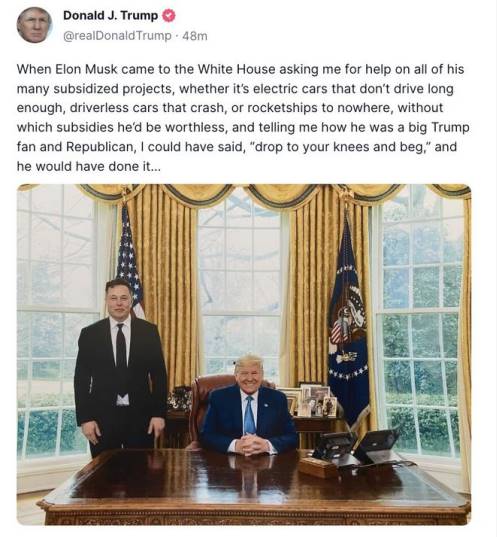
Thereafter, as a figurehead for tech innovation and immigration reform, Musk gradually leaned toward the Democratic Party, bringing relations with Trump to a freezing point. They clashed repeatedly on social media. In 2022, Musk said Trump should retire. Trump fired back: “Musk came to the White House begging for help with his subsidy-dependent ventures—whether it’s electric cars that don’t sell well, self-driving cars causing accidents, or rockets with nowhere to go. Without these subsidies, Musk would be worth nothing.”
Trump added: “He told me back then he was a loyal fan of Trump and a Republican—and that if I told him to kneel, he would kneel.” Not satisfied, he attached a photo of Musk smiling beside him, dripping with sarcasm.
In adult politics, there are no permanent enemies. Less than two years later, the pair are back in a honeymoon phase. When asked why, Musk explained in interviews that he supports Trump because current Democratic policies and values no longer align with his own—that the party’s embrace of racial diversity is accelerating national division. Given Musk’s populist leanings and admiration for strong leaders, this rationale holds some water. But ideology alone cannot explain such a complete turnaround. The core reason boils down to one thing: interest.
Start with the turning point in Musk’s relationship with Democrats. Initially, Musk supported Biden due to promises of advancing clean energy and electric vehicles. Development did occur—but the Biden administration seemed intent on excluding Tesla. In August 2021, the White House hosted an EV summit and signed an executive order aiming for half of new vehicle sales in the U.S. to be zero-emission by 2030. Curiously, while inviting GM, Ford, and Stellantis, the largest EV company—Tesla—was left out. The reason? Pressure from the United Auto Workers, long-time allies of the Democratic Party.
This rift deepened. As Musk’s businesses expanded, tensions grew over billionaire wealth taxes, anti-union stances, and regulatory policies. During Biden’s term, Tesla, SpaceX, and other Musk enterprises became targets of at least 20 government investigations or audits—further fueling conflict.
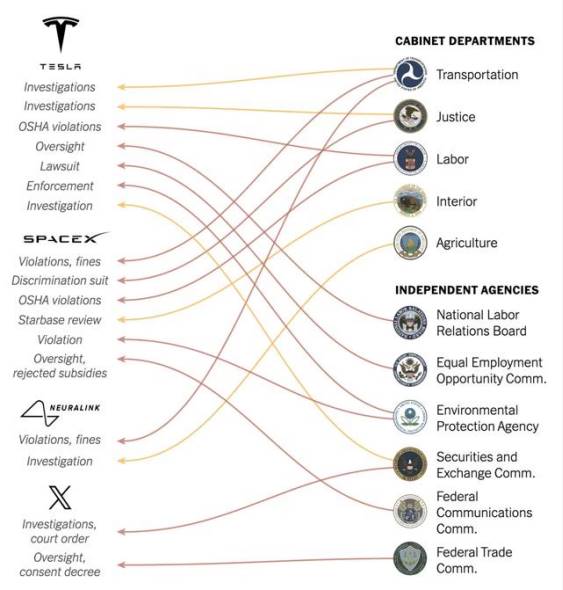
Musk’s companies have been scrutinized by multiple U.S. regulators. Source: The New York Times
Take SpaceX: according to The New York Times, last year, SpaceX signed nearly 100 contracts with 17 federal agencies, securing $3 billion in commitments. The government has become SpaceX’s biggest funder.
But recently, the FAA initiated a $633,009 fine against SpaceX for violating safety permits during two Florida launches. Ahead of the latest Starship test flight, the FAA delayed launch approval for weeks over concerns about wildlife impact. Recently, the Department of Justice sued SpaceX, accusing it of refusing to hire refugees and asylum seekers based on citizenship.
Subsidies are also drying up. The FCC revoked $886 million in federal funds meant for SpaceX’s rural internet service via Starlink, citing its expansion into non-rural areas.
Tesla isn’t spared either—the National Highway Traffic Safety Administration has launched five investigations into Tesla, including complaints of unintended braking, loss of steering control, and crashes under “Autopilot” mode.
Musk has long complained of political persecution, once calling U.S. regulators “a bunch of assholes” in 2022. Personal matters also played a role: Musk’s son transitioning gender made him feel Democratic ideology had become too radical. This became the catalyst for Musk’s break with California—and later, his acquisition of Twitter. After a series of events, Musk gradually aligned with Republicans, officially endorsing Trump on July 13 this year.
03 Beneath the Support: Hidden Transactions of Money and Power
Supporting Trump stems from mutual promises.
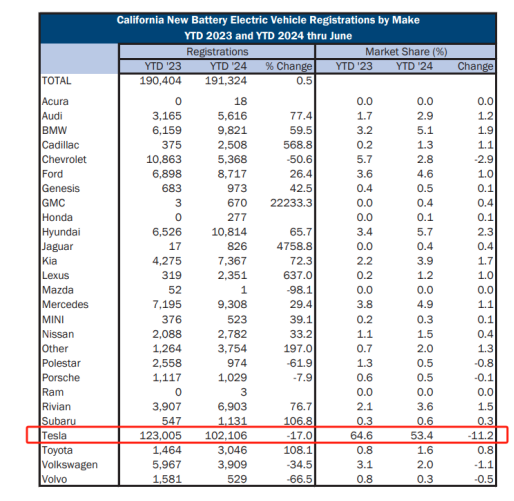
Notably, although Trump softened his tone after allying with Musk, claiming he’d support electric vehicles, he wasn’t previously an EV advocate. As a result, environmentalist liberals have begun boycotting Tesla. According to data from the California New Car Dealers Association, in California—the largest EV market and a Democratic stronghold—Tesla’s Q2 sales dropped 17%.
So what exactly did Trump promise Musk to justify such bold actions?
An entity known as a “Department of Government Efficiency” has now surfaced. On August 12, during a conversation with Musk, Trump mentioned that if elected, Musk might take on a role in his administration. Days later, Musk posted an AI-generated image on X labeled “Department of Government Efficiency”—but most saw it as just a meme.
On September 5, Trump brought it up again, stating he would accept Musk’s suggestion to formally establish a “Government Efficiency Committee” led by Musk. Trump didn’t detail how it would operate, only saying it would conduct comprehensive financial and performance audits across the federal government and recommend reforms to reduce spending. On October 18, Musk elaborated: the department would run like a corporation, improving how taxpayer money is used and streamlining spending departments.
Superficially, bringing in outside experts to enhance transparency and efficiency seems reasonable—especially given Musk’s track record of cost-cutting. Final expenditures would still require congressional approval. But upon closer inspection, the committee could gain de facto regulatory authority by recommending cuts to federal programs. It might also streamline bureaucratic processes—effectively becoming a regulator of regulators. Given Musk’s history as a major recipient of federal subsidies and contractor, serious conflicts of interest are inevitable.
For example, SpaceX once stated: “The paperwork required to obtain government launch permits takes longer than designing and building the actual hardware.” Under these circumstances, would the efficiency department be qualified to “recommend” simplifying these regulations? More critically, could Musk use this position to cut funding for competitors or redirect government spending to benefit his own companies?
The committee’s operational model hasn’t been revealed, but potential conflicts of interest are already swirling beneath the surface. Why Trump chose Musk is easy to understand. During his first term, Trump was a political novice. Although establishment elites temporarily rallied behind him due to Hillary Clinton’s missteps, his blunt “America First” agenda quickly alienated them, severely undermining governance effectiveness.
This time, Trump has learned his lesson—building a party better suited to his needs. He picked a younger, more controllable running mate in Vance and naturally gravitated toward someone like Musk: similarly minded, highly influential, and a fellow businessman. Musk’s choice is reciprocal. Within the entrenched Democratic Party—where he once felt sidelined—Musk had little chance of gaining real power. But alongside the political outsider Trump, his value skyrockets, offering far greater potential for political advancement. Thus, their alliance emerged—a shift from “feuding” to “honeymoon” in the public eye.
Yet for the opposing party, this partnership poses a serious threat. Musk has repeatedly claimed he doesn’t want to enter politics—it’s a necessity. Otherwise, a Democratic win could endanger his personal safety, even increasing the risk of assassination. Whether Musk, who acquired a media platform and aggressively backed a candidate, truly lacks political ambitions is debatable. But the possibility of criminal prosecution upon defeat is very real—and if that happens, his empire—SpaceX, Tesla, Neuralink, X—could face widespread repercussions. Hence, Musk’s repeated emphasis on assassination threats may serve to deter Democrats from targeting him—a likely form of self-protection.
Worth noting: despite a net worth of $250 billion, Musk doesn’t hold large amounts of liquid cash. His wealth is primarily in stock—Tesla shares alone account for 60% of his fortune. Therefore, even for Musk, election donations and promotional campaigns represent significant expenditures.
In the end, the sheer investment of time, effort, and resources reflects one truth: this election is, for Musk, a do-or-die moment.
Luckily, Trump is currently performing well. Although recent polls show Harris leading 46% to Trump’s 43%, Trump has regained clear momentum in swing states. As of October 21, polls indicate Trump leads in 8 of 9 battleground states. In betting markets, Trump’s odds of winning have reached 57.9%, far ahead of Harris’s 40.8%. Crypto prediction markets give Trump a lead of nearly 30 percentage points over Harris. If trends continue, Trump’s return to the White House may be inevitable. Reflecting this sentiment, cryptocurrency markets reacted swiftly—BTC surged past $66,000, and DOGE caught a bullish wave.
Of course, the final outcome remains uncertain. But one thing is clear: Musk and Trump, bound by shared interests, are now firmly aboard the same ship.
Join TechFlow official community to stay tuned
Telegram:https://t.me/TechFlowDaily
X (Twitter):https://x.com/TechFlowPost
X (Twitter) EN:https://x.com/BlockFlow_News