Thoughts and insights on the AI Agent sector
TechFlow Selected TechFlow Selected
Thoughts and insights on the AI Agent sector
Why has the AI Agent sector captured such a large market share?
 Navigating Web3 tides with focused insights
Author: cryptoHowe.eth
Recently, ArkStream Capital published a research report on the AI Agent sector. After reading it, I found their analysis quite reasonable and agree with many of their viewpoints. In this article, I’ll expand upon some of the points they raised and share my own perspectives—feel free to join the discussion.
Disclaimer: This article contains strong personal opinions. The views expressed herein are not to be taken as investment advice and are shared solely for discussion and informational purposes. All insights are based on my current understanding and available data, and may be updated at any time.
Why Has the AI Agent Sector Captured Such a Large Market Share?
From the report, we can see that AI Agents currently occupy nearly a quarter of the entire AI market. In my view, there are two main reasons for this:
1. Broad applicability, low barriers to entry, and short product cycles
The AI industry is primarily composed of five components: data, storage, computing, algorithms, and communication. Data requires substantial resource accumulation and is vulnerable to geopolitical influences. Storage and computing are highly competitive and resource-intensive fields today. Meanwhile, algorithms and communication demand significant technical expertise.
The AI Agent sector sits in a "just right" position—it doesn’t require the massive datasets, storage, or computational power needed by general-purpose large models, nor does it depend on incremental breakthroughs in algorithmic or communication technologies. As long as an Agent meets its specific product development needs, it can be brought to market quickly. Compared to other AI products, Agents have relatively low entry barriers, broad application scenarios, shorter development cycles, and fast time-to-market—often described as “small but beautiful.”
2. Agents better meet mainstream user needs, are easier to deploy, and fit the Mass Adoption narrative
The narrative around Agent products closely resembles that of the Chain Abstraction space—both aim to let users focus solely on their goals without worrying about implementation details or underlying participants. Agents play a crucial role in helping Web2 users transition into Web3. Instead of requiring users to learn wallet management, signatures, and other technical basics from scratch, Agents allow them to express their needs naturally in plain language, after which the Agent automatically executes the required operations. For example, if a user wants to exchange all their BTC for ETH, the Agent will autonomously plan and execute the necessary cross-chain transfers and trades. The user simply waits until the task is complete. Thus, Agents represent one of the few directions capable of truly enabling mass adoption.
The Survival Challenges of Content-Generating Agents
The report categorizes Agent products into infrastructure-type and content-generating type, noting that most current projects fall into the former category. Why has the latter developed more slowly? In other words, what are the survival challenges facing content-generating Agents? I believe there are two key reasons:
1. Content-generating Agents primarily fulfill emotional needs, which are hard to price
To put it simply, their business model struggles to close the loop. Infrastructure-type products offer clearly defined services or resources—such as providing computational power or model APIs to AI developers. Pricing here is straightforward: which GPU model was used, for how long, etc.—basic arithmetic yields a clear cost, and prices remain relatively stable.
In contrast, sustaining a business model around fulfilling users’ emotional needs is extremely difficult. Emotional states are inherently unstable—a user might feel joyful one day and deeply discouraged the next. Their willingness to engage with the product fluctuates accordingly. Moreover, different users have varying emotional needs at different times, leading to inconsistent payment willingness and amounts. This results in high price volatility and makes monetization challenging.
2. It's difficult to determine whether generated content actually satisfies the user
In content-generating applications, human subjectivity plays a dominant role. For instance, whether a generated image is satisfactory lacks objective metrics—evaluation relies largely on personal feelings rather than standardized benchmarks like those in compute markets. Consequently, user retention and conversion rates tend to be lower for such products.
My Personal Outlook on AI Agents
Looking ahead at the evolution of the AI Agent sector, I believe the following four points deserve attention:
1. Pure Agent narratives struggle to gain competitive advantage; differentiation is essential. In today’s environment, an increasing number of AI projects incorporate Agents into their storylines. Standalone Agent-only projects face an uphill battle. Consider this: among hundreds or even thousands of AI projects, simply touting “Agent capabilities” won’t capture user attention—today, even great wine risks going unnoticed if it’s hidden down a deep alley.
2. AI Agents will evolve from isolated entities into interconnected AgentFi ecosystems. Currently, Agent products operate in silos—data and services aren't shared across platforms. Users must repeatedly input personal information when switching between different Agents. If interoperability could be achieved—allowing an Agent trained on Product A to function seamlessly on Product B—the potential and user experience would improve dramatically.
3. Projects following the "selling shovels" logic will emerge first and dominate market share. Put simply, while everyone else builds Agents, building tools that enable efficient Agent development becomes a surefire “gold rush shovel” business—one that profits regardless of who wins the race.
4. Agent revenue will primarily come from B2B; B2C strategies are more about building reputation. This reflects a common trend across the AI sector—enterprise users (B-end) have far stronger payment willingness and capacity than individual consumers (C-end). Therefore, true profitability hinges more on the quality of B2B partnerships. That said, C-end users shouldn’t be overlooked: strong consumer adoption helps generate buzz and provides valuable feedback for future growth and marketing.
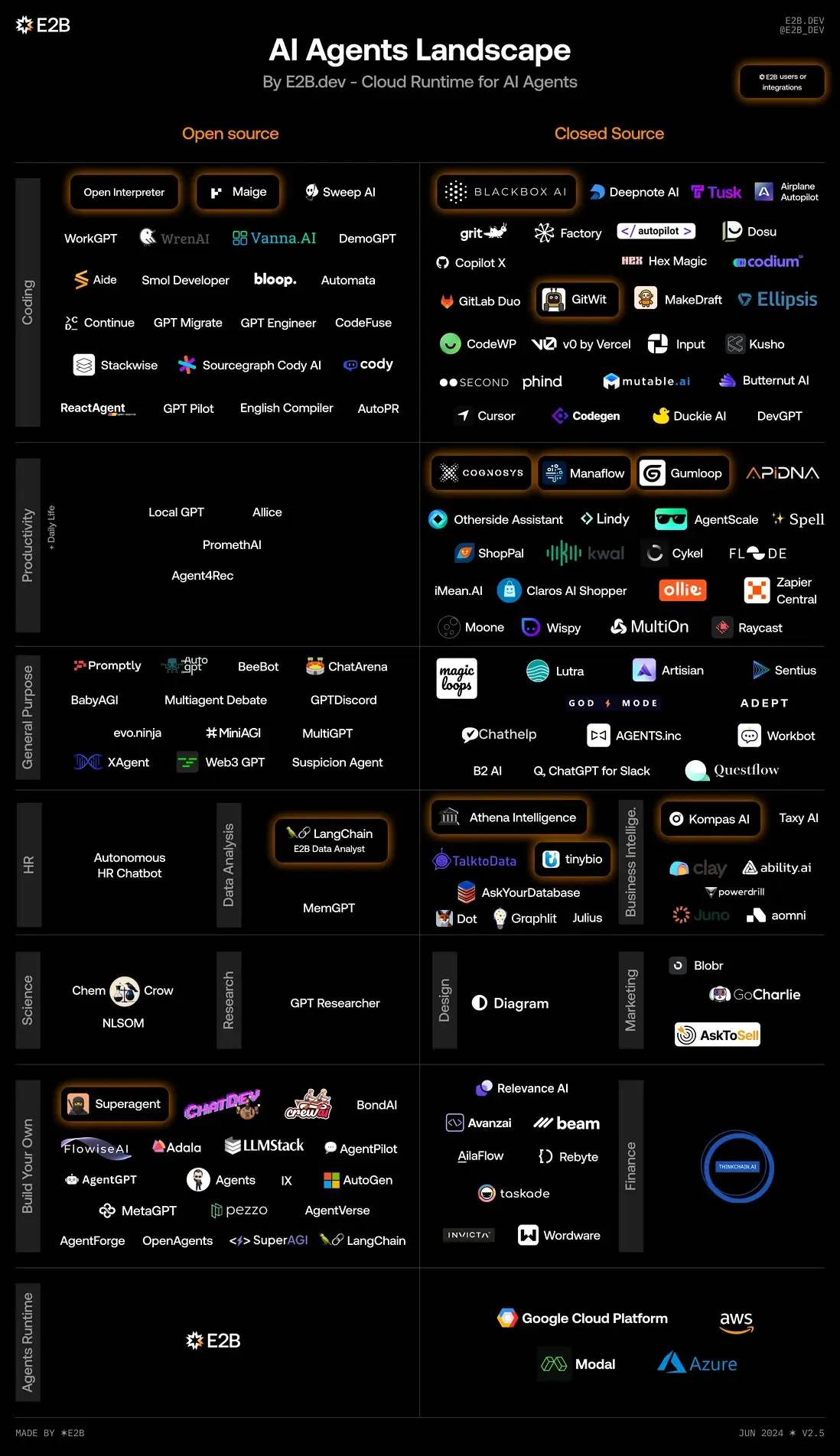
Finally, here’s a helpful framework diagram summarizing the current AI Agent landscape that I recently came across:
Join TechFlow official community to stay tuned
Telegram:https://t.me/TechFlowDaily
X (Twitter):https://x.com/TechFlowPost
X (Twitter) EN:https://x.com/BlockFlow_News
 @weihaoming