








5-Day 100% Surge: Examining Opportunities and Current Challenges in MEME Projects Through the CTO Dispute in the Slerf Community
TechFlow Selected TechFlow Selected
5-Day 100% Surge: Examining Opportunities and Current Challenges in MEME Projects Through the CTO Dispute in the Slerf Community
From viral meme sensation to facing community skepticism, what has Slerf been through?
 Navigating Web3 tides with focused insights
Author: Web3Mario
Summary: It's been a while, everyone. After taking some time off to rest and recharge both physically and mentally, I'm back to continue learning and sharing. Recently, market attention has largely been captured by China's stock market, while the crypto space hasn't lived up to pre-rate-cut expectations, appearing somewhat quiet. However, one event did catch my attention: a classic meme on Solana—Slerf, the sloth-themed token—is currently undergoing a CTO (Community Take Over) battle initiated by a Chinese-speaking community influencer within the Slerf ecosystem. As a result, Slerf’s price has doubled in just five days. Since I previously lacked sufficient understanding and reflection on memecoins, I see this incident as a valuable opportunity for learning. After researching it for some time, I’ve gathered some insights that I’d like to share and discuss with you all.
From Viral Meme to Community Backlash: What Has Slerf Been Through?
First, let’s briefly review the Slerf project. Launched in March 2024 by grumpy@youlovegrumpy on Solana, Slerf is a meme coin featuring a sloth as its central motif. At the time, the market was heavily influenced by the phenomenal wealth effect generated by BOME, which fueled a wave of memes promoting fair launches and presales as core selling points—and Slerf was among them. The project promised to allocate 50% of its total supply for presale, then inject all proceeds plus the remaining 50% into a DEX to provide liquidity for the trading pair, subsequently renouncing ownership over that liquidity. During the presale phase, it quickly raised about $10 million worth of SOL at approximately $0.02 per token. However, during TGE (Token Generation Event), due to a developer error, the team renounced minting rights before issuing the presale tokens—even after providing liquidity and locking funds. This meant that no participants could receive their purchased Slerf tokens, and since the raised funds were already locked in the liquidity pool, refunds became impossible.
This incident brought Slerf immediate widespread attention. On one hand, it effectively created a meme coin with a perceived floor value of $0.02 and zero circulating supply—meaning early buyers would have the lowest possible cost basis, dictated by the bonding curve mechanism on DEXs. This triggered massive FOMO, driving Slerf’s price from an initial $0.02 to as high as $1.2—a nearly 60x increase. On the other hand, the large number of affected presale participants represented significant follow-up traffic potential, quickly attracting attention and support from various institutions and projects. Many exchanges and prominent projects began offering compensation efforts as a way to gain visibility, including major platforms and well-known initiatives.
Leveraging this surge in attention, Slerf launched donation campaigns to compensate presale participants, with exchange LBank serving as the organizer. I believe the fundraising and repayment process was conducted fairly. Additionally, Slerf raised repayment funds through new NFT sales, ultimately collecting a total of 36,180 SOL.
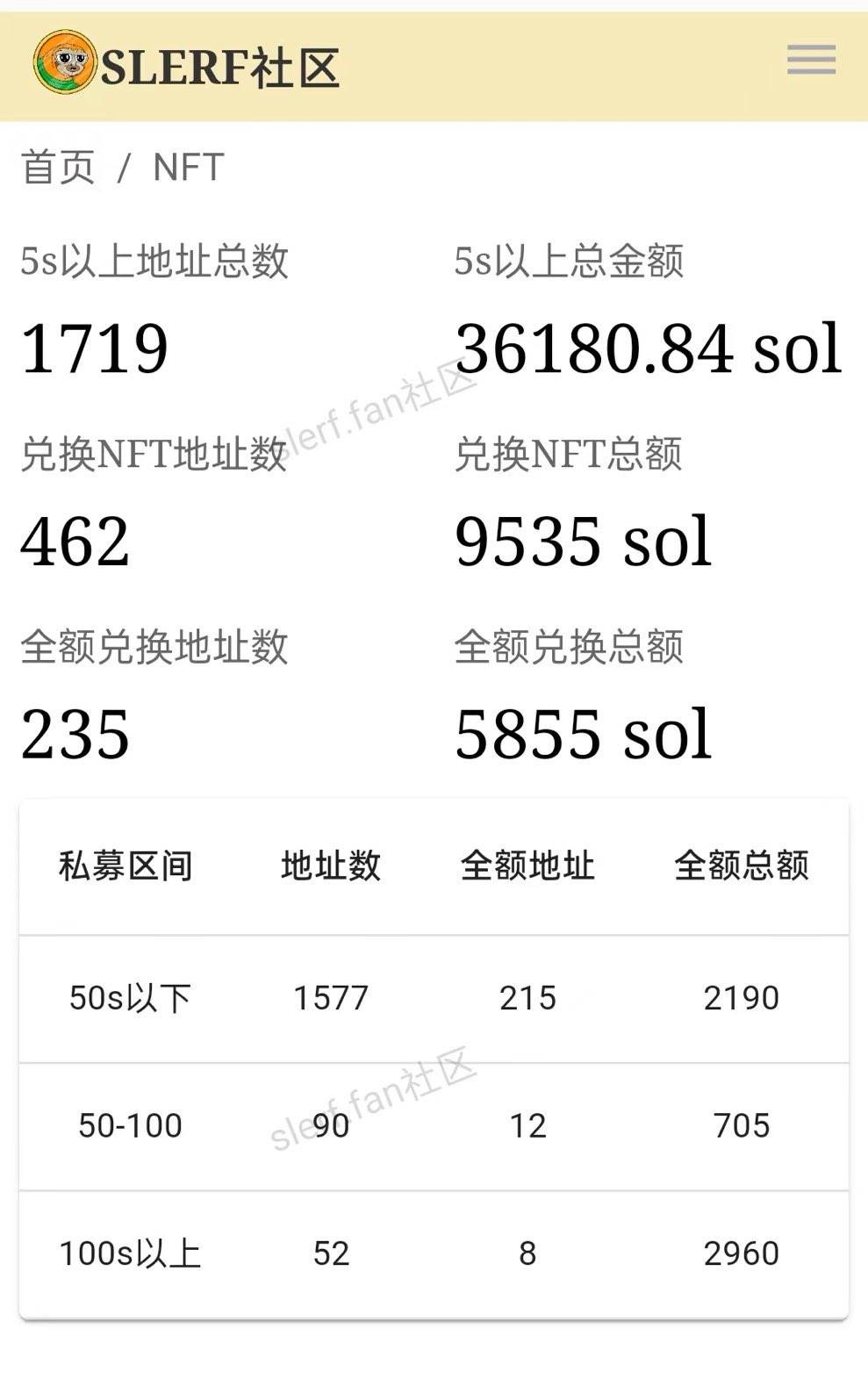
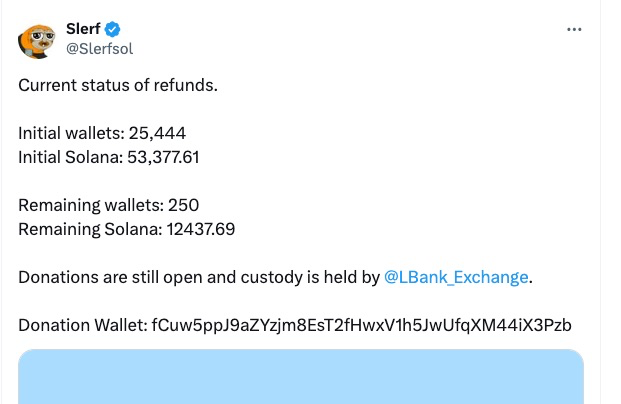
As of September 9, 2024, according to data published on the official X account, out of 25,444 presale participant addresses who collectively contributed 53,377 SOL, 25,194 addresses have been repaid with a total of 40,940 SOL. There remain 250 outstanding addresses owed 12,437 SOL, averaging around 60 SOL per address. This suggests the repayment strategy prioritized smaller contributors. But here lies a problem: once most small holders are compensated, the legal exposure faced by the founding team diminishes significantly, potentially reducing their motivation and effort to repay larger claims. Large investors may find it increasingly difficult to recover their funds. Meanwhile, as public attention fades, Slerf holders face declining prices due to lack of new buying pressure.
The recent CTO movement initiated by BillyWen@billywen_, a key opinion leader in the Chinese-speaking Slerf community, is a direct response to this reality. Fans often refer to him affectionately as "Fengjing Ge" ("Brother Scenery"), though the origin of this nickname remains unclear to me. My research indicates two main reasons behind his strong influence in the Slerf community: first, he holds a massive 500,000 Slerf position (possibly representing a token fund), and claims not to have sold during price downturns; second, he donated a staggering 6,778 SOL—worth about $1 million—to the Slerf relief campaign. On-chain data confirms these figures. Therefore, it's fair to say BillyWen stands as a highly committed and respected figure within the Slerf community.

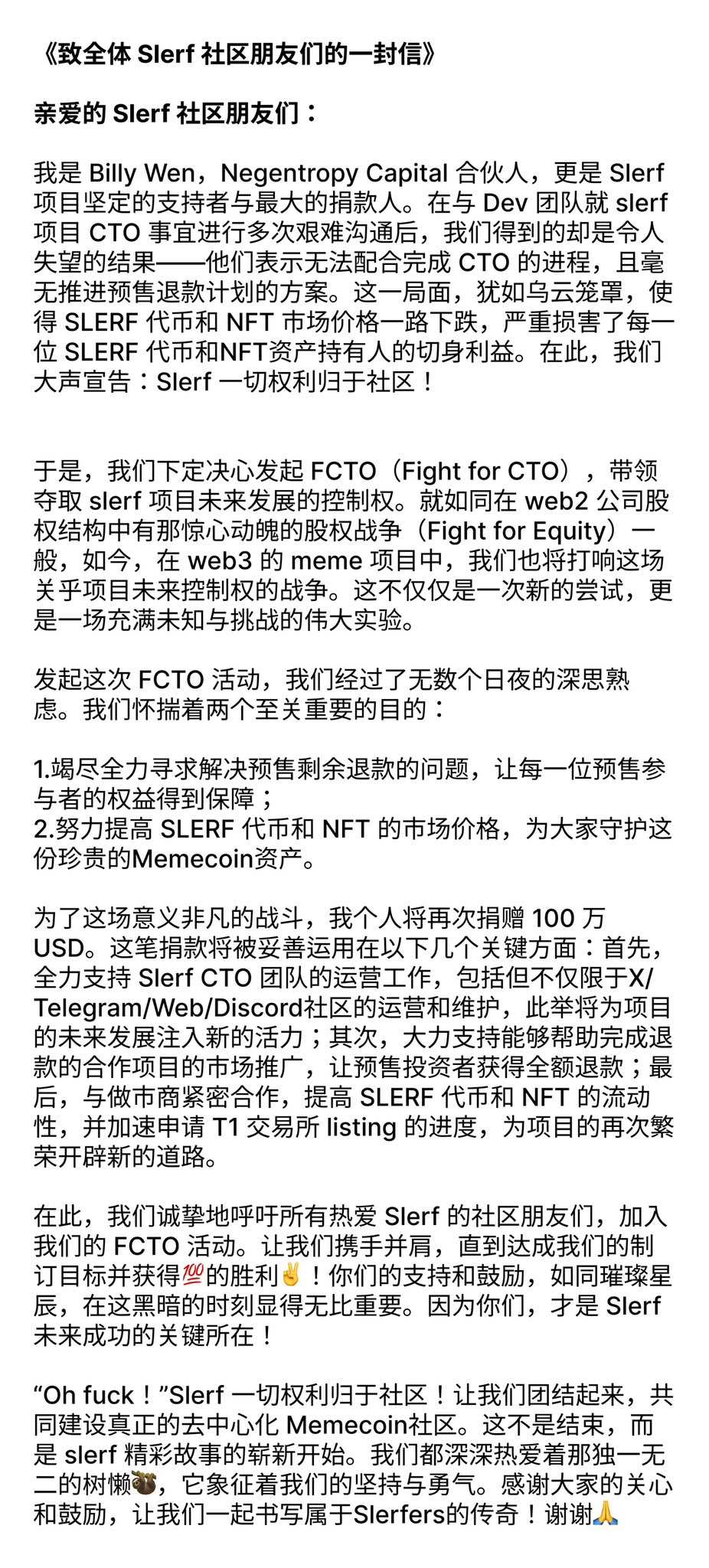
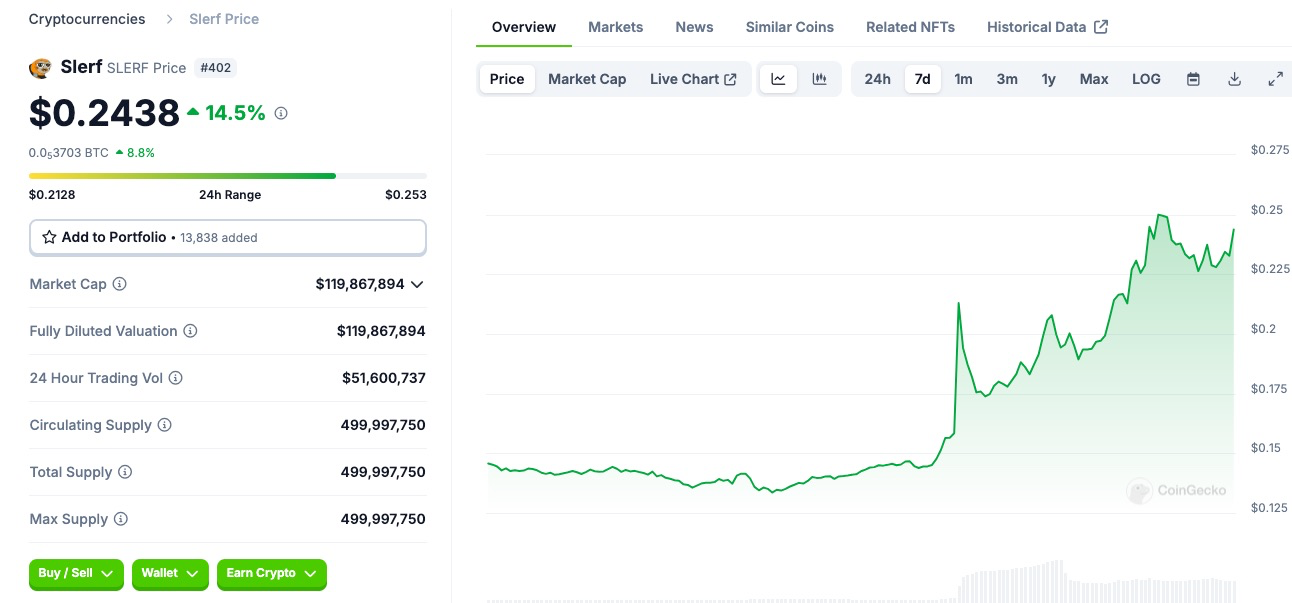
CTO stands for Community Take Over—a mechanism emerging in response to the proliferation of meme launchpads that have drastically lowered issuance costs, leading to numerous rug pulls where founding teams sell off immediately post-launch and abandon the project. Yet, some communities still maintain belief in certain projects and wish to revive them under new leadership. That revival process is known as CTO. Unlike DeFi protocols, most memecoins don’t require on-chain governance, so the most critical aspect of a CTO is gaining control of the project’s primary social media accounts. For example, Slerf’s official X account boasts 166,000 followers. On October 12, Billy announced that after being rejected in talks with the Slerf team regarding CTO, he would proceed with an FCTO—short for "Forced Community Take Over"—and pledged another $1 million to fund the new team’s operations. Specific execution details haven’t been fully disclosed yet, but this move clearly resonated with the Slerf community and won backing from investors, pushing Slerf’s price rapidly from $0.14 to $0.24.
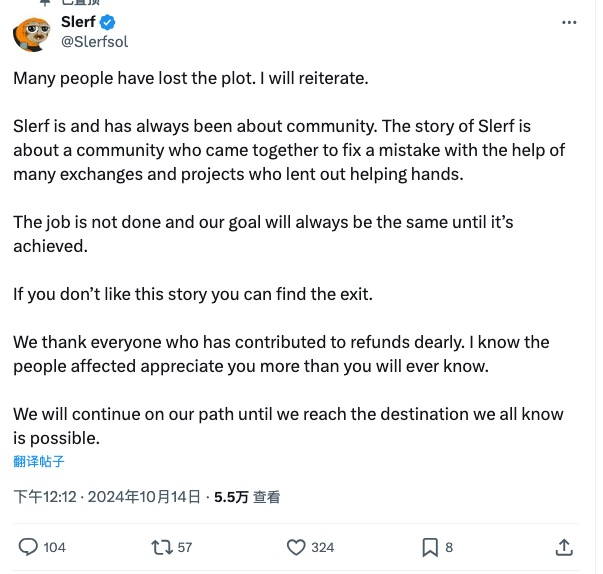
After a long silence, the Slerf team posted a cryptic message seemingly responding to the situation, highlighting their past efforts. However, the community remains dissatisfied with three specific actions: founder Grumpy leveraged Slerf’s influence to promote his newly launched projects—specifically $CUFF, $MEMECHAN, and $OODLES—all of which later suffered sharp price declines. Profits from these ventures were not reinvested into Slerf compensation or development, which the community views as a betrayal.
The above summarizes the background of the current Slerf incident. Regardless of how things unfold, I believe this is a noteworthy attempt that could significantly impact the operational paradigms of future meme projects. At the same time, I’d like to abstract a few observations about the broader meme sector for discussion.
Opportunities and Current Challenges in Meme Project Development
This analysis focuses on two aspects. First, why has the meme sector seen such rapid growth recently? I identify three underlying reasons:
1. Equal opportunity via fair launches, leading to more balanced risk-reward profiles for secondary market investors compared to VC-backed tokens: Traditional VC tokens are often criticized because VCs can leverage their influence to acquire cheaper allocations in private rounds before public listing, putting retail traders at a structural disadvantage in terms of entry cost. While common in traditional finance, the absence of robust regulatory oversight in crypto makes such advantages even more pronounced, indirectly increasing risks for retail traders. Fair launches level the playing field—retail investors enjoy equal access. Although whales benefit from higher absolute gains, their large capital size results in greater slippage during accumulation and exit. Retail traders, despite lower absolute returns, enjoy flexibility and agility, enabling solid returns if they actively trade and respond swiftly to market movements.
2. Low product cold-start costs: With numerous launch platforms available, development costs are minimal. Professional teams can operate at industrial scale with batch production capabilities, minimizing risk. Operational strategies resemble those used in NFT projects, making it easier to attract talent and users migrating from the cooling NFT sector.
3. No established valuation models: Unlike utility or security-based projects, memes derive value primarily from cultural resonance, making it difficult to establish standardized valuation frameworks. This frees them from constraints like P/E ratios, allowing elastic price movements, evenly distributed holding costs, and more active trading.
In light of the Slerf CTO incident, I also see several challenges facing the current meme landscape:
1. How to create sufficient and sustained incentives for meme founders to adopt long-term thinking: Most meme projects are run by founding teams, but for fair-launch models, long-term incentives for founders aren't clear. Beyond potential brand and traffic benefits, there's no reserved allocation for the team. Even if the token surges in value, the team cannot profit in the short term since all presale funds go directly into liquidity. Relaxing this requirement—such as allocating a small percentage to the team—might improve sustainability, but could dampen trader enthusiasm given how low the barrier to launching a meme truly is.
2. Is there a better governance model for meme projects to combat the ongoing dilution of liquidity? The rapid emergence of similar projects inevitably siphons liquidity away from any breakout meme, meaning meme projects face higher maintenance costs than others. Moreover, due to low entry barriers, founding teams may lack strong marketing or commercialization skills, insufficient to sustain long-term growth. This places greater demands on operator competence, yet the current ecosystem lacks effective governance models to address this. CTO appears to be a proposed solution, but since a meme’s core asset is traffic value—with limited on-chain components—traditional DAO tools struggle to enable credible transfer of such intangible resources.
3. If control over a meme project can change hands, then who should rightfully lead it becomes an intriguing question: the founding team, whales, or decentralized DAO governance? We've already discussed limitations of founding teams. Whale-led control brings its own issues—given that whales primarily seek speculative profits, this zero-sum game puts operators in conflict with regular users. Armed with inside information and large positions, whale operators face strong temptation to dump tokens for profit, exposing other participants to risk. Conversely, DAO-based governance suffers from inefficiency in execution.
Join TechFlow official community to stay tuned
Telegram:https://t.me/TechFlowDaily
X (Twitter):https://x.com/TechFlowPost
X (Twitter) EN:https://x.com/BlockFlow_News
 @web3_mario






