








Interview with Sui Co-founder Adeniyi: What Have We Done to Improve User and Developer Experience?
TechFlow Selected TechFlow Selected
Interview with Sui Co-founder Adeniyi: What Have We Done to Improve User and Developer Experience?
Adeniyi delved into the advantages of the Sui network and several practical use cases, discussing innovative applications on Sui.
 Navigating Web3 tides with focused insights
Source: Grayscale
Translation: Scof, ChainCatcher
Editing: Nianqing, ChainCatcher
This article features Grayscale's interview with Adeniyi Abiodun, co-founder of Sui. Adeniyi Abiodun is the co-founder and Chief Product Officer of Sui/Mysten Labs. Prior to founding Mysten Labs, Adeniyi led numerous R&D initiatives in blockchain and cryptocurrency at Meta, including the Diem (formerly Libra) network and the Move programming language. In this interview, Adeniyi provides an in-depth look at Sui’s advantages and real-world use cases, discusses innovative applications for both users and developers, and outlines Sui’s future direction.
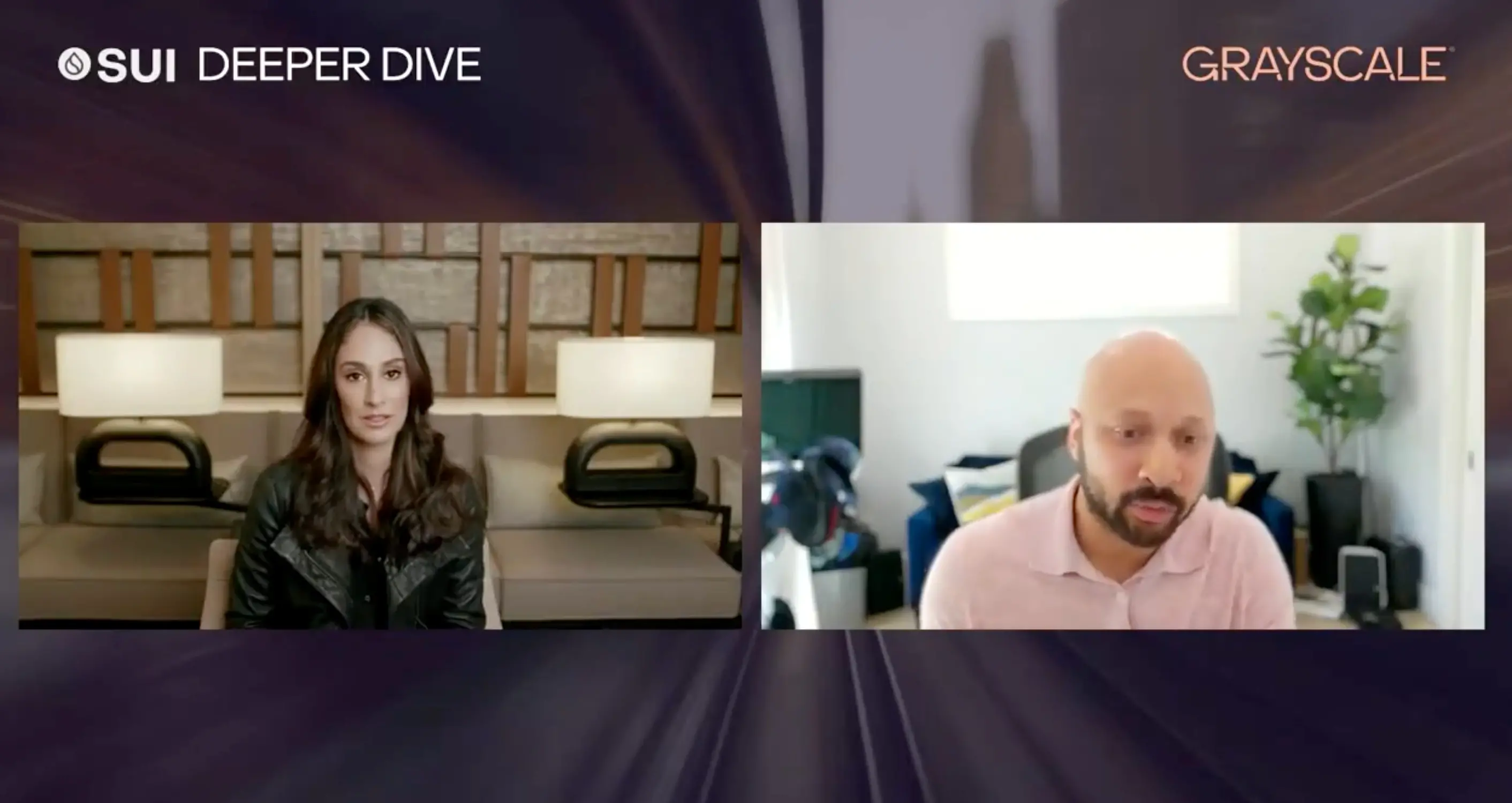
Full transcript below:
Grayscale: Hello everyone, welcome to Grayscale's deep dive into Sui. Today we're honored to have Adeniyi Abiodun, co-founder of Mysten Labs—the initial contributor behind the Sui blockchain. I’ll hand it over to Adeniyi first. Could you introduce yourself and tell us how Sui came about? For example, what problems were you trying to solve?
Adeniyi:
Sure, thank you. First off, thanks for having me. I'm truly honored to share the story of Sui. I’m one of the co-founders of Mysten Labs. We were original contributors to Facebook’s project formerly known as Libra. We later renamed it Diem, aiming to build a layer that would make sending money as simple as sending a message on WhatsApp or email. We wanted to simplify this experience because lowering adoption barriers and removing friction in transferring value could unlock countless financial opportunities previously impossible worldwide.
As many know, unfortunately, that project never materialized—it never launched. But for us, the silver lining was being able to pursue that vision outside of Facebook. Alongside fellow Libra R&D leads—including Sam Blackshear, creator of the Move programming language—we left Facebook and founded Mysten Labs. Our new mission went beyond what we started with Libra: building a global coordination layer. Our belief is that if developers can atomically coordinate user actions or intentions at scale, entirely new business models emerge—unlocking trillions in value for consumers and businesses alike. We believe entire ecosystems of users and developers can be built simply around coordinating user intent at massive scale. Hopefully that gives some context.
Grayscale: Before diving into technical details, let me ask a big-picture question: What exactly is Sui? Can you explain it as simply as explaining to a five-year-old?
Adeniyi:
Absolutely. The internet is amazing at transmitting data, right? If I want to send you a file, the internet was built for exactly that purpose—and it does it well. But now, if I want to send you value—say, money—the internet wasn’t designed to help us agree on a sequence of events or represent my intent atomically.
So what we’re building—what Sui actually is—is a global coordination layer for user intent. It allows developers to easily conceptualize and orchestrate what many users want to do simultaneously. For instance, imagine wanting to buy a plane ticket, pay for your hotel room, and book tour activities—all at once. On today’s internet, this process is fragmented—you’d visit five different websites, search, and reserve things separately. You might end up booking the hotel but missing the flight. But with a coordination layer like Sui, you could complete all these tasks with just one click.
So Sui isn’t just redefining blockchains. Sui enables developers to coordinate user intents atomically at an unprecedented scale. I’d love to dive into the tech, especially our innovations around object-oriented design—basically the ability to model everything as objects—which makes development incredibly accessible. To summarize: the internet excels at sending data, but struggles with sending value. Sui handles both exceptionally well, allowing you to do so seamlessly and programmatically in one go.
Grayscale: You’ve made a complex concept very clear. Now, I’d like to dig deeper: What makes Sui unique? Particularly its programming language, Move, which sets Sui apart from other Layer 1 blockchains. Can you elaborate on Sui’s advantages?
Adeniyi:
First, a quick note: during our time at Facebook, research led by SIM showed that we couldn't stand before regulators using Solidity or any existing language without guarantees of transaction correctness. There's a big difference between a transaction failing versus one that executes incorrectly and results in lost funds. Money holds value because you trust you can redeem it at face value. If programming bugs routinely lead to loss—as often happens in crypto—and with constant risk of hacks, we believed a billion-dollar exploit was inevitable, rendering VMs insecure. You can’t build a sustainable financial ecosystem around such risk.
That’s why we created the Move language—to ensure security—and after leaving Facebook, we further refined it to be more intuitive and developer-friendly. Traditional Web3 development revolves around account abstraction, but in the real world, everything is an object. Sui uses an object-oriented model that enables parallel transaction processing instead of sequential execution. For example, my transfer and someone else’s flight purchase can happen simultaneously, greatly improving efficiency. Sui has no maximum throughput cap; performance scales linearly as more machines join, preventing congestion. This full-stack innovation—from object model down to storage—mirrors how companies like Google and Facebook scale their infrastructure.
Grayscale: Speaking of speed, my next question naturally turns to performance and capabilities. Could you expand on that? How fast is Sui exactly? I used Sui today and had a fantastic experience—it felt blazingly fast. Can you share specifics about Sui’s speed, throughput, and how it compares to other blockchains today?
Adeniyi:
We set a bold goal for our team: make user interactions on the platform faster than loading a website. For example, executing a swap on Swand today completes in under 700 milliseconds—that’s finality, not optimistic confirmation. By comparison, the average website takes three seconds to load. That means Sui is 14x faster than Solana, revolutionizing finality.
This opens up entirely new use cases: games where every action is recorded on-chain, or concerts managing tickets directly on-chain—applications requiring ultra-low latency. Beyond low latency, Sui also delivers high throughput. Because each object in Sui is independent, validators can dynamically add or remove hardware based on demand. During peak times—like Christmas—more machines come online to handle increased transactions, then scale back afterward. This means Sui has no upper throughput limit.
Our current production system achieves roughly 297,000 peer-to-peer transactions per second on minimal hardware. Add seven times more hardware, and performance scales sevenfold—with zero increase in latency. Sui offers industry-leading throughput and the lowest latency, enabling frictionless user experiences. Applications run smoother, eliminating the traditional hassle of waiting for pages to load before trading.
Grayscale: That leads perfectly into my next question. What are people building? How are we using Sui? Who’s using it, and what kinds of applications are emerging on Sui? It seems an ecosystem is forming—one with huge potential to become highly significant.
Adeniyi:
In the early days of Sui, we identified a key goal: achieve a 100x improvement in a specific domain—not just 2x, since incremental gains don’t create transformative impact. We chose gaming, as it’s historically the earliest adopter of new technologies, driving advances in AI and high-performance computing. So Sui focused on solving ownership issues in games, successfully attracting major game developers including Korea’s top three publicly traded companies: NHN Entertainment, Netmarble, FNC, and NCSoft. Currently, around 75 publishers are building apps on Sui.
We’ve also launched the Sui Playser X One console, integrated with the advanced Playron operating system, enhancing the overall gaming experience across Web3 and Web2. Meanwhile, Sui hosts a robust financial ecosystem, ranking in the top ten for total value locked (TVL) in DeFi protocols—achieved in just 14–15 months. Sui’s unique decentralized finance tools, like AndIntent, allow coordination of up to 1,024 users or agents’ intents within a single transaction—an impossibility on other blockchains.
Another critical area is commerce. USDC is coming to Sui, and we’ve announced a partnership with MoviePass to redefine film financing and payment models. Additionally, Sui’s zk-login technology allows users to securely log in via Google or Facebook accounts and automatically generate private on-chain addresses—disrupting traditional advertising and creating novel forms of user engagement. This unlocks unprecedented innovation opportunities for Web3.
Grayscale: User experience—an exciting theme for us—is central to our thinking about interfaces and their crucial role in driving the next wave of crypto and blockchain adoption. Underlying this simplicity is a sophisticated stack. You’ve done something different with zk login. Let’s talk about zk login and what it means for abstraction and user experience.
Adeniyi:
In my view, wallets are the worst user experience we’ve ever imposed on people. Imagine getting ready to play a game or make a trade, only to be asked to download an app, buy tokens, and go through complicated steps—this kills interest instantly. Web2 nailed user experience, and we should learn from it.
On Sui, we introduced the world’s first zero-knowledge proof (zk) login system. Users can securely create Sui accounts using existing OpenID providers like Google or Facebook—no need to remember seed phrases. If you forget your password, just reset your Google account; your funds remain safe. This lets users join without learning new concepts.
We also incorporate sponsored transactions, where developers pay gas fees on behalf of users, shielding them from the complexity of “gas.” Finally, our naming system (CNs) eliminates the need to memorize long addresses. Users can send funds via simple domain names, like “stashed.app.”
Together, these features blend Web2’s ease-of-use with Web3’s technological strengths. Sui delivers the best-in-class user experience, ideal for mass adoption, while reducing friction for developers building apps that feel native to Web2.
Grayscale: What you’re describing is indeed a massive leap forward—it mirrors the familiar experience of sending money via email or Venmo, something many of us now do effortlessly. Can you walk us through a concrete demo?
Adeniyi:
Sure, let me share my screen. Okay, I have a few demos to show you. (Refer to original video for visuals.)
Sui delivers seamless user experiences, letting users transact without complex steps. For example, transfers happen instantly—no worrying about long addresses or keys. Take Stashed, an app built on Sui: it lets users log in with their Google account and create a simple username, replacing traditional wallet operations entirely.
With Stashed, I can send funds using just a username—no need to recall or enter lengthy addresses. It feels just like traditional Web2. Without downloading a wallet, I can even use Hop aggregator to swap tokens, streamlining the whole process. This intuitive design removes the cumbersome steps typical of legacy blockchain systems, making Sui easy for anyone to pick up and use.
I want to show you something called CNS (Composable Naming System). Here’s an NFT I own—a shirt and a pair of goggles—showcasing Sui’s composability. Everything is an object, easily merged or split.
I’m connected to my Sui wallet and can see my NFT. I can choose to wear an item or take it off. Imagine doing this instantly while playing a game. After saving changes and approving, my NFT updates—now only one NFT remains in my wallet.
On Sui, asset history and provenance are preserved in real-time and recorded directly on-chain, thanks to our object model. Users don’t risk burning an NFT and losing all historical data. When I check the block explorer, I can see the full combination history. For example, if an asset was originally created by Stephen Curry, I can verify he was the direct builder—adding significant value to the asset.
One key aspect of UX we prioritize is simplifying workflows. Suppose I want to convert 10 SUI into USDC and deposit it into a lending pool. In other ecosystems, this usually requires multiple steps: swap first, then transfer to the pool. On Sui, one click automates both—now the USDC is swapped and deposited.
Moreover, Sui allows handling multiple distinct intents in a single transaction—like buying concert tickets, converting them to USD, and using those dollars to pay for vacation expenses. Such complex flows are difficult or impossible on other blockchains due to architectural constraints. But Sui’s unique design makes them fast and natural. In the future, we’ll roll out auto-approval features, allowing users to grant one-time permissions to trusted apps, eliminating repeated confirmations.
Wallets like Stashed exemplify this simplicity. They free users from remembering addresses or worrying about gas—all handled seamlessly in the background. This is a critical step toward realizing our vision: smoothly transitioning Web2 users into Web3.
Grayscale: Yes, I definitely need a new wallet for my Sui. So what happens then? What do I need to remember? If I open Safari and think, ‘Wait, I had some value stored somewhere,’ what do I need to recall to access that value?
Adeniyi:
All you need is your Google email account. If you use Google to store value, that’s it—nothing more. Whether you log in via Twitter, Facebook, or any existing identity, once authenticated, your value is there. These primitives are built directly into the chain, making integration effortless. For example, you could set up multi-sig for your $100 worth of assets—easy.
Grayscale: That brings us back to speed, right? I remember years ago when sending something, if you hadn’t received confirmation within half an hour, you’d almost cry, unsure whether you’d permanently sent value into Ethereum limbo. So yes, it looks like you’ve built—and continue optimizing—a blockchain designed to delight users. For us, abstracting away the user experience is a massive stepping stone toward widespread adoption.
Adeniyi:
Exactly why we’re seeing strong institutional interest and growing attention from consumer brands. They’ve tried various approaches before, but at scale, those solutions break down—or they’re forced to expose users directly to blockchain interactions within their apps. Now we’re saying: forget all that. Just build your app as you normally would, using your standard login mechanism. Users gain true ownership under the hood. You don’t need to teach them about addresses or blockchains. Instead, you give them the ability to send value seamlessly—from app to app, wallet to wallet, name to name. It becomes completely natural. I use application logic to send emails today—I’ll use the same mechanism tomorrow to send value across ecosystems.
Grayscale: That’s precisely why we hope the next generation of users won’t have to endure the magical ordeal of losing seed phrases or transacting thousands of dollars on-chain. Let’s shift gears and talk about the token. Of course. Let’s discuss the token—how does it fit in? How is it used? Tell us about supply and demand dynamics.
Adeniyi:
The Sui token is primarily used to pay gas fees for transactions, store data on-chain, and reward validators. Its storage costs are significantly lower than other blockchains, making it economical to store data like NFTs directly on-chain. As more data is stored, increasing amounts of Sui get locked up, creating a semi-deflationary effect. Users can stake Sui to earn yield, and through the Storage Fund, they can burn obsolete NFTs and receive 99% of the storage deposit back. The entire economic model was designed by Chief Economist Lonz Deatari, aiming to effectively manage on-chain data value through incentives.
Grayscale: Turning to mass user acquisition—what use cases or developments do you see in the near or mid-term that could drive large-scale adoption?
Adeniyi:
In Web3, gaming holds the greatest potential to drive widespread adoption and will likely catalyze the growth of decentralized finance (DeFi) at scale. We focus on user engagement rates—how many users interact with multiple apps rather than isolated silos.
There are about 3.3 billion gamers globally, who spent $200 billion last year—offering immense opportunity for user acquisition. Games require users to exchange in-game assets or NFTs, facilitated by built-in DeFi mechanisms.
Currently, DeFi is mostly accessed directly via websites, but users care more about seamless experiences—like easily swapping game items. Sui reduces friction so much that even mainstream users will participate willingly. They won’t worry about gas fees, which remain stable regardless of Sui’s market price.
Grayscale: We have about five minutes left. I’d like to take a few investor questions—could you compare Sui with Aptos, and differentiate Sui’s exposure from Solana’s? Maybe briefly—what are the key differences?
Adeniyi:
First, Sui and Aptos are often confused, but they originated from two separate teams at Facebook. Our team focused on foundational research and science to support blockchain deployment. When we left Facebook, we decided not to reuse prior code, opting instead to build a completely new platform—ensuring faster development and regulatory compliance.
We moved quickly with Sui because we carried no technical debt, whereas Aptos builds upon Facebook’s original Libra infrastructure, albeit with updates. We believe Sui’s architecture is far more scalable. We also have more developers than Aptos, and the development experience differs drastically from both Aptos and Solana. In fact, many top developers who worked on Solana say Sui’s dev experience is ten times better. While we deeply respect Solana’s achievements, we believe Sui will bring even greater transformation.
Grayscale: The theme of experience keeps coming up. So I’ll pick another developer-focused question: How difficult is it for developers switching between different programming languages?
Adeniyi:
We find developers typically spend between four hours and four days learning Move before shipping useful applications. That’s because Sui’s design closely mirrors traditional object-oriented programming—developers don’t have to wrestle with account complexities, making onboarding feel natural.
There are over 9 million JavaScript developers worldwide, yet only about 20,000 active developers in the entire Web3 ecosystem. Our goal is to attract that 9+ million—a vastly larger opportunity than the current Web3 market. Move currently represents about 6–7% of Web3 developers and is growing rapidly. We expect our next capital update to reflect significant growth. Ultimately, developer experience is central to Sui—that’s our key differentiator.
Grayscale: Again, whether it’s developers or everyday consumers interacting with the chain, the idea of experience boils down to meeting people where they are.
Adeniyi:
If you’re building a developer platform, you must ask: who uses it? Developers build for consumers and enterprises—and those are people. So we must enable the simplest possible path for users to join. We start with the user, then the developer, and work backward to build a platform where developers can serve users effectively. Most Web3 infrastructure today is built for infrastructure’s sake, not for users. We took a strongly product-centric approach to building infrastructure—an approach we’re very comfortable with. We’ve been building infrastructure for decades.
Grayscale: Alright, time’s up. Thank you so much for taking the time to sit down with me. And thank you to everyone who called in. I hope you all have a wonderful day and week ahead.
Join TechFlow official community to stay tuned
Telegram:https://t.me/TechFlowDaily
X (Twitter):https://x.com/TechFlowPost
X (Twitter) EN:https://x.com/BlockFlow_News
 @Grayscale






