









From Crypto Enthusiasts to Mass Adoption: Deep Dive into Cryptocurrency User Experience
TechFlow Selected TechFlow Selected
From Crypto Enthusiasts to Mass Adoption: Deep Dive into Cryptocurrency User Experience
User experience is the most important infrastructure before the wave of large-scale applications.
 Navigating Web3 tides with focused insights
Author: Pzai, Foresight News
Since the inception of blockchain, crypto enthusiasts have aimed to build a rebellious and fundamentalist environment and architecture for interaction—one that ensures purity while simultaneously creating certain barriers. As more and more ordinary people begin participating in blockchain ecosystems, user experiences trending toward mass adoption will determine how the next billion users navigate the vast ocean of crypto.
When traditional user experience design collides with the new architecture of blockchain, we must consider how to dismantle the existing gaps between them. This article dissects user experience architecture piece by piece, offering a glimpse into the future formation of UX in the crypto space through the lens of its historical development.
Paradigm Shift: From Personal Homepages to Free Money
In human interaction with self-constructed information networks, paradigm shifts have always been measured in "years." In the early internet era, most users hosted their own personal homepages, building information networks based on individual connections. The corresponding user experience was largely derived from implicit social ties and a sense of belonging formed through the network (or rather, users themselves participated in shaping the experience as part of the network). A clear example is that early internet communication carried strong ideological overtones, and the deconstruction of language output (e.g., GM :) ) profoundly influenced the primitive forms of communication across later internet culture.
Subsequently, with the trend toward network centralization, a group of internet companies began aggressively expanding their territories, and most of the user experiences we use today originated from this period. During this phase, users started losing their dominant role online, replaced by centralized, intensive service models. It may also have been during this time that product designers began emphasizing user experience—because for centralized services, smoothness in interactions designed for the masses determined competitive advantage, a point proven by the growth of mobile internet. Zhang Yiming of ByteDance believed recommendation algorithms could deliver highly personalized, customized content aligned with user psychology, leading to the creation of TikTok.
In today’s crypto space, I believe it has undergone both of these phases within just over a decade. Initially, it emerged as an ideological offshoot of cypherpunks and a symbol of free money, where users could engage in multiple ways (e.g., running full nodes or contributing to technical proposals). Later, as major players flooded in and asset scale and diversity expanded dramatically, user experience has increasingly become a key consideration in protocol design. If we view these paradigm shifts as a linear progression, crypto represents a return to past ideologies under conditions of centralization, using this reversion to generate and nurture new paradigms of interaction and experience. As large-scale applications draw near, we need to find the Nash equilibrium among these elements—thus requiring deeper analysis of crypto user experience.
What Is Crypto User Experience?
The term "user experience" originates from cognitive psychologist Donald Norman, referring to a purely subjective feeling established during a user's interaction with a product. Originally a psychological concept emerging alongside the rise of usability and human-computer interaction in the last century, even when computer technology was not yet widespread, researchers were already studying the interaction processes and outcomes between human physiology, psychology, and machines—giving birth to the concept of user experience. In cognitive psychology, user experience is defined across three levels:
-
Visceral Level: The visceral level reflects instinctive reactions, focusing on aesthetics and creating a positive first impression, primarily related to visual experience, brand perception, and browsing experience.
-
Behavioral Level: The behavioral level concerns how users feel during interaction with an application, including functional, content, and interactive experiences, mainly tied to application usability.
-
Reflective Level: The reflective level is the highest tier of user experience, aiming to shape a project’s brand value, create memorable experiences, evoke pleasure and satisfaction, foster a sense of identity, and enable users to enhance their self-worth through interaction.
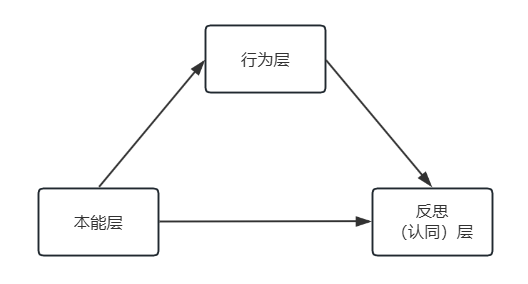
Hierarchy of User Experience
Within this framework, we can abstract the layers of crypto user experience by incorporating characteristics unique to the crypto domain:
-
Crypto Visceral Layer: As one bloom among many in the diverse ecosystem, a crypto project’s initial appeal lies in community atmosphere and frontend presentation, which together form users’ first impressions and lay the groundwork for reflective-level experiences.
-
Crypto Behavioral Layer: This can be divided into two parts: front-end interaction and smart contract engagement. Frontends, built upon contracts, can layer richer experiences atop on-chain assets—for instance, Farcaster Frame optimizes user interaction by integrating on-chain activity with off-chain visualization (rather than limiting usage to mere on-chain financial transactions).
-
Identity Layer: Through the combined effect of the previous two layers, users come to understand a project’s brand value, develop loyalty within the community, gain emotional value through various incentive mechanisms, and gradually participate in protocol governance—evolving into “loyal users” who actively contribute to the protocol’s growth.
However, before these layers truly form a closed loop of crypto user experience, many projects still fail to recognize the importance of UX after years of development. Due to legacy issues and inherent traits of the crypto space, they often cannot effectively build meaningful user experiences. Therefore, this article explores how crypto UX must transcend its current state—and even surpass all other forms of user experience.
How Do We Build It?
The transition from Web2 to Web3 involves significant changes. For example, if users want to transfer assets on-chain, remembering passwords alone isn’t enough; if they wish to invest in on-chain products, they must bear the risk of smart contract exploits. These learning barriers are acutely felt at the behavioral level of user experience and are precisely what deter many potential users. The unique environment spawned by the crypto space presents additional challenges to UX migration, manifested in the following aspects:
-
Isolated Circulation Systems: Most users’ needs for transferring crypto assets currently rely heavily on centralized exchanges or onramp/offramp services, severely restricting cross-system liquidity. This isolation not only limits cross-platform applicability (let alone the fragmentation between different blockchains within the broader ecosystem), but also indirectly creates a gap in frontend experience compared to traditional applications, thereby impairing perception at the behavioral level.
-
Cultural Differences: Early cypherpunk culture emphasized extreme technical pursuit, and cryptography-related fields have traditionally been niche communities with limited outreach—resulting in reduced emphasis on frontend interaction design. Designs catering to users’ instinctive responses remain minimal (for example, assuming users are inherently lazy, the optimal way to present a transaction would be one-click execution, but this contradicts self-custody principles). Additionally, due to high composability at the infrastructure level and complex token economics, frontend design primitives in many crypto projects lack consistency compared to traditional design, causing fragmented user journeys and suboptimal solutions in many cases (some DeFi protocols restrict LP distribution across chains, forcing users to locate specific DEXs to achieve optimal trading depth).
-
Poor User Sustainability: If part of the user base could achieve long-term retention throughout the industry’s evolution, user experience would naturally become a subset of that success. But amid constant churn, most users never encounter crypto projects capable of reshaping their sense of self-identity. Evidence shows that current product cycles in crypto are fundamentally incapable of achieving sustainable growth in the traditional sense.
Yet the uniquely strong composability of crypto also generates novel interaction layers. While these layers interconnect, they ultimately define the zero-to-one user journey. Yu Jun, former Chief Product Officer of Baidu, once said: “Every interaction between a user and a product is essentially a transaction. Users may not pay monetary costs, but they do expend time, cognitive load, and mental effort. Every detail in interaction and experience design essentially reduces the user’s transaction cost while increasing the benefits gained during the exchange.” Jon Crabb, founder of Web3UX, divides Web3 user experience into four layers: Visual, Functional, Access, and Technical Architecture.
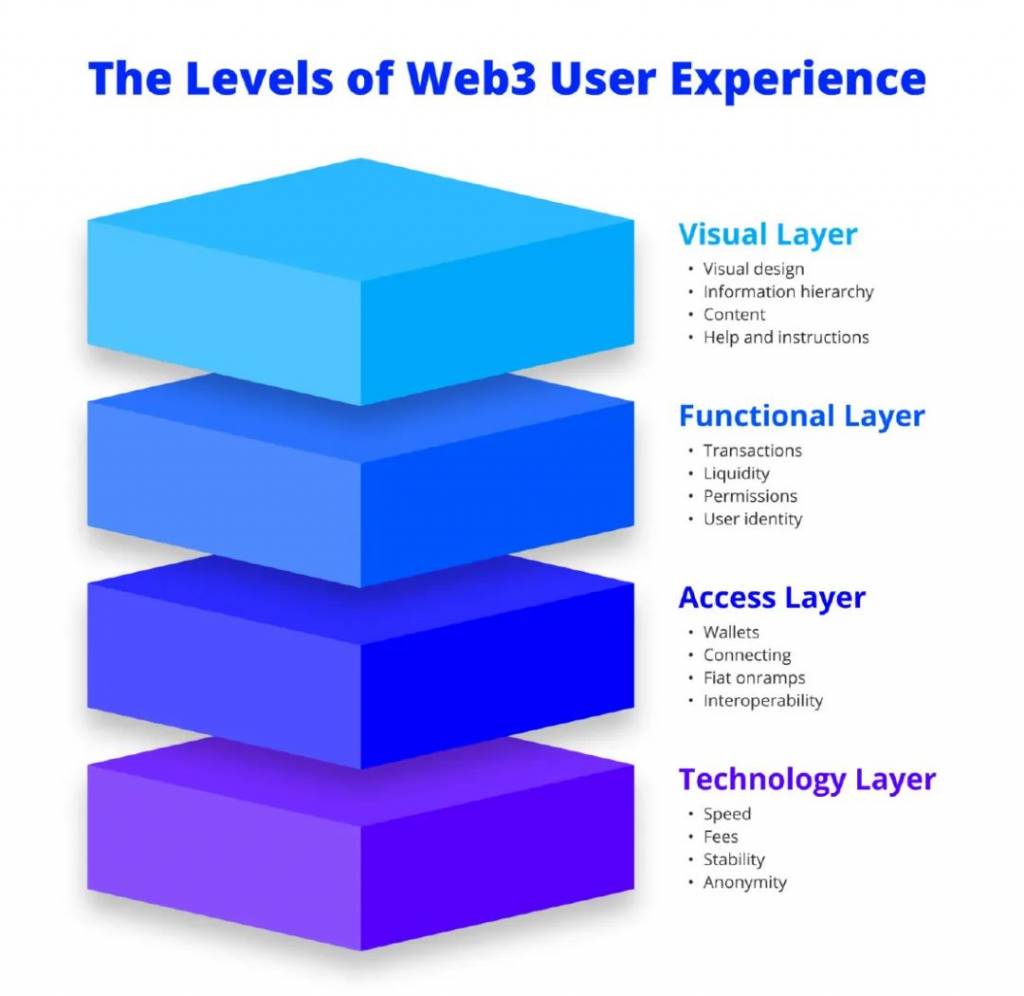
The Four Layers of Web3 User Experience – Source: Jon Crabb
Visual Layer
At this level, UX design closely resembles that of Web2. However, due to differences in each protocol’s ecological positioning, design styles vary significantly. Overall, designs at this layer should maximize accessibility—by minimizing jargon, highlighting core protocol functions, and improving clarity.
Functional Layer
In Web3, smart contracts serve as the foundation for nearly all operations. Algorithms and assets derived from smart contracts—such as AMMs and NFTs—create experiences distinct from traditional systems. However, this structure complicates understanding and execution of transactions, and governance derived from it remains accessible to only a select few—a critical factor in building user identification with a project. Thus, at the functional layer, we can introduce automated strategies for transactions, unify experiences (e.g., cross-chain account and asset uniformity to prevent transaction failures due to asset discrepancies), simplify front-end operations via aggregators, enhance governance functionality, and enable NFTs to provide utility in specific contexts.
Access Layer
Users typically access protocols via wallets (software or hardware). An intuitive wallet can greatly simplify setup processes. Many technical solutions are now advancing toward this goal (e.g., Passkey login or account abstraction wallets). Additionally, sufficient fiat service providers are needed to ensure seamless onboarding of real-world funds onto the chain. For address readability, on-chain naming services like ENS and 3DNS are creating increasingly user-friendly environments. In the future, we might even transcend current internet interaction paradigms, making on-chain participation the primary mode of engaging with digital activities.
Technical Layer
Compared to traditional payment systems, blockchain can already achieve second-level confirmations. Yet when used merely as a settlement layer for on-chain economic activity, this is far from sufficient. Demand for stablecoins is growing visibly, not to mention the vast depth of on-chain economic activity yet to be explored. Thus, building the technical layer of user experience means “speeding up and lowering fees.” Once massive transaction volumes can be processed in seconds, all economic activities will thrive collectively. Furthermore, to strengthen connectivity between on-chain and off-chain economies, more transaction verification infrastructure (such as ZK-proof layers) is required.
Leveraging Strengths, Mitigating Weaknesses
At this year’s EDCON, Ethereum co-founder Vitalik shared a comparison of the evolution of decentralized Twitter. The earlier version, EtherTweet, was built on simple transactions and featured a crude interface, lacking any semblance of a social media platform. The latter, Firefly—a decentralized social app—boasts a frontend comparable to Twitter’s modern UI.
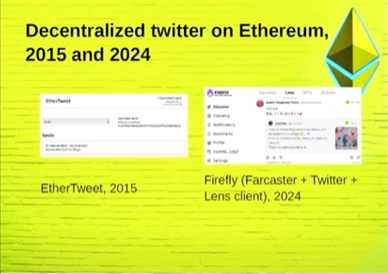
Analyzing this through the earlier framework, Firefly improves upon several key areas:
-
Frontend Uniformity: Firefly delivers a “unified” social media experience, with consistent interfaces and interaction patterns that lower user entry barriers. Aggregated experiences allow users to manage complex information flows within a single interface.
-
Reduced Experience Gap: By mirroring X’s (formerly Twitter) interface, Firefly minimizes users’ learning curve, narrowing the overall experience gap.
-
Better Infrastructure: Without foundational protocols like Lens and Farcaster, Firefly would merely be an “X Plus” rather than a true decentralized social platform. The key lies in infrastructure providing a foundation that matches—and exceeds—existing user experiences.
Future potential applications should focus on the following aspects when constructing user experience:
-
Initial Impression & Onboarding: Projects can cultivate community identity through recognizable schemas (e.g., public chains often leverage well-known memes like Pepe, combined with signature color schemes to amplify community vibe). Tight integration between frontend and community enables users to form initial perceptions directly through participation.
-
Mid-Term Behavior Building: Using incentive mechanisms and tokenomics, projects can tailor ecosystem experiences to individual users while establishing standardized interaction patterns. Immediate feedback on user actions helps build a highly sticky, sustainable interaction model.
-
Long-Term Identity Formation: A user’s sense of self-worth emerges jointly from behavior and sensory input. After initial UX construction, reinforcing users’ sense of participation—through governance or ecosystem events—strengthens their self-perception and generates sustainable value for the project.
Join TechFlow official community to stay tuned
Telegram:https://t.me/TechFlowDaily
X (Twitter):https://x.com/TechFlowPost
X (Twitter) EN:https://x.com/BlockFlow_News
 Foresight News











