Beyond robots, AI agents will drive the next wave of enterprise automation
TechFlow Selected TechFlow Selected
Beyond robots, AI agents will drive the next wave of enterprise automation
Explore how AI agents can be applied in enterprises to drive a new era of automation.
 Navigating Web3 tides with focused insights
Authors: JP Sanday, Steve Sloane, Naomi Pilosof Ionita, Derek Xiao
Translation: TechFlow
Every job in the economy can be viewed as a collection of tasks jointly performed by humans and machines. Over the years, software has gradually taken on more and more of these tasks, yet even today, humans remain responsible for the vast majority of business processes. In every functional area, personnel costs far exceed software spending.
AI agents are poised to decisively shift this balance. Unlike past software that primarily handled low-level, sequential, and mechanically executable tasks, new cognitive architectures enable agents to dynamically automate end-to-end workflows. This isn't just AI that can read and write—it's AI capable of determining application logic flows and taking actions on your behalf.
They represent the largest opportunity for large language models (LLMs) in enterprises today. In another article, we discussed the definition of these new "agents" and the design patterns enabling them. Here, we explore how they will be applied within enterprises to usher in a new era of automation.
Deja Vu with Robotic Process Automation (RPA)?
If this sounds familiar, it's because over the past decade, companies like UiPath and Zapier have been marketing similar visions under the banner of "robotic automation."
UiPath was first to market. The RPA giant’s core offering enables “robots” to record user actions and replicate those sequential steps to automate processes—such as extracting document information, moving folders, filling out forms, and updating databases—via screen scraping and GUI automation.
Later, iPaaS providers like Zapier emerged with a lighter-weight approach focused on “API automation” to boost productivity. Their platforms deliver more stable automation through pre-built API integrations and webhooks, though this confines their scope to web applications, whereas UiPath can automate across different software—including legacy systems lacking APIs.
UiPath and Zapier demonstrated strong demand for composable, rule-based horizontal automation platforms that solve long-tail process challenges both inside and outside enterprise-specific or industry-specific software systems. However, as organizations scaled robotic automation, gaps began to emerge between what these traditional architectures could deliver and the autonomy they promised—particularly in the following areas:
-
(Still) highly manual and labor-intensive. Despite talk of robots and automation, building and maintaining automations remains extremely tedious. In fact, for every $1 UiPath earns, $7 goes to implementation and consulting partners like EY, resulting in long and expensive deployment and maintenance cycles.
-
Fragile UI automation or limited API integration. UI automation frequently breaks when software interfaces change, while APIs are more stable but offer fewer integrations—especially with legacy or on-premise software.
-
Difficulty handling unstructured data. Unstructured and semi-structured data account for 80% of enterprise data, yet rule-based automation struggles to intelligently process it. Intelligent Document Processing (IDP) solutions like Hyperscience and Ocrolus have made progress here, but still face challenges with edge cases and exception handling in basic “extract and transform” document use cases.
Moreover, even when attempting to incorporate LLMs, traditional RPA and iPaaS solutions remain constrained by their deterministic architectures. Today, UiPath’s AI solution Autopilot and Zapier’s AI Actions only use LLMs within sub-agent design patterns, such as (1) text-to-action, or (2) nodes for semantic search, summarization, or one-off generation.
These AI features are indeed powerful—they allow business teams (not just IT) to define automation rules, enable stronger object detection using visual Transformers instead of OCR, and support robust data extraction and transformation via RAG. Yet they still fall short of realizing the more transformative use cases of LLMs in process automation, which we’ll examine next.
The Role of AI Agents as Decision Engines
Agents are fundamentally different. Positioned at the heart of application control flow as decision engines, they contrast sharply with today’s hardcoded RPA bots—and even with the RAG applications that defined the first wave of the generative AI revolution. For the first time, agents enable adaptive multi-step operations, complex reasoning, and robust exception handling.
To illustrate their impact, consider invoice reconciliation. Below is a simplified flowchart showing how a new invoice PDF might be matched against a company’s general ledger—a task often modeled visually by implementation engineers for RPA:
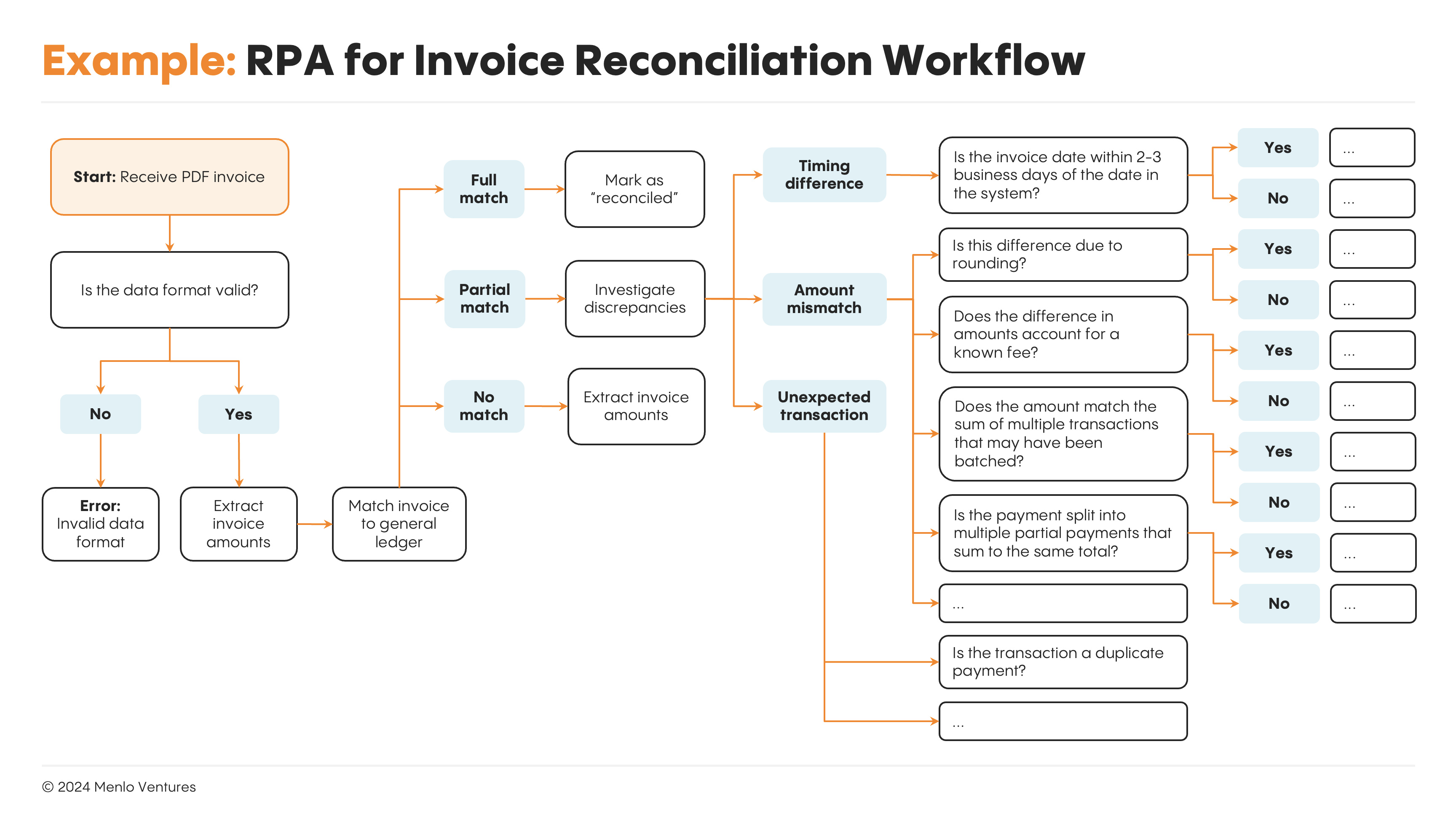
Clearly, workflow complexity escalates quickly, making it nearly impossible to cover all relevant edge cases and exceptions within the first three decision points. Typically, an RPA bot tasked with mechanically executing this workflow would fail and escalate partially matched or missing entries to humans—perhaps explaining why most enterprises still employ hundreds of people monthly to perform this highly manual task rather than fully automating it.
When applied to the same workflow, however, agents perform significantly better, enabling:
-
Adaptation to new environments. Agents can intelligently identify and adapt to new data sources, invoice formats, naming conventions, account numbers, and even policy changes based on basic reasoning and business context—without reprogramming or reliance on explicit SOPs.
-
Support for multi-step actions. When invoice amounts don’t match, agents can conduct multi-step investigations—for example, scanning recent supplier emails for potential price change notifications.
-
Complex reasoning capabilities. For instance, reconciling international supplier invoices requires considering multiple factors: invoice currency, ledger currency, transaction date, exchange rate fluctuations, cross-border fees, and bank charges—all of which must be retrieved and calculated together to complete payment reconciliation. Agents can handle such intelligent operations, while RPA bots would likely escalate the issue to a human.
-
Handling uncertainty. Agents manage uncertainty by leveraging contextual clues—such as matching total order value, historical invoice timing, and frequency—to resolve rounding errors or unreadable digits in individual line items.
Current State of the AI Agent Market
Agents are no longer science fiction. While still evolving, both startups and Fortune 500 companies are already buying and deploying these systems at scale.
The current agent landscape can be mapped along two key dimensions:
-
Domain specificity: Ranging from highly specialized agents built for verticals like healthcare or functions like customer support, to horizontal agent platforms with broad, general-purpose capabilities.
-
LLM autonomy: Reflecting the degree to which language models can independently plan and direct application logic.
These two axes form the framework for our AI agent market map, shown below.
In the top-right quadrant—representing the most generalizable and scalable agents—are:
-
Enterprise agents. Scalable agent platforms allow enterprises to build and manage agents across multiple functions and workflows using natural-language SOPs or employee onboarding-style guidelines. These platforms particularly appeal to centralized IT buyers seeking broadly applicable agent capabilities rather than siloed solutions per business unit. For example, Sema4's invoice reconciliation agent core can be repurposed for various data validation tasks across finance, procurement, and operations.
Nonetheless, most enterprise agents adopt a “rails-on-agent” architecture, requiring each new workflow to define a fixed set of operations, business context, and safeguards upfront. While some data infrastructure may be shared across workflows, the breadth of these platforms stems more from accumulated use cases than true human-like generalization. As a result, some players in this space have begun narrowing focus into specific domains to gain stronger product-market advantages (e.g., Brevian focusing on customer support and security, Ema on sales and support).
-
Browser agents. Web agents like MultiOn, Induced, and Twin represent another class of broad, generalizable agents. Most follow a “general-purpose AI agent” design, leveraging visual Transformer models trained on diverse software interfaces and underlying codebases. This enables agents to “understand” web components, their functions, and interactions—automating browsing, visual UI manipulation, and text input.
However, despite greater generality, these agents often sacrifice consistency. Currently, most target simple productivity or e-commerce use cases and struggle to achieve enterprise-grade reliability. Without a more constrained problem space and adequate data, infrastructure, and safeguards, more dependable browser agents must overcome key challenges: managing complex action and observation spaces, maintaining context across pages, and interpreting diverse web interfaces.
-
AI-powered services. Enterprise demand for agent capabilities currently exceeds customers’ ability to self-serve, especially since “rails-on-agent” designs require extensive data infrastructure and safeguards to function effectively. This is where companies like Distyl and Agnetic step in, offering front-end engineering services akin to an “AI version of Palantir.” Similar to Palantir’s Foundry, these firms reuse modular system infrastructure across clients, gradually rebalancing the ratio of platform to service over time.
Not all agents aim for horizontal scalability. We’re increasingly seeing domain- and workflow-specific agents emerge, improving reliability by constraining the types of problems they solve:
-
Vertical agents. The most promising opportunities for vertical agents lie in manual, procedure-driven processes currently handled by humans following standard operating procedures (SOPs) or rulebooks. Many companies already outsource these functions to BPOs or contractors. These tasks are often too complex for rule-based automation but not strategic enough to justify retaining internal knowledge workers. Key categories include customer support, recruitment, certain software development tasks (code review, testing, maintenance), cold outbound sales, and security operations.
-
AI assistants. Another way to narrow agent scope is through task specificity rather than domain specificity. AI assistants handle simpler, productivity-focused tasks instead of complex end-to-end workflows like enterprise or vertical agents. Common basic tasks include lightweight web research, knowledge extraction, summarization, and ad-hoc unstructured data conversion—such as chatting with PDFs or extracting feature requests from Gong transcripts.
Finally, it's worth noting that several broad generative AI solutions—while not agents themselves—compete with agent solutions on budget and sometimes participate in the same workflows. Built primarily on RAG architectures and operating outside application control flows, they cannot fully emulate human-like reasoning. Nevertheless, their capabilities significantly enhance service automation while giving enterprises greater control.
-
Vertical AI. Semantic search and unstructured data transformation are powerful foundational capabilities in vertical workflows. For example, healthcare AI automation platform Tennr extracts unstructured data from faxes, PDFs, phone calls, and other messy sources, feeding it into clinics’ EHR systems to streamline referral processing and reduce manual data entry. Industrial AI follows a similar model to automate manufacturers’ quoting processes.
-
RAG-as-a-service. Companies like Danswer and Gradient serve as horizontal counterparts to vertical semantic search and unstructured data transformation firms, enabling customers to query unstructured sources (like PDFs), extract data, and populate structured databases or systems of record.
-
Enterprise search. Glean, Perplexity, and Sana provide semantic querying to index and retrieve relevant documents, improving organizational knowledge management and breaking down data silos.
The Future of Enterprise Automation
The second wave of generative AI will be defined by agents capable of replacing human thinking and acting—not just reading and writing. As these architectures mature, they will become powerful catalysts for AI to take over service industries. At Menlo, we’re excited to meet teams building this future. If you’re developing in the agent space, we’d love to connect.
JP Sanday ([email protected])
Steve Sloane ([email protected])
Naomi Ionita ([email protected])
Derek Xiao ([email protected])
Join TechFlow official community to stay tuned
Telegram:https://t.me/TechFlowDaily
X (Twitter):https://x.com/TechFlowPost
X (Twitter) EN:https://x.com/BlockFlow_News
 @MenloVentures