Base Founder Jesse Answers 100 Community Questions
TechFlow Selected TechFlow Selected
Base Founder Jesse Answers 100 Community Questions
Jesse elaborated on Base's development plan for the next year.
 Navigating Web3 tides with focused insights
By Zhou Zhou, Foresight News
Base may soon become the new king of L2s.
According to data from Dune and DeFiLlama, between October 6, 2023, and October 6, 2024, Base’s revenue increased by $64.57 million—$7 million more than Arbitrum, which ranked second. Base’s TVL grew by $1.8 billion over the same period, reaching a current total of $2.26 billion, while Arbitrum’s TVL rose by $700 million to $2.39 billion. Base now sees 35 million weekly transactions, with daily transaction volume exceeding Arbitrum’s by more than double in recent months. Additionally, Base added 59 million active addresses. With nearly every key metric leading the pack, Base is widely seen as one of the most rapidly growing blockchains today.
Last autumn, Jesse launched Base. In just one year, Base has risen above dozens of other L2s.
This past autumn (October 1), Jesse joined Coinbase’s executive team as one of eight core executives. Beyond Base, he will now lead Coinbase Wallet, overseeing nearly all of Coinbase’s onchain operations for the largest U.S. crypto exchange.
On October 2, Jesse hosted an AMA on Warpcast (a social platform within the Base ecosystem), answering user questions about his vision and plans for Base over the coming year.
During this AMA, Jesse answered nearly 100 questions covering topics such as: "Future potential products on Base: uncollateralized lending, regional stablecoins, Web3 social and creator tools," "The next steps for Base and Coinbase Wallet," "Infrastructure and applications within the Base ecosystem like Warpcast and Moxie," "His views on memes such as degen and basegod," and even "Personal interests and emotional life." Foresight News has curated and categorized 60 of these questions for readers.

What Will Be Base’s Next Breakout Application?
Community: What upcoming project on Base are you most excited about?
Jesse: I think we can do a lot with basenames—the framework recently launched on basenames is a great example. They feel like a crucial piece in closing the final gap for onchain identity, unlocking many other interesting onchain applications.
Community: What are the top three products you’d like to see built on Base?
Jesse: Right now, I’m thinking: 1. Uncollateralized lending onchain—borrowing based on credit scores, transaction history, or other onchain data. This is a very important use case that's now becoming feasible thanks to identity tools like usernames and builder scores. 2. Local stablecoins for every country—every nation should be able to use its own currency onchain. This will become a major focus for developers. 3. Onchain social media and creator tools—current creator tools aren’t friendly to anyone. Onchain will become the most powerful creator platform in history, offering tenfold better economics and improved experiences for both consumers and creators through open data.
Community: (Regarding stablecoins) Are you still involved in real-world promotion efforts in Oakland and San Francisco? I thought your collaborations with farmers' markets and community events were excellent.
Jesse: Yes, we’re still very actively involved! We have a stablecoin running (OAK, available at swap.oak.community) and have conducted many offline tests. However, we paused toward the end of last year because PoS tools weren’t mature enough.
In the past six months, led primarily by @chintan, we’ve made significant progress on PoS. We’ve started more consistent outreach via acceptusdc.com and hope to refine merchant and user experiences over the next six months until everything “just works.” Then, we plan to reintroduce OAK into Oakland’s market promotions.
I see this as a strong example of onchain composability: if we get USDC working smoothly, OAK will work too—it’s simply an ERC20 running on Base. From my perspective, it’s pure magic.
Community: (Regarding Web3 social) How did you first encounter Farcaster? What aspects made you decide to stay?
Jesse: I knew @dwr.eth and @v when I joined Coinbase, and they invited me to join when they launched Farcaster. From the moment I joined, I felt it represented the future, so I invested significant time and energy posting there. When I launched Base, I did the same.
These investments have paid off tremendously—Base’s core developer culture was largely shaped on Farcaster. I’m deeply grateful every day for having such an open onchain social platform. Thank you, Farcaster, Dan, Varun, and the rest of the team!
Community: How is Farcaster being adopted internally at Coinbase? How fast is onchain social growing? What’s the year-over-year growth rate? It seems we haven’t yet reached hyper-exponential growth in any onchain social graph.
Jesse: There are many experiments underway—almost everyone onchain has a Farcaster account and uses it actively. I don’t have exact numbers, but I’m certain it’s at least 10x larger and more relevant than a year ago. We need another 10x growth before we start seeing compound super-exponential growth, but I’m confident about the future.
Community: What are your thoughts on Moxie (Farcaster’s financial layer)?
Jesse: I love seeing @betashop.eth’s progress—I’m glad they’re iterating on @airstack.eth and applying those learnings to Moxie. Excited to see where it goes.
Community: Which onchain products would you like to see thrive on Base? For example: art, gambling, memecoins, etc.?
Jesse: Well, basically everything? I believe almost any Web2 product can be better built onchain, and I want to support them all going onchain. That said, I’m currently most focused on social and payment products—these areas seem best positioned for product-market fit and viral growth dynamics that could rapidly scale from zero to a billion users.
Community: If any company, event, or service went onchain tomorrow, which one would excite you most?!
Jesse: The fact that small businesses in the U.S. average only 3–5% profit margins while paying 3–5% in payment processing fees is a real problem. It’s personal for me—I co-own a restaurant in Oakland (thisisdaytrip.com)—and I’ve seen firsthand how thin those margins are. I truly hope payments go onchain.
Community: I often feel you and the Base team have turned “onchain” into a buzzword. While this helps bring mainstream attention to our space, I also think it dilutes the term’s definition. Maybe I’m just a purist—we need a new set of terms. What are your thoughts on using “onchain” to describe everything from loose blockchain interactions to fully onchain art, games, and protocols that truly embody the medium (security, permanence, interoperability, trust, etc.)? Should we create a new word for the latter? Also, what are your thoughts on current terms like “crypto” and “NFT”? They’ve gained negative reputations since the last bull cycle—should they be replaced?
Jesse: I think we need new language to describe what we're building, positioning it as a technological transformation rather than carrying the baggage of crypto’s history. So far, “onchain” is the best term we’ve found.
I believe “NFT” should disappear. We should start talking about “onchain media,” “onchain music,” “onchain video,” etc.—much easier to understand.
Community: What’s your outlook for Base’s development over the next year (after the 2025 onchain summer)?
Jesse: So far, during each onchain summer, I’ve felt we had a big opportunity for consumer virality—but it hasn’t happened yet. I think the third time’s the charm. By this time next year, we’ll have had over a year to truly perfect smart wallets, delivering seamless experiences for users and developers that are ten times better than Web2. The small products launched over the past year will have undergone another year of creative refinement, and I believe we’ll see some real breakthroughs. Hopefully, our scaling efforts will provide enough block space to support it all. We’ll have another onchain summer—and I believe we’ll finally achieve real consumer virality.
Base: More Than Just an L2
Community: I’d love to hear your thoughts on Base’s development over the next year. I’ve been using Base for over a year, and I can say it surpasses any other Layer 2. It’s not just a Layer 2.
Jesse: It’s far more than a Layer 2—it’s a global onchain economy that will increase innovation, creativity, and freedom. If you haven’t read it, check out our mission, vision, and strategy. That’s where we’re headed.
Community: Will Base spin off from Coinbase into an independent entity?
Jesse: There are no current plans for that. But I’d say Base has always had tremendous autonomy within the company—that’s actually one of the biggest reasons for its success. @barmstrong essentially gave us full freedom, and I’ve built a great working relationship with him, learning from him and incorporating feedback. I’m incredibly grateful to work alongside such founders and a CEO.
Community: What lessons did you learn from building Clef and early consumer products at Coinbase, and how have they influenced your strategy for scaling Base?
Jesse: At Clef (a wallet management and transaction signing tool), we built an identity product very similar to today’s passwords and smart wallets—but we were too early. Still, many foundational strategies and ideas from back then are finally proving valuable. My decade of experience is helping me navigate this now.
At Coinbase on the consumer side, it was my first time building a team and thinking strategically over the long term. I learned many lessons from both right and wrong approaches, which I now apply to scaling Base and the wallet, while also gaining new insights. Of course, there’s still so much more to build!
Community: Will you show proof of reserves for cbBTC? Or conduct an audit?
Jesse: Yes.
Community: Why wasn’t Base included in the recent communications about how OP Superchain works? It felt intentionally excluded, especially without the Base logo. I’m curious why?
Jesse: I’m confused about that too—we were the first chain after OP mainnet to join the Superchain, and we’re very excited about future interoperability. I’ll ask them.
"Memes Changed My Mind"
Community: Hey Jesse, congratulations! What an incredible journey. Over the past year, what changed your mind about something?
Jesse: The first thing that comes to mind is memecoins.
At the beginning of the year, I mostly saw them as noise and a waste of energy. My posts were bombarded with memes, which was frustrating. But after multiple conversations with @basegod, I realized there was meaning behind it—they were just the internet memes I knew and loved, now in a new onchain form. That opened my eyes and shifted my attitude significantly.
Community: What are your thoughts on degen beyond being a tip token, meme coin, and brand? What other clear potentials do you see?
Jesse: I’m inspired by @jacek (degen’s founder) as an independent leader. It’s extremely difficult work, especially when tied to a volatile asset. I’ve seen him remain positive, thoughtful, and unafraid to do the right thing. Thank you, Jacek.
Community: What prompted you to list degen on Coinbase? Do you prefer red or blue?
Jesse: I didn’t list degen on Coinbase and don’t know why it (or any other asset) was listed. Coinbase’s asset listing team is isolated from other teams to prevent misconduct, which I think is good. That said, I’m genuinely happy it was listed—and hope more Base assets get listed on Coinbase too. I prefer blue.
Community: On X, people discuss whether Base’s leadership has truly embraced degen culture and memes as they should. What would you say to those people?
Jesse: I think people overestimate Base’s influence on memes (or other products) and underestimate the value these teams deliver—culturally, fun-wise, or otherwise. A few things to know:
1. I have no influence over Coinbase’s listing process (the listing team is walled off from nearly all other teams to prevent misconduct). 2. I own nearly every meme and NFT on Base. 3. I’m active in multiple Twitter and Telegram communities, engaging and amplifying voices. 4. I constantly listen and learn what works and what doesn’t.
Given this, I can say I work every day to help all kinds of builders succeed—including meme builders. This shows up in many ways, but currently focuses on (1) making it easier for new users to go onchain; (2) creating scalable, hands-off growth mechanisms.
"Privacy Is a Critical Human Right!"
Community: As you move toward a future onchain world, will you embrace privacy-preserving assets or technologies, or is this still off the table?
Jesse: Yes! A few weeks ago, we held our Base 2025 strategy meeting, where we agreed we must make significant investments in privacy next year. 2023 was the year of L2 (Base), 2024 is the year of smart wallets (Coinbase Wallet). Privacy will be our next major technical upgrade.
Community: You just said you’re working toward a private onchain world—what would that look like, and how will you achieve it?
Jesse: In the short term, I believe we should build a compliant privacy pool on Base. People could use this pool just like coinbase.com to get new private addresses. Others could build wallet features like “one-click generate new private address”—a simple primitive that unlocks many possibilities.
In the medium term, we need R&D to explore how to natively integrate privacy into smart wallets and the Layer 2 stack. My vision: you could send and receive messages from private.jesse.base.eth—fully private, with zero UX complexity. How exactly to achieve this isn’t clear yet—we need deeper research to determine the best path forward.
Community: That’s exciting! You should check out the work @moritz and @fluidkey’s team are doing on ENS and stealth addresses—it might inspire you.
Jesse: Yes, I’m in touch with them and very excited about that direction!
Community: How do you view the “compliance” of Base’s privacy pool? Will Coinbase still need access to keys for all transactions, or will you pursue more ambitious privacy guarantees using zero-knowledge proofs so Coinbase can’t blindly view transactions deemed innocent?
Jesse: We haven’t started building this yet, so I can’t say exactly what we’ll make. But I’m inspired by @ameensol’s work on privacy pools—perhaps we can achieve fully private compliance via opt-in/opt-out mechanisms. Still, there’s much work ahead to ensure this goal is achievable.
Community: I appreciate you holding this view—it could set an important precedent for the industry and raise standards. Coinbase launching a compliant onchain privacy solution may be one of the most impactful moves in this space.
Jesse: Thank you. There’s still much work to do. But privacy is a critical human right. That’s why we took legal action in the Tornado Cash case. We won’t stop pushing for privacy.
Jesse’s Promotion Accelerates Base-Wallet Integration
Community: How did you join Coinbase’s executive team? How does this promotion affect your day-to-day work on Base? What does it mean for the future of smart wallets? How many people do you estimate are using onchain services today?
Jesse: 1. About six weeks ago, I discussed joining Coinbase Wallet with @barmstrong (founder & CEO) and @max (VP of Product). We saw excellent work from Base and Wallet teams on smart wallets and believed integration would accelerate platform growth. After discussion, we agreed this was the right path. 2. Minimal impact on Base—I have an outstanding leadership team and will continue close collaboration. Most plans remain unchanged, except for smart wallets, where we’ll accelerate team integration. 3. Data suggests roughly 5–10 million people are doing some form of onchain payments, 1–2 million are trading onchain, and fewer than 1 million are trying emerging onchain apps like social, music, and gaming. Huge growth potential ahead, and we’re starting to have the right products to achieve it.
Community: Congratulations on your promotion! In your new role, where do you feel you can drive changes at Coinbase that weren’t possible before?
Jesse: Thanks. Frankly, I’m grateful to have stayed at the company so long, gradually proving my value and participating in most strategic decisions.
But this promotion gives me greater visibility and stronger voice. I hope to use this platform to push the company more aggressively toward the future onchain world. The tech stack is ready—we now need to build truly compelling onchain applications.
Community: Again, congratulations—and thank you for doing this AMA. Coinbase’s alumni network has spawned countless blockchain founders, including yourself as Base’s founder. What made you choose to stay at Coinbase and build Base from scratch instead of launching your own external app or protocol?
Jesse: I enjoy working within existing systems to improve them. Not sure why, but it’s always been part of my nature.
In 2021, after stepping back from leading consumer product engineering, I considered leaving. But I re-engaged and saw an opportunity—if I could figure out how to bring Coinbase onchain, it would have massive impact. With my organizational knowledge and trust, I was uniquely positioned to make it happen.
Years later, it’s proven true. Without Coinbase, Base couldn’t be what it is today. I’m deeply grateful for this opportunity!
Community: First, again congrats on the new role! What do you see as the biggest challenge in your new position? How can we (the community) help you overcome it?
Jesse: The biggest challenge remains the same as before—even if Base or Wallet perform well, the reality is we can’t do it alone. People will only come onchain when there are truly useful things to do there.
That’s where you come in. Keep talking to users, build things people actually need that solve real problems, keep giving feedback on how to make development easier, and ensure your products are accessible to regular people. There’s still much to do—only together can we achieve it.
Community: What changes do you hope to see in Coinbase’s new executive role?
Jesse: Over the past two years, as Base grew, the company began building more onchain. But it’s still a small fraction of overall focus and resources. I hope to see this share grow until onchain becomes the company’s primary business.
As part of this, I believe Coinbase has a rare chance to lead large-scale onchain development. For example, if executed well, we could soon have hundreds or thousands of smart contract engineers working together. This is a chance to build a generation-defining team and toolkit, paving the way for countless organizations across the industry.
Community: In the photo of Coinbase’s executive team: it could’ve been a real photo of Jesse, but instead it’s a Cryptopunk. What does that represent for you?
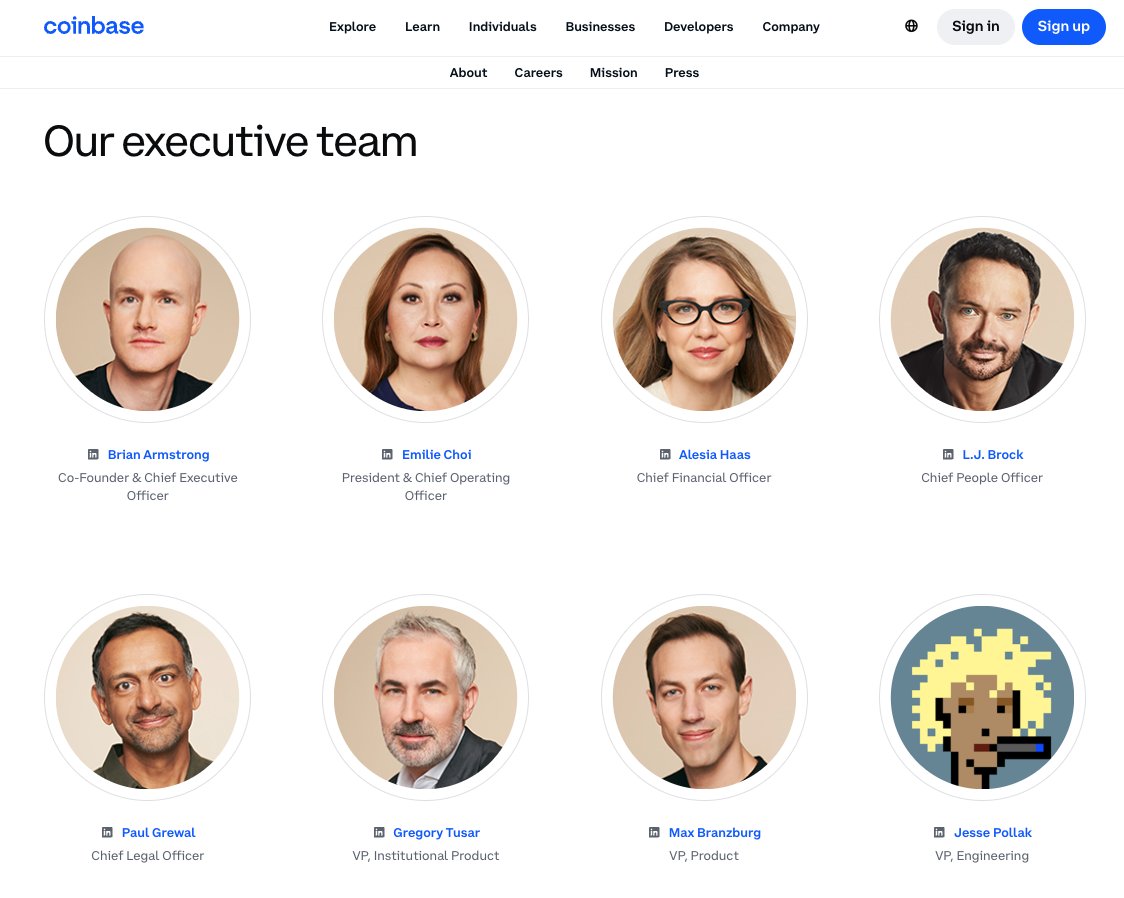
Jesse: Right now, my Punk feels more like a part of me than anything else I own. Online and onchain, it genuinely represents me. Seeing my real face online actually feels uncomfortable to me.
"Next Year, We’ll Buy Hot Dogs with Coinbase Wallet"
Community: In your view: what was the single biggest factor holding crypto back over the past decade? And what will be the biggest driver over the next decade?
Jesse: 1. Fees; 2. Wallets; 3. Identity.
We need 10x improvements in wallets and identity while keeping fees low despite rising demand. If we achieve this, rapid growth will follow. Smart wallets and the Farcaster social graph are huge drivers here.
Community: What are your thoughts on current crypto UX? Is Coinbase developing wallet tools to warn users before interacting with suspicious addresses?
Jesse: UX needs to reach a state of “default security.” Yes, we’re working on better tools so users don’t risk losing funds by clicking the wrong link. That’s unacceptable for everyday users.
Community: When do you expect we’ll be able to buy hot dogs at baseball games using Coinbase Wallet?
Jesse: Hopefully by next summer? We’re making real progress on acceptusdc.com—I believe merchant and consumer UX have improved significantly over the past year.
But more work remains: we need better PoS support for crypto and QR code payments. Our team is pushing both, and I expect big advances within the year.
Community: Congrats on the promotion! What changes will you make to Coinbase Wallet? Could frame functionality be added in the future?
Jesse: 1. Easier to use; 2. Better performance; 3. Clearer use cases per tab; 4. Clearer distinction between app (daily onchain utility) and wallet (supporting multiple apps); 5. Adding frame functionality to Coinbase Wallet could be really cool.
Community: What led you to prioritize “truly consumer-facing onchain wallets” as your top personal focus?
Jesse: For about three years, I’ve said we need to solve three big problems for consumer adoption: (1) lower fees; (2) build a truly usable wallet; (3) bring identity onchain.
Last autumn, after launching Base, @wilsoncusack told me: “Jesse—we’ve got a good start, but we can’t be complacent. We need another 10x improvement, and I believe solving smart wallets is the way.” At first, I resisted—I was exhausted and unsure if I was ready for another big strategic push—but he persisted, and eventually we decided to try. We built the first prototype, then worked with @chintan and @sid to launch the MVP. We knew there’d be issues, but we wanted to release something we could build publicly.
Now, we realize the best way to accelerate both wallet and Base is to work together. Much more to do!
Community: Honestly, where does Coinbase Wallet stand as a gateway for mainstream users entering crypto/onchain compared to other wallets? Can you comment specifically on whether the wallet has too many features, affecting UX?
Jesse: I’d rate it 4/10 today—we need to get it to 10/10. Huge credit to the team for impressive progress over the past few years, but we still have a long way to go.
I don’t think it does too much—in fact, I think it’ll do even more in the future. But we need to distill key use cases (payments, apps, discovery, etc.) and make them simple and intuitive. We also need to tackle structural challenges that make onboarding hard for average users. Smart wallets are the final infrastructure piece to break through these barriers.
Community: Can recovery phrases from Coinbase’s smart wallet be exported in BIP39 format?
Jesse: Current key signers can’t be exported. But I believe you can add a recovery signer and export that in BIP39 format! We’ll add more flexibility for adding signers so you can do whatever you want.
Community: Do you think Coinbase Wallet will become the primary Coinbase ecosystem app within 1–2 years? Do you see Coinbase Wallet evolving beyond just a wallet?
Jesse: I think Coinbase App and Coinbase Wallet App will diverge more. Both will be impactful in different ways—Coinbase focusing more on financial products, Wallet becoming a daily-use tool. I strongly believe in this direction.
Community: Do you think app store ecosystems like Apple will restrict crypto/smart wallet apps again to avoid fees? How would you respond to such restrictions?
Jesse: Apple is already quite strict—I certainly hope they don’t get stricter. If they do, I believe it will spark the rise of real competitors, breaking the current duopoly in app stores.
Overall, I’m optimistic—the inevitability of an open onchain economy will become clearer, and businesses of all sizes will find ways to adapt and leverage this trend.
Jesse’s Daily Life
Community: Where do you get your endless energy? Do you have a morning routine to kickstart your day?
Jesse: Hey, I’m not sure I can pinpoint one exact reason, but a few things come to mind:
1. I have a wonderful wife, great family, and close friends who give me immense support. 2. The Base team is exceptional—they do so much heavy lifting that I can stay energized across many fronts. 3. Since childhood, I’ve naturally had intense focus and drive. Not sure where it comes from, but friends and family have noticed and commented on it (both good and bad!).
My rough morning routine:
1. Wake up 2. Exercise (weightlifting or 45min–1hr run/bike ride at 60–70% max heart rate) 3. Make breakfast and a decaf cappuccino 4. Start work
Nothing fancy, but it works for me.
Community: Do you play sports? Any favorites?
Jesse: Mainly weightlifting, running, and cycling now. I’ve also started playing some tennis. I played competitive soccer from childhood through college. Still love it, but I get injured easily, so I’ve decided to pause for risk reduction. A real shame.
Community: What are your evening habits? How do you focus on cultivating good daily routines and rituals?
Jesse: My wife and I play casual games like Connections, Wordle, and mini crosswords. Then I read a bit (books or Slack), then go to sleep. Nothing complex! But I really enjoy these little games with my wife—it’s a habit added last year, a great way to connect and unwind.
Community: What’s newly married life like? Any differences?
Jesse: Not much change—we’ve been together a long time! Maybe a bit more certainty and peace of mind now.
Community: What were the highlights of your summer wedding?
Jesse: Ah! So many wonderful moments!
One of my favorite memories: after dinner, the music and dancing were actually a few blocks away from the small beach town where we held the wedding. So we grabbed a speaker, handed out tambourines and crowns, and paraded from dinner to the venue. Walking at sunset with our whole crew, listening to our favorite songs—truly a once-in-a-lifetime memory.

Photo by Jesse
Community: If you could only listen to three albums for the rest of your life, which would you pick?
Jesse: Wow, that’s tough! Drake’s *Views*, Anderson .Paak’s *Venice*, Kanye West’s *The College Dropout*.
Community: What hobbies do you have outside of crypto?
Jesse: 1. Exercise—running, cycling, weightlifting 2. Time with my wife and close friends 3. Working to improve living conditions in Oakland and the East Bay 4. Enjoying good food
Community: What’s your ideal IQ?
Jesse: I’m not sure there’s an “ideal” IQ, but I’d say: (1) I’ve never taken an IQ test; (2) if I had to guess, mine is probably in the top 10–20%, but not top 1%. I’ve never felt like a “genius”—but I can work extremely hard and make the most of what I know and can do.
Community: Favorite color?
Jesse: Yellow!
Community: Beer or wine?
Jesse: Beer! Specifically IPA (a popular style among beer enthusiasts, known for higher alcohol content and strong hop aroma, with a notably bitter taste). Though I quit drinking about two years ago, so now I only drink non-alcoholic IPA.
Community: Winter or summer?
Jesse: I love both—but I especially love snow. I grew up in Washington, D.C., and one of my childhood hobbies was amateur meteorology. On the East Coast, there’s a winter storm called a “Nor’easter”—very specific formation patterns. They develop in the central U.S., then low-pressure systems move southeast and travel up the coast. Depending on the track, it could rain or dump heavy snow.
I used to stay up watching GFS and ECMWF model runs, tracking storms with fellow weather geeks on forums. The models predict step-by-step, with each 6-hour interval shown about a minute apart—everyone trying to interpret results and forecast outcomes. Of course, predictions and reality always differ, just like trying to predict the future.
I still enjoy reading weather forecast reports.
Vision, Mission, and Purpose
Community: Why did you join crypto? What’s kept you going all these years?
Jesse: I grew up in a Quaker school and always felt a strong calling to make the world better. Quaker values deeply shaped me—simplicity, peace, integrity, community, equality, and stewardship.
When I first learned about crypto, I immediately saw it as a powerful lever to advance these values. It could simplify legacy systems, unite people across borders, promote transparency, empower communities, and create fair opportunities for all. From that moment, I knew it was my life’s work. Honestly, I thought it would happen in a few years… but it’s been about 12. Hope it’s soon.
Community: How do you balance your multifaceted identity—working at a big company while being a public figure who talks only about crypto?
Jesse: Haha, honestly, it’s hard—probably the most anxiety-inducing thing I deal with. The internet (especially Twitter) is brutal. But my guiding principle is to always be myself, no matter what. It might not please everyone, but at least I know I’m authentic. This mindset has served me well so far!
Also, while I post a lot about crypto on Twitter, it’s not all I talk about. I frequently post about Oakland, the East Bay, and how we can create more for our local communities. I’m deeply passionate about this and spend nights and weekends on it.
Community: How do public perceptions of the industry affect our ability to realize crypto’s full potential, both technically and culturally?
Jesse: I’ve always been optimistic and wanted to believe it doesn’t matter, but the reality is—it does. Public sentiment toward crypto is overwhelmingly negative and hasn’t improved. This creates a major barrier to getting people to try and benefit from this new technological paradigm.
I think two things are key to addressing this:
1. Build real, useful, impactful onchain products. We have more every day, but the more concrete they are, the easier it is for people to see value. 2. Change how we talk about it. Using “onchain” and framing it as a tech platform makes it more engaging.
There’s still much to do.
Community: Beyond blockchain, what other decentralized technologies should we be building?
Jesse: One idea immediately comes to mind: more decentralized energy production. It feels like a critical component of a resilient society, and I believe it could also be a major lever against climate change.
Community: Sounds like small nuclear grids capable of powering cities independently. I’m uncertain about their safety, but I hope remote areas could have such power sources—or compact, powerful outlets, like in places such as North Carolina, to maintain electricity supply.
Jesse: Fully agree.
Community: What’s your best advice for mentoring others?
Jesse: Always lead with curiosity and questions—it’s easy to jump to solutions, but usually, asking genuine questions helps mentees discover the right answers themselves (and often better than anything you’d suggest).
Community: Will that fire inside you ever fade?
Jesse: That fire will never fade. By the way, we need to stop chasing others’ tails and start being real warriors. Constantly reacting to others, products, or competitors easily leads to distraction and loss of focus. I’ve seen this pattern lead to poor products, weak market strategies, and incremental progress.
It’s harder—but far more important—to define who we want to become and go all-in. It can be scary, as it often means envisioning 1–2 years ahead and drawing a path that doesn’t yet exist. It takes immense effort, but it gives us a shot at tenfold success.
In my career, I’ve found that even if predictions are wrong, the process of observing, deciding, and moving forward ultimately helps you find the right direction.
Join TechFlow official community to stay tuned
Telegram:https://t.me/TechFlowDaily
X (Twitter):https://x.com/TechFlowPost
X (Twitter) EN:https://x.com/BlockFlow_News
 Foresight News