With trading volume up 86%, how has Hong Kong become the leader in East Asia's crypto market?
TechFlow Selected TechFlow Selected
With trading volume up 86%, how has Hong Kong become the leader in East Asia's crypto market?
Hong Kong ranks 30th globally in cryptocurrency adoption, indicating its potential to become a major player.
 Navigating Web3 tides with focused insights
Source: bitcoinist
Translation: Blockchain Knight
Hong Kong's crypto asset trading volume has surged 86% year-on-year—an impressive figure. According to Chainalysis, Hong Kong leads the East Asia region in crypto asset adoption.
The region ranks 30th globally in digital currency adoption, indicating its potential to become a major player.
Several factors are driving this remarkable growth. First, Hong Kong’s regulatory environment is unique. Compared to mainland China, which enforces strict regulations, Hong Kong has adopted a more accommodating approach toward crypto assets.
This adaptability fosters financial innovation, attracting attention from both institutional and individual investors looking to strengthen their crypto portfolios.
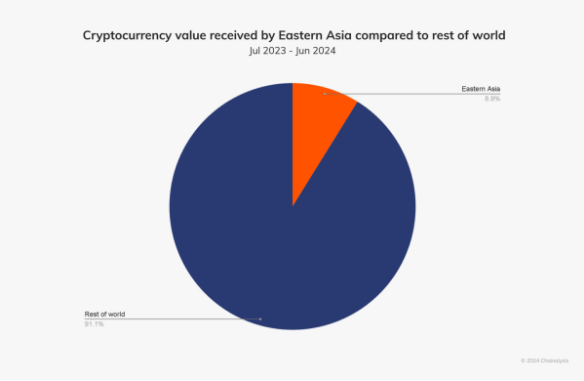
The total value acquired in the market primarily comes from centralized exchanges, accounting for approximately 64% of the total value received across East Asia.
This pattern indicates that investors rely on these centralized platforms to meet their trading needs.
In East Asia, the crypto asset landscape reveals a deep divide. Centralized trading platforms remain the most popular, capturing 65% of market value.
The convenience and reliability of these platforms draw in retail traders, but behind this lies a lesser-known truth—an increasing number of institutional players are moving away from these centralized platforms.
Decentralized exchanges (DEXs) and decentralized finance platforms are gaining traction among institutional investors, even though ordinary traders still prefer centralized exchanges.
This shift suggests that larger participants are seeking diverse investment strategies capable of exploiting market inefficiencies—a common feature of decentralized markets.
In East Asia, the use of crypto assets has increased significantly in recent years. Between July 2023 and June 2024, the region accounted for about 9% of global crypto asset transaction volume.
During this period, over $400 billion worth of transactions were executed on blockchains.
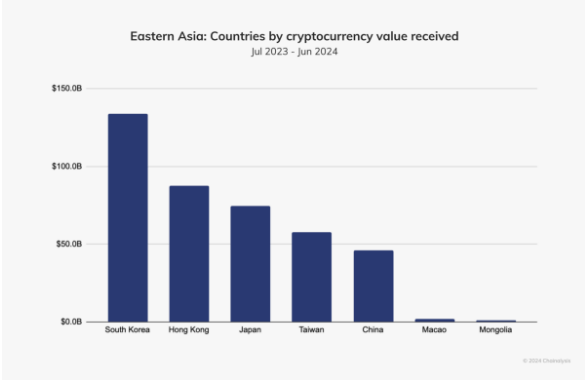
During the research period, South Korea led the East Asia region with approximately $130 billion in crypto asset value.
Although Hong Kong is developing rapidly, it will still face significant challenges in the near future.
The SEC’s recent approval of Ethereum ETFs has eroded some of Hong Kong’s competitive advantages over other global crypto destinations.
Crypto asset investments will attract greater attention from other financial centers; Hong Kong must continue innovating to remain a top focus among premier digital currency destinations.
Despite promising prospects, the future development of crypto assets in Hong Kong remains uncertain. While it has solidified its dominant position in East Asia, the region must navigate evolving domestic and offshore policies.
Investors are closely watching how the financial hub responds and whether it can sustain its growth momentum. A supportive regulatory environment and growing institutional interest within and around the region contribute to further development.
However, maintaining its edge will require innovative thinking and clearer legal frameworks to address new challenges arising from domestic policy shifts and international competition.
Join TechFlow official community to stay tuned
Telegram:https://t.me/TechFlowDaily
X (Twitter):https://x.com/TechFlowPost
X (Twitter) EN:https://x.com/BlockFlow_News
 @bitcoinist