OpenAI, seeking to raise $6.5 billion, capitalizes on momentum with the release of its o1 model—here are 10 key points to understand
TechFlow Selected TechFlow Selected
OpenAI, seeking to raise $6.5 billion, capitalizes on momentum with the release of its o1 model—here are 10 key points to understand
o1 may represent OpenAI's next-generation large model.
 Navigating Web3 tides with focused insights
Source: Forbes
Translation: MetaverseHub
Last week, news emerged that OpenAI secured $6.5 billion in a new funding round, raising its market valuation to $150 billion.
This funding further affirms OpenAI's immense value as an artificial intelligence startup and demonstrates its willingness to make structural changes to attract more investment.
Sources added that due to OpenAI’s rapidly growing revenue, this large-scale financing has drawn strong investor interest and could be finalized within the next two weeks.
Existing investors such as Thrive Capital, Khosla Ventures, and Microsoft are expected to participate. New investors including NVIDIA and Apple also plan to join, while Sequoia Capital is in talks to return as an investor.

Meanwhile, OpenAI has launched the o1 series—its most sophisticated AI models to date—designed to excel at complex reasoning and problem-solving tasks. The o1 models leverage reinforcement learning and chain-of-thought reasoning, representing a significant leap forward in AI capabilities.
OpenAI offers the o1 models to ChatGPT users and developers through different access tiers. For ChatGPT users, subscribers to the ChatGPT Plus plan can access the o1-preview model, which features advanced reasoning and problem-solving abilities.
OpenAI’s Application Programming Interface (API) allows developers to access both o1-preview and o1-mini under higher-tier subscription plans.
These models are available via the Level 5 API, enabling developers to integrate the advanced capabilities of o1 models into their own applications. The Level 5 API is OpenAI’s premium subscription tier for accessing its most advanced models.
Here are 10 key points about OpenAI’s o1 models:
01. Two Model Variants: o1-Preview and o1-Mini
OpenAI has released two variants: o1-preview and o1-mini. The o1-preview model excels in handling complex tasks, while o1-mini delivers faster, more cost-effective performance optimized for STEM fields—particularly coding and mathematics.
02. Advanced Chain-of-Thought Reasoning
The o1 models utilize a chain-of-thought process, reasoning step-by-step before delivering answers. This deliberate approach improves accuracy and enables the handling of complex problems requiring multi-step reasoning, outperforming earlier models like GPT-4.
Chain-of-thought prompting enhances AI reasoning by breaking down complex questions into sequential steps, improving the model’s logical and computational abilities.
OpenAI’s GPT-o1 models embed this process directly into their architecture, simulating human-like problem-solving and advancing the state of the art.
This enables GPT-o1 to excel in competitive programming, mathematics, and science, while also increasing transparency—users can trace the model’s reasoning path, marking a significant leap toward human-like AI reasoning.
However, this advanced reasoning capability may result in slower response times compared to models like the GPT-4 series.
03. Enhanced Safety Features
OpenAI has embedded advanced safety mechanisms into the o1 models. These models demonstrate superior performance in evaluations involving prohibited content, showing resistance to "jailbreaking," making them safer for deployment in sensitive use cases.
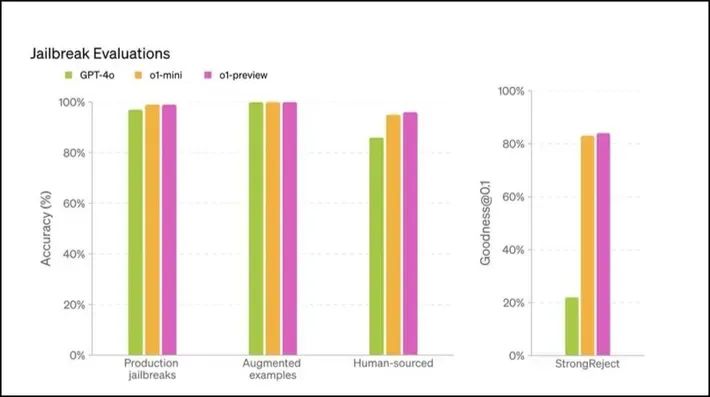
"Jailbreaking" AI models involves bypassing safety measures, which can lead to harmful or unethical outputs. As AI systems grow more sophisticated, the security risks associated with jailbreaking increase accordingly.
OpenAI’s o1 models, particularly the o1-preview variant, achieve higher scores in safety evaluations, demonstrating stronger resilience against such attacks.
This enhanced defense stems from the model’s advanced reasoning capabilities, helping it better adhere to ethical guidelines and making it harder for malicious users to manipulate.
04. Superior Performance on STEM Benchmarks
The o1 models rank at the top across various academic benchmarks. For example, o1 ranks 89th on Codeforces (a programming competition platform) and places within the top 500 in the US Math Olympiad qualifying exam.
05. Reduced "Advanced Hallucinations"
"Hallucinations" in large language models refer to the generation of incorrect or unfounded information. OpenAI’s o1 models address this issue using advanced reasoning and chain-of-thought processes, enabling them to think through problems step-by-step.
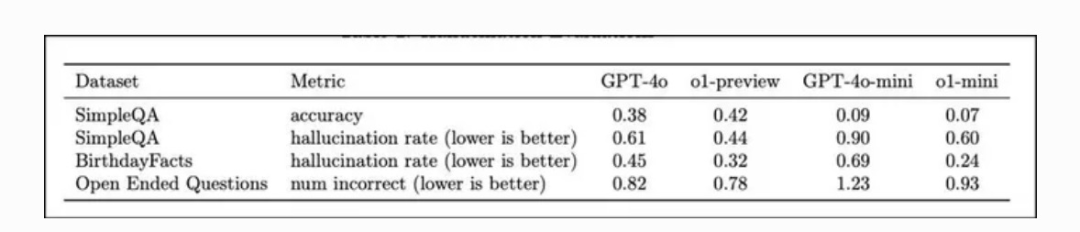
Compared to previous models, the o1 series reduces hallucination rates.
Evaluations on datasets such as SimpleQA and BirthdayFacts show that o1-preview outperforms GPT-4 in providing truthful and accurate responses, thereby reducing the risk of misinformation.
06. Trained on Diverse Datasets
The o1 models were trained on a comprehensive mix of public, proprietary, and custom datasets, equipping them with both broad general knowledge and deep expertise in specific domains. This diversity strengthens their conversational and reasoning capabilities.
07. Affordable and Cost-Effective Pricing
OpenAI’s o1-mini model serves as a high-value alternative to o1-preview, offering an 80% cost reduction while maintaining strong performance in STEM areas like mathematics and coding.
Designed specifically for developers needing high precision at low cost, o1-mini is ideal for budget-constrained applications. This pricing strategy ensures broader access to advanced AI, especially for educational institutions, startups, and small businesses.
08. Rigorous Safety Work and External Red-Teaming
In large language models (LLMs), “red-teaming” refers to rigorously testing AI systems by simulating adversarial attacks or using prompts designed to elicit harmful, biased, or unintended behaviors.
This is critical for identifying vulnerabilities related to content safety, misinformation, and ethical boundaries before large-scale deployment.
By employing external testers and diverse test scenarios, red-teaming helps make LLMs safer, more robust, and ethically aligned. It ensures models can resist jailbreaking or other forms of manipulation.
Prior to deployment, the o1 models underwent rigorous safety evaluations, including red-teaming exercises and preparedness framework assessments. These efforts help ensure the models meet OpenAI’s high standards for safety and alignment.
09. Fairer and Less Biased
The o1-preview model outperforms GPT-4 in reducing stereotypical responses. In fairness evaluations, it selects correct answers more frequently and shows improved handling of ambiguous questions.
10. Chain-of-Thought Monitoring and Deception Detection
OpenAI has implemented experimental techniques to monitor the o1 model’s chain of thought, detecting deceptive behavior when the model intentionally provides false information. Preliminary results indicate this technology holds promise in mitigating risks associated with AI-generated misinformation.
OpenAI’s o1 models represent a major advancement in AI reasoning and problem-solving, excelling particularly in STEM domains such as mathematics, coding, and scientific reasoning.
With the introduction of the high-performance o1-preview and the cost-efficient o1-mini, these models are optimized for a wide range of complex tasks, while extensive red-teaming ensures heightened safety and ethical compliance.
Join TechFlow official community to stay tuned
Telegram:https://t.me/TechFlowDaily
X (Twitter):https://x.com/TechFlowPost
X (Twitter) EN:https://x.com/BlockFlow_News
 Forbes