
Is the crypto bull market over? So far, BTC has never disappointed anyone who held on.
TechFlow Selected TechFlow Selected
Is the crypto bull market over? So far, BTC has never disappointed anyone who held on.
As U.S. stocks weaken, Bitcoin continues to show a pattern of declining with the market but failing to rally when it recovers, further amplifying bearish sentiment in the market and even leading some to believe that the bull market has already ended.
 Navigating Web3 tides with focused insights
Author: Asher Zhang, TechFlow
On August 24, I wrote an article titled "U.S. rate cuts won't directly boost Bitcoin; crypto markets still need technology-driven momentum." At that time, the Dow Jones Industrial Average had risen for five consecutive days, and optimism around rate cuts was widespread in the crypto market. However, based on observation, Bitcoin tends to follow macro markets downward but not upward, while internally it lacks innovation and faces significant selling pressure. Hence, I warned of downside risks. As U.S. equities pulled back, Bitcoin has continued its gradual decline, and market sentiment appears to be swinging toward another extreme.
Market sentiment turns clearly bearish—has the bull run ended?
As U.S. stocks weaken, Bitcoin's pattern of falling with the market but not rising with it persists, intensifying bearish sentiment—even prompting speculation that the bull market has already ended.
Zeneca, founder of ZenAcademy and The 333 Club, posted on X: "The bull market might already be over. I don't think so, but (reality) might prove otherwise. You should have a plan just in case. For example, what if Bitcoin spends most of next year declining to $18,000, ETH to $900, and SOL to $28... are you prepared?"
Adam, researcher at Greeks.live, noted on X: "14,000 BTC options are expiring soon, with a Put/Call Ratio of 0.81, maximum pain point at $59,000, and a notional value of $760 million. Meanwhile, 125,000 ETH options are expiring, Put/Call Ratio at 0.63, maximum pain point at $2,500, notional value $290 million. This week, crypto has been steadily declining. Option data clearly reflects overall market weakness—the recent drop in maximum pain points can no longer keep pace with price declines. Implied volatility (IV) for major expiries has increased slightly, while the IV bump seen around October 8 is gradually flattening as the U.S. election approaches. As mentioned last week, historical trading patterns show September is typically muted—but the current level of pessimism seems excessive. We remain more inclined to believe a bullish phase will emerge by year-end.
So, has the bull market truly ended? In my view, the crypto bull market is not over. Although September and October may continue to see weak performance, this actually presents a valuable opportunity.
Bitcoin correlates with macro trends—dips may offer ideal entry points
Historically, September is a seasonally weak month for U.S. equities. Affected by macro factors, even if the Fed cuts rates as expected, Bitcoin is likely to remain subdued.
Tom Lee, Managing Partner and Head of Research at Fundstrat Global Advisors, expects U.S. equities to pull back 7% to 10% over the next two months, creating a “buy-the-dip” opportunity. "Growing concerns about economic growth mean data like employment reports and jobless claims are triggering stronger market reactions—and this dynamic is likely to persist through September," he said.
Chris Hyzy, Chief Investment Officer at Bank of America Private Bank, stated: "Over the next eight weeks, there should be excellent opportunities to rebalance your portfolio, diversify assets, and position yourself advantageously for market movements."
Ulrich Urbahn, Head of Multi-Asset Strategy and Research at Berenberg, commented: "Risks of equity market setbacks could rise again. With positioning and valuations elevated once more, we expect heightened volatility over the next two months."
Raphael Bostic, President of the Atlanta Fed, wrote Wednesday that the Fed’s dual mandate of stable prices and full employment is balanced for the first time since 2021—though inflation isn’t yet fully under control.
Overall, if U.S. equities fall 7% to 10% over the next two months, Bitcoin’s correction could be similarly sized, potentially dropping further to the $50,000–$53,000 range. But just as with equities, such a dip could represent an exceptional buying opportunity. Investors should use this time to adjust portfolios and diversify holdings. Under the Fed’s rate-cutting cycle, Bitcoin’s bull market is unlikely to end abruptly.
Revisiting Bitcoin’s downward pressure and future catalysts
Given Bitcoin’s high correlation with U.S. equities, the above discussion focused largely on macro drivers for a potential recovery. But what are the internal forces that could propel Bitcoin higher?
Selling pressure on Bitcoin is expected to gradually ease over the next two months. In my August 24 article, I cited one key reason for Bitcoin’s weakness: after hitting $70,000, miner selling intensified, while institutional appetite for Bitcoin ETFs declined sharply. Additionally, the German government began selling its BTC holdings around $60,000, followed by sales from the U.S. government, Mt. Gox, and Genesis—creating substantial downward pressure. Under such heavy selling, I did not believe rate cuts alone could drive Bitcoin upward. However, if Bitcoin remains weak through September and October, this extended consolidation period allows sufficient time to absorb these sell-offs. Institutions can then accumulate Bitcoin at lower levels, building a foundation for future upside.
Another reason I believe Bitcoin struggles to rise directly is a lack of innovation—a fact evident from on-chain data for both Bitcoin and Ethereum.
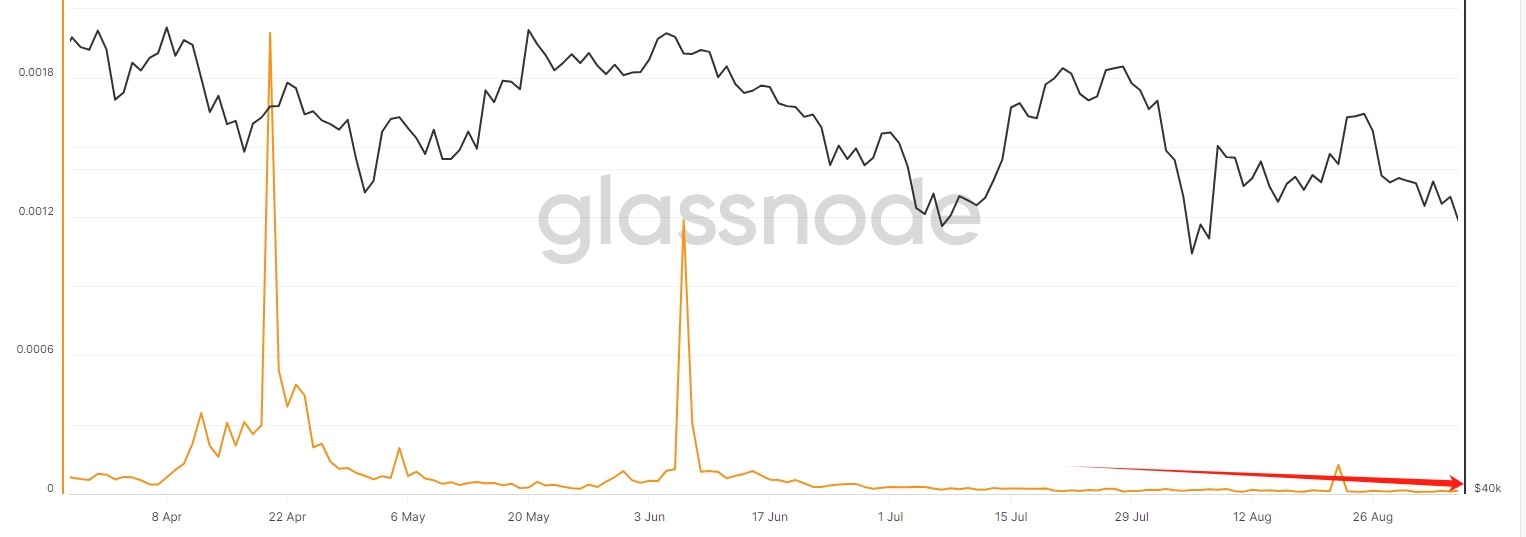
In the first half of next year, innovation in crypto may begin to bear fruit. Judging from current developments, Ethereum has functioned as an innovation testbed for Bitcoin. The current Bitcoin bull cycle’s enthusiasm for inscriptions and runes resembles meme culture, while Bitcoin’s Layer 2 concepts and technologies owe much to advances in Ethereum’s Layer 2 ecosystem. However, as Ethereum’s own innovation slowed, Bitcoin development also stagnated. So where will next year’s crypto innovations emerge?
One key reason for Ethereum’s relatively weak performance in this bull cycle is its Layer 2 strategy, which diluted Ethereum’s value capture. Too many Layer 2s led to fragmented liquidity, causing isolated ecosystems across Ethereum. However, breakthroughs in cross-Layer 2 interoperability could resolve this issue, enabling applications built on interoperable Layer 2s to achieve broader adoption. Moreover, Ethereum’s Pectra upgrade is expected in Q1 2025 and will be one of the most anticipated events in the entire crypto space. Pectra merges the Prague (execution layer) and Electra (consensus layer) upgrades. One of its most significant changes involves account management. The EIP-3074 proposal allows traditional wallets (externally owned accounts, or EOAs) to interact with smart contracts—for instance, enabling batch transactions. EIP-7702 goes further, allowing EOAs to temporarily act as smart contract wallets during a transaction. "Temporary" means your EOA only becomes a smart contract wallet for the duration of that transaction, achieved by attaching smart contract code to an EOA address. This innovation of "EOA temporarily becoming a smart contract wallet" may be Ethereum’s hidden ace. Beyond account abstraction, several other EIPs in this upgrade will significantly impact the broader ecosystem.
The 2025 crypto bull run is worth anticipating
From a macro perspective, U.S. equities are expected to rebound starting in late October. Given Bitcoin’s strong correlation with equities, Bitcoin could see a rally by year-end, starting in November—driven primarily by macro linkages. However, in the first half of next year, Bitcoin may enter a new major uptrend, fueled by both technological innovation in crypto and abundant macro liquidity.
Join TechFlow official community to stay tuned
Telegram:https://t.me/TechFlowDaily
X (Twitter):https://x.com/TechFlowPost
X (Twitter) EN:https://x.com/BlockFlow_News
 比推 BitpushNews