Gold rises, BTC falls: How financial advisors view the "store of value" narrative
TechFlow Selected TechFlow Selected
Gold rises, BTC falls: How financial advisors view the "store of value" narrative
The U.S. approval of cryptocurrency ETFs could represent a market structure disruption similar to that of gold.
 Navigating Web3 tides with focused insights
By: Ilan Solot, Sarah Morton
Translation: Mary Liu, BitpushNews
Summary:
-
Ilan Solot, Senior Global Markets Strategist at Marex Solutions, analyzes the role of gold and bitcoin as stores of value and how that role has evolved over time.
-
DJ Windle, Founder and Portfolio Manager at Windle Wealth, explains how both bitcoin and gold serve as stores of value and highlights the differences between these two assets.
The Case for Weakening Store-of-Value Functions in Gold and Bitcoin
Summary: The approval of bitcoin and ether ETFs may represent a structural market shift similar to the one central banks triggered in the gold market after 2022—this new factor could temporarily override traditional narratives, including the concept of "store of value."
This August’s market sell-off disappointed advocates of bitcoin’s store-of-value properties. After all, while cryptocurrencies fell sharply this week, gold surged repeatedly. Even worse, during broader market rebounds, bitcoin underperformed.
Yet despite rising prices, gold too once lost some of its supposed store-of-value characteristics, with price and narrative decoupling around 2022. As real yields and inflation expectations rose ahead of central bank tightening cycles, traditional investors continued their decade-long pattern of selling gold. The difference this time? Gold moved in the opposite direction.
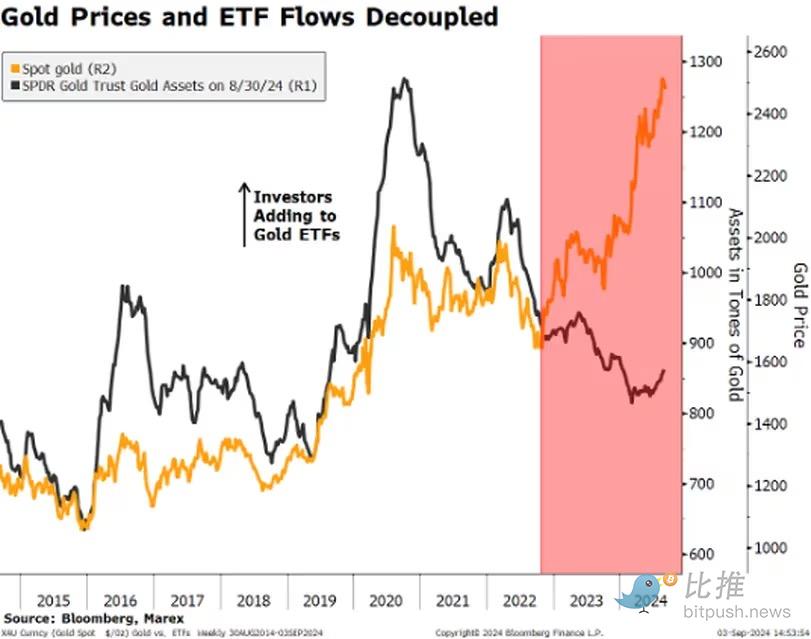
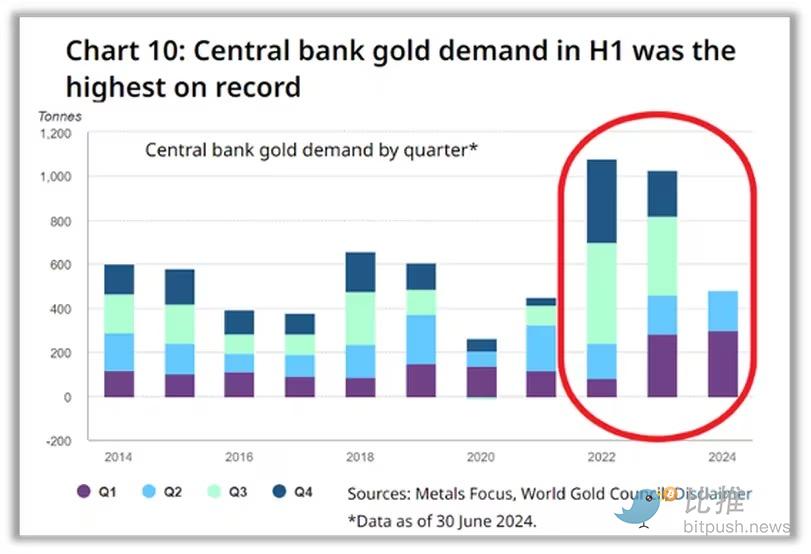
Why didn’t gold prices respond to macro drivers of its store-of-value function? Market structure changed: following Russia's invasion of Ukraine and the seizure of its foreign reserves, central banks across Asia significantly increased gold purchases. One might even argue these governments are operating under competing narratives of their own.
From a Western investor perspective, policymakers in Russia, India, and China do not prioritize gold as a “store of value.” Federal Reserve policy, inflation expectations, and liberal economic principles may never influence the accumulation or eventual deployment of their gold reserves.
Over time, the U.S. approval of cryptocurrency ETFs could similarly disrupt market structure in a way analogous to what happened in the gold market.
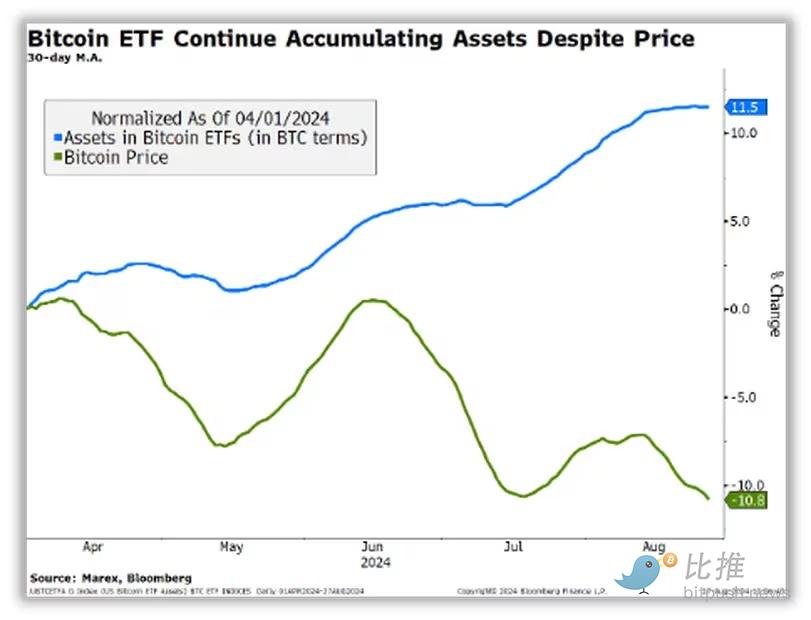
This may bring the BTC (store of value) and ETH (crypto technology) narratives closer to those of traditional investment assets. In other words, ETF investors may follow different narratives and demand functions—such as portfolio rebalancing or discretionary income—than native crypto investors, just as Asian central banks buy gold for reasons distinct from traditional investors.
In fact, recent ETF and bitcoin price data appear to support this conclusion. Despite significant bitcoin price volatility and shifting narratives over recent months, ETFs continue to attract inflows. Note that this covers a very short time period, so any conclusions should be drawn cautiously. But so far, the trend appears valid. Indeed, outflows from Grayscale’s BTC and ETH funds have shown us how cycle-independent ETF flows can impact prices.
Does this mean gold and bitcoin are no longer stores of value?
Not necessarily. Narratives can coexist, evolve, weaken, and take turns driving prices. However, the presence of large, new, and divergent investor groups in both markets may dilute original narratives and alter how prices react to macroeconomic events.
- Ilan Solot, Senior Global Markets Strategist, Marex Solutions
Expert View: DJ Windle, Founder and Portfolio Manager at Windle Wealth
Q: What is a store of value?
A: A store of value is an asset that can be saved, retrieved, and exchanged in the future without significant loss of purchasing power. Assets such as gold, real estate, or stable currencies have traditionally served this purpose, as they tend to preserve value over time and through market downturns. This does not mean they are immune to short-term volatility. The core idea is to provide protection against inflation, currency devaluation, and economic instability over time, enabling investors to preserve wealth across generations.
Q: How is bitcoin similar to gold?
A: Bitcoin and gold share several characteristics that make them attractive as stores of value. Both have limited supply—gold due to natural scarcity, and bitcoin capped at 21 million coins. Neither is controlled by a central government, making them appealing alternatives to traditional fiat currencies. However, both bitcoin and gold carry different types of security risks that need to be addressed when investing. During times of economic uncertainty or inflation, investors often flock to these assets for preservation of value, viewing them as hedges against market volatility and erosion of purchasing power.
Q: How is bitcoin different from gold?
A: Bitcoin possesses novel attributes absent in gold. As a digital asset, bitcoin can be transferred globally within minutes, whereas gold is cumbersome and costly to move. Bitcoin’s underlying blockchain technology ensures transparency, enabling verifiable ownership and transaction history. Furthermore, bitcoin is programmable, meaning it can be integrated into digital applications such as smart contracts and DeFi platforms, giving it high versatility within modern financial ecosystems. These qualities make bitcoin an innovative alternative that goes beyond the traditional uses of gold.
Join TechFlow official community to stay tuned
Telegram:https://t.me/TechFlowDaily
X (Twitter):https://x.com/TechFlowPost
X (Twitter) EN:https://x.com/BlockFlow_News
 CoinDesk