








People's Court Daily published an article: What are the difficulties in the judicial disposal of virtual currency?
TechFlow Selected TechFlow Selected
People's Court Daily published an article: What are the difficulties in the judicial disposal of virtual currency?
In current judicial practice, the handling of virtual currency has become a focal issue drawing widespread attention.
 Navigating Web3 tides with focused insights
Author: Lawyer Liu Honglin, ManQin Law Firm
At the end of August, the Supreme People's Court released the "Announcement on Bidding for Major Judicial Research Projects of 2024." At first glance, this may seem unrelated to the crypto community. But upon closer inspection, one key topic stands out among those prioritized for funding: "Research on the Disposal of Virtual Currency Involved in Cases." You might think, "Well, it's just a research project—how long before anything actually reaches practical implementation?"
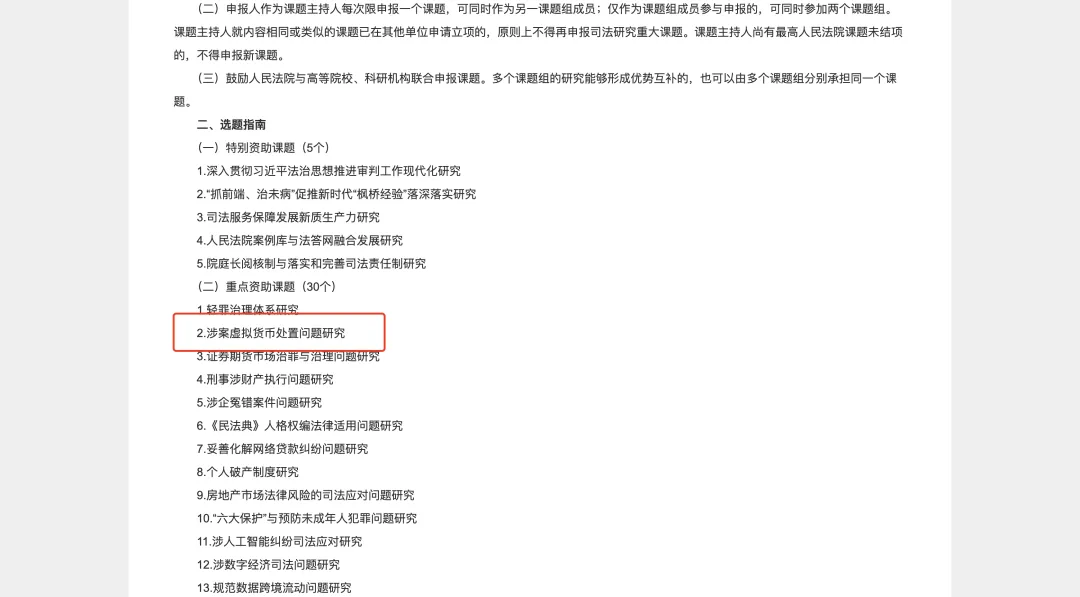
* Image source: Screenshot from the official website of China’s Supreme People's Court
Then came fresh news on September 3: the People's Court Daily published an article titled *Standardization is Needed for the Judicial Disposal of Virtual Currency*, stating: "In current judicial practice, the disposal of virtual currency has become a highly watched focal issue," and further emphasized that "legal regulation of virtual currency disposal is now urgent." Words like "highly watched," "focal point," and "urgent" collectively reflect the Chinese judiciary’s growing attention and strong determination to resolve virtual currency disposal issues as soon as possible.
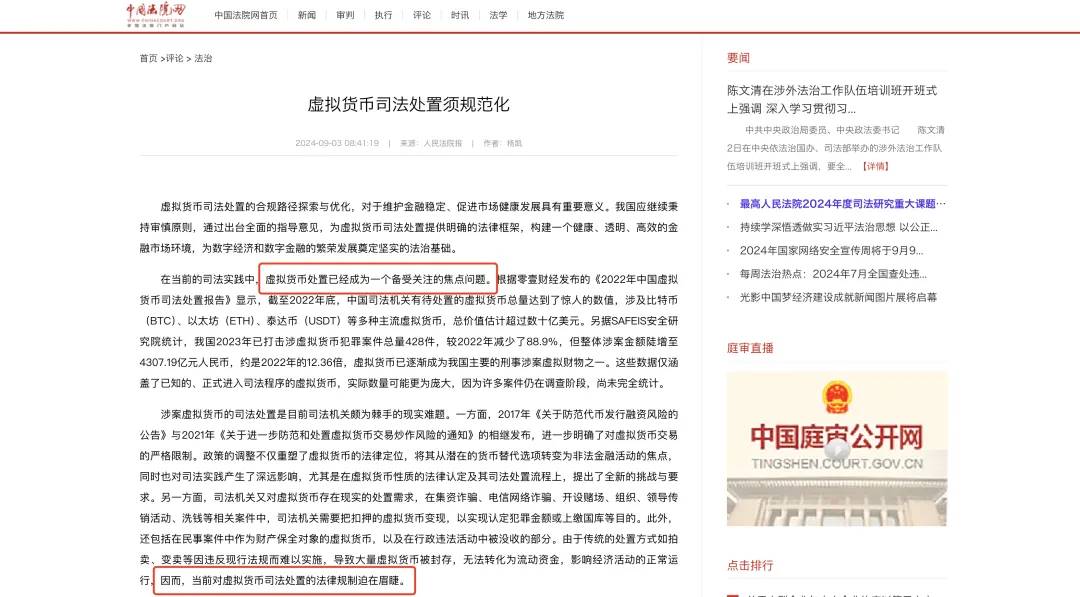
* Image source: Screenshot from China Court Website
The article also outlines common legal challenges currently faced in China regarding the judicial handling of virtual currency—specifically, ownership identification, value assessment, and lawful liquidation. These points align closely with the analysis presented by ManQin Law Firm in its November 2023 article, *Three Key Challenges in the Disposal of Virtual Currency in Criminal Cases*. In that earlier piece, Lawyer Liu Honglin provided an in-depth examination of these three core challenges—an analysis we are pleased to share again here.
How Should Virtual Currency Ownership Be Determined?
Establishing ownership is the prerequisite and foundation for judicial disposal of virtual currency. Due to its anonymity and decentralized nature, ownership of virtual currency does not rely on real-name accounts or third-party registration systems but is instead secured through cryptographic principles. Simply put, whoever holds the private key (a complex string of numbers or characters) associated with a given virtual currency possesses control over it.
Therefore, in judicial practice, determining whether seized, detained, or confiscated virtual currency truly belongs to a suspect or defendant—and identifying whether other legitimate rights holders exist—poses significant challenges.
Currently, judicial authorities primarily obtain virtual currency involved in cases through the following methods:
(1) Searching, seizing, or confiscating electronic devices (such as phones, computers, hardware wallets) from suspects or defendants, then using technical means to extract stored private keys or passwords;
(2) Seizing physical documents containing recorded private keys or passwords (e.g., paper wallets, notebooks);
(3) Confiscating used recharge cards, bank cards, or payment accounts to trace fund flows, locate the individual’s accounts on cryptocurrency exchanges or other platforms, and gain access to the virtual currency via judicial assistance or technical tools;
(4) Directly obtaining private keys or passwords based on confessions or corroborating evidence from the suspect or defendant.
No matter which method is used, judicial agencies must confront several critical questions:
(1) How can they prove that the suspect or defendant had actual control over the obtained private key or password, rather than merely borrowing, stealing, or fabricating it?
(2) How can they demonstrate that the virtual currency linked to the key was derived from criminal activity or its proceeds, rather than being lawfully acquired?
(3) How should claims from third parties asserting legitimate interests in the seized virtual currency be reviewed or dismissed?
(4) How can the leakage, theft, or misuse of private keys or passwords obtained during judicial procedures be prevented?
To address these issues, ManQin Law Firm recommends the following compliance-oriented measures:
(1) When acquiring private keys or passwords, collect and secure as much supporting evidence as possible regarding their origin, nature, and ownership—including search records, seizure lists, electronic data extraction reports, bank statements, transaction logs, network activity logs, and witness testimony—while minimizing reliance solely on confessions;
(2) To determine whether the virtual currency constitutes illicit gains, integrate case facts and evidence using direct inference, indirect inference, and statutory presumptions—such as tracing the source, flow, and use of the virtual currency, analyzing causal links between the digital assets and criminal acts, and comparing the quantity, type, and value of holdings against the suspect’s legitimate income and known assets;
(3) When addressing third-party claims, fully respect and protect their legal rights, inform them of available remedies such as hearings, appeals, or litigation, review submitted evidence rigorously, and render decisions based on principles of no-fault liability and relief claims;
(4) During storage and use of private keys or passwords, strictly adhere to confidentiality protocols and procedural standards, establish dedicated account management mechanisms, prevent unauthorized disclosure or abuse, and immediately take corrective actions and hold responsible parties accountable if anomalies occur.
How Should the Value of Virtual Currency Be Assessed?
Valuation is a crucial step in judicial disposal. Because the virtual currency market lacks unified regulation and standardized pricing mechanisms, prices fluctuate dramatically due to various influencing factors, and significant price differences often exist across different trading platforms. Thus, determining the value of seized, detained, or confiscated virtual currency—for purposes of liquidation, restitution, or state remittance—remains a major challenge in practice.
Currently, judicial authorities mainly adopt two approaches to assess virtual currency value:
(1) Referencing real-time or historical market data from cryptocurrency exchanges or other authoritative sources, converting virtual currency into fiat currency using specific exchange rates or conversion formulas;
(2) Commissioning qualified and reputable professional institutions or experts to issue formal appraisal reports based on scientific evaluation principles and methodologies.
Regardless of the method chosen, several key issues must be addressed:
(1) How to select an appropriate valuation timing: Given the volatility and time sensitivity of virtual currency prices, should valuation be based on the price at seizure, detention, or confiscation, or at the time of liquidation, restitution, or remittance—or some reasonable compromise?
(2) How to choose an appropriate valuation standard: With numerous types of virtual currencies and varying prices across platforms, should valuation rely on a single designated platform, an average across multiple platforms, or another balanced approach?
(3) How to ensure objectivity and fairness in assessments: Considering manipulation, fraud, and insider trading risks in the market—which may distort data accuracy—how can conflicts of interest and corruption in the appraisal process be avoided?
(4) How to handle disputes and objections to valuation results: Since valuations affect suspects, victims, third parties, and others, how can all stakeholders’ rights to information, participation, defense, and redress be fully protected?
To tackle these concerns, ManQin Law Firm proposes the following measures:
(1) When setting the valuation date, consider the specifics of each case and the purpose of the judicial action, balancing fairness, reasonableness, and operational feasibility. Choose the moment—such as the time of incident, seizure, judgment, or enforcement—that best reflects the true market value, with dynamic adjustments when necessary;
(2) For valuation standards, select benchmarks that best reflect liquidity and fair market value based on the characteristics and dynamics of virtual currency—preferably referencing well-known, regulated, and secure domestic and international trading platforms, applying weighted averages or range-based estimates where appropriate;
(3) To ensure objectivity and impartiality, strictly follow legal requirements and professional ethics, enhance scrutiny, oversight, and accountability over data sources, processes, and outcomes, and promptly disclose relevant information transparently to all interested parties;
(4) In resolving disputes, fully safeguard the legitimate rights of all stakeholders, clearly inform them of avenues for objection, re-evaluation, appeal, or litigation, carefully examine their arguments and evidence, and make rulings according to established legal procedures and criteria.
How Can Virtual Currency Be Legally Liquidated?
Liquidation is the ultimate goal and outcome of judicial disposal. As virtual currency does not have legal tender status in mainland China, it cannot be directly used for payments, settlements, or state remittances. It must first be converted into fiat currency to realize its value. Therefore, choosing an appropriate liquidation method to promptly and effectively dispose of seized, detained, or confiscated virtual currency remains an urgent issue in practice.
Currently, judicial authorities primarily employ the following methods for liquidation:
(1) Entrusting third parties to sell virtual currency on cryptocurrency exchanges in exchange for fiat currency;
(2) Conducting judicial auctions to transfer virtual currency to willing and capable buyers in return for fiat currency;
(3) Returning virtual currency to original right holders or transferring it to new ones through judicial mediation or negotiated settlement, in exchange for compensation or damages.
No matter the method, several critical questions arise:
(1) How to determine the optimal timing for liquidation: Given price volatility and uncertainty, should authorities liquidate quickly to lock in value and minimize risk, wait for favorable conditions to maximize returns, or pursue a balanced strategy?
(2) How to select the most suitable liquidation channel: Considering the complexity and diversity of cryptocurrency markets, should authorities use正规, legal, and secure platforms, or opt for more flexible, convenient, and efficient alternatives—or combine approaches?
(3) How to ensure compliance and security during liquidation: Given potential legal implications related to taxation, foreign exchange controls, and anti-money laundering regulations, how can authorities comply with laws and policies while preventing fund loss, theft, or freezing during the process?
(4) How to allocate and distribute liquidation proceeds: Since proceeds may involve suspects, victims, third parties, and others, how should shares be fairly determined under law and court rulings, and how should funds be paid, refunded, or remitted in a timely manner?
To address these challenges, ManQin Law Firm recommends the following compliance-focused steps:
(1) When determining liquidation timing, consider case-specific circumstances and judicial objectives, weighing fairness, reasonableness, and practicality. Choose the moment—such as upon judgment effectiveness, start of enforcement, or conclusion of enforcement—that best realizes asset value and protects stakeholder interests, adjusting dynamically when needed;
(2) For liquidation channels, prioritize options that best ensure asset security and fair market value realization—ideally through reputable, regulated, and secure domestic or international trading platforms or judicial auction systems, with comparative analysis or combined strategies applied when necessary;
(3) To ensure transparency, strictly follow legal and ethical guidelines, strengthen auditing, supervision, and accountability throughout the liquidation process, and proactively disclose key information to all stakeholders;
(4) Regarding distribution of proceeds, fully respect and protect the legal rights of all parties, clearly communicate available remedies such as objection, review, appeal, or litigation, evaluate submitted evidence and arguments, and render decisions according to legal procedures and standards.
ManQin Lawyer’s Summary
"A single unjust trial does infinitely more harm than countless crimes, for the latter merely pollute the stream, while the former poisons the source." This famous quote—often invoked to underscore the importance of judicial justice—is equally applicable in the context of virtual currency judicial disposal.
Join TechFlow official community to stay tuned
Telegram:https://t.me/TechFlowDaily
X (Twitter):https://x.com/TechFlowPost
X (Twitter) EN:https://x.com/BlockFlow_News












