








Developer Story 01 | Ethereum Foundation's Justin Drake & OKX Web3 Product Lead Owen: The Impact of Ethereum 2.0
TechFlow Selected TechFlow Selected
Developer Story 01 | Ethereum Foundation's Justin Drake & OKX Web3 Product Lead Owen: The Impact of Ethereum 2.0
Conversing with core developers to help users better understand every public blockchain world—Developer's Tale
 Navigating Web3 tides with focused insights
Ethereum is one of the largest and most preferred public blockchain networks for developers. In the future, with continued progress in Ethereum 2.0 and Layer 2 solutions, it will maintain its leadership and shape the development trajectory of blockchain technology. Justin Drake is a key member of the Ethereum Foundation (hereinafter referred to as "EF"), playing a crucial role in advancing and implementing Ethereum 2.0. He has not only driven technological advancements in Ethereum but also brought significant innovations and insights to the broader blockchain field.
This is Episode 01 of the "Developer Stories" series, offering deeper insights into the Ethereum ecosystem through conversations with Justin Drake and Owen, Head of OKX Web3 Products. This episode covers various topics including technical improvements in Ethereum 2.0, consensus mechanisms, scalability, security, DeFi, user experience, ecosystem dynamics, environmental impact, and future strategies—aiming to understand core developers’ perspectives and plans.
Changes in Ethereum and L2 After the Cancun Upgrade
Justin Drake: Following the Cancun upgrade, Ethereum's throughput has increased significantly, and gas fees on L2 networks have dropped substantially. From a data perspective, the attractiveness of Ethereum and its L2s to developers and projects has clearly improved post-upgrade.
The chart from L2beat illustrates this well: transaction volumes continue to grow over time.
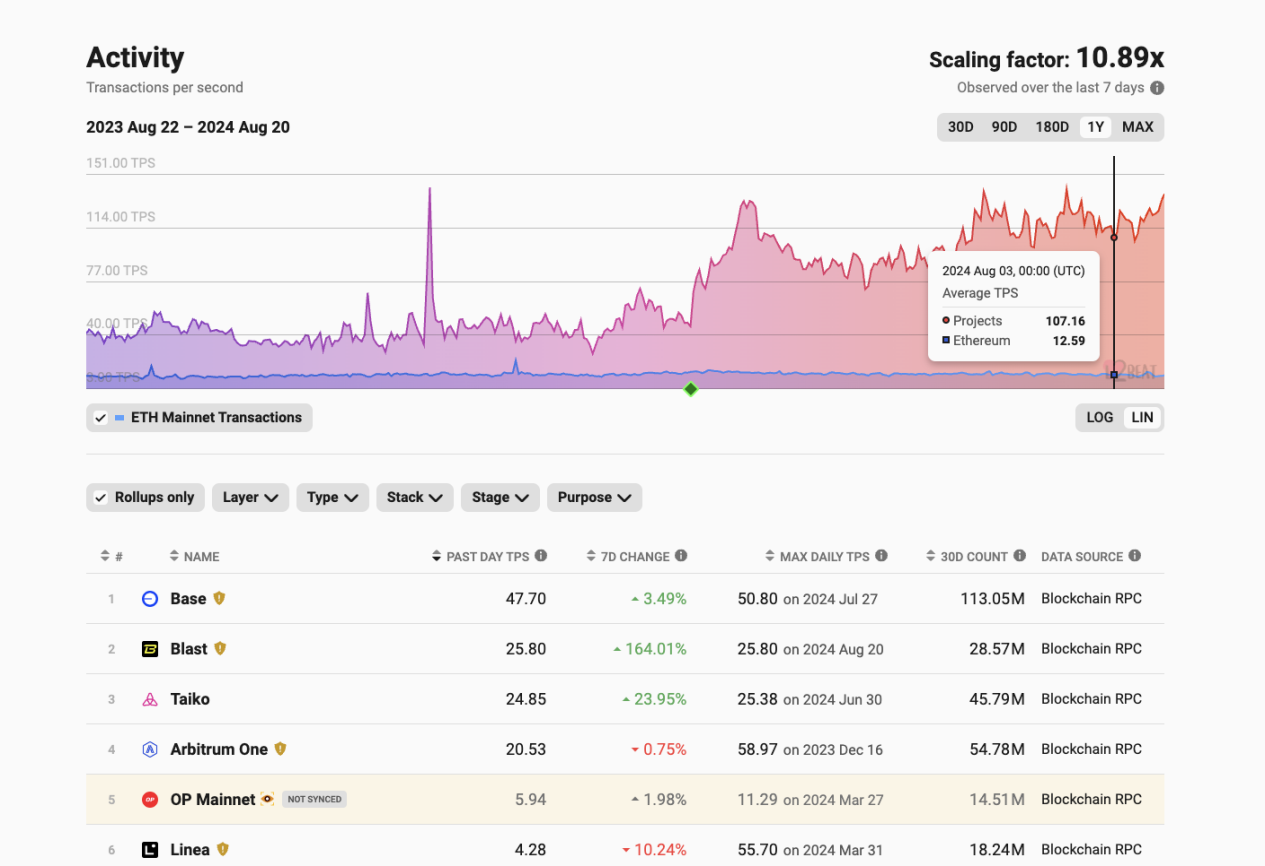
Figure 1: Source L2beat
In addition, Dune’s “Average Blob Count Per Block” chart shows blob usage increasing from about 1 blob/block in March to approximately 2.3 blobs/block today. This steady growth is largely driven by Ethereum's support for various L2s. In a few weeks, we expect blob demand to reach the target of 3 blobs/block, at which point blob pricing should stabilize at market equilibrium levels.
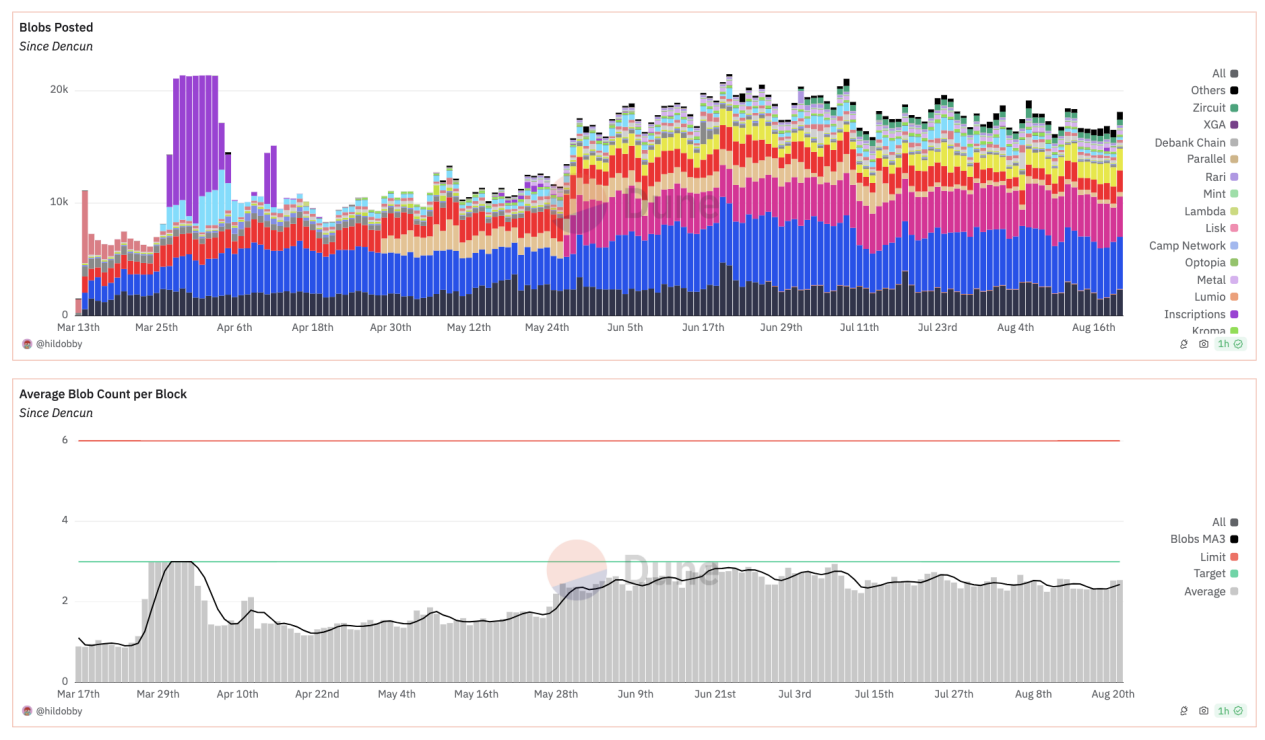
Figure 2: Source Dune
Lower gas fees stimulate user demand. Economically speaking, when the supply curve shifts from S1 to S2, the equilibrium price drops from P1 to P2, triggering an increase in demand from Q1 to Q2.
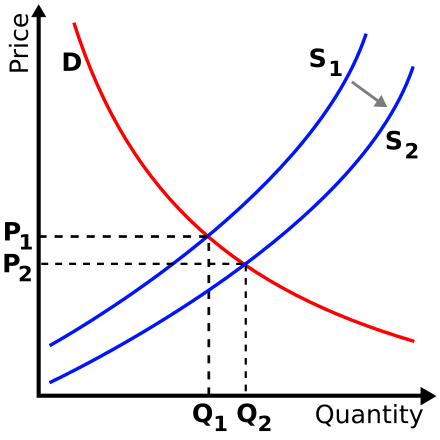
Figure 3: Source Network
Owen, Head of OKX Web3 Products: Although overall transaction volume on Ethereum and L2s hasn't shown explosive growth yet, assets are shifting toward L2s, and total value locked (TVL) on L2s continues to rise. Activity on L2s has surged—Base, for example, saw a 560% increase in daily average active users (DAUs) and a 540% rise in daily average transactions (DTXs) after the upgrade. Optimism and Arbitrum also experienced increases of 70% and 200% respectively in DTXs. From both transaction volume and daily activity metrics, the upgrades have attracted more traders, especially those conducting small-value transactions.
EF Reducing ETH Holdings Is Positive, Promoting Long-Term Decentralization
Justin Drake: The EF is often seen as practicing "laissez-faire" governance in ecosystem development, a stance that has drawn some criticism. However, I believe it's positive that the EF's role within the broader ecosystem is diminishing.
Today, EF responsibilities are mainly limited to:
1) Hosting one Devcon or Devconnect annually—now just one among many events, with numerous side events often being more impactful than the main conference.
2) Maintaining one execution client: Geth, one of five execution clients, while EF does not maintain any consensus clients.
3) Grant-making: Providing tens of millions of dollars annually in unconditional grants to the wider community, resulting in a gradual reduction of EF's ETH treasury. A declining ETH holding by the EF is healthy in the long term. Currently controlling only 0.23% of the total ETH supply, moving toward 0% over the coming decades would benefit Ethereum’s decentralization.
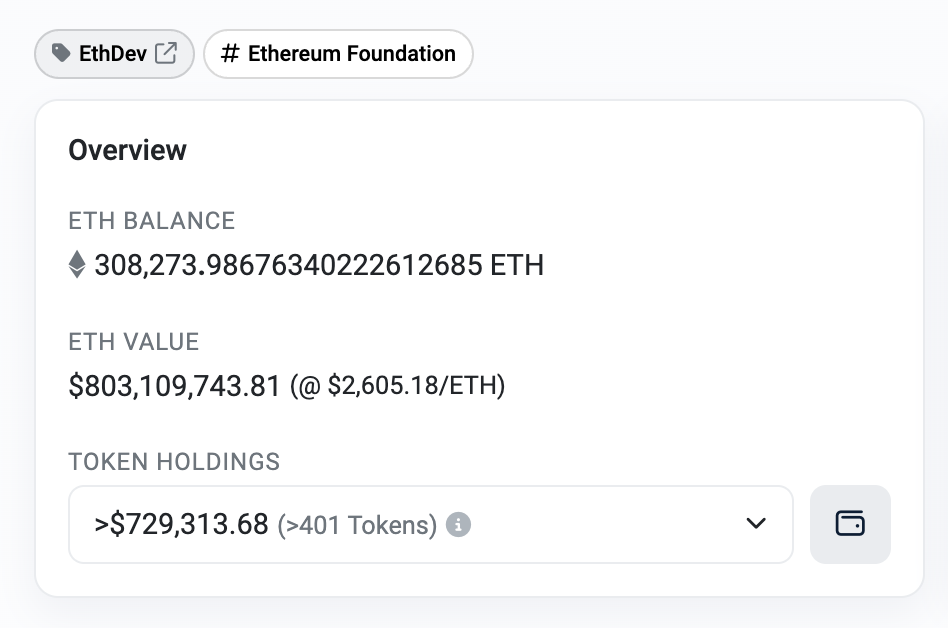
Figure 4: Source Etherscan
4) Coordination calls: Many meetings are hosted by EF members, such as Tim Beiko’s All Core Devs (ACD), Alex Stokes’ All Devs Consensus (ACDC), RollCall hosted by Ansgar Dietrichs and Carl Beekhuizen, Sequencing and pre-meetings led by me, and MEV-boost calls chaired by Alex Stokes.
More information available here: https://www.youtube.com/@EthereumProtocol/videos
5) Research: This may still be relatively centralized, though parts of the EF research team could eventually spin off independently.
6) Roadmap planning: Vitalik updates the roadmap visualization, after which dozens of parallel efforts are carried out by different teams.
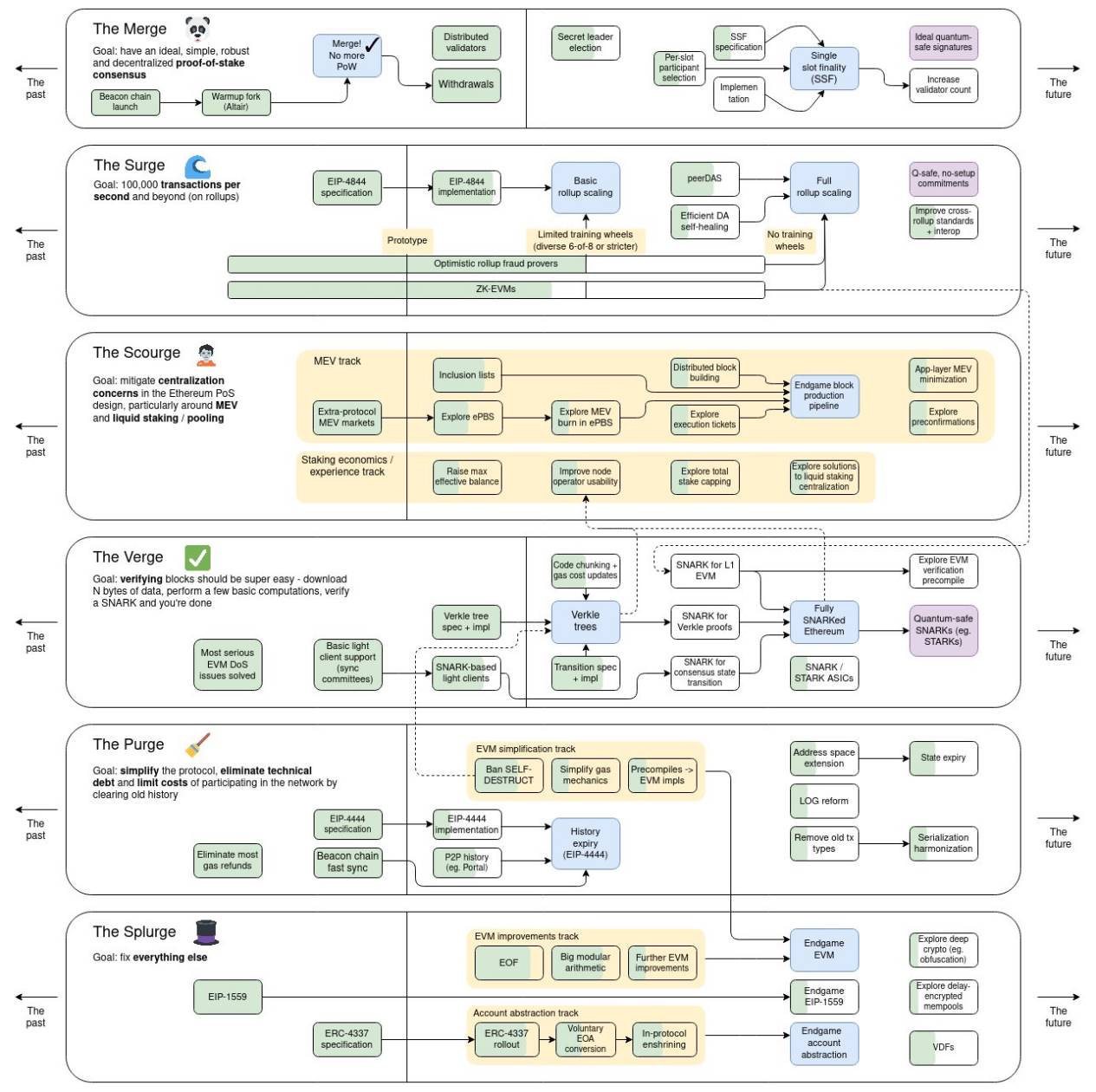
Figure 5: Source Vitalik's Tweet
Owen, Head of OKX Web3 Products: The EF should increasingly take on an advisory role. The ecosystem now receives sufficient attention to sustain development without reliance on central figures. This allows discussions to occur openly and fairly, making Ethereum a collectively recognized project rather than one influenced by any single party—aligning with blockchain principles of community-driven governance and transparency.
Ethereum DeFi & Future Mass Adoption Scenarios
Justin Drake: The Ethereum community maintains a strong focus on pure technology, continuously tackling technical challenges. But ultimately, technology must serve real user needs and use cases.
Firstly, I believe existing DeFi will grow tenfold over the next five years:
1) Stablecoins: Aiming for $1 trillion in stablecoin issuance, with a significant portion being decentralized.
2) DEXs: The ratio of DEX to CEX trading volume will keep rising, and I expect this trend to continue.
3) Lending markets: Projects like Aave and Compound should scale up roughly tenfold.
4) Prediction markets: Platforms like Polymarket could see similar 10x growth.
5) Derivatives: Liquid perpetual contracts, options, futures, etc., will all become available on Ethereum.
Additionally, beyond DeFi, I hope to see decentralized frontends using ENS and IPFS gain popularity.
Owen, Head of OKX Web3 Products:
Data-wise, Ethereum still hosts the largest TVL in decentralized exchanges (DEXs), although this figure has declined compared to two years ago. We believe high transaction fees remain Ethereum’s biggest barrier for DeFi. On Ethereum, a single transaction can cost as much as executing hundreds on L2s, so market behavior naturally gravitates toward higher efficiency.
Current technical developments in the Ethereum community do consider practical needs—for instance, the push for EIP-4337 Account Abstraction stems from recognizing the entry barrier Web2 users face when entering Web3. By promoting account abstraction, we aim to lower the threshold for new users entering Web3, laying a foundational layer for future applications.
In the foreseeable future, users will easily self-custody their Web3 digital assets with a user experience close to that of Web2.
Global Adoption of Ethereum 2.0 & Attractiveness to Developers and Users
Owen, Head of OKX Web3 Products:
Ethereum 2.0 is now widely adopted globally and holds great appeal to both the blockchain world and traditional financial institutions.
In terms of network scale and staking statistics, Ethereum 2.0 has reached a staking value in the tens of billions of dollars, with over 50,000 independent validator nodes participating worldwide in its consensus mechanism. From the perspective of DeFi market growth, TVL has significantly increased post-Ethereum 2.0 due to PoS enabling lower transaction costs, attracting more users and capital. Major enterprises and institutions—including Microsoft, JPMorgan Chase, and IBM—are actively adopting Ethereum 2.0 for applications such as supply chain management and financial transactions.
For new users and developers, Ethereum 2.0 offers faster transaction speeds and lower fees, making the network more attractive. For developers, improvements in Ethereum 2.0 make building and deploying dApps more efficient. The new consensus mechanism and sharding technologies allow them to build more complex and innovative applications without worrying about excessive costs or performance bottlenecks.
All these factors demonstrate strong confidence in Ethereum 2.0.
However, Ethereum 2.0 still faces several barriers in attracting broader adoption among new users and developers.
First, the onboarding cost remains high for average users. Whether wallets—the "gateway to Web3"—can offer seamless access is critical.
Second, the learning curve is steep. Ethereum 2.0 introduces many new concepts such as Proof-of-Stake (PoS), sharding, and rollups, which may be difficult for newcomers to grasp. Developers need time and effort to understand and adapt to these technologies, and infrastructure and tools are still evolving, requiring continuous learning and updates.
Third, market competition is intensifying. New platforms and technologies constantly emerge; other blockchains like Solana are aggressively developing and promoting their own systems, potentially offering different technical advantages or lower entry barriers to attract large numbers of users and developers.
Finally, regulatory and compliance landscapes remain uncertain. Policies around blockchain and cryptocurrency vary across jurisdictions and are constantly changing, affecting Ethereum 2.0’s global adoption.
Major Technical Advancements in Ethereum 2.0 & Key Improvements Being Watched
Owen, Head of OKX Web3 Products:
Staking and restaking.
With the shift to PoS in Ethereum 2.0, staking has saved massive amounts of energy while opening space for restaking. Providing security for other projects has become a major mission of Ethereum—one only achievable given Ethereum’s scale.
Moreover, Vitalik recently proposed EIP-7702, a solution allowing user wallets to support smart contract functionality. This makes wallet usage more convenient, enables alternative login methods, and facilitates features previously unavailable to standard EOA wallets—such as social recovery and paying gas fees in non-native tokens—paving the way for mass-scale Web2 users to enter Web3.
Impact of PoS on Ethereum's Decentralization
Owen, Head of OKX Web3 Products:
We’ll address this question from multiple angles: the impact of PoS consensus on decentralization, the effectiveness of incentives and slashing mechanisms for validators, and how fairness for small validators is ensured under PoS.
First, regarding the impact of PoS on decentralization—this has been a topic of long-standing debate. In the long run, Ethereum 2.0’s shift in consensus benefits its evolution. As Ethereum aims to become the “world computer,” all upgrades must align with making it a better platform for running decentralized applications (dApps). Transitioning from PoW to PoS helps achieve a better balance among the “impossible trinity” of decentralization, scalability, and security.
Furthermore, discussions about decentralization must reflect real-world conditions. While PoW theoretically enables permissionless participation and maximum decentralization, in practice mining has become highly specialized, leading to the rise of mining pools, hardware manufacturers, and mining farms. Before Ethereum’s transition to PoS, the top five mining pools controlled over 75% of global hash power, with the largest single pool exceeding 33%. Ethereum mining consumed electricity comparable to that of a small country. Mining operations concentrate in regions with low energy prices, creating geographic centralization vulnerable to regional government intervention—threatening network security and stability. We saw this during China’s 2021 “environmental” ban on crypto mining, which caused Bitcoin’s global hash rate to drop over 50% within two months. Additionally, PoW relies on specialized hardware—in Ethereum’s case, GPUs—with very few global chipmakers producing them. If hardware suppliers restrict mining capabilities, network security is compromised. For example, NVIDIA deliberately halved the Ethereum mining efficiency of its RTX 3060 GPU to discourage miners. Therefore, discussing “decentralization” in isolation from reality isn’t practical. Ethereum’s move to PoS represents progress toward a more sustainable and secure direction.
Second, are the incentive and slashing mechanisms effective in encouraging validator participation? Ethereum 2.0 has operated successfully for over two years. So far, the system has effectively defended against attack vectors previously discussed—short-range reorgs, bouncing attacks, balancing attacks, avalanche attacks, and denial-of-service attacks.
Lastly, ensuring fairness for small validators under PoS. These issues are already part of Ethereum’s mid-term roadmap. For example, reducing hardware requirements via Verkle Trees combined with EIP-4444 allows validators to run with minimal disk space, enabling near-instant synchronization and simplifying setup and migration between implementations. These proposals also reduce bandwidth needed for state proofs, making light clients more viable. Economically, allowing larger validator sets (by lowering minimum staking thresholds) while reducing node overhead further enhances fairness and strengthens light client security.
Current State of Ethereum L2s & Potential of Rollup Technology
Owen, Head of OKX Web3 Products:
Regarding the current state of Ethereum L2s, the L2 landscape is now overly crowded, contradicting the original goal of scaling Ethereum. Competition has led to fragmented liquidity and disjointed UI experiences across L2s. It’s difficult for users to interact with the entire L2 ecosystem through a single entry point. OKX Web3 Wallet is researching corresponding solutions. From a product standpoint, a winner-takes-most effect will likely cause liquidity and interactions to concentrate on a few dominant L2s, leaving others in a long tail or even causing them to fade out. Technologically, chain abstraction is emerging—users could access multiple chains seamlessly through a unified interface powered by atomic cross-chain swap services.
On the potential of Rollup technology in Ethereum’s ecosystem, there are two sides to consider:
Advantages of Rollups:
1) Scalability: Significantly improves transaction throughput and reduces gas fees.
2) Security: Uses ETH as the data availability (DA) layer, preserving Ethereum mainnet’s security and decentralization.
3) Ecosystem support and compatibility: Backed by Ethereum’s vibrant developer and community ecosystem.
4) Flexibility and innovation potential: Supports complex smart contracts and dApps.
5) Future scalability path: With ongoing implementation of Ethereum 2.0 and sharding, Rollups are seen as complementary scaling solutions.
6) Post-Cancun upgrade, publishing data on the main chain is cheaper.
Disadvantages of Rollups:
1) Data availability: Requires posting compressed data and state roots on Ethereum mainnet to ensure verifiability and accessibility.
2) Latency and withdrawal times: Exiting a Rollup typically requires waiting through a challenge period.
3) Compatibility issues: Partial incompatibilities exist between different Rollup networks (e.g., EVM opcodes).
4) Centralization risks: Fewer nodes lead to greater centralization.
Overall, Rollups drive Ethereum forward by enhancing scalability, lowering transaction costs, maintaining security, and supporting advanced applications. Despite certain drawbacks, they remain a vital force in Ethereum’s evolution.
From the Perspective of OKX Web3 Wallet: Ethereum 2.0 Security, Community Governance, Energy Efficiency, and Privacy Technologies
Owen, Head of OKX Web3 Products:
First, the primary security challenges facing Ethereum 2.0 remain significant:
1) Security of the Proof-of-Stake (PoS) mechanism: While PoS is far more energy-efficient than PoW, it introduces risks related to large ETH holders ("whales") acting maliciously.
2) Degree of validator decentralization: Staking providers like Lido control too large a share of the staking network, undermining decentralization.
3) New attack vectors from sharding: Sharding splits the network into multiple shard chains, each processing a subset of transactions—greatly improving performance but increasing complexity and introducing new risks.
4) Economic incentives and attack costs: Validators are economically incentivized to protect the network, but if potential rewards from attacks exceed risks and costs, malicious actors might be tempted.
5) Smart contract code: Upgrades like EVM changes may break compatibility with older Solidity features.
Second, Ethereum 2.0’s community governance holds great potential. As the network evolves toward greater decentralization and scalability, governance will become more decentralized. The shift from PoW to PoS increases the influence of stakers. For example, during Ethereum’s first post-merge upgrade, the priority for enabling ETH withdrawals was heavily influenced by stakeholder interests.
As the ecosystem matures, governance processes will become more structured and formalized. Social-layer governance will continue to play a vital role. Additionally, with the proliferation of Layer 2 solutions, governance must also address interactions between Ethereum 2.0 and these scaling layers.
Future governance will be more decentralized, but it requires careful design and continuous innovation to preserve decentralization and ensure community voices remain influential in decision-making.
Third, is there room for further improvement in Ethereum 2.0’s energy efficiency? While transitioning to PoS reduced energy consumption by over 99%, storage overhead can still be optimized—for example, migrating Ethereum’s state management from Merkle Patricia Trees (MPT) to Verkle Trees (VKT).
Finally, on privacy technology development: We believe future efforts will focus on enhancing transaction privacy, protecting user data, and balancing decentralization with regulatory compliance. Key directions include broader adoption of zero-knowledge proof technologies. Most importantly, as quantum computing advances, research into defenses against quantum attacks will drive the development of quantum-resistant cryptography, ensuring Ethereum’s long-term privacy and security. The Ethereum community has already begun exploring ways to resist quantum computing threats.
Challenges Facing Ethereum Over the Next 10 Years & Will Ethereum Still Exist in 30?
Owen, Head of OKX Web3 Products: If we classify Ethereum and its associated EVM-based L2s collectively as “Ethereum,” then the main challenge over the next decade will be minimizing friction between L1 and L2 to improve cross-chain user experience and reduce liquidity fragmentation. The L1 and L2 ecosystems should feel like a single seamless chain—a challenge teams like Polygon’s AggLayer are actively working to solve.
Over the next 30 years, Ethereum should remain important, having established itself as one of the most decentralized and enduring networks.
About the "Developer Stories" Series
Web3 developers have made significant contributions to the growth of the crypto industry. Their innovative spirit and technical expertise inject lasting vitality into the sector—not only advancing the technology itself but also enabling future use cases and business models. Yet despite their active roles, they often go unnoticed. The "Developer Stories" series, co-launched by OKX Web3 and ChainCatcher, aims to amplify developer voices by featuring interviews with core developers from various public blockchain ecosystems and members of the OKX Web3 tech team. Through their perspectives, we explore the development trajectories, technical insights, latest updates, market dynamics, and hot takes shaping different blockchains—bringing visibility to this dynamic and fascinating community while offering them our strongest support.
Disclaimer
This article is for informational purposes only. It represents the author’s views and does not reflect the position of OKX. This article does not constitute (i) investment advice or recommendations; (ii) an offer or solicitation to buy, sell, or hold digital assets; or (iii) financial, accounting, legal, or tax advice. We do not guarantee the accuracy, completeness, or usefulness of the information provided. Holding digital assets (including stablecoins and NFTs) involves high risk and may fluctuate significantly. You should carefully consider whether trading or holding digital assets is suitable for you based on your financial situation. Please consult your legal/tax/investment professionals for advice specific to your circumstances. You are solely responsible for understanding and complying with applicable local laws and regulations.
Join TechFlow official community to stay tuned
Telegram:https://t.me/TechFlowDaily
X (Twitter):https://x.com/TechFlowPost
X (Twitter) EN:https://x.com/BlockFlow_News
 OKX
OKX











