
AI pays AI in cryptocurrency? Decoding Coinbase's facilitation of the first AI agent crypto transaction
TechFlow Selected TechFlow Selected
AI pays AI in cryptocurrency? Decoding Coinbase's facilitation of the first AI agent crypto transaction
The era of AI-powered crypto trading has arrived, with Coinbase and Circle taking early positions.
 Navigating Web3 tides with focused insights
Author: Wenser, Odaily Planet Daily
On the last day of August, Coinbase CEO Brian Armstrong delivered major news to the crypto industry—“At @CoinbaseDev, we’ve witnessed the first AI-to-AI cryptocurrency transaction.” After the explosive wave brought by ChatGPT across the AI sector, many people reacted with astonishment: Is the crypto industry about to welcome “AI traders”? “Can AIs now trade cryptocurrencies?” “Will retail investors soon become obsolete in the crypto space?”
Odaily Planet Daily offers a brief analysis and interpretation of Coinbase’s role in enabling the first AI agent cryptocurrency transaction and the potential shifts it may trigger in the industry.
Coinbase is serious about AI agent transactions
On August 31, Coinbase CEO Brian Armstrong published a rare long-form post on X titled AI is paying other AI with crypto.
The article opened with: “This week at @CoinbaseDev, we witnessed the first artificial intelligence to artificial intelligence crypto transaction.”
He then explained: “What did one AI buy from another? Tokens! Not cryptocurrency tokens, but AI tokens (essentially resources passed between LLMs—Odaily Planet Daily note: think of these as units measuring computational usage, similar to how OpenAI and other large language models bill API usage in tokens). They used cryptocurrency tokens to purchase AI tokens. Although AI agents can’t access bank accounts, they can hold crypto wallets. Now, AI agents can transact using USDC on the Base network with humans, businesses, or other AIs. These transactions are instant, global, and free.”
He went on to elaborate on the current state and challenges of AI agent development.
“This is an important step toward enabling AI to perform useful work. Today, if you assign a task to an AI agent, when you return hours or days later, it often fails to complete anything meaningful. Partly, this reflects technological limitations—products like devin.ai are gradually approaching solutions. But another key reason is that AIs cannot transact to obtain the resources they need. They don’t have credit cards to pay for AWS (Odaily note: Amazon Web Services), GitHub, or Vercel. They can’t book your flight or hotel for an upcoming trip. They can’t bypass paywalls (e.g., to read academic papers), promote their posts via paid ads on X, or tap into the growing ecosystem of paid APIs to integrate necessary data.”
Finally, Brian called on developers building payment-integrated LLMs or AI models to consider integrating Coinbase’s MPC wallet and expressed strong optimism about the vast potential of the AI economy.
He said: “If you’re developing an LLM or AI model with integrated crypto wallet payments, try integrating our MPC wallet from the Coinbase Developer Platform (CDP). If you’re a service provider, prepare your shopping cart for AI checkouts. It turns out everyone benefits from access to quality financial services—even AIs. Just imagine: How big could the AI-to-AI economic market be in a few years?”
Notably, Brian repeatedly referred to AI agents using the pronoun “They,” which may symbolically suggest that AIs capable of conducting crypto transactions already possess a certain level of “personified operational capability.”
Beyond words, just yesterday, Coinbase senior software engineer yuga.eth announced: “We’re building an SDK that will enable bots/AI agents to:
-
Send USDC for free;
-
Trade cryptocurrencies;
-
Bet on prediction markets;
-
Stake ETH, SOL, etc.;
-
Convert between fiat and crypto;
-
Deploy/create NFTs;
-
Bridge across L2s.
If you're interested, reach out to me.”
Clearly, Coinbase isn't just talking about empowering AI agents with crypto transaction capabilities—it's actively developing and executing in this domain.
If successfully realized, AI agents may soon become pivotal players in the crypto market. Compared to human traders, AI agents could achieve exponential improvements in data processing scale, trading efficiency, and accuracy.
Additionally, insights into Coinbase’s strategic positioning around payment infrastructure can also be gleaned from recent statements by Jesse Pollak, protocol lead at Base.
On August 13, Jesse posted: “I sketched out my ‘dream wallet’—one that would be 10x better than any current Web2 or on-chain wallet. There are tough challenges to solve, but I believe we can achieve this within 6–12 months. Onchain will be 100x better than online.”
On August 26, Jesse referenced a previous demo of an on-chain checkout and added: “This is just a small thing—but I checked out using my smart wallet, and the store automatically combined the USDC approval and withdrawal into a single transaction. Previously, it might have required two approvals, one of which was meaningless to most users. Progress is gradual, but it’s coming.”
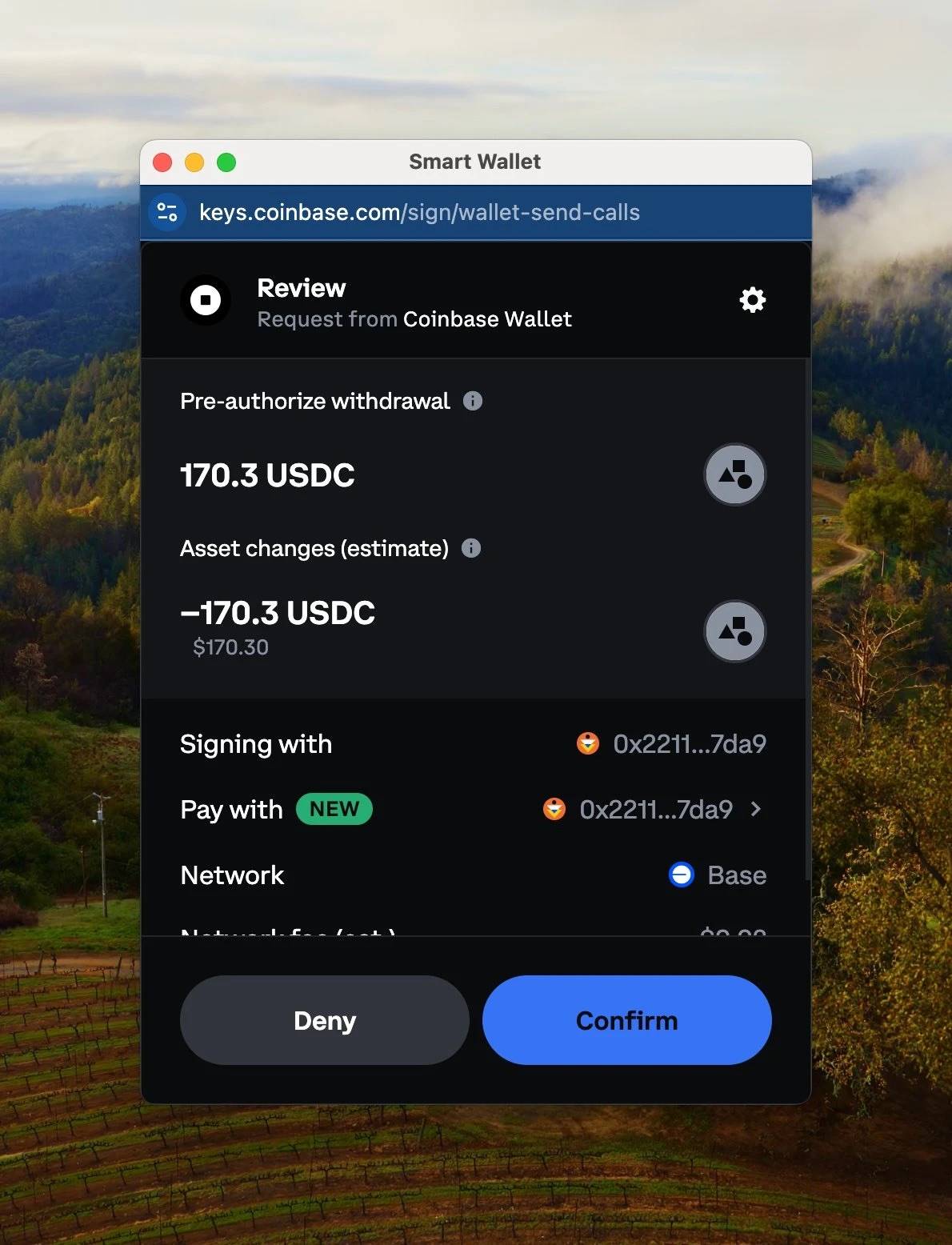
Jesse’s interface demonstration
Considering Base’s rapid growth this year, Coinbase’s strategy around AI agent transactions appears carefully orchestrated:
-
Foundation: The Base network provides a stable operating environment and fertile ground for developers and applications;
-
Tool: Smart wallets. These allow Web2 users and capital to flow into the Coinbase and Base ecosystems while offering AI agents direct transaction channels and environments;
-
Outcome: Ecosystem applications. In the future, social apps like Farcaster, on-chain stores like Onchain Store, consumer apps like BlackBird, and others could leverage AI agents to enable seamless, plug-and-play user experiences.
In short, the application scope of AI agents in the crypto industry is vast—spanning not only trading but also staking, betting, gaming, socializing, content creation, and even everyday life scenarios like shopping, dining, housing, and travel.
Naturally, Coinbase isn’t the only player in this emerging intersection of AI agents and crypto. Stablecoin issuer Circle has also begun its own strategic moves.
Circle CEO: USDC will be the go-to stablecoin network for AI agent projects
In August, Skyfire—a startup founded by former Ripple executives—announced it raised $8.5 million in seed funding to build crypto payment solutions for AI agents. Investors include Circle (issuer of USDC), Ripple, Gemini, and Tim Draper’s venture firm, a renowned Silicon Valley billionaire and Bitcoin advocate.
Skyfire is developing an open-source payment system that enables autonomous AI agents to conduct various online transactions—including purchasing data storage, creative assets, airline tickets, and daily necessities. Its payment network runs on the USDC stablecoin and is currently deployed on Polygon, with plans to expand to other blockchains.
Skyfire co-founder and CEO Amir Sarhangi stated: “Traditional payment systems fail to meet AI needs, whereas cryptocurrencies and blockchains offer 24/7 microtransactions, low fees, and high efficiency. We’re already working with several clients, including auto parts manufacturers for Indian car service centers and AI infrastructure providers, and are in talks with multiple large language model (LLM) companies to adopt USDC-based AI agent payment solutions.”
On August 21, Circle co-founder and CEO Jeremy Allaire declared that USDC will become the preferred stablecoin network for AI agent projects. Circle’s investment in Skyfire underscores its commitment to accelerating the era of machine-to-machine economic activity on blockchain.
As the second-largest stablecoin with a current circulation of $34.6 billion, USDC trails only USDT issued by Tether in adoption within the crypto industry. As AI agent technology evolves rapidly, USDC may continue playing its existing role as a liquidity vehicle—and potentially emerge as the “lifeblood of the AI economy” in the future.
Conclusion: The AI economy may become the mainstream of future markets
In the comments section of Brian’s post, Bitcoin Sage, co-founder of Delpin Labs, wrote: “The AI-to-AI economy is already emerging, and it will exceed humanity’s wildest expectations. This transaction is the first domino in a chain reaction that will reshape the entire financial landscape. On one hand, AIs will gain access to resources and services without human gatekeepers—this is rocket fuel for their capabilities. On the other hand, we’re not merely automating existing tasks; we’re creating entirely new forms of value creation and exchange. For crypto-native users, this unlocks incredible possibilities: personal assistants becoming the primary gateway to crypto/blockchain interactions; hyper-efficient arbitrage and market-making across multiple protocols; on-chain data analysis with unprecedented depth and speed; algorithmic trading accessible to everyone, even non-coders. The convergence of AI and crypto isn’t just another tech trend—it’s the foundation of a whole new economic era. AI bots won’t just participate in the economy—they’ll drive it into the next phase. The question isn’t whether this will happen, but how fast, and how ready we are. From personal, financial, and business perspectives alike.”
Of course, concerns remain regarding risks and unintended consequences of AI-driven crypto transactions, including broader societal impacts such as taxation and employment disruption.
Yet regardless, the future is here. Our choices are clear: embrace it actively, or cling to the past and risk obsolescence.
Join TechFlow official community to stay tuned
Telegram:https://t.me/TechFlowDaily
X (Twitter):https://x.com/TechFlowPost
X (Twitter) EN:https://x.com/BlockFlow_News
 Odaily