Complex product details and worried about pitfalls? Read this guide to quickly master how to choose CEX lending
TechFlow Selected TechFlow Selected
Complex product details and worried about pitfalls? Read this guide to quickly master how to choose CEX lending
Binance's lending scheme is relatively favorable to borrowers, as collateral can still earn interest; OKX offers greater flexibility and combinability, making it relatively advantageous for depositors.
 Navigating Web3 tides with focused insights
Author: Nanzhi, Odaily Planet Daily
Since last year, several centralized exchanges have faced controversies over their lending products, with users claiming "significant losses" due to unclear terms. In reality, the lending products offered by major centralized exchanges are not simply about depositing collateral and borrowing funds—there are numerous "unique" rules involved.
To address this, Odaily Planet Daily will summarize and detail in this article the lending rules of Binance, OKX, and Bybit to help readers understand the product specifics.
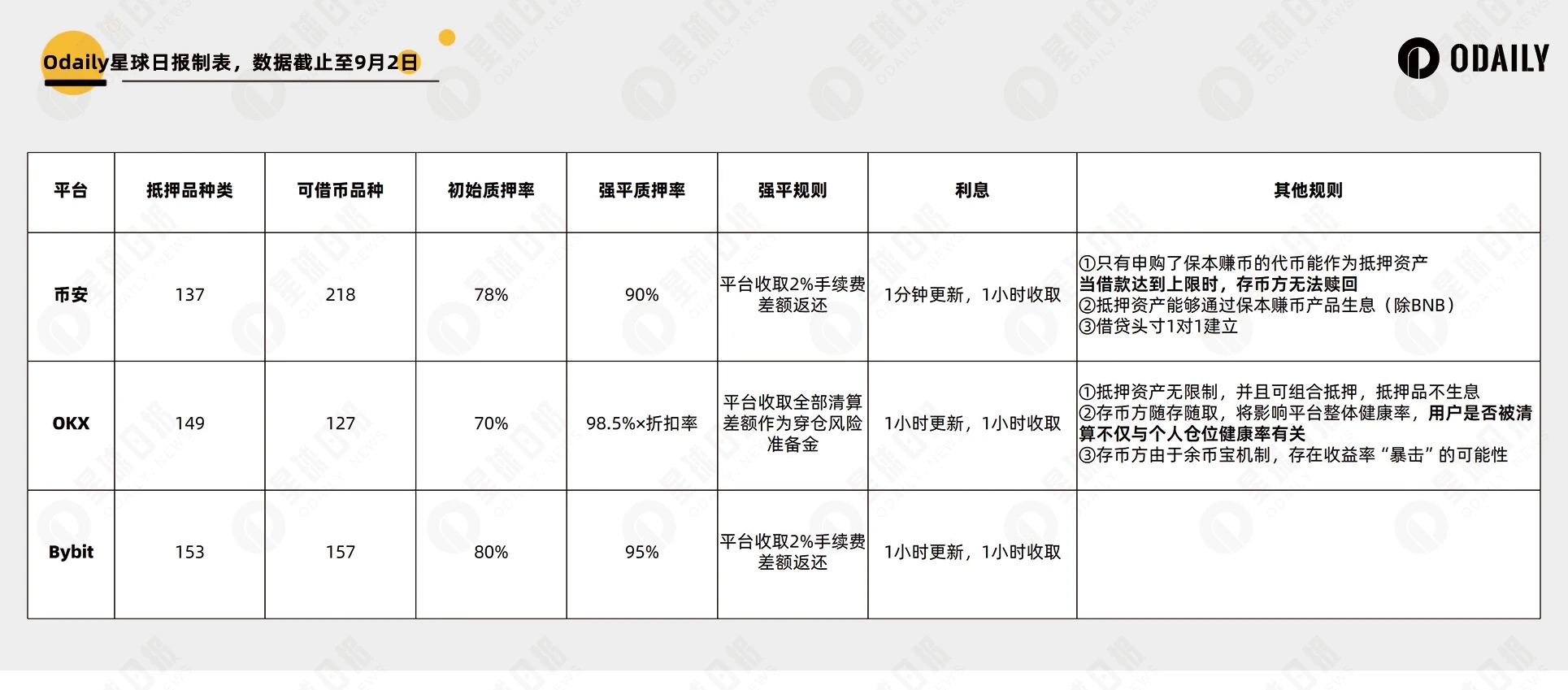
Binance Flexible Lending
Collateral
Users can only pledge assets that have been subscribed into Binance's principal-protected flexible savings products as collateral, including USDT and 136 other tokens, totaling 137 supported cryptocurrencies. If the value of such principal-protected savings collateral is insufficient to cover the desired loan amount, users may also subscribe additional digital assets from their spot accounts into these flexible savings products and use them as collateral.
Borrowing Details
Isolated Positions: There are 218 borrowable assets available. Each "collateral - borrowed asset pair" can open an isolated borrowing position—for example, one position could be "USDT collateral + ETH borrowing," while another could be "USDT collateral + BTC borrowing." Each such pair operates independently, with its own collateralization ratio, margin call threshold, and liquidation ratio calculated separately.
No Active Liquidation: Binance’s flexible lending is a termless product. As long as the platform supports both the borrowed asset and collateral cryptocurrency, and the collateralization ratio remains within acceptable limits, users may hold their positions indefinitely.
Collateralization Ratio: Initial collateralization ratios vary depending on the collateral type, but most are set at 78% (meaning $100 worth of collateral can borrow up to $78 worth of assets).
Liquidation Rules
If any single currency reaches the maximum liquidation collateralization ratio of 90%, or if the outstanding loan value drops below $200, full liquidation will occur. All debts will be repaid using equivalent collateral from the borrowing position. In the event of forced liquidation, the platform charges a 2% liquidation fee based on the borrowed amount.
Borrowing Interest
Borrowing interest rates can be checked on Binance’s lending page and are updated every minute. Notably, Binance does not publicly disclose the exact calculation method for each token's borrowing interest. Generally speaking, the higher the overall demand (utilization rate) for a given token, the higher the interest rate. When borrowing reaches a certain cap, depositors may no longer redeem their holdings immediately, but interest rates rise significantly to incentivize borrowers to repay early.
(Odaily Note: This clause was central to the previous CYBER controversy incident. Binance states in its “Binance Principal Protected Flexible Savings Product Guide” that “if there are too many redemption requests for a particular coin, available balances might temporarily become insufficient. Redemptions will resume normally once borrowers repay or additional liquidity is provided by other users.”)
After a borrowing order is successfully placed, interest accrues every minute, and the accumulated interest is added to the total outstanding debt.
Special Terms
Due to regulations under the EU’s Markets in Crypto-Assets Regulation (MiCA), users in the European Economic Area (EEA) cannot borrow unregulated stablecoins such as USDT and FDUSD. See the English version of the lending terms for details.
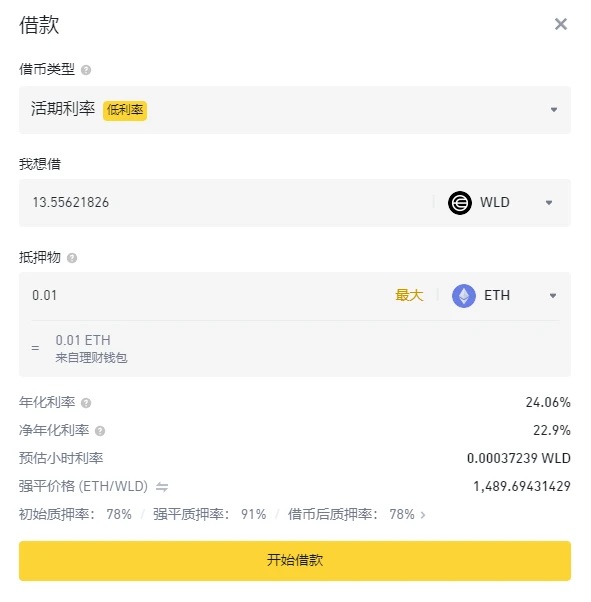
Digital assets used to subscribe to principal-protected flexible savings products continue to earn real-time annualized returns and tiered annualized yields after being pledged into Binance’s flexible lending program. However, BNB no longer earns Launchpool rewards during this period. As shown in the image below, WLD’s original borrowing rate is 24.06%. After deducting ETH’s flexible savings yield and applying the 78% collateralization ratio, the net borrowing cost becomes 22.9%.
(Odaily Note: The net annualized rate displayed on the interface is always calculated using the initial collateralization ratio and does not change with different borrowing amounts. Users who do not borrow at full capacity must manually calculate their actual annualized borrowing cost.)
OKX Flexible Lending
Collateral
A total of 149 cryptocurrencies, including USDT, are accepted as collateral. These assets are simply locked without generating additional returns or meeting special requirements.
Borrowing Details
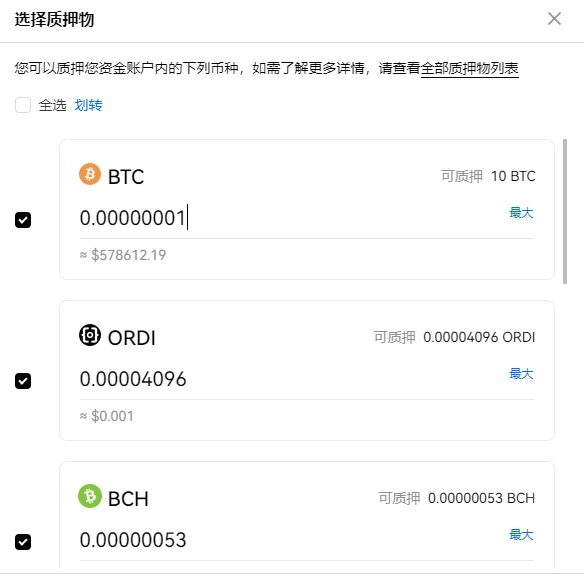
Flexible Mode: Users can borrow any of 127 supported assets and freely combine multiple collateral types to create a “multi-collateral - borrowed asset” position. For example, as shown in the image below, BTC, ORDI, and BCH are used together as collateral, while the borrower selects one of the 127 supported tokens to borrow. While a borrowing position exists, users can freely adjust their collateral mix within the safety margin.
Collateralization Ratio: OKX has relatively low initial collateralization ratios, mostly set at 70%.
Liquidation Rules
OKX calculates the liquidation collateralization ratio as: (Collateral Value × Coin Discount Rate – Borrowed Value × Maintenance Margin Rate – Liquidation Fee) / Collateral Value. The effective liquidation ratio is generally around 98.5%. However, individual coin discount rates vary significantly. Top-tier coins like BTC, ETH, USDT, and USDC have discount rates ranging between 0.9 and 1 depending on value. At the lower end are various altcoins such as NOT, 1INCH, ACE, etc., which have a discount rate of 0.5 for values under $50,000 and 0 above $50,000—meaning their borrowing limit is half that of top-tier coins, capped at $50,000 maximum.

Additionally, it should be noted that after a forced liquidation in flexible lending, any remaining funds go into the platform’s risk reserve fund to cover potential shortfall losses and are not returned to users.
Borrowing Interest
OKX updates flexible lending interest rates hourly, and interest is deducted hourly. The rate mechanism is unique—it matches lenders’ posted rates via the YuBit (YuBi Bao equivalent) system to form a market-clearing interest rate. For example:
User A deposits 1,000 USDT with a minimum lending rate of 1%, and User B deposits 1,000 USDT with a minimum rate of 10%. If a borrower takes out 1,500 USDT, User A’s entire 1,000 USDT is matched at 1%, and 500 USDT from User B is lent at 10%, while the rest remains unmatched. Thus, lenders on OKX may experience “critical hit” earnings when high-rate deposits get partially matched.
Special Terms
In addition to personal loan health metrics, OKX implements an automatic coin swap mechanism tied to borrowing activity. When the platform-wide borrowing-to-deposit ratio reaches 100%, to quickly reduce systemic risk, OKX begins executing automatic swaps starting with the largest borrowers, segmented in tiers by borrowing size. In short, whether your loan gets liquidated depends not only on your own position but also on the overall market borrowing level.
(Odaily Note: The official document outlining this process is titled “Automatic Coin Swap Rules.”)
This design enables OKX depositors to enjoy instant withdrawals at any time—a stark contrast to Binance’s model, where high utilization triggers elevated interest rates to encourage repayment. According to official announcements, this mechanism is not expected to change in the near future.
As a result, borrowers must monitor not only their personal health ratios but also the broader market borrowing rate. However, to prevent malicious attacks exploiting this data, the overall market borrowing rate is not publicly disclosed. Instead, users receive risk warnings and information about liquidation tiers directly via email.
Bybit Collateralized Lending (Simple Earn Lending)
Collateral
A total of 153 cryptocurrencies, including USDT, are supported as collateral. These are pledged directly without generating additional returns or requiring special conditions.
Borrowing Details
Isolated Positions: Users can borrow any of 157 supported assets. Each "collateral - borrowed asset pair" opens an isolated borrowing position, similar to Binance’s approach.
Collateralization Ratio: Bybit sets an initial collateralization ratio of 80%, with a liquidation ratio of 95% (93% for a few exceptions), significantly higher than other platforms.
Liquidation Rules
When liquidation occurs, the user’s collateral will be automatically used in full to repay the debt, plus a 2% liquidation fee. This fee is deducted from the collateral value, and any remaining balance after full repayment will be returned to the account previously designated by the user for collateral deductions.
Borrowing Interest
Flexible lending has no fixed repayment date, and interest rates fluctuate hourly based on market conditions. Interest is charged hourly until the loan is fully repaid or liquidated.
Conclusion
Most DEXes adopt models where deposited assets earn yield, and when borrowing limits are reached, withdrawals are paused and interest rates spike sharply to prompt repayment—similar to Binance’s approach.
Comparatively, Binance and OKX have introduced more complex lending mechanisms than other exchanges. Under extreme price surges combined with platform-wide liquidity exhaustion, Binance depositors may be unable to withdraw and sell, which favors borrowers. OKX offers greater flexibility and composability and tends to favor depositors instead.
Join TechFlow official community to stay tuned
Telegram:https://t.me/TechFlowDaily
X (Twitter):https://x.com/TechFlowPost
X (Twitter) EN:https://x.com/BlockFlow_News
 Odaily