a16z: The New Era of "Pixar"—How Will AI Merge Film and Gaming?
TechFlow Selected TechFlow Selected
a16z: The New Era of "Pixar"—How Will AI Merge Film and Gaming?
Pixar of the next century won't emerge through traditional film or animation, but through interactive video.
 Navigating Web3 tides with focused insights
Author: Jonathan Lai
Translation: TechFlow
Over the past century, technological change has given rise to many of our favorite stories. Take the 1930s: Disney invented the multiplane camera and produced the first synchronized sound, full-color animated feature. This breakthrough enabled the creation of the groundbreaking film *Snow White and the Seven Dwarfs*.
In the 1940s, Marvel and DC Comics rose to prominence during what's known as the "Golden Age of Comics," made possible by the widespread adoption of four-color rotary presses and offset printing techniques that allowed mass production of comics. The technical constraints—low resolution, limited color range, dot-matrix printing on cheap newsprint—created the iconic “pulp” aesthetic still recognizable today.
Likewise, in the 1980s, Pixar was uniquely positioned to leverage a new technology platform—computers and 3D graphics. Co-founder Edwin Catmull, an early researcher at NYIT’s Computer Graphics Lab and Lucasfilm, pioneered foundational CGI concepts that later powered the first fully computer-generated animated feature, *Toy Story*. Pixar’s rendering suite, RenderMan, has since been used in over 500 films.
In each wave of technology, early prototypes initially seen as novelties evolved into new formats for deep storytelling, led by generations of creators. Today, we believe the next Pixar is emerging. Generative AI is driving a fundamental shift in creative storytelling, empowering a new generation of human creators to tell stories in entirely new ways.
In particular, we believe the next-century Pixar will not emerge through traditional film or animation—but through interactive video. This new narrative format will blur the lines between video games and TV/film—merging deep storytelling with audience agency and “play”—unlocking a massive new market.
Games: The Frontier of Modern Storytelling
Two major trends are now converging that could accelerate the formation of a new generation of storytelling companies:
-
Consumer shift toward interactive media (vs. linear/passive media like TV/film)
-
Technological advances driven by generative AI
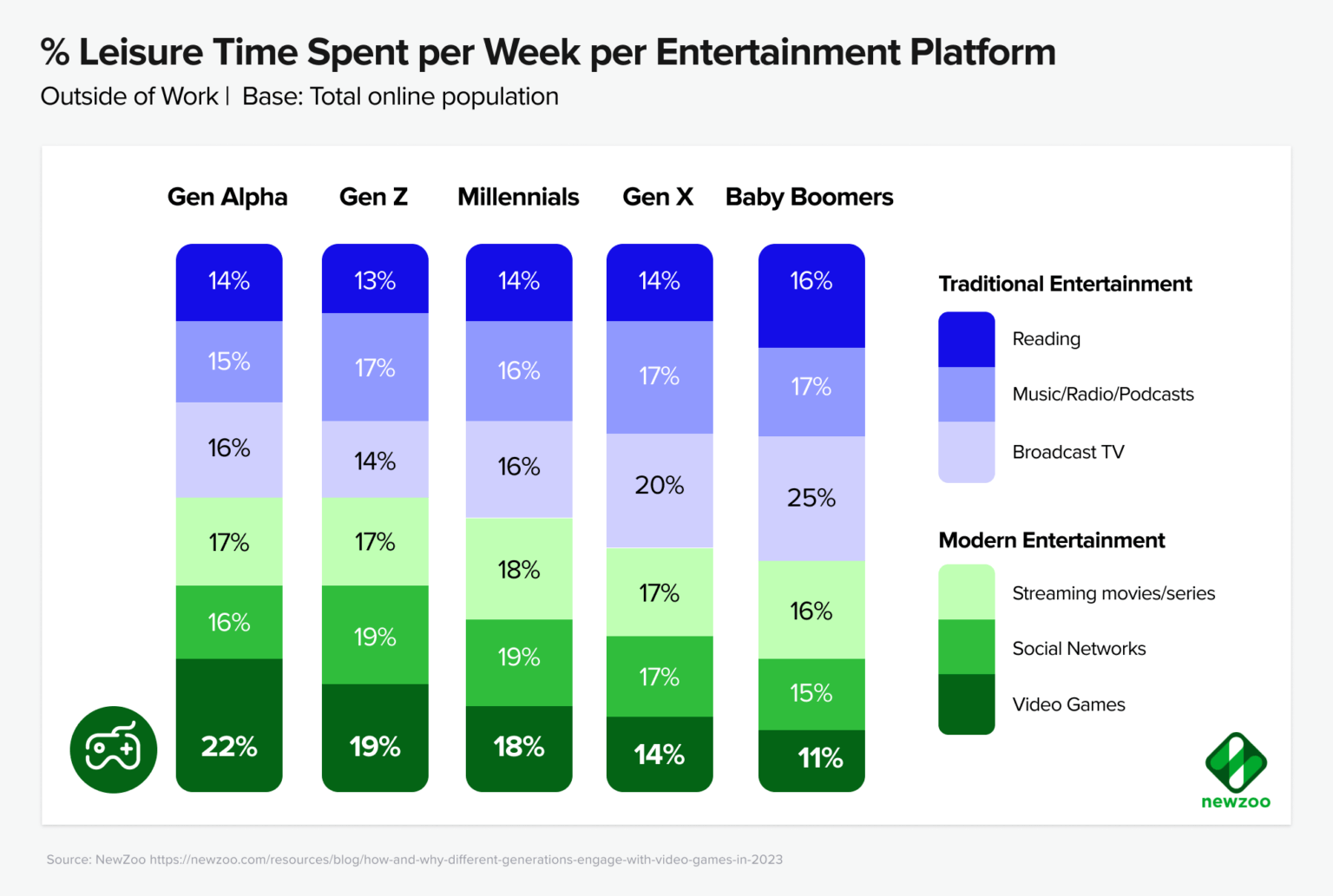
Over the past 30 years, we’ve seen a deepening consumer shift, with games and interactive media growing more popular with each generation. For Gen Z and younger, gaming is now their preferred leisure activity, surpassing TV and movies. In 2019, Netflix CEO Reed Hastings wrote in a letter to shareholders: “Our biggest competition is Fortnite—and we often lose.” For most households, the question is no longer “What are we watching?” but “What are we playing?”
While TV, film, and books continue to deliver compelling narratives, some of the most innovative and successful new stories are now being told through games. Consider *Harry Potter*. The open-world RPG *Hogwarts Legacy* immerses players in the experience of becoming a Hogwarts student like never before. It was one of 2023’s top-selling games, earning over $1 billion at launch—outperforming all *Harry Potter* films except the final installment, *Deathly Hallows Part 2* ($1.03 billion).
Game IPs have also found recent success in TV and film adaptations. Naughty Dog’s *The Last of Us* became HBO Max’s most-watched series in 2023, averaging 32 million viewers per episode. *The Super Mario Bros. Movie* achieved the highest-grossing opening weekend ever for an animated film, with $1.4 billion in box office revenue. Other successes include the critically acclaimed *Fallout* series, Paramount’s *Halo* series, Tom Holland’s *Uncharted* film, and Michael Bay’s *Skibidi Toilet* movie—among many others.
A key reason interactive media is so powerful is that active participation fosters intimacy with a story or universe. One hour of engaged gameplay delivers far more attention than one hour of passive viewing. Many games are also social by design, incorporating multiplayer mechanics at their core. The most memorable stories are often those we co-create and share with friends and family.
When audiences engage with intellectual property across multiple mediums—watching, playing, creating, sharing—the story becomes more than entertainment; it becomes part of personal identity. The magical transformation occurs when someone evolves from a casual “Harry Potter viewer” into a devoted “Potterhead,” building identity and community around what was once a solitary activity.
Overall, while our greatest stories were historically told through linear media, looking ahead, games and interactive media will be where future stories are told—and thus, we believe the next century’s most important storytelling companies will emerge here.
Interactive Video: Merging Narrative and Play
Given games’ cultural dominance, we believe the next Pixar will emerge through a medium that blends narrative and play. One particularly promising format is interactive video.
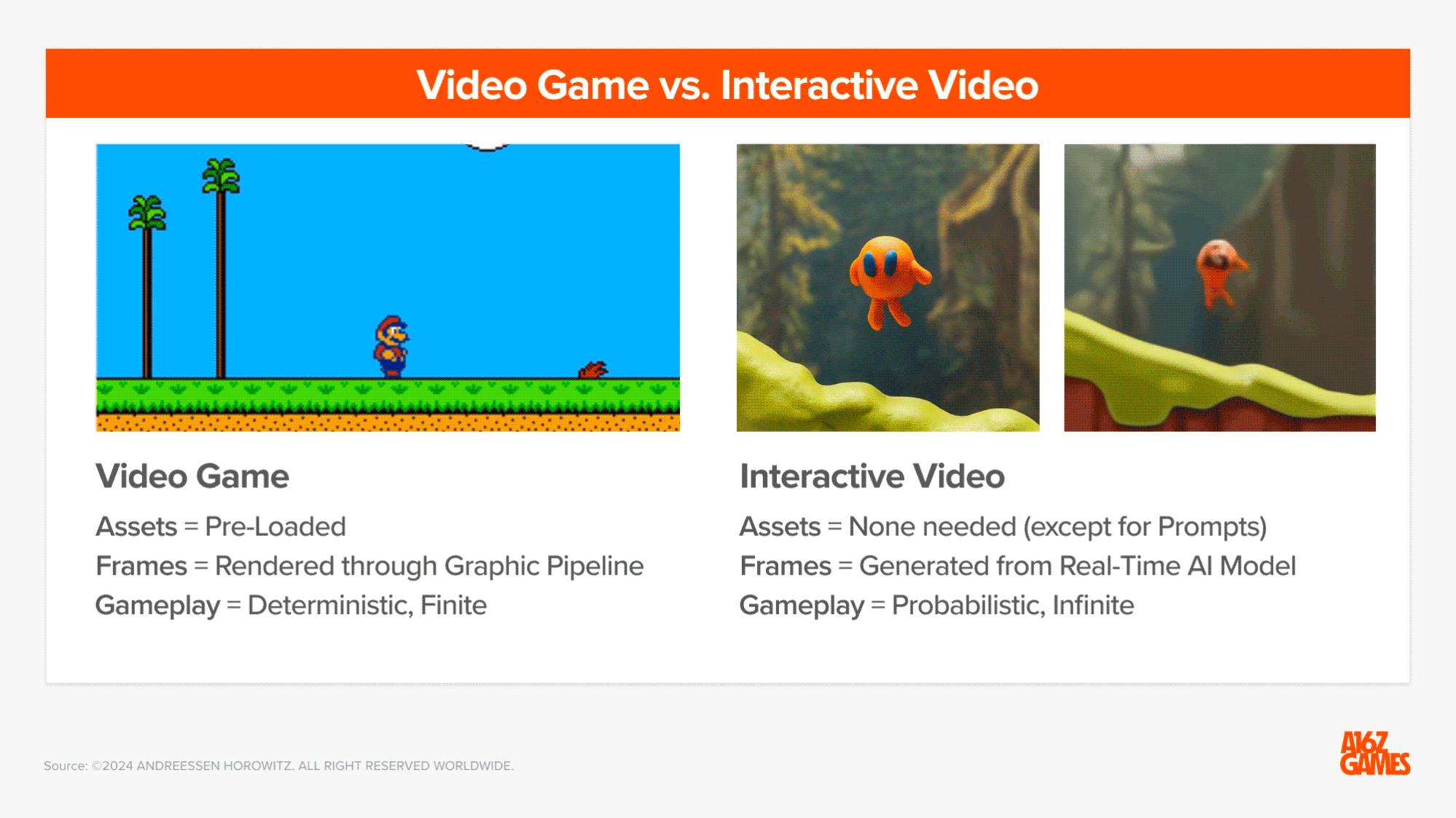
First, what is interactive video, and how does it differ from video games? In video games, developers pre-load a set of assets into a game engine. For example, in *Super Mario Bros.*, artists design Mario, trees, and backgrounds. Programmers define that pressing the “A” button makes Mario jump 50 pixels. The jump frames are rendered via traditional graphics pipelines. This results in a highly deterministic and computational architecture, with full developer control.
Interactive video, by contrast, relies entirely on neural networks to generate frames in real time. No assets need to be uploaded or created beyond a creative prompt (which can be text or a representative image). A real-time AI image model receives player input (e.g., the “up” button) and probabilistically predicts the next generated frame.
The promise of interactive video lies in combining the accessibility of TV and film with deep narrative, while integrating the dynamic, player-driven systems of video games. Everyone knows how to watch TV and follow a linear story. By adding video generated in real time based on player input, we can create personalized and potentially infinite gameplay experiences—enabling media properties to engage fans for thousands of hours. Blizzard’s *World of Warcraft* has lasted over 20 years and still maintains around 7 million subscribers today.
Interactive video also offers multiple modes of consumption—audiences can passively enjoy content like a TV show, or actively play on mobile devices or controllers. Enabling fans to experience their favorite IP universes in as many ways as possible is central to transmedia storytelling, which strengthens emotional connection to the IP.
Over the past decade, many storytellers have attempted to realize the vision of interactive video. An early breakthrough was Telltale’s *The Walking Dead*—an interactive experience based on Robert Kirkman’s comic series, where players watch animated scenes unfold but make choices at key moments through dialogue and quick-time events. These choices—such as deciding which character to save during a zombie attack—created personalized story variants, making each playthrough unique. Launched in 2012, *The Walking Dead* was a massive success—winning multiple Game of the Year awards and selling over 28 million copies to date.
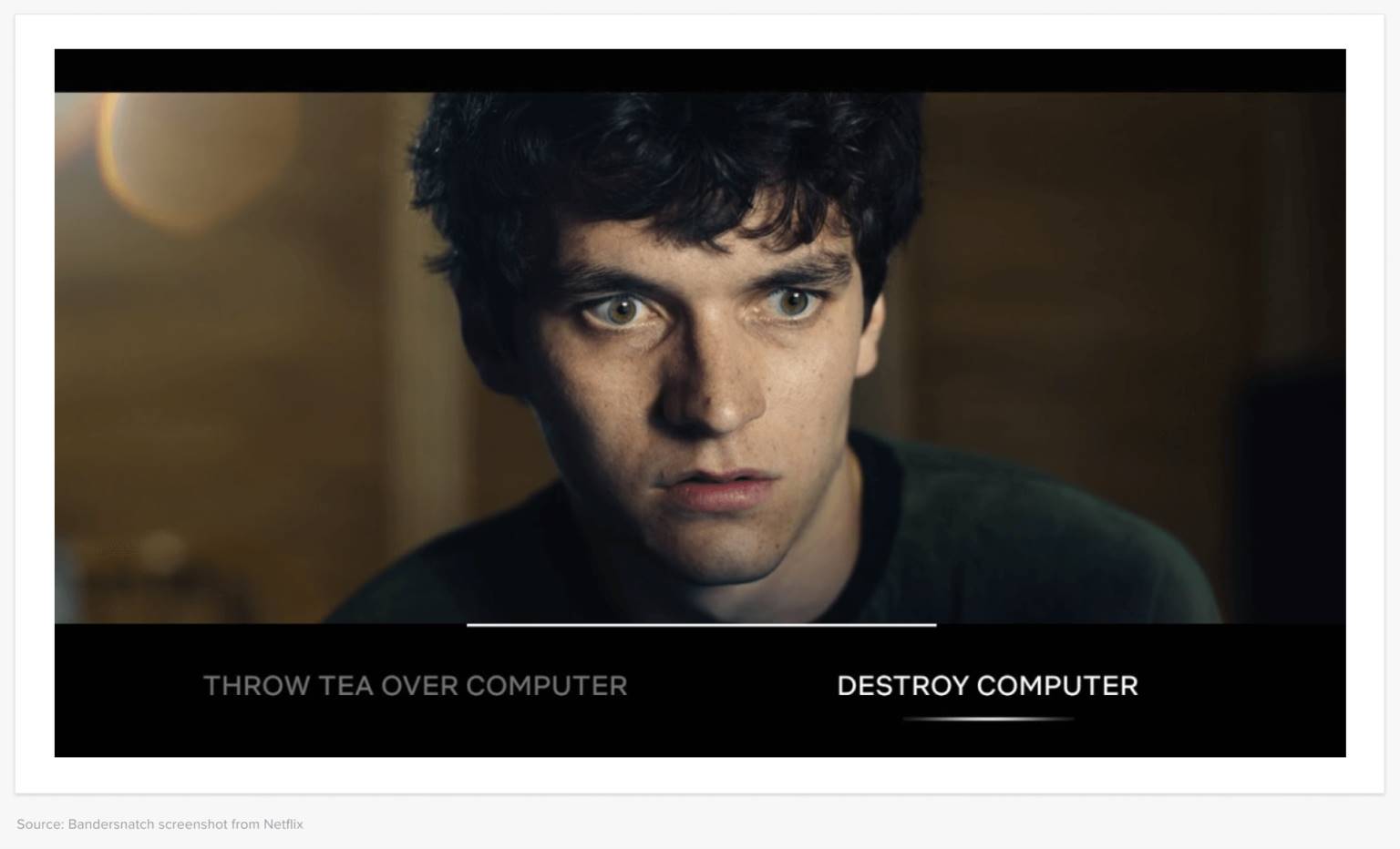
In 2017, Netflix entered the space—starting with animated titles like *Puss in Book*, then releasing the critically acclaimed *Black Mirror: Bandersnatch*, a live-action film where viewers make choices for a young programmer adapting a fantasy novel into a video game. *Bandersnatch* became a holiday phenomenon, inspiring a fanbase that created flowcharts to map every possible ending.
However, despite positive reception, both *Bandersnatch* and *The Walking Dead* faced existential challenges—manually creating the countless branching storylines defining the format proved too time-consuming and expensive. As Telltale expanded across projects, they developed a culture of crunch among developers, who complained of “burnout and exhaustion.” Narrative quality suffered—while the original *Walking Dead* earned a Metacritic score of 89, four years later Telltale’s ambitious *Batman* title received a disappointing 64. In 2018, Telltale announced bankruptcy, failing to build a sustainable business model.
For *Bandersnatch*, the crew shot 250 video segments, totaling over five hours of footage to account for its five endings. The budget and production time were reportedly double that of a standard *Black Mirror* episode, with producers likening the complexity to “making four episodes at once.” Ultimately in 2024, Netflix decided to shut down its entire interactive special division—shifting instead to traditional games.
Until now, the content cost of interactive video projects has scaled linearly with gameplay time—with no way around this problem. However, advances in generative AI models may be the key to scaling interactive video.
Generative Models Will Soon Be Fast Enough for Interactive Video
Recent progress in distilling image generation models has been astonishing. In 2023, the release of Latent Consistency Models and SDXL Turbo dramatically improved speed and efficiency, enabling high-resolution rendering in just one step instead of 20–30, reducing costs by over 30x. The idea of generating video—a sequence of coherent images with temporal consistency—suddenly became highly feasible.
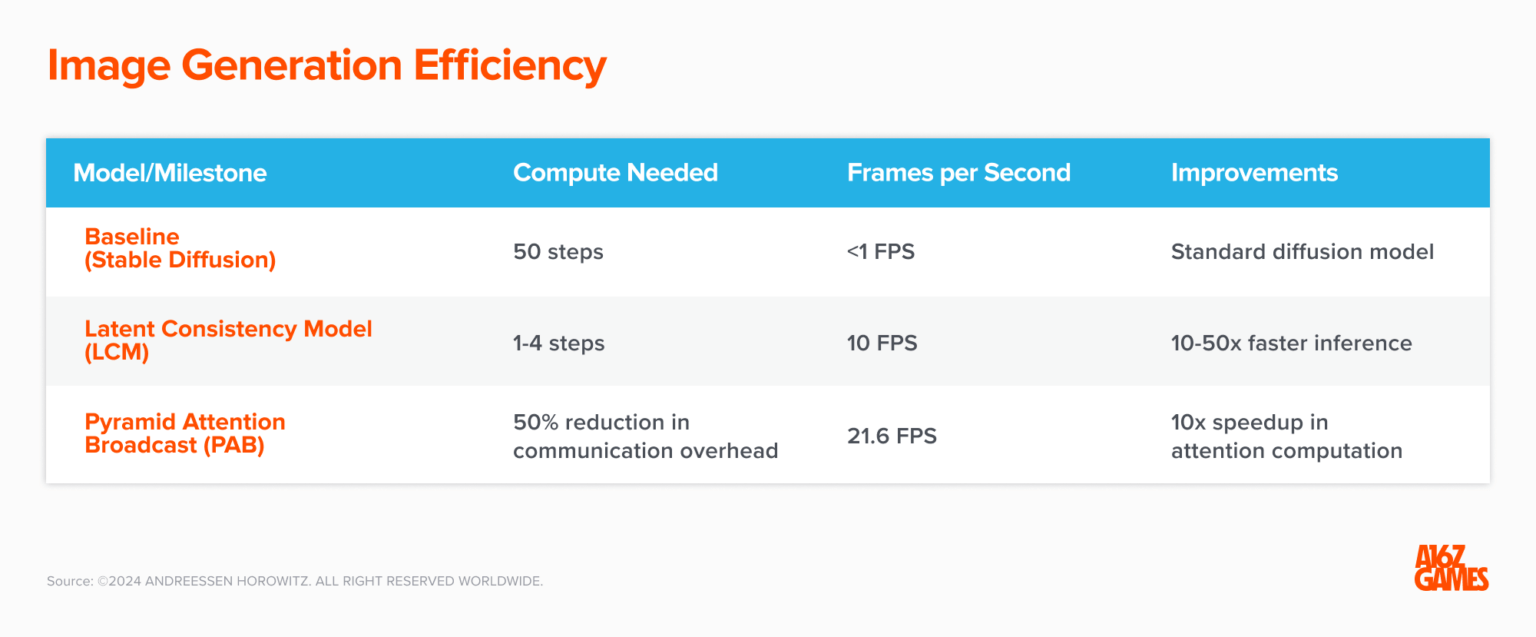
Earlier this year, OpenAI captured widespread attention by unveiling Sora, a text-to-video model capable of generating videos up to one minute long while maintaining visual fidelity. Shortly after, Luma AI released Dream Machine, a faster video model that generates 120 frames (about five seconds of video) in 120 seconds. Luma recently shared they reached a staggering 10 million users in just seven weeks. Last month, Hedra Labs launched Character-1, a character-focused multimodal video model that generates 60 seconds of expressive human emotion and voiceover in 90 seconds. Runway recently introduced Gen-3 Turbo, a model that renders a 10-second clip in just 15 seconds.
Today, an aspiring filmmaker can quickly generate minutes of 720p HD video content from text prompts or reference images, optionally paired with starting or ending keyframes for specificity. Runway has also developed a suite of editing tools offering finer control over diffusion-generated videos, including in-frame camera control, frame interpolation, and motion brush. Luma and Hedra are also expected to release their own creator toolkits soon.
Although workflows remain early, we’ve already met several content creators using these tools to tell stories. Resemblance AI created *Nexus 1945*, a compelling three-minute alternate history WWII story made with Luma, Midjourney, and Eleven Labs. Independent filmmaker Uncanny Harry collaborated with Hedra on a cyberpunk short film. Creators have also made music videos, trailers, travel vlogs, and even fast-food burger ads. Since 2022, Runway has hosted an annual AI film festival, showcasing 10 outstanding AI-made short films.

It must be noted that significant limitations remain—there’s still a clear gap in narrative quality and control between a two-minute AI-generated clip and a two-hour film crafted by a professional team. Generating exactly what creators envision from prompts or images remains difficult, and even experienced prompt engineers often discard most outputs. AI creator Abel Art reported needing about 500 videos to produce one minute of coherent output. Visual consistency typically breaks down after a minute or two of continuous playback, often requiring manual editing—this is why most generated videos today are capped at around one minute.
For most major Hollywood studios, diffusion-generated video is currently useful for storyboarding in pre-production—to visualize scenes or characters—but cannot replace live filming. There are also opportunities to use AI in post-production for audio and visual effects, but overall, AI creator toolkits remain in early stages compared to traditional workflows refined over decades.
In the near term, one of the biggest opportunities for generative video lies in new media formats such as interactive video and short-form content. Interactive video is naturally segmented into short 1–2 minute clips based on player choices, and is often animated or stylized, allowing lower-resolution assets. More importantly, creating these short videos via diffusion models is significantly more cost-effective than during the Telltale/Bandersnatch era—Abel Art estimates a one-minute video from Luma costs $125, roughly equivalent to renting a film lens for one day.
Despite inconsistent quality today, the popularity of vertical short-form platforms like ReelShort and DramaBox demonstrates audience demand for low-budget episodic content. Despite criticism for amateurish cinematography and formulaic scripts, ReelShort has driven over 30 million downloads and over $10 million in monthly revenue, launching thousands of micro-series like *Forbidden Desires: Alpha’s Love*.
The biggest technical hurdle for interactive video is achieving fast enough frame generation speeds for real-time content. Dream Machine currently generates about one frame per second. Modern game consoles require a minimum stable 30 FPS, with 60 FPS being the gold standard. With technologies like PAB, this can improve to 10–20 FPS for certain video types, but still falls short.
Current Landscape: The State of Interactive Video
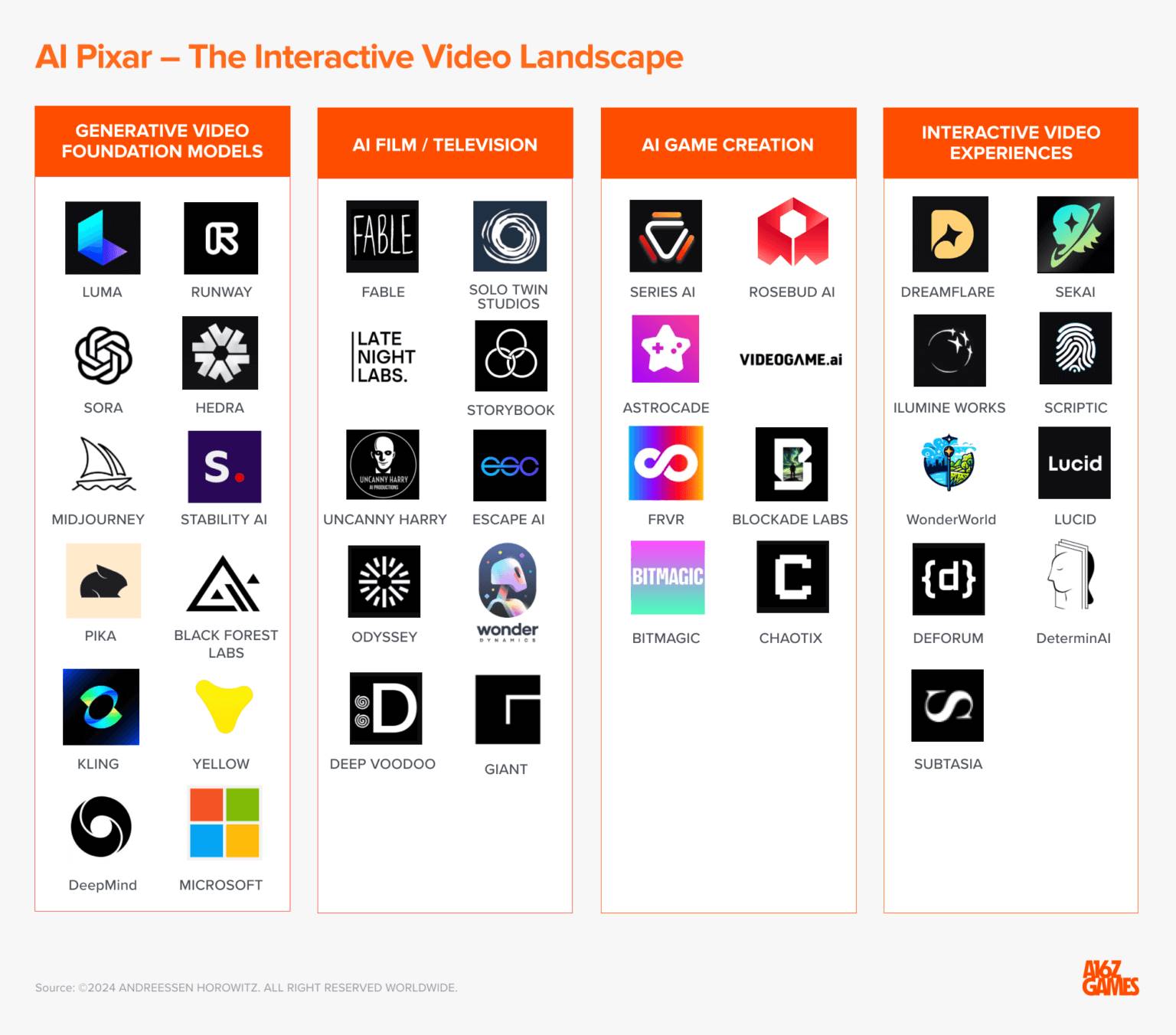
Given the pace of improvement in underlying hardware and models, we estimate fully generative interactive video is about two years away from commercial viability.
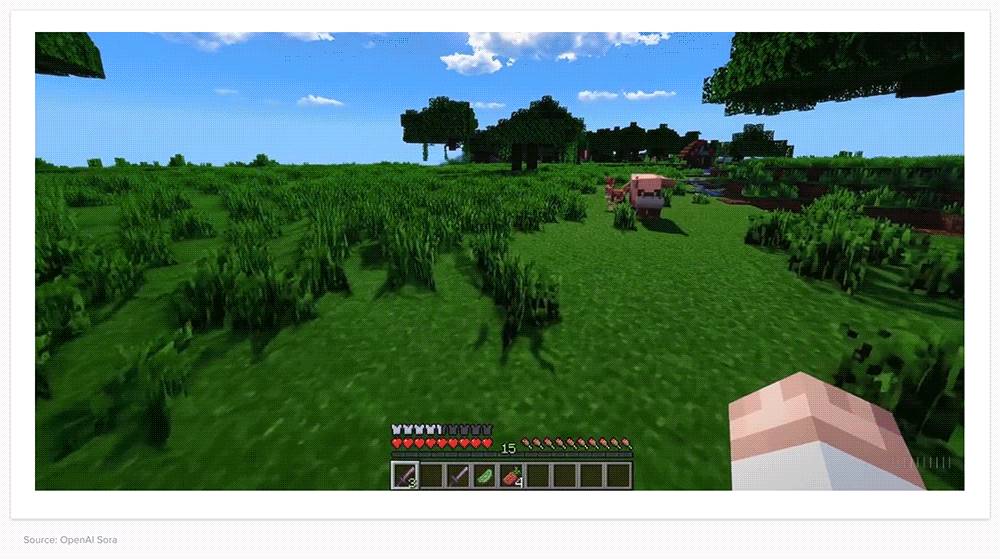
Today, we see participants like Microsoft Research and OpenAI advancing research into end-to-end foundation models for interactive video. Microsoft’s model aims to generate fully “playable worlds” in 3D environments. OpenAI demonstrated Sora simulating Minecraft in “zero-shot”: “Sora can control player actions in Minecraft while rendering the world and its dynamics with high fidelity.”
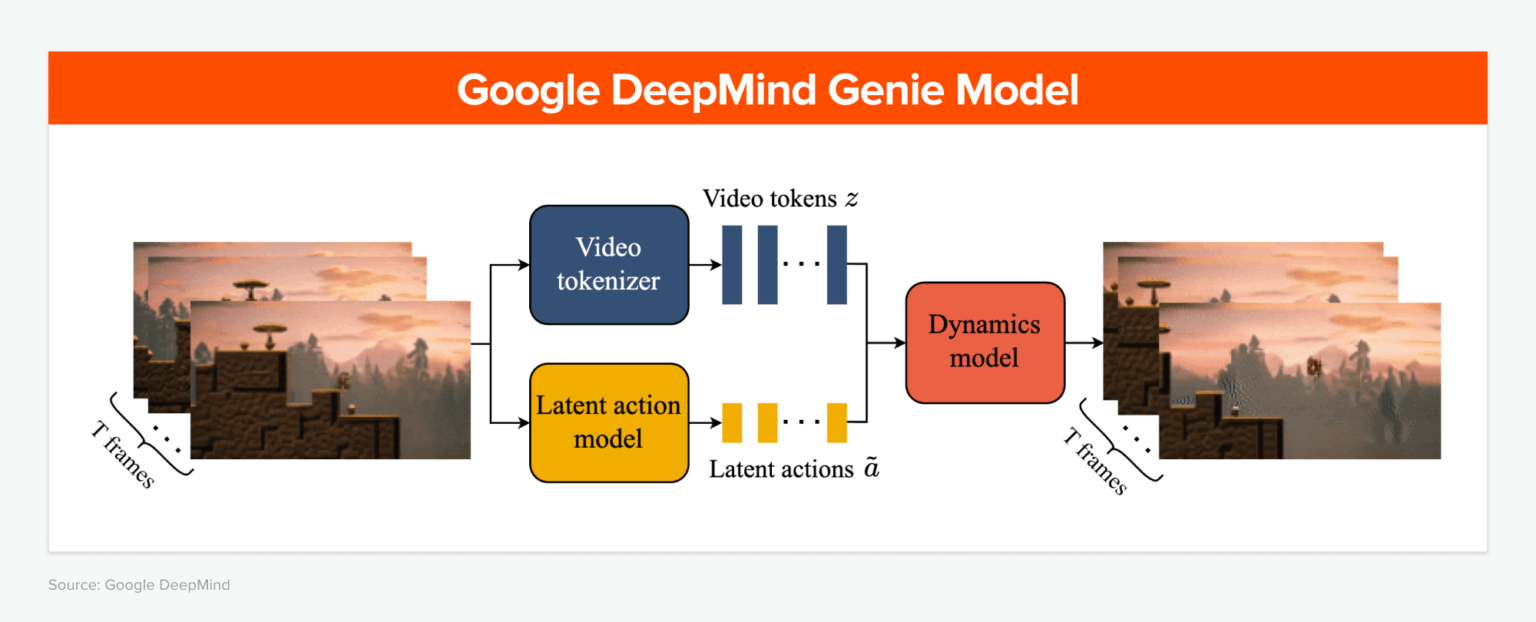
In February 2024, Google DeepMind released its own end-to-end interactive video foundation model, Genie. Genie’s innovation lies in its latent action model, which infers potential actions between pairs of video frames. Trained on 300,000 hours of platformer gameplay, Genie learned to recognize character movements, such as how to jump over obstacles. This latent action model, combined with a video tokenizer, feeds into a dynamics model that predicts the next frame, forming an interactive video system.
At the application level, we’re seeing teams explore new forms of interactive video experiences. Many are developing generative films or TV shows designed around current model limitations. Others are integrating video elements into AI-native game engines.
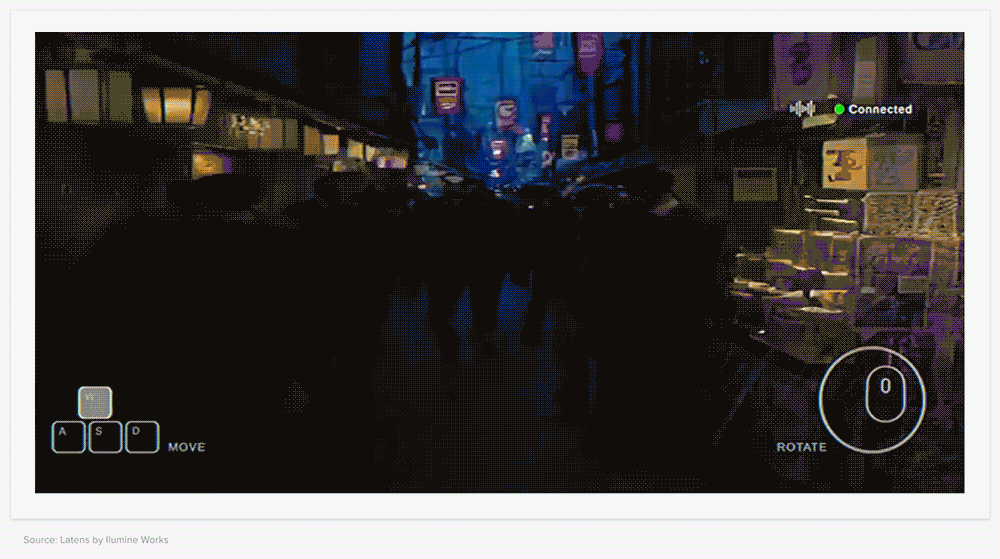
Ilumine’s Latens is building a “lucid dream simulator” where visuals are generated in real time as users walk through dreams. The slight latency enhances the surreal experience. Open-source community Deforum developers are creating immersive, interactive video installations in the real world. Dynamic is developing a simulation engine where users control robots in first-person using fully generated video.
In TV and film, Fable Studio is developing Showrunner, an AI streaming service allowing fans to adapt versions of popular shows. Their proof-of-concept project, *South Park AI*, garnered 8 million views when it premiered last summer. Solo Twin and Uncanny Harry are two leading-edge AI filmmaking studios. Alterverse created a D&D-inspired interactive video RPG where the community decides what happens next. Late Night Labs is a new top-tier film studio integrating AI into its creative process. Odyssey is building a visual storytelling platform powered by four generative models.
As boundaries between film and games blur, AI-native game engines and tools will emerge, giving creators greater control. Series AI has developed the Rho Engine, an end-to-end platform for AI game development, and is using it to co-create original works with major IP holders. We’re also seeing AI creation suites from Rosebud AI, Astrocade, and Videogame AI that allow non-programmers and non-artists to quickly create interactive experiences.
These new AI creation suites will unlock market opportunities for storytelling, enabling a new class of citizen creators to bring their imaginations to life through prompt engineering, visual sketching, and voice input.
Who Will Build the Interactive Pixar?
Pixar leveraged foundational shifts in computing and 3D graphics to build an iconic company. Today, we’re witnessing a similar wave in generative AI. But it’s important to remember that Pixar’s success stemmed largely from *Toy Story* and its world-class storytelling team led by John Lasseter. Human creativity, combined with new technology, produces the best stories.
Likewise, we believe the next Pixar will need to be both a world-class interactive storytelling studio and a leading tech company. Given the rapid pace of AI research, creative teams must work closely with AI teams, blending narrative and game design with technical innovation. Pixar had a unique blend of art and technology, backed by a partnership with Disney. The opportunity today lies in a new team that fuses gaming, film, and AI disciplines.
Make no mistake—this will be a massive challenge extending beyond technology. Teams will need to invent new ways for human storytellers to collaborate with AI tools to enhance—not replace—their imagination. Moreover, numerous legal and ethical hurdles remain—unless creators can prove ownership of all data used to train models, the legal rights and copyright protection for AI-generated creative works remain unclear. Compensation for original writers, artists, and producers behind training data also needs resolution.
Yet today, one thing is clear: demand for new interactive experiences is strong. In the long run, the next Pixar won’t just create interactive stories—it will build complete virtual worlds. We’ve previously explored the potential of the neverending game—dynamic worlds combining real-time level generation, personalized narratives, and intelligent agents—akin to HBO’s *Westworld*. Interactive video solves one of the biggest challenges in making *Westworld* a reality: rapidly generating vast amounts of personalized, high-quality interactive content.
One day, with AI assistance, we may begin the creative process by constructing a story world—a fully realized IP universe with characters, narratives, and visuals—and then generate various media products tailored for audiences or specific contexts. This would represent the ultimate evolution of transmedia storytelling, completely blurring the boundaries of traditional media forms.
Pixar, Disney, and Marvel have all created unforgettable worlds that became core parts of fan identity. The opportunity for the next interactive Pixar lies in leveraging generative AI to achieve the same goal—creating new story worlds that dissolve the boundaries of traditional narrative formats, resulting in experiences never seen before.
Join TechFlow official community to stay tuned
Telegram:https://t.me/TechFlowDaily
X (Twitter):https://x.com/TechFlowPost
X (Twitter) EN:https://x.com/BlockFlow_News
 a16z
a16z