1 Minute to Reach 300M, the Japanese Force "Yay!" That Raised $22M—Who Are They?
TechFlow Selected TechFlow Selected
1 Minute to Reach 300M, the Japanese Force "Yay!" That Raised $22M—Who Are They?
Whether it's Soneium's high-profile promotion or Yay!'s recent small breakthrough, both seem to represent the Japanese crypto community's efforts to expand outward.
 Navigating Web3 tides with focused insights
While the market’s attention has been focused on Telegram’s founder and a series of developments within the TON ecosystem, a group of relentless "gold miners" have quietly discovered the next potential crypto goldmine.
Last night, the SocialFi project Yay! and the cross-chain liquidity asset protocol StakeStone jointly launched their first staking campaign. Within about one minute of launch, the public sale allocation of 300 ETH was completely filled. Discussions about the project immediately flooded social media feeds. But instead of debating how degenerate the project was or how impressive its team background might be, people were asking—Why haven’t I heard of this hot project before?
Contrary to the puzzled Chinese-speaking community, Yay! has sparked intense discussion in Japanese-language circles, with mentions of the #Yay hashtag surging. This situation echoes past stories of Solana meme coins exploding in popularity: foreign communities are already buzzing while Chinese-speaking participants are just beginning to figure out what it’s all about.

Rooted in the 'Sony Chain,' with Real Experience
The 'Sony Chain' – Soneium
Before introducing Yay!, let's briefly cover Soneium, the new L2 blockchain where Yay! is built.
Just recently, Sony—the global entertainment and electronics giant—launched its own new L2 blockchain, Soneium, developed in collaboration with Japan’s leading blockchain organization Startale using the OP Stack. This marks Sony’s deeper exploration into the crypto space.
Due to its close ties with Sony, Soneium is humorously dubbed the “Sony Chain.”
According to official statements, Soneium isn't limited to promoting Sony’s strengths in gaming and audiovisual entertainment—it aims to serve across multiple domains, clearly positioning itself as a platform for mass adoption.
For more information on Soneium, see the TechFlow article: Everything You Need to Know About Sony’s Entry into Blockchain and Soneium
Not a Rookie
Although most crypto users have never heard of it, Yay! is not some sudden newcomer. It originally launched as a Web2 social app back in 2020, primarily serving users from Japan and South Korea. Therefore, Yay! isn't a crypto-native project born from thin air, but rather an established social application with extensive experience and a solid user base, now strategically transitioning into the Web3 SocialFi space.
Official data shows that by the end of 2023, Yay! already had over 9 million registered users. Its core features include:
-
Timeline Feed: A chronological feed similar to Twitter or Weibo;
-
"Circles": Users can create and join communities based on shared interests;
-
Real-Time Voice Chat: Supports multi-user voice chat rooms;
-
Avatars: Users can create and customize their own 3D avatars;
In short, Yay! is essentially a supercharged hybrid of popular social platforms like Twitter, Discord, and WeChat, with early ambitions toward the metaverse.

Economic Model Already Set?
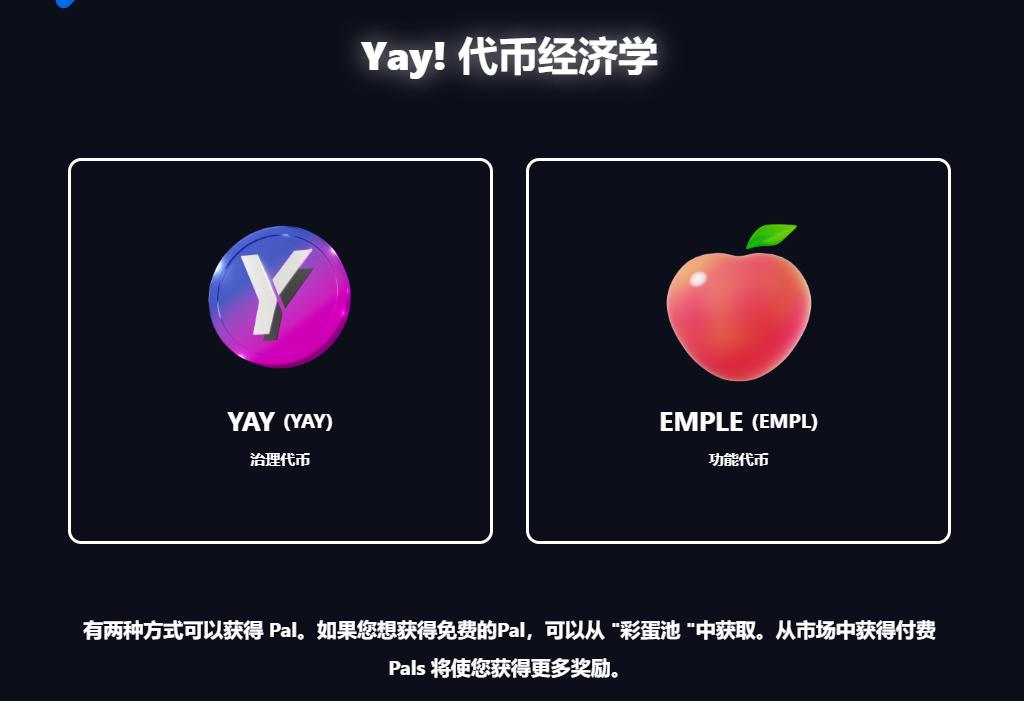
Despite being in early stages, Yay! has already disclosed its tokenomics framework. The economic model revolves around four key assets:
-
Governance Token $YAY (ERC-20)
-
Total supply capped at 10 billion
-
Holders have voting rights on key ecosystem decisions
-
-
$EMPLE/$EMPL (ERC-20)
-
Utility token with no supply cap
-
Distributed as rewards for community contributions and Pal competition results
-
Comes in two forms: regular $EMPL (convertible to $YAY at market rate) and locked $EMPL (non-withdrawable from platform)
-
-
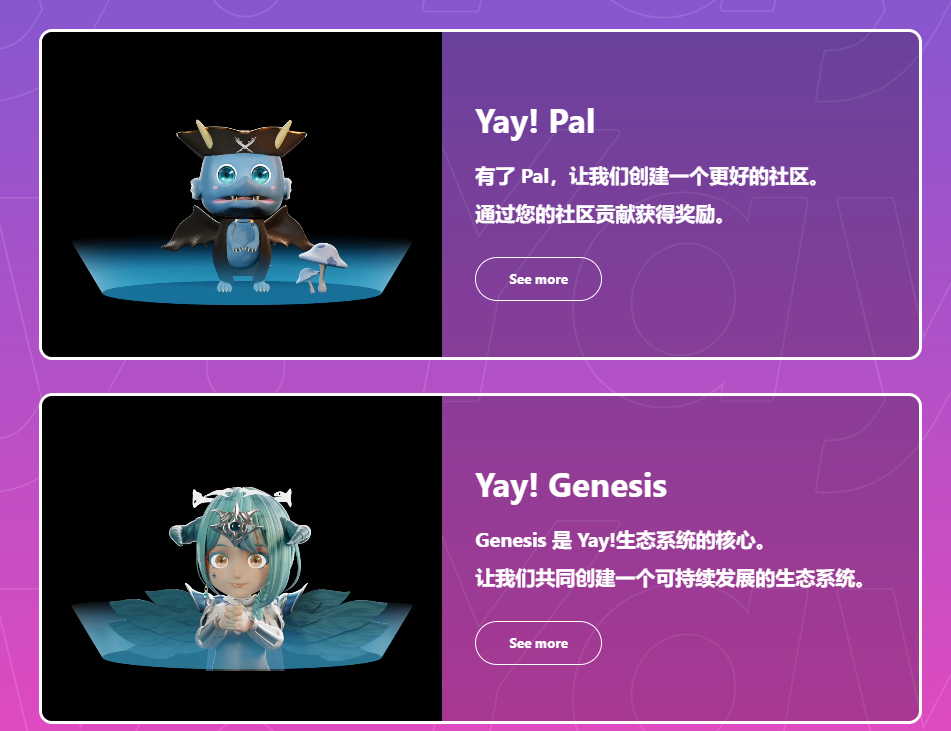
Yay! Genesis NFT (ERC-721)
-
Limited to 5,000 units
-
Holders can mint Pals via staking; after minting, there is a cooldown period, but no limit on total mints
-
-
Yay! Pal NFT (ERC-721)
-
Holders can participate in competitions to earn EMPL and locked EMPL rewards (play-to-earn)
-
Pals have lifecycles; rarity affects lifespan and mortality rate
-
Obtained either by staking Yay! Genesis or purchased from the marketplace
-
Can be sold on the open market, with prices determined by supply and demand
-
Massive Funding—A Japanese-Style Setup?
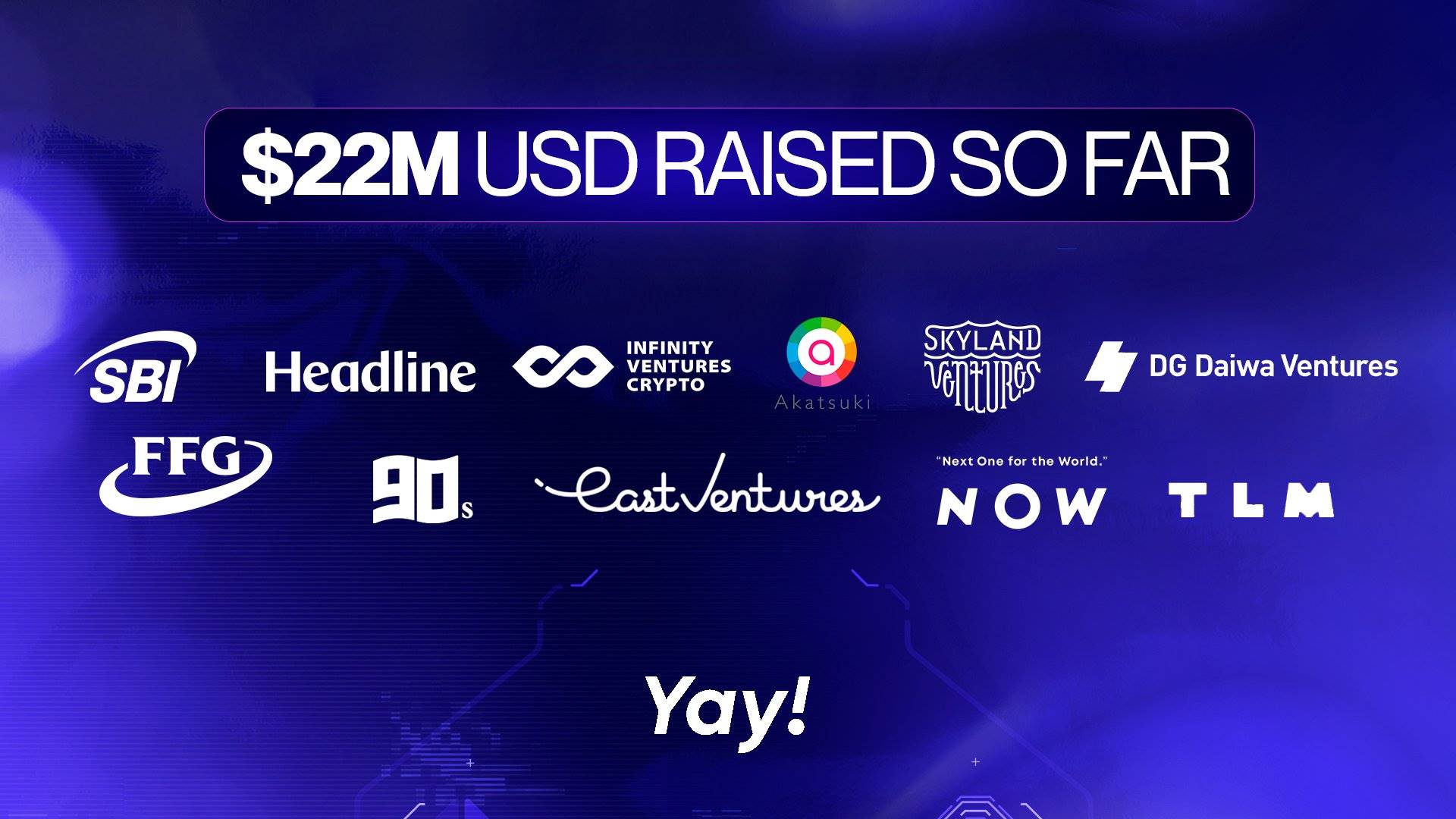
According to official documents, Yay! secured a massive B-round funding of 1.6 billion JPY (approximately $11 million today) back in 2022, bringing its total funding to $22 million to date.
The same document notes that the majority of B-round investors were Japanese VCs, or non-Japanese VCs represented by Japanese leads—confirming Yay! as a Japan-native project orchestrated largely by Japanese institutions.
Summary
A New Approach for VC Projects?
Large funding rounds and backers actively promoting the project—yes, Yay! is undeniably a VC-backed project.
In today’s environment where “VC coins” are widely criticized, both VCs and projects themselves may be seeking ways to reshape their image. Instead of focusing solely on grand narratives in infrastructure, they’re turning toward user-facing applications—integrating token use cases while slowly rebuilding trust with users. Perhaps “application-focused VC projects” represent a new survival strategy amid growing anti-VC sentiment.
Information Asymmetry Exists in Crypto Too—and So Do Opportunities
From personal observation, Japan’s crypto community interacts less with the rest of the global crypto world and maintains its own self-contained ecosystem—somewhat like a closed loop. This explains why Yay! received little attention in Chinese-speaking circles: whether considering its team, investors, or user base, Yay! is firmly rooted in Japan.
However, recent moves by Japanese-origin crypto projects—such as Soneium’s high-profile promotion and Yay!’s small breakout moment—suggest that Japan’s crypto scene is trying to break out of its isolation and reach a broader audience.
The fact that Yay!’s staking event lit up Japanese communities while barely registering in Chinese ones shows that even during these so-called “garbage times” filled with drama, rumors, and scams, valuable opportunities still exist in places known only to a few.
Can Web2 Players Easily Win in Web3?
Looking at Yay!’s official announcement of its partnership with Soneium, it’s clear they’re aiming for “mass adoption.” And indeed, as a social media app with prior Web2 experience and a large existing user base, Yay! may already be closer to mass adoption than most (similar in this regard to Telegram + TON).
But if the assumption is that simply adapting an existing model with minor Web3 integrations will guarantee mass adoption, it might be too early to celebrate.
Facing different challenges in the crypto world, balancing investor returns, project reputation, community satisfaction, and external perception—all while achieving ambitious goals—remains a tall order. Let’s see whether Yay!, backed by Japan, can successfully navigate this path.
Learn more:
Yay! Chinese website: https://portal.yay.space/zh-CN
Yay! Official X: https://x.com/Yay_Global
Join TechFlow official community to stay tuned
Telegram:https://t.me/TechFlowDaily
X (Twitter):https://x.com/TechFlowPost
X (Twitter) EN:https://x.com/BlockFlow_News
 深潮TechFlow