20 Billion USD Market Cap in 151 Days: Tokenized Treasuries Achieve Explosive Growth
TechFlow Selected TechFlow Selected
20 Billion USD Market Cap in 151 Days: Tokenized Treasuries Achieve Explosive Growth
Currently, BUIDL's assets have reached $503 million, nearly overwhelming other investment firms in the tokenized treasury space.
 Navigating Web3 tides with focused insights
Source: bitcoinist
Translation: Blockchain Knight
The tokenized U.S. Treasury market has reached a market capitalization of $2 billion, achieving this milestone in just 151 days. This remarkable growth is primarily driven by substantial institutional investments, with BlackRock being the largest participant by far.
However, things are shifting with the launch of BlackRock's USD Institutional Digital Liquidity Fund (BUIDL). BUIDL currently holds a market cap of $503 million, significantly outpacing other players in the tokenized treasury space.
Within four months, BUIDL’s market cap surged to approximately $503 million, making it the largest single fund in the tokenized Treasury sector.
The fund’s success has not only boosted investor confidence but also heightened interest in tokenized Treasuries among broader investor groups.
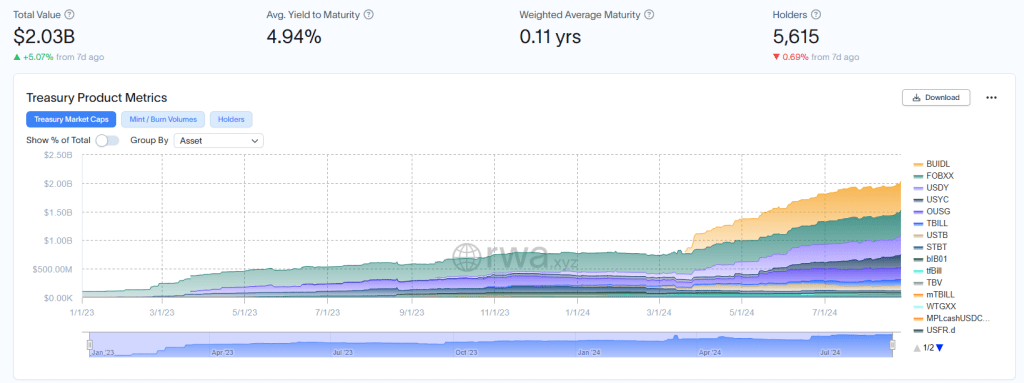
Meanwhile, growth from other well-known funds appears less impressive. For example, Franklin Templeton’s OnChain U.S. Government Money Fund FOBXX and Ondo Finance’s USD Yield Fund USDY.
These firms have also seen increases in their assets, but starting from a lower base—$425 million and $364 million respectively.
The rise in institutional capital not only drives market expansion but also brings significant credibility to tokenized U.S. Treasuries.
Today, investors are increasingly willing to engage with this innovative financial product, allowing the traditional world of government securities to benefit from blockchain technology.
Tokenized Treasuries digitize U.S. Treasury assets, enabling seamless trading on public blockchains such as Ethereum and Solana.
This technological advancement simplifies U.S. Treasury transactions and opens access to the U.S. Treasury market for a broader range of investors, including foreign participants. By converting securities into digital tokens, it lowers market entry barriers.

One of the greatest benefits of tokenization is liquidity. Tokenized securities operate around the clock, allowing investors to redeem funds at any time—an advantage starkly contrasting with traditional markets.
Investors can also easily convert their tokens into cash via smart contracts that redeem stablecoins, bypassing the lengthy wait times typical in traditional finance.
Analysts in the tokenized Treasury space forecast a relatively optimistic outlook. With growing interest from DeFi projects and DAOs in this asset class, the market size could slightly exceed $3 billion by year-end.
In particular, some companies find tokenized Treasuries highly suitable for inclusion in their portfolios, as they offer stable and risk-free returns.
Nonetheless, the market must also contend with potential headwinds. These include macroeconomic factors and negative investor sentiment. If interest rates rise too sharply, the appeal of these tokenized assets may quickly diminish. Additionally, regulatory hurdles remain, as the integration of traditional finance with blockchain technology is still largely uncharted territory.
Join TechFlow official community to stay tuned
Telegram:https://t.me/TechFlowDaily
X (Twitter):https://x.com/TechFlowPost
X (Twitter) EN:https://x.com/BlockFlow_News
 @bitcoinist