Does Vitalik Actually Understand DeFi?
TechFlow Selected TechFlow Selected
Does Vitalik Actually Understand DeFi?
One stone stirs up a thousand waves!
 Navigating Web3 tides with focused insights
By Alex Liu, Foresight News
Accusations Against Vitalik
Vitalik Buterin's controversial views on DeFi stem from his reply to a post that accused him of poor communication regarding DeFi. The original post stated:
"Vitalik, one reason people might be confused or frustrated by your views on DeFi is — poor communication:
It seems like, to you, 'DeFi' means the 2021 yield farming boom and Ponzi schemes; but for many others (I’d say most), 'DeFi' means depositing and borrowing on money markets like Aave, CDPs like RAI (which you mentioned!), synthetics, etc. These are healthy decentralized financial applications — where yields come from borrowers, trading fees, etc." (Editor’s note: CDP, collateralized debt position, a decentralized stablecoin mechanism; other representative projects include Maker, whose decentralized stablecoin is DAI.)
This may be why people are confused about why Vitalik appears to oppose DeFi while supporting gambling/prediction markets like Polymarket and centralized stablecoins like USDC.
I agree that much of the 'Ponzi economics' integrated into the DeFi ecosystem only temporarily boosts certain metrics, but this isn’t all that DeFi is."
Vitalik’s Response
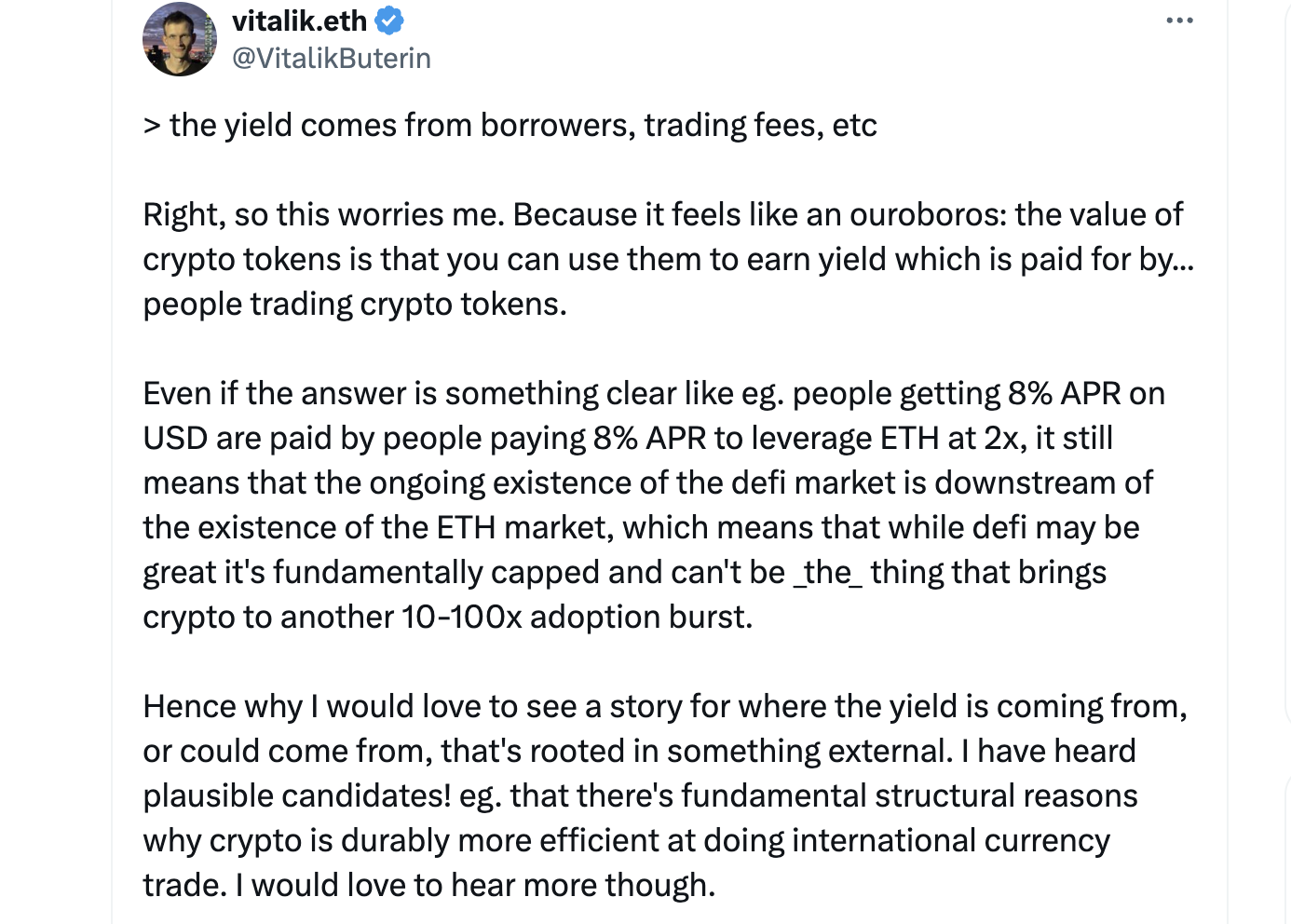
"Yields come from borrowers, trading fees, etc.
Yes, and that’s exactly what worries me. Because it feels like an ouroboros: crypto tokens are valuable because you can use them to earn yield, and that yield is paid by people trading crypto tokens."
The answer is clear—for example, the person earning 8% APY in USD is being paid by someone paying 8% APY to go 2x leveraged long on ETH. But this means DeFi markets exist downstream of the ETH market, so while DeFi might be great, it is fundamentally constrained—it cannot become the breakthrough innovation that pushes crypto adoption another 10-100x.
This is why I want to hear a story about where yield comes from—or could come from—that’s rooted in external realities. I’ve heard some seemingly plausible candidates! For instance: due to fundamental structural reasons, cryptocurrencies can sustainably maintain higher efficiency in international money transfers. I’d love to hear more."

Ouroboros, the self-devouring snake
Vitalik’s comments sparked heated discussion, with many influential figures pushing back:
Multiple Rebuttals
Ken Deeter, Partner at Electric Capital
My immediate reaction to Vitalik Buterin’s comment is: "Doesn’t this describe all finance?"
Much of finance is about "people expressing their views on the future using various tools, then changing those views through numerous mechanisms, creating markets for those who want to take opposing positions."
In terms of structural advantages, I believe blockchain-based DeFi has one major edge: trustlessness enables far more global capital to access financial opportunities previously out of reach.
The passive capital you see in DeFi proves market or lending liquidity—I bet this kind of opportunity is extremely hard to access outside blockchain for many DeFi users, while automated markets make it nearly trivial. As more RWA comes on-chain, these opportunities will increasingly overlap with today’s TradFi.
Yes, in 2020, 'food tokens' weren’t super efficient, but there were massive second-order effects—testing spot markets, liquidation systems, congestion under stress, validating demand for block space ahead of today’s explosion—and other positive spillovers.
New platforms often go mainstream via use cases initially dismissed as toys. These platforms gain enough traction to absorb the risk of new technology, paving the way for mass adoption. Today’s DeFi is unlikely to bypass this same process.
PaperImperium, KOL
"Vitalik’s statement reflects a misunderstanding of human economic history.
You could just as well say all human markets are downstream of a few agricultural commodity markets. Yet barley isn't necessarily a more foundational market than all its 'downstream' derivatives."
Cryptohuntz, CEO of Alphaverse Capital
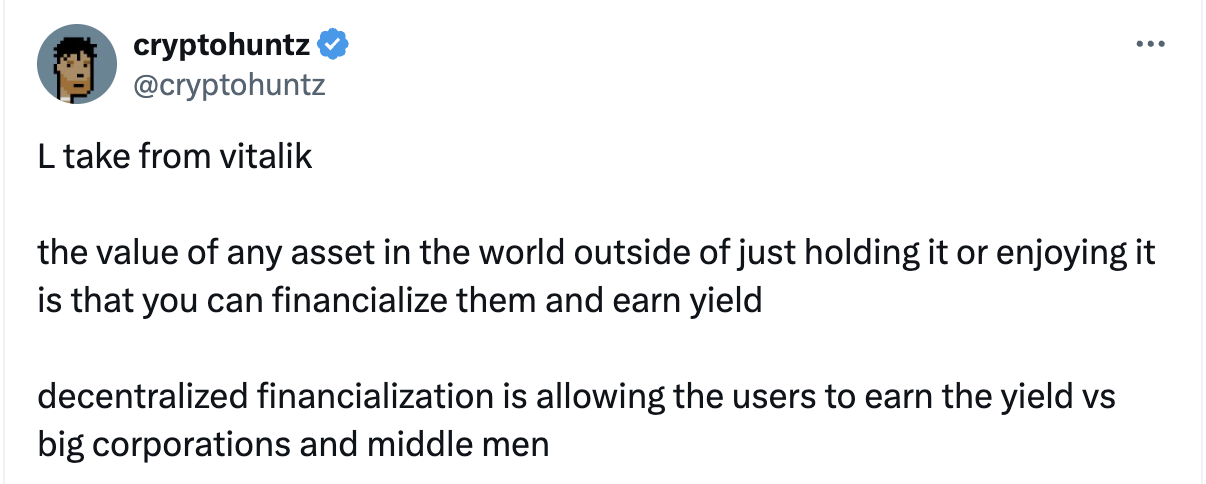
"A flawed take from Vitalik.
The value of any asset in the world, beyond holding or enjoying it, lies in your ability to financialize it and earn yield.
Decentralized financialization allows users to capture yields otherwise reserved for large corporations and intermediaries."
Vitalik’s Playful Reply
In response to the backlash, someone defended Vitalik: “You might be upset by Vitalik’s comments on DeFi, but he’s speaking from a business standpoint.” Vitalik humorously replied: “In fact, during my recent flight, I was seated — and in economy class.”

Conclusion
The editor also clearly opposes Vitalik’s viewpoint. Does Vitalik actually understand DeFi? The answer might be “Yes, but not necessarily correctly.”
Vitalik is the philosophical source behind Ethereum as a technological platform; but his understanding of finance and DeFi may not be accurate. We shouldn’t mythologize him excessively. In fact: “Without DeFi, Ethereum’s price might still be around $400.”
Join TechFlow official community to stay tuned
Telegram:https://t.me/TechFlowDaily
X (Twitter):https://x.com/TechFlowPost
X (Twitter) EN:https://x.com/BlockFlow_News
 Foresight News