Grayscale Changes Leadership: Why Did the Veteran Crypto Firm Choose a Wall Street Figurehead as its New Leader?
TechFlow Selected TechFlow Selected
Grayscale Changes Leadership: Why Did the Veteran Crypto Firm Choose a Wall Street Figurehead as its New Leader?
Grayscale hopes to find a more experienced leader in its new growth phase, enabling the company to compete with major firms like BlackRock and Fidelity.
 Navigating Web3 tides with focused insights
By Leo Schwartz, Fortune Magazine
Translated by Luffy, Foresight News
Peter Mintzberg has officially taken over as CEO of Grayscale, handing leadership of one of the crypto industry’s oldest firms to a Wall Street veteran. Having held senior roles at Goldman Sachs and BlackRock, Mintzberg’s appointment raises questions about the future direction of both Grayscale and the broader cryptocurrency sector.
Under former CEO Michael Sonnenshein, Grayscale brought traditional investors into crypto through its Bitcoin Trust product. In August 2023, the company won a landmark legal battle against the U.S. Securities and Exchange Commission (SEC), paving the way for Bitcoin ETFs. Sonnenshein joined Grayscale in 2014 as a salesperson and became CEO in 2021.
Yet despite helping lay the groundwork for today’s booming Bitcoin ETF market, Grayscale now faces intense competition from much larger players like BlackRock and Fidelity. Since the launch of spot Bitcoin ETFs in January, Grayscale has seen continuous outflows of crypto assets under management. Compounding its challenges, its parent company, Digital Currency Group (DCG), remains embroiled in lawsuits brought by the New York Attorney General and the SEC.
Mintzberg spent two decades at rival financial firms, building an impressive resume in traditional finance. But as an outsider to the crypto industry, whether he is the right leader for a company trying to reinvent itself remains an open question.

Peter Mintzberg, Grayscale’s new CEO
The Crypto Arms Race
When Grayscale launched its Bitcoin Trust in 2013, it created something truly novel: a way for accredited investors to gain exposure to cryptocurrencies through a stock-like instrument—an attractive alternative at a time when many direct crypto sellers operated non-compliantly.
In 2015, Grayscale’s Bitcoin Trust began trading publicly over-the-counter, offering early buyers of GBTC (the trust’s ticker symbol) substantial arbitrage opportunities. These investors bought shares of GBTC—and later trusts for Ethereum and other assets—then resold them months later at a premium to retail investors eager to join the crypto boom, reaping significant profits.
However, the trust structure meant investors could not redeem their GBTC shares for actual bitcoin at the underlying asset’s price. By early 2021, these trusts began trading at a discount. This triggered a domino effect, contributing to the collapse of several crypto firms including Three Arrows Capital and FTX the following year. Adding insult to injury, investors grew frustrated that Grayscale continued charging management fees as high as 2%.
This prompted Sonnenshein to sue the SEC, pushing for approval of its long-pending application to convert the trust into an ETF—one that would allow shareholders to redeem shares for physical bitcoin. In 2023, a court ruled in Grayscale’s favor. The decision was hailed as a major milestone for crypto and ultimately led to the approval of spot Bitcoin ETFs in January 2024.
While Sonnenshein successfully guided Grayscale to this achievement, the firm still faces mounting challenges. New entrants like BlackRock and Fidelity have set ETF fees close to zero, while Grayscale only reduced its fee from 2% to 1.5%. Investors have flocked to competitors, causing massive outflows. As Bloomberg analyst Eric Balchunas told Fortune: “Sonnenshein was caught in a bind—on one hand, the company needs revenue; on the other, it wants to stay competitive in the ETF space. These goals are fundamentally at odds.”
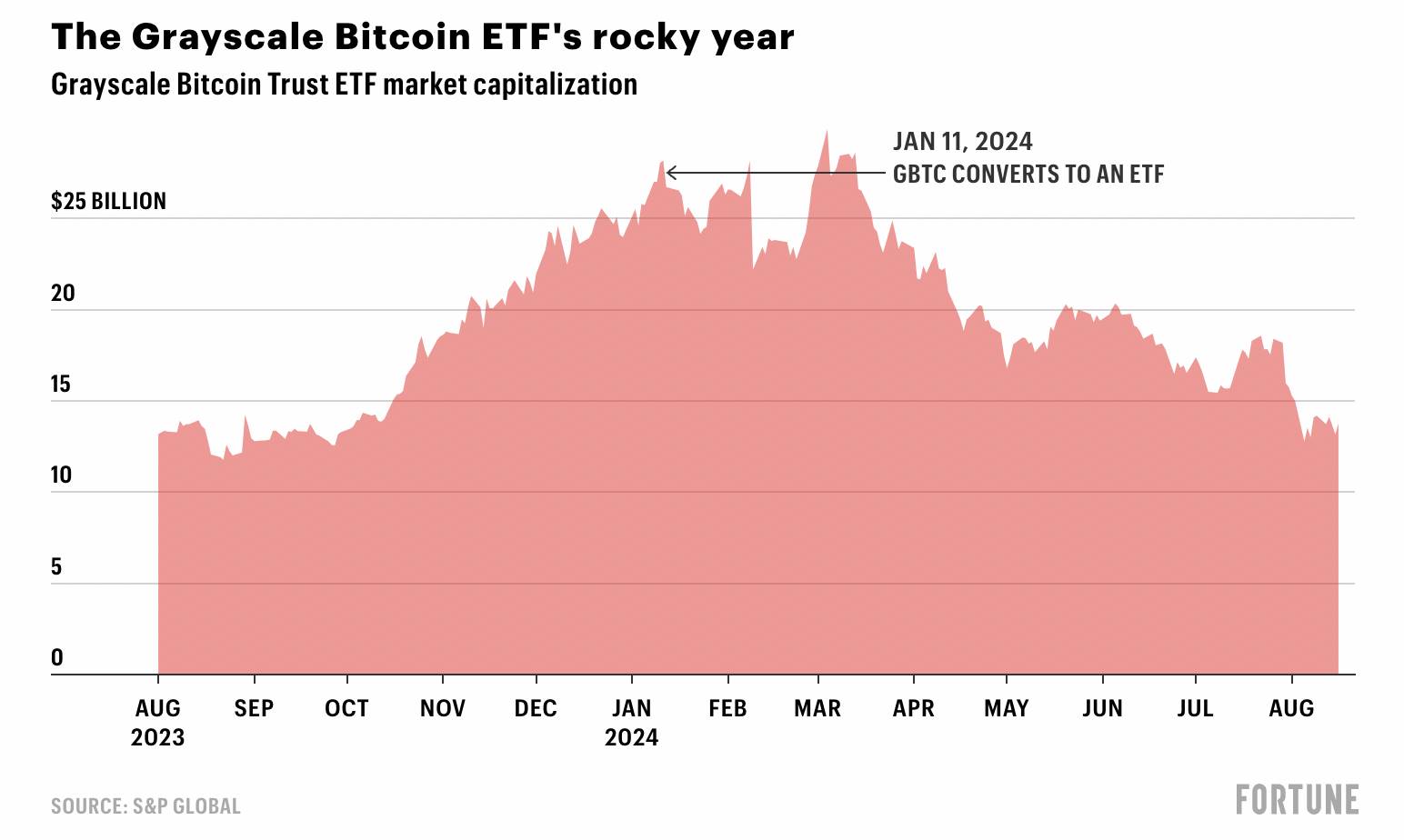
Market value of Grayscale Bitcoin Trust and ETF. Source: S&P GLOBAL
According to the Wall Street Journal, Grayscale’s board and DCG began searching for a new CEO by late 2023, even before official approval of Bitcoin ETFs, though the court victory had already cleared the path.
Insiders say the board decided to replace Sonnenshein in search of a more seasoned leader capable of steering Grayscale into a new growth phase and competing with giants like BlackRock and Fidelity. A person close to Sonnenshein disputes this narrative, saying the decision was mutual, given his decade-long tenure at the firm.
Mark Shifke, CFO of DCG and chairman of Grayscale’s board, said in a statement shared with Fortune: “Peter brings the experience, vision, and maturity of a seasoned C-suite executive who has worked at some of the world’s largest asset management firms. Under Peter’s leadership, Grayscale will be better positioned for its next stage of growth.”
Regulatory Burden
Despite Sonnenshein’s success in converting the trust, ongoing outflows—totaling around $20 billion—have placed fresh pressure on the firm. “Grayscale can’t sustain this pace of outflows,” Balchunas said. “I’ve never seen anything like it.”
An executive at another ETF issuer, speaking anonymously to Fortune, suggested Grayscale may have wanted a leader without Sonnenshein’s regulatory baggage—even though Sonnenshein has never been accused of financial misconduct. With large institutions like Morgan Stanley now allowing advisors to recommend Bitcoin ETFs to clients, Grayscale hopes to get its products onto approved lists. “They want someone experienced in this space who doesn’t come with any regulatory red flags,” the executive said.
Steven McClurg, chief investment officer at Grayscale’s longtime rival Valkyrie—who once bid to manage Grayscale’s Bitcoin Trust—told Fortune that Grayscale had previously tried to bolster its credibility by hiring David LaValle. LaValle, formerly of State Street and Nasdaq, joined Grayscale in 2021 as global head of ETFs. Hiring Mintzberg represents Grayscale’s next step.
“Grayscale has a lot of catching up to do against Invesco, BlackRock, and Fidelity,” McClurg said. “DCG already has enough regulatory issues—it might take years to fully emerge from that shadow.”
The Arrival of Mintzberg
Mintzberg joins Grayscale at a critical juncture. In recent weeks, the firm has launched two key products: an Ethereum ETF and a lower-fee “mini” version of its Bitcoin ETF. According to a letter DCG shared with shareholders this week, Grayscale ended Q2 managing $28 billion in assets, serving as a crucial revenue stream for its parent company.
Yet the path ahead remains uncertain, especially as its flagship products face fierce competition. At the time of the Bitcoin ETF launch, rumors swirled that Grayscale might be acquired, but its high valuation and regulatory entanglements deterred potential buyers. One unnamed competitor told Fortune that hiring Mintzberg could be seen either as a commitment to staying competitive or as a move to improve the company’s image ahead of a possible acquisition.
Mintzberg is a seasoned operator who held strategy and investor relations roles at firms like BlackRock and Invesco—both of which now offer crypto ETFs. According to Mintzberg’s LinkedIn profile, he also led Goldman Sachs’ digital asset strategy from 2021 to 2023.
Mintzberg appears ready for this career shift. An insider said he spent his final day at Goldman Sachs last Wednesday and began his new role at Grayscale just hours later. Mintzberg declined to be interviewed for this article—a notably low profile for an incoming CEO.
A Grayscale spokesperson told Fortune: “Peter is a seasoned asset management executive with deep expertise and leadership in driving client-centric growth strategies.”
Born in Brazil, Mintzberg attended Harvard Business School in the late 1990s before launching his career in asset management consulting at McKinsey.
In 2019, Oppenheimer Funds was acquired by Invesco, where Mintzberg was working at the time. Loren Starr, Invesco’s former CFO, told Fortune that during a period of “muddled” investor communications, Mintzberg played a key role in helping the newly merged firm strengthen its investor relations—a challenge he’ll face again at Grayscale as it tries to compete with larger, lower-cost rivals.
Balchunas said Grayscale’s main task, beyond expanding its product suite—including new offerings focused on AI—is leveraging relationships with major institutions to win ETF distribution deals. “Sonnenshein was known primarily as a crypto fund manager,” he told Fortune. “Mintzberg brings extensive experience and credibility in traditional finance. If you were designing the perfect CEO for an asset management firm, Peter would be the blueprint.”
Join TechFlow official community to stay tuned
Telegram:https://t.me/TechFlowDaily
X (Twitter):https://x.com/TechFlowPost
X (Twitter) EN:https://x.com/BlockFlow_News
 @FortuneMagazine