Inside GrayScale Digital Asset Trust: Overview of Operating Model and Premium Situation
TechFlow Selected TechFlow Selected
Inside GrayScale Digital Asset Trust: Overview of Operating Model and Premium Situation
All Grayscale products are structured as trusts, meaning the value of shares can fluctuate with the value of the underlying asset portfolio.
 Navigating Web3 tides with focused insights
Author: Matias Andrade Cabieses
Compiled by: TechFlow
A major development in the field of digital asset investment is the anticipated launch of spot exchange-traded funds (ETFs). The arrival of spot ETFs could greatly simplify digital asset investing and expand the range of investment products available—especially for U.S. investors. Currently, investment options are primarily futures-based. These instruments have fixed expiration dates and established term structures that may impose unexpected costs on investors. Alternatively, investments can be managed through trusts, as with Grayscale’s products.
In this article, we will delve into how Grayscale's digital asset trusts operate and compare them with potential spot ETFs.
Trust Products for Trustless Assets
In the digital asset space, demand for exchange-traded products has steadily grown for various reasons. One key reason is the distinction between tax-advantaged accounts and self-custody of assets. While self-custody offers full control over assets, it involves significant complexity and requires extensive technical knowledge to ensure security and successful implementation. Moreover, investments made in this manner face substantial tax obligations, proportional to capital gains and income taxes.
Currently, most major tax-advantaged accounts available to U.S. investors—including Individual Retirement Accounts (IRAs), 401(k) plans, and Health Savings Accounts (HSAs)—do not allow direct investment in digital assets, despite notable exceptions such as Fidelity, publicly listed mining companies, and MicroStrategy. This restriction hinders the ability to defer or offset taxes associated with digital asset investments, representing a significant disadvantage for investors. Even for those who opt for self-custody, these accounts remain crucial because even a slight reduction in capital gains tax payments can significantly impact overall investment performance—especially when short-term capital gains rates apply, as illustrated below.
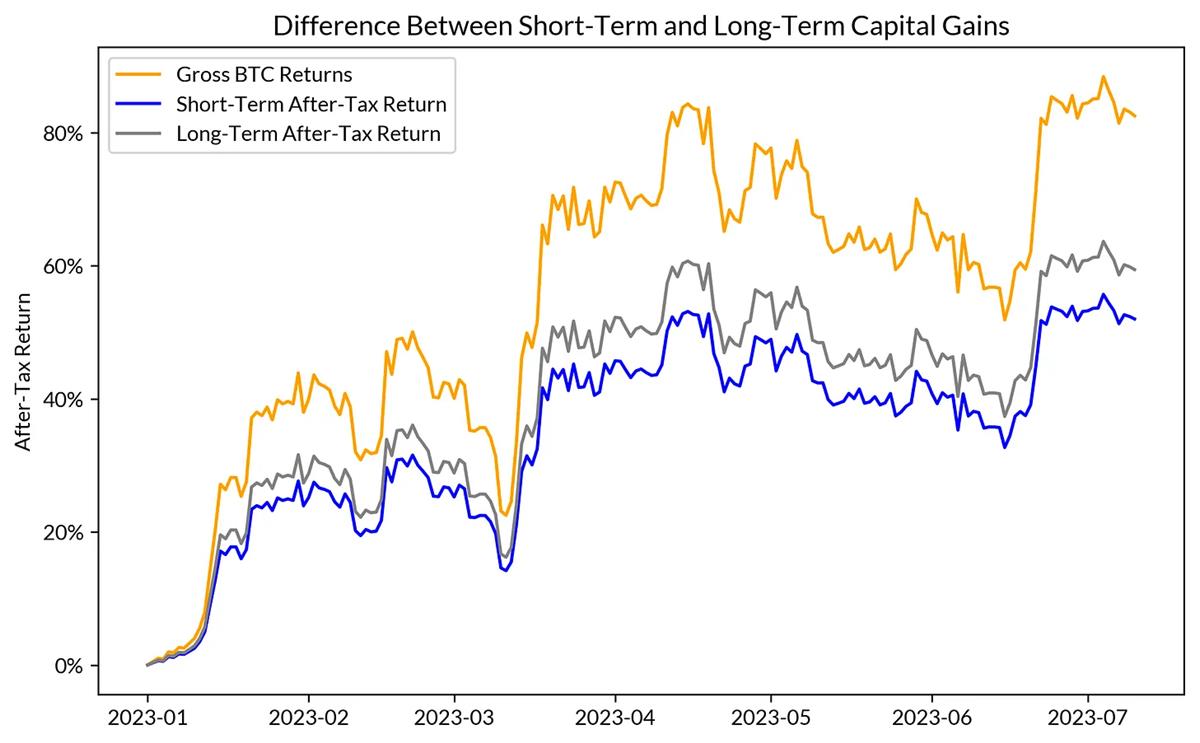
(TechFlow note: Blue line represents after-tax short-term return, gray line long-term after-tax return, yellow line net return of BTC itself)
We can further consider that for most people, self-custody is simply not a viable option—either due to lack of technical expertise or because regulatory or legal constraints interfere with such ownership, especially for corporate entities. Given these barriers, exchange-traded products are not just convenient alternatives but essential components of the digital asset investment landscape. They serve a similar role as in other asset classes where self-custody might be possible but impractical—such as with precious metals.
However, it is important to understand that not all exchange-traded products are the same. Each product has unique characteristics that may differently affect an investor’s portfolio. In this case, we turn our attention to Grayscale’s product suite. Our goal is to gain a deeper understanding of the specific features of their offerings to better grasp their nuances. By doing so, we can more clearly understand why the potential introduction of spot ETFs has generated such excitement in the market.
Grayscale Trust Products
Grayscale offers a range of investment products that give investors exposure to individual digital assets (such as BTC, ETH, etc.) or track various indices composed of multiple assets. All Grayscale products share one common feature: they are structured as trusts, meaning the value of shares fluctuates with the value of the underlying asset portfolio. Throughout its history, Grayscale’s Bitcoin Trust (GBTC) has at times traded at a premium above the value of the underlying bitcoin—peaking during the 2020–2021 bull run. At other times, shares have traded below the value of the underlying bitcoin, even as low as 50% of its value. These fluctuations are commonly referred to as premiums and discounts.
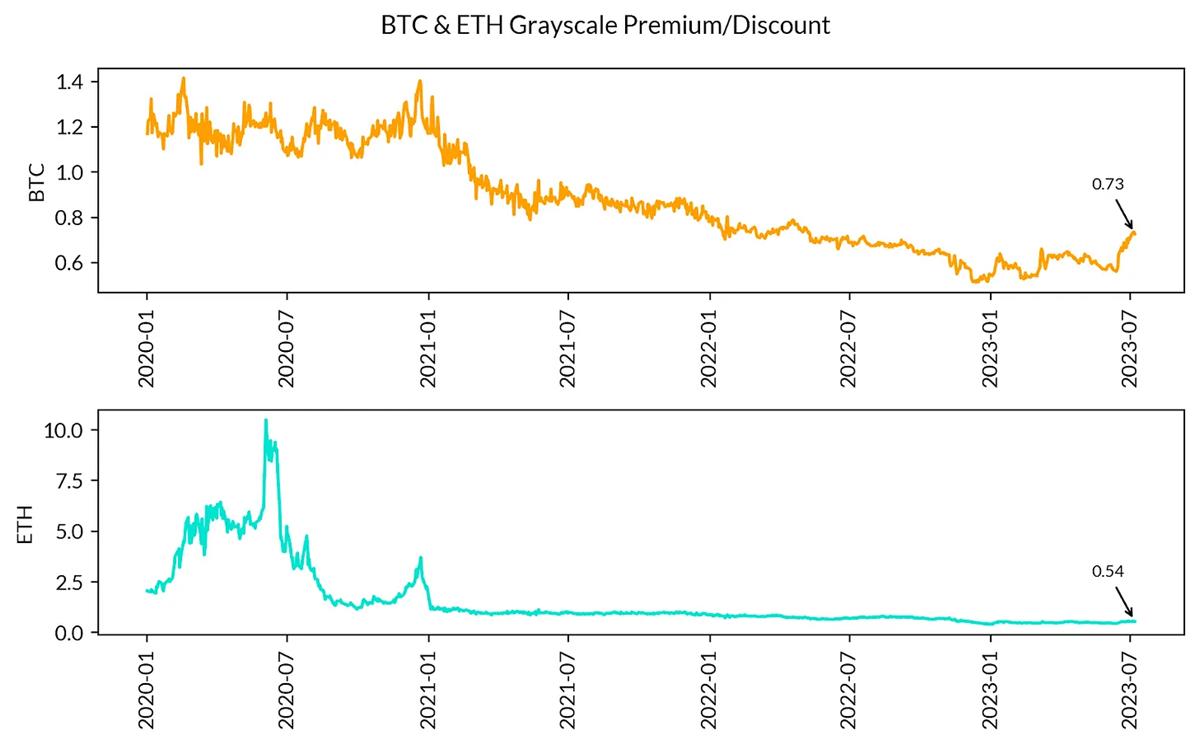
These trust product valuation dynamics are important for two main reasons. First, as an investor, you can purchase shares at the current market price. This means you may gain exposure to bitcoin at either a discount or a premium depending on prevailing market conditions—potentially altering your investment risk profile, particularly compared to spot investments without annual management fees. A second notable reason is that sophisticated investors can profit from mispriced assets through arbitrage trading strategies. For instance, when GBTC trades at a premium to bitcoin, risk-free trades can be executed by selling or shorting GBTC in the spot or futures markets while simultaneously buying bitcoin. Investors can profit from the price convergence between these two positions, achieving theoretically minimized risk.
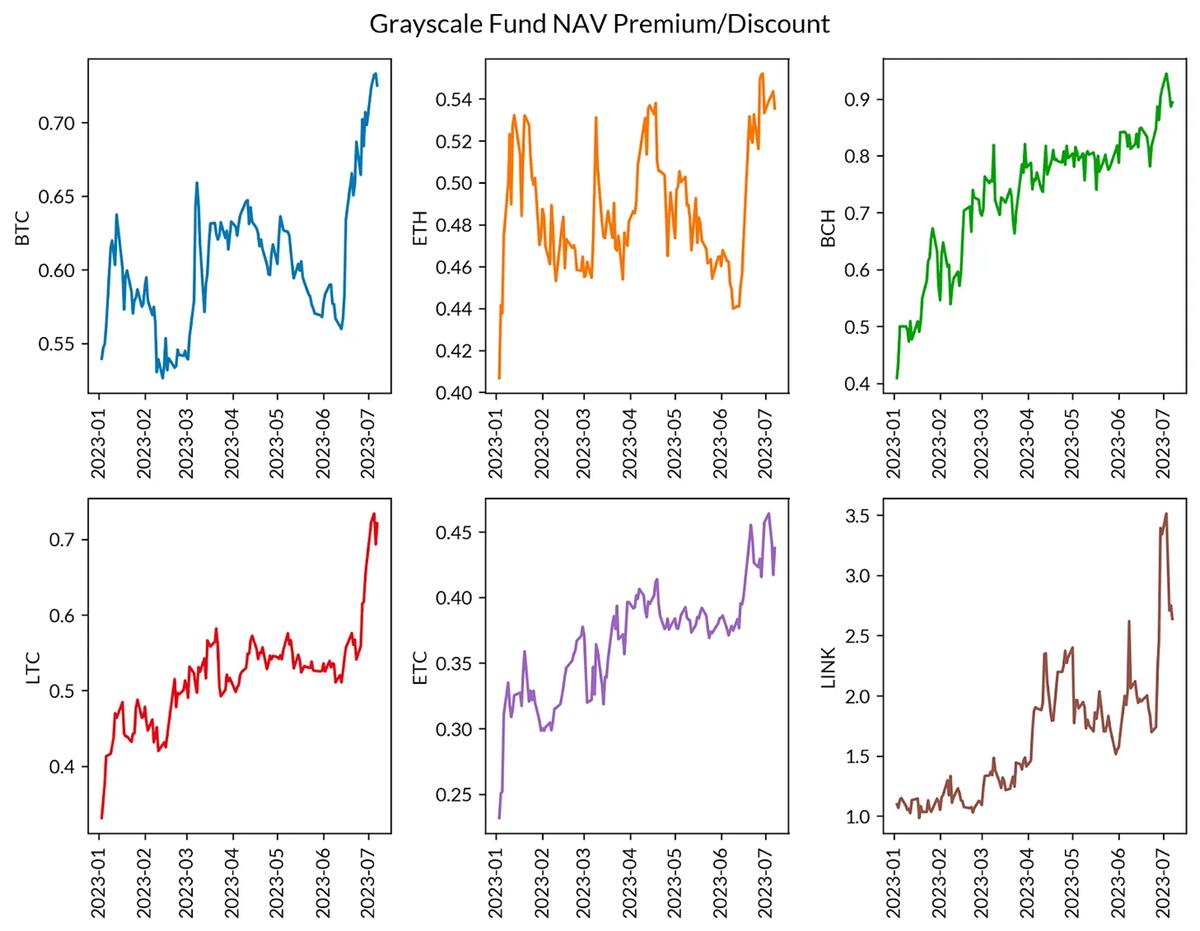
(TechFlow note: Overview of Net Asset Value (NAV) changes across Grayscale’s various digital asset trusts; vertical axis shows premium/discount ratio)
Looking at the chart above, we see that various trusts established for different assets have evolved quite differently. While ETH consistently trades at around a 50% discount, BTC, BCH, LTC, and ETC trend closer to parity, whereas LINK actually exceeds parity, trading at a 270% premium. This trend may reflect investor anticipation following recent news that BlackRock has applied to create a spot Bitcoin ETF—if Grayscale also receives approval to convert these funds into ETFs, prices would likely converge toward parity. While this may sound implausible (meaning people pay nearly three times the spot price), such situations are common with particularly illiquid investment vehicles, especially when speculative capital flows dominate. We can observe the same behavior in other trusts offered by Grayscale, as shown below.
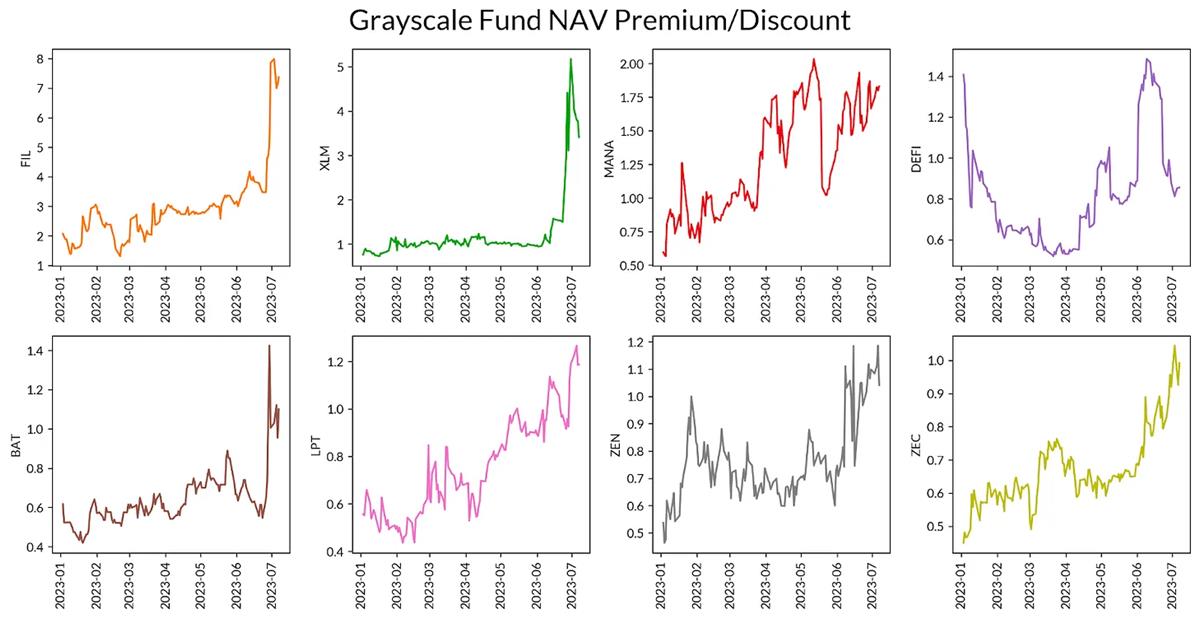
Filecoin (FIL) and Stellar (XLM) trade at approximately 8x and 4x their spot prices, respectively. These severe pricing discrepancies indicate extremely poor liquidity in these funds and limited access to these assets within the U.S., where arbitrageurs could easily compress premiums and profit. Yet, they also suggest that some investors are willing to pay substantial premiums to gain exposure—an interesting observation indeed.
Conclusion
In conclusion, the evolution of the digital asset investment landscape—particularly the anticipated launch of spot ETFs—holds the promise of revolutionary change. Currently, options such as futures and trust-based investments offered by Grayscale face a series of unique challenges. However, the introduction of spot ETFs could streamline these complexities, offering investors a more efficient and direct way to access digital assets. As we continue exploring this fascinating domain of digital investing, the adaptability and innovation of investors, along with regulatory progress, will undoubtedly play pivotal roles in shaping the future of digital asset investment.
Join TechFlow official community to stay tuned
Telegram:https://t.me/TechFlowDaily
X (Twitter):https://x.com/TechFlowPost
X (Twitter) EN:https://x.com/BlockFlow_News
 @coinmetrics