








Conflict Between High Court's New Virtual Asset Money Laundering Regulations and the Reality of Profit-Driven Law Enforcement
TechFlow Selected TechFlow Selected
Conflict Between High Court's New Virtual Asset Money Laundering Regulations and the Reality of Profit-Driven Law Enforcement
There are two kinds of power: one based on fear, the other on justice. Only power based on justice can endure.
 Navigating Web3 tides with focused insights
Author: Aiying

Recently, crypto-related groups across WeChat and other platforms have been buzzing with heated discussions. The most talked-about topic during casual conversations is the new regulation set to take effect on August 20, 2024 — the "Interpretation on Several Issues Concerning the Application of Law in Handling Money Laundering Criminal Cases." Almost everyone is asking: What does this judicial interpretation really mean? Will it affect our trading activities? Especially those who frequently engage in OTC (over-the-counter) transactions are particularly concerned. After all, cryptocurrency transactions involve complex and diverse methods, especially OTC — a popular way for users to bypass traditional financial channels when buying or selling virtual currencies, even transferring funds across borders. However, the release of this new rule has triggered unprecedented caution around what was once a familiar and routine practice.
In WeChat and Telegram groups, seasoned players are sharing various analyses, and some have issued warnings: "Be careful selling USDT now — profits are hard to come by, don’t end up getting yourself into trouble!" Such statements naturally raise concerns: Is the era of free and open trading in the crypto space coming to an end due to this judicial interpretation? Will it bring greater legal risks? Particularly for newcomers, the connection between intricate legal provisions and complex transaction behaviors can be confusing and unsettling.
How significant is the impact of this judicial interpretation? Has holding and trading virtual currency suddenly become high-risk? Aiying's team has consulted multiple law firms, as many urgently seek answers. I won't quote the full text of the regulation here — you can find the link at the bottom of the article. Instead, let me summarize and address the key questions people care about most:
1. The Line Between Virtual Asset Transactions and Money Laundering
This is the core focus of the new rules. Think of it as a legal “red line.” As long as your virtual currency transactions stay outside this boundary, you're fine. The problem arises when you cross this line by using virtual assets to conceal the origins of illegal proceeds, such as money from fraud or drug trafficking — that’s when you breach the law.
To put it simply, virtual assets are like knives — the knife itself isn’t illegal; using it to cut vegetables is perfectly legal, but using it to commit crimes turns it into an illegal tool. The same applies to cryptocurrencies: normal buying and selling is not illegal, but using them to hide or transfer illicit funds is where problems arise.
The key point of the new interpretation is this: it doesn’t target virtual currency trading per se, but rather the use of virtual assets to launder money or conceal criminal proceeds. Therefore, as long as your transactions are legitimate, with clear sources and purposes of funds, you have nothing to worry about.
In short, the legal red line is: Virtual asset trading can continue, but be cautious not to get involved in flows of illegal funds. Stay on the right side of this line, and you’ll remain safe.
2. How Individuals and Institutions Can Avoid Being "Used as Tools"
The crux lies in the source and purpose of funds. If you can prove your funds are legal and your transactions transparent, you need not fear being mistaken for money laundering. For example, normal OTC (over-the-counter) trading is not illegal. However, if you fail to verify the source of a counterparty’s funds and unknowingly accept proceeds from criminal activity, you could inadvertently become involved in money laundering risks. So how do you ensure you don’t cross the legal red line during transactions? These are several critical precautions Aiying often emphasizes in anti-money laundering articles — principles broadly applicable under anti-money laundering regulations worldwide:
1. Strengthen KYC (Know Your Customer)
-
Recommendation: Conduct strict KYC checks before every transaction. Whether large or small, you should know who the counterparty is, where their funds originate, and what they intend to use them for. In OTC trades, avoid large-value transactions with unidentified individuals.
-
Action Steps: Require counterparties to provide identity documents such as ID cards or passports, and verify the authenticity of the information. If dealing with corporate clients, review the company’s legitimacy and financial background. Use professional identity verification tools to assist with automated screening.
2. Maintain Complete Transaction Records
-
Recommendation: Keep detailed records of every transaction, especially those involving virtual asset trades. This includes electronic receipts, fund transfer confirmations, chat logs, contracts, etc. Should any transaction later be suspected of involving illicit funds, these records will serve as clear evidence of your lawful conduct.
-
Action Steps: Store transaction records using encrypted cloud storage or local backup systems, with regular backups. For online transactions, capture screenshots or screen recordings of key steps, and archive files chronologically.
3. Exercise Caution with Large-Value Transactions
-
Recommendation: Be extra vigilant with large-value transactions, especially cross-border ones, as they are more likely to attract regulatory scrutiny.
-
Action Steps: Before proceeding with large transactions, ensure the counterparty’s funds are legally sourced and compliant. Use formal channels like banks or authorized payment platforms for transfers, avoiding cash or unregulated payment methods. Consider splitting large transactions into smaller batches to allow thorough review at each stage.
4. Avoid High-Risk Clients
-
Recommendation: Do not easily transact with high-risk clients, especially those with unclear identities or suspicious funding sources. Such clients may be involved in money laundering or other crimes, potentially dragging you into legal trouble.
-
Action Steps: Conduct background checks before transacting with new clients. Be especially cautious with those who frequently change accounts or refuse to disclose information. Immediately terminate transactions involving unusual requests — for example, funds transferred from multiple accounts across different countries — and consider reporting suspicious behavior to relevant authorities.
5. Understand and Comply with Local Laws and Regulations
-
Recommendation: Familiarize yourself with national and regional laws, especially those related to virtual assets and anti-money laundering. As regulations tighten globally, staying updated on legal changes is crucial.
-
Action Steps: Regularly monitor policy updates from government agencies, industry associations, and legal platforms. Subscribe to Aiying’s global Web3 legal newsletter or consult professional lawyers and advisory teams to ensure ongoing compliance with evolving legal requirements.
3. Three Key Terms in the Supreme People’s Procuratorate’s Interpretation
1. Serious Circumstances

Let’s discuss "Serious Circumstances." This legal term might seem abstract, but essentially means that if you’re involved in exceptionally large amounts or cause severe consequences, the law will treat you more harshly. For instance, if you help a friend move house and unknowingly transport stolen goods worth 5 million yuan, you could face serious legal repercussions. Similarly, if your actions prevent victims from recovering stolen funds, that outcome would also qualify as “serious.”
2. "Should Have Known"
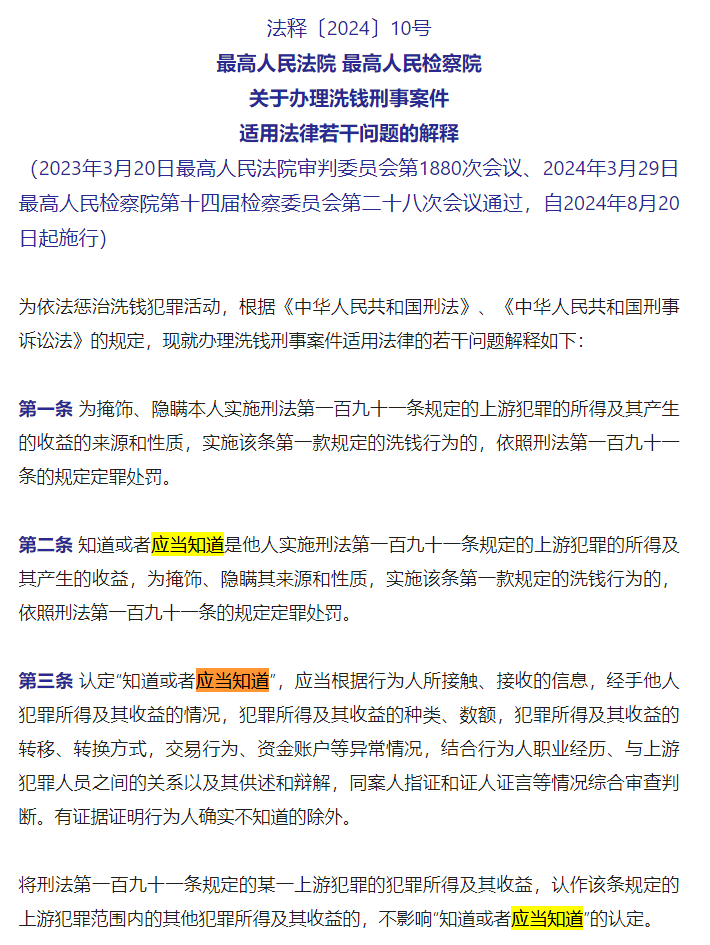
Now consider the phrase "should have known" — a concept that may confuse many. You might wonder: How could I possibly know whether someone else’s money is illicit? But the legal standard doesn’t require actual knowledge — only whether you should reasonably have suspected. For example, if you routinely handle large sums of questionable origin and deal with suspicious actors, yet never bother to verify or ask questions, the law may conclude that you ought to have known the funds were problematic.
The law won’t excuse ignorance. Just as driving without looking at road signs doesn’t exempt you from speeding tickets, turning a blind eye in crypto transactions won’t protect you legally. In OTC trading, staying alert is essential. If a client’s funding source is murky and you proceed regardless, the law may view this as deliberate risk avoidance — or even complicity.
3. "Fugitive and Not in Custody"
Now look at Article 7’s mention of "fugitive and not in custody." This clause states that even if someone flees and remains at large, they can still be held accountable as long as sufficient evidence proves their involvement in criminal activity. For example, if someone uses virtual assets to launder money and then flees overseas, but evidence of their actions remains, the law can still hold them responsible. For crypto professionals, this means: even if the counterparty has left the country, legal liability for related transactions may still be pursued.
Therefore, whenever your transactions involve large amounts, suspicious activity, or serious consequences, extreme caution is required. The law offers no leniency for negligence — wherever vigilance is needed, exercise it; wherever verification is required, carry it out. Only then can you ensure your trading activities remain within legal boundaries.

4. Controversial Points in the Supreme Procuratorate’s Interpretation
1. Clarification Needed on the Relationship Between “Virtual Assets” and “Virtual Currencies”
Previous judicial interpretations on illegal fundraising used the term “virtual currency,” while this new anti-money laundering interpretation uses “virtual assets” in quotation marks. The relationship between the two terms is not clearly defined. Does “virtual assets” include items beyond virtual currencies — such as NFTs or in-game virtual items? Aiying believes that if the term refers only to virtual currencies, why not stick with the original terminology?
This ambiguity requires further clarification through official guidance or judicial interpretation. It is critically important for industry participants, as different asset types may carry distinct legal risks.
2. Ambiguity of the Phrase “Other Methods”
Open-ended clauses sometimes grant broad discretion to law enforcement, but they can also leave practitioners uncertain about which specific behaviors constitute violations. This vagueness increases legal risk, as the phrase “other methods” of concealing criminal proceeds is overly broad, leading to uncertainty. Further judicial interpretation or precedent is needed to clarify which specific acts fall under “other methods,” to prevent misinterpretation or abuse.
5. Judicial Interpretation Amid Profit-Driven Enforcement
The so-called “Ten Crimes of the Crypto World”: 1. Illegal Business Operations, 2. Fundraising Fraud, 3. Illegal Absorption of Public Deposits, 4. Pyramid Schemes, 5. Fraud, 6. Money Laundering, 7. Aiding Information Network Criminal Activities (‘Helping Crime’), 8. Concealing or Hiding Criminal Proceeds (‘Concealment Crime’), 9. Operating Gambling Sites, 10. Illegal Foreign Exchange Transfer
This latest judicial interpretation specifically targets money laundering. Its stated goal is undoubtedly to combat money laundering and uphold legal fairness and authority. Yet, as the saying goes: “Laws are made for the public good, but often become tools for private gain.” In some regions, profit-driven enforcement persists — prompting us to question: In such an environment, how effective can this judicial interpretation truly be?
Profit-driven enforcement leads some local judicial bodies to prioritize economic gain over justice. We know there are two forms of power: one based on fear, the other on justice. Only power rooted in justice can endure. Profit-driven enforcement clearly violates the principle of justice, turning law enforcement into a profit-seeking mechanism. According to Aiying’s research, this phenomenon is especially evident in cases involving large sums — particularly in the crypto sector, where massive transaction values attract disproportionate attention from local police, shifting the focus from “crime suppression” to “revenue generation.”
For example, in one real case, a well-functioning blockchain project received a report to local police, who initially filed charges of “illegally using information networks.” The case was later escalated to “pyramid scheme,” resulting in frozen corporate accounts and the arrest of key personnel. Despite internal business models being widely reviewed and not constituting a crime, the sheer scale — hundreds of millions of yuan — led authorities to push forward, ultimately causing capital chain collapse and operational paralysis. Aristotle said: “The highest form of justice is fairness.” Yet in such cases, fairness is abandoned — the motive shifts from upholding justice to extracting financial benefit.
This phenomenon raises doubts: Under profit-driven enforcement, how effective can judicial interpretations really be? As the Bible says: “You cannot serve both God and money.” If law enforcement agencies aim to generate revenue rather than fairly resolve cases, even the strictest laws cannot fulfill their intended mission of justice. Profit-driven enforcement undermines the credibility of the legal system, placing law-abiding businesses and individuals in unnecessary legal jeopardy.
To address this, we must ensure judicial power returns to its proper role. Law should exist to protect human freedom, not to enslave. Society today demands stronger oversight of local judicial bodies to prevent judicial interpretations from becoming tools for personal gain. At the same time, vague clauses in these interpretations must be clarified, and institutional safeguards must ensure equal rights and opportunities for all — reducing arbitrariness in enforcement.
Furthermore, to prevent local judicial bodies from deviating from the rule of law due to financial pressures, their funding must not depend on fines or confiscated assets. We must not allow the law to become a weapon against enterprises and individuals, but rather ensure it functions as a true shield. By refining legal provisions and strengthening supervision over enforcement practices, we can build a more just and transparent judicial environment, protecting the legitimate rights of businesses from harm caused by profit-driven enforcement.
In the end, the essence of law is to uphold fairness and justice — not to serve as a profit-making instrument for local law enforcement. As Cicero said: “Law is the mother of justice.” We must return to this founding principle, ensuring that while combating crime, the law also protects lawful enterprises and individuals, making justice the sole benchmark of judicial action.
Join TechFlow official community to stay tuned
Telegram:https://t.me/TechFlowDaily
X (Twitter):https://x.com/TechFlowPost
X (Twitter) EN:https://x.com/BlockFlow_News
 Aiying Compliance











