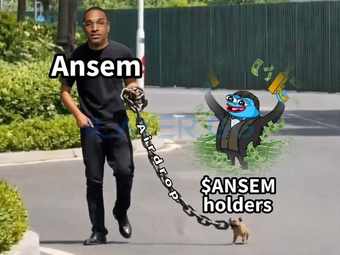
From Top Meme KOL to Utterly Wiped Out: Why Ansem No Longer Works
TechFlow Selected TechFlow Selected
From Top Meme KOL to Utterly Wiped Out: Why Ansem No Longer Works
From starting with a thousandfold WIF to mocking his retirement from the scene in tweets, Ansem seems to have faded—but new "legendary traders" are on the rise.
 Navigating Web3 tides with focused insights
Authors: Joyce, Weird Thinker
Last week, well-known Solana ecosystem trader Ansem posted a tweet admitting that his recent trading performance has been extremely poor, involving a series of wrong decisions. He stated he had completely lost his edge in the current market and was even considering cashing out and exiting altogether.
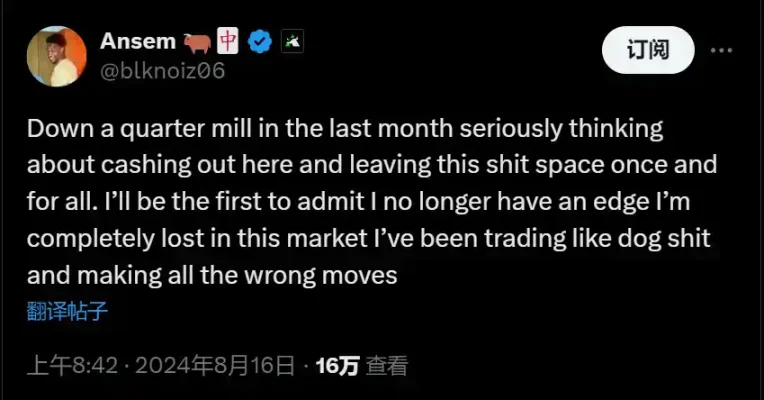
Regarded by the community as the "godfather of WIF," Ansem once achieved thousands of times returns on WIF when its market cap surpassed $1 billion. After WIF, he also witnessed BILLY (peaking at $200 million market cap) and BODEGN (peaking at $300 million market cap) grow from zero. However, after several iterations of meme market strategies on Solana, Ansem's golden touch seems to have faded.
What has Ansem experienced over these past few months? The address widely recognized in the community as belonging to Ansem is AVAZvHLR2PcWpDf8BXY4rVxNHYRBytycHkcB5z5QNXYm. BlockBeats used GMGN, an on-chain analytics tool, to analyze meme trades actively participated in by this address between February and August 20 this year, attempting to identify patterns in his trading behavior. We excluded 531 purely sell transactions, which typically represent tokens sent by project teams rather than purchases made by the wallet itself. The remaining 2,590 transactions were considered active meme trades conducted by the address. Note that due to limitations in Solana’s data format, raw data may be incomplete; thus, analysis results are for reference only.
Rise with WIF
Before diving into the analysis, let's revisit Ansem’s origin story in the meme coin space—WIF being the most pivotal chapter. On December 1, 2023, Ansem spent $472 to buy his first batch of WIF at an initial price of $0.0003. Eight days later, he added another $185 worth. Following this, Ansem frequently traded WIF and repeatedly promoted it on his X (formerly Twitter) account.
Four months later, WIF surged to a high of $4.90—nearly 16,000 times Ansem’s initial purchase price. This early bet cemented Ansem’s status as a legendary trader and “golden finger” caller within the Solana community.
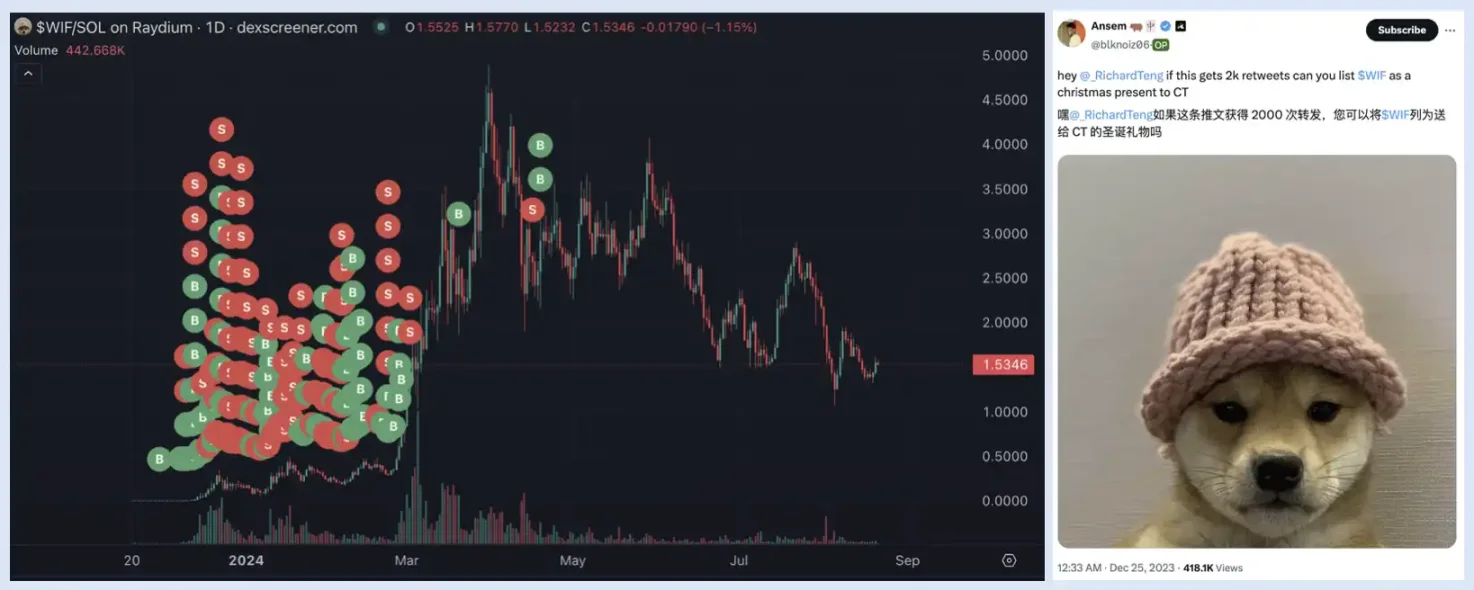
Left: Ansem’s public wallet transaction history on $WIF shown on Dexcreener; Right: Ansem promoting $WIF on X
Although Ansem entered and promoted WIF early, he was far from a typical “diamond hands” holder. His trade records show frequent buying and selling—over 80 buys and 110 sells. According to data from Cielo, Ansem invested a total of $2.14 million in WIF, sold $2.85 million worth, realizing $804,000 in profit, while still holding unrealized gains of $745,000.
After WIF, more people began monitoring Ansem’s address. As a result, many meme project teams started sending their tokens directly to Ansem’s wallet, hoping to use “Ansem holds” as social proof for their projects.
Following WIF, one of Ansem’s notable successes was with BODEN. He bought into BODEN in early March and rode a month-long upward trend, ultimately earning $540,000 in profit. Although he began selling shortly after acquiring it, the signal “Ansem is on board” spread widely across X. Notably, GMGN data shows that some of the BODEN he sold had a cost basis of $0, indicating those tokens were transferred in externally rather than purchased by the address itself.
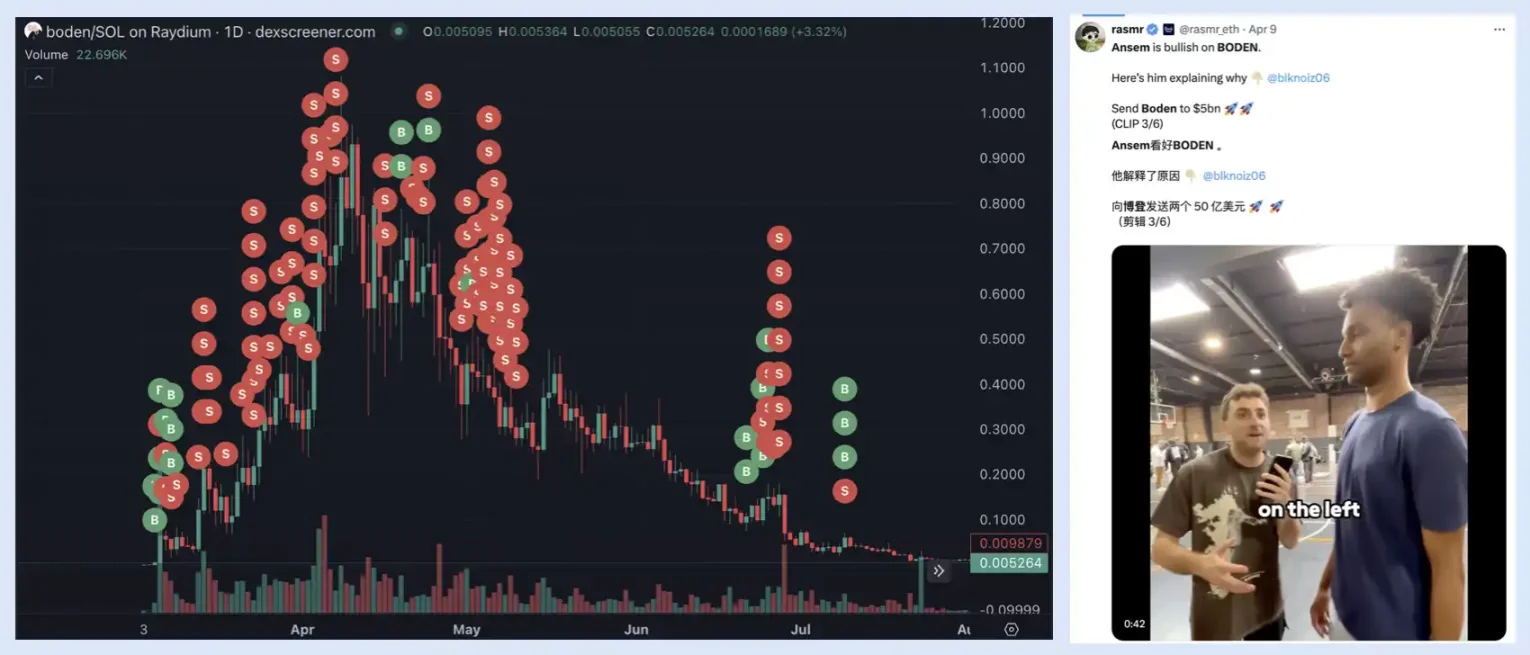
Left: Ansem’s public wallet transaction history on $boden shown on Dexcreener; Right: Community discussions about Ansem buying $boden
The Cost of Being a Whale
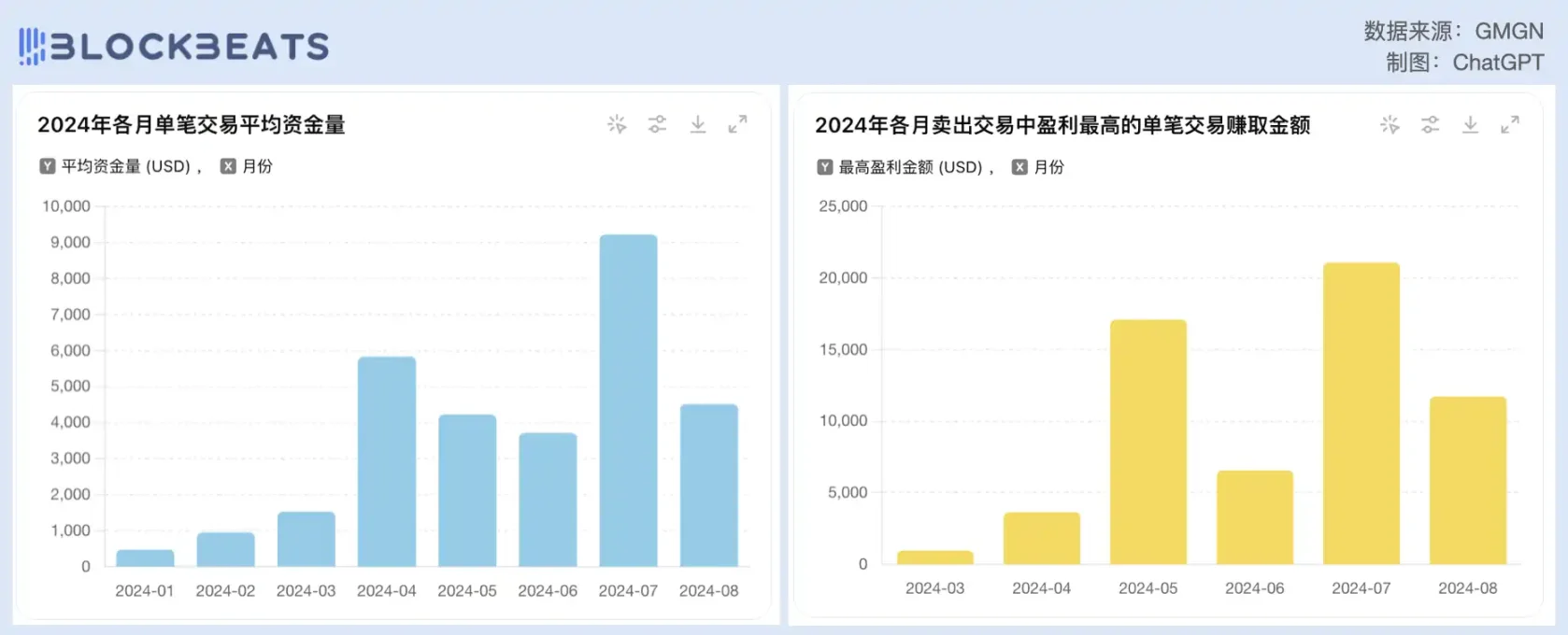
What happened after WIF? According to GMGN data, Ansem deposited $1.93 million in SOL into his wallet over the past eight months, with the majority—$1.32 million—coming in July. Correspondingly, July saw his highest investment in meme trades, totaling $3.39 million. Ansem’s individual buy amounts were substantial. Since April, his average single trade size ranged between $3,000 and $9,000.
In terms of frequency, Ansem’s number of trades increased steadily over these eight months, peaking in July with 500 buys and over 800 total trades.
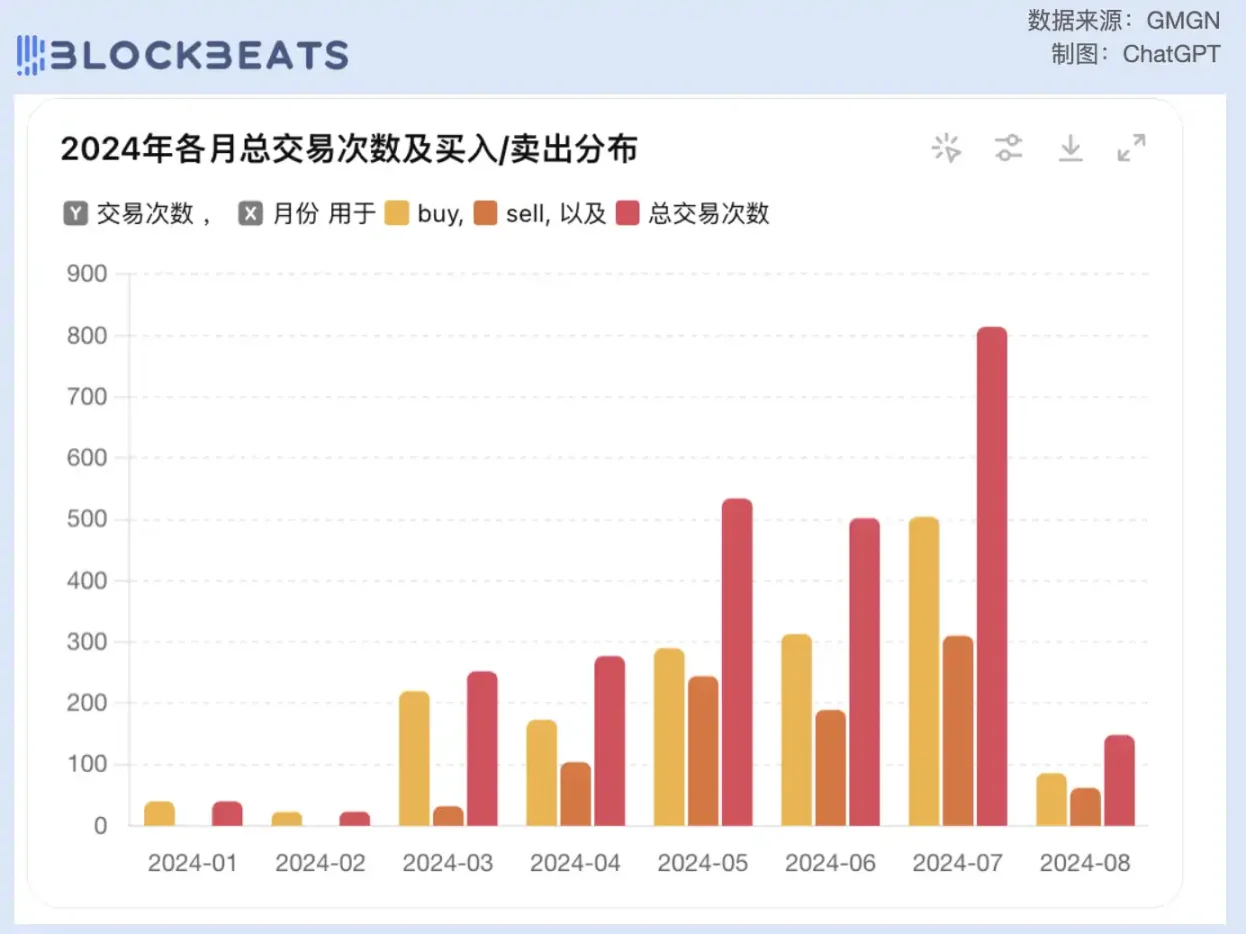
High-frequency trading has become a survival strategy for many meme traders in the Solana ecosystem, with some players executing dozens of trades per day. It’s clear Ansem has gradually adapted to this fast-paced style. As trade frequency increased, so did his capital deployment. With greater principal backing his moves, Ansem managed to maintain a modest upward trend in maximum single-trade profits.
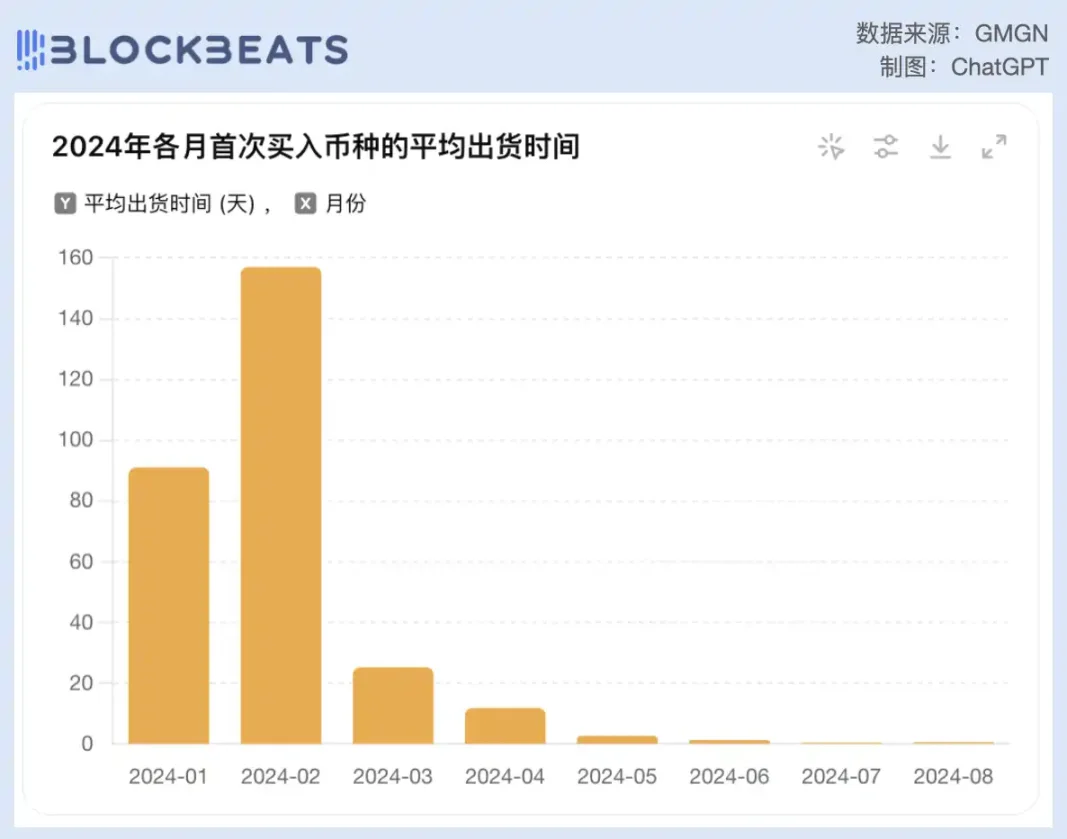
If we define “exit timing” as the duration between first purchase and first sale of the same token, Ansem held tokens bought in January and February for averages of 91 and 157 days, respectively—only selling them gradually from April through August. Afterward, his holding periods shortened significantly.
In terms of returns, Ansem’s peak profitability ended in May. Return efficiency dropped sharply after that, and August’s gains likely stemmed mostly from meme coins he accumulated back in February. Meanwhile, the proportion of trades where Ansem realized over 200% profit declined drastically in May before slowly recovering—a possible sign he began adopting a “double and withdraw principal” strategy.
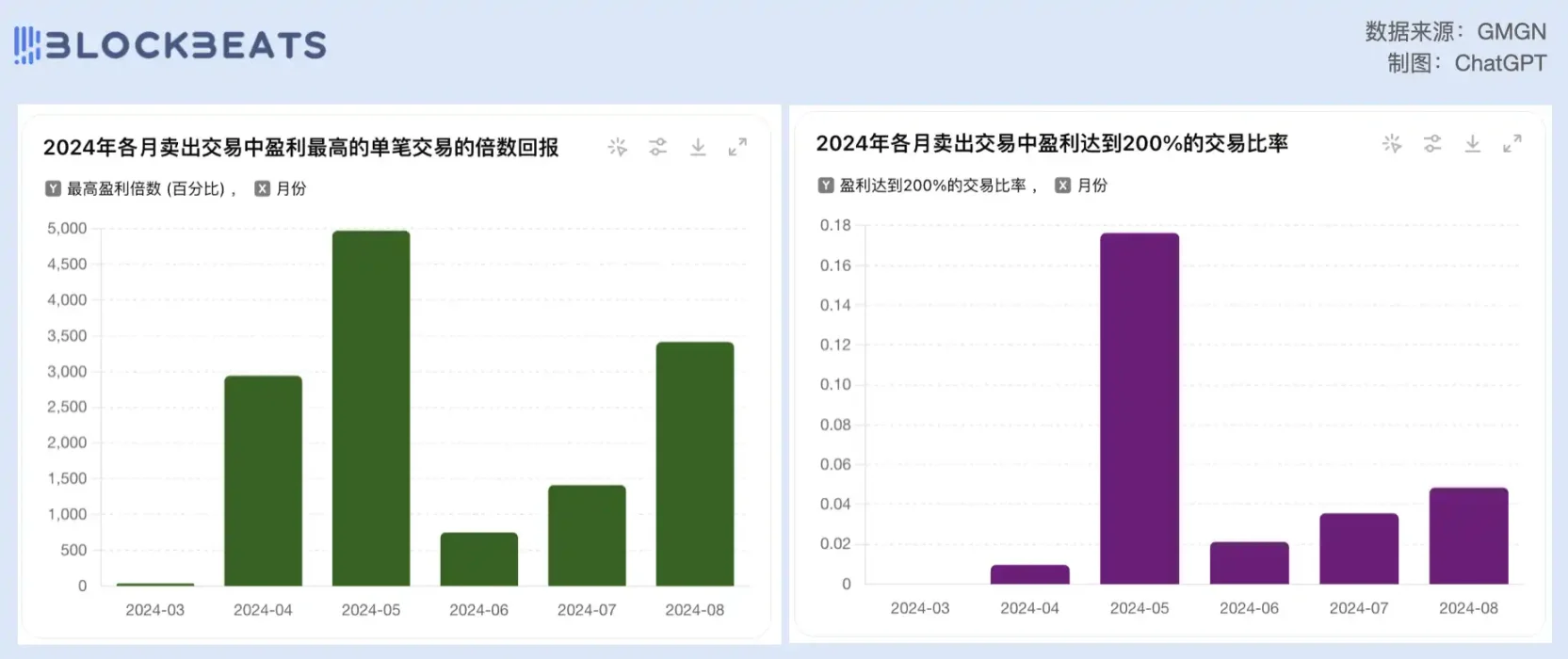
Overall, however, Ansem’s trading scale remains large compared to average retail traders, reflected in slower profit-taking, frequent re-buying, and lingering habits of holding too long—traits ill-suited to today’s volatile meme markets.
Neiro Waterloo
In August, Ansem suffered a true “Waterloo,” losing $448,000. Most of this loss came from Neiro. He executed 28 separate buys on Neiro, averaging down during the decline with a total investment of $350,000, but eventually exited with a 77% loss—$270,000 wiped out.
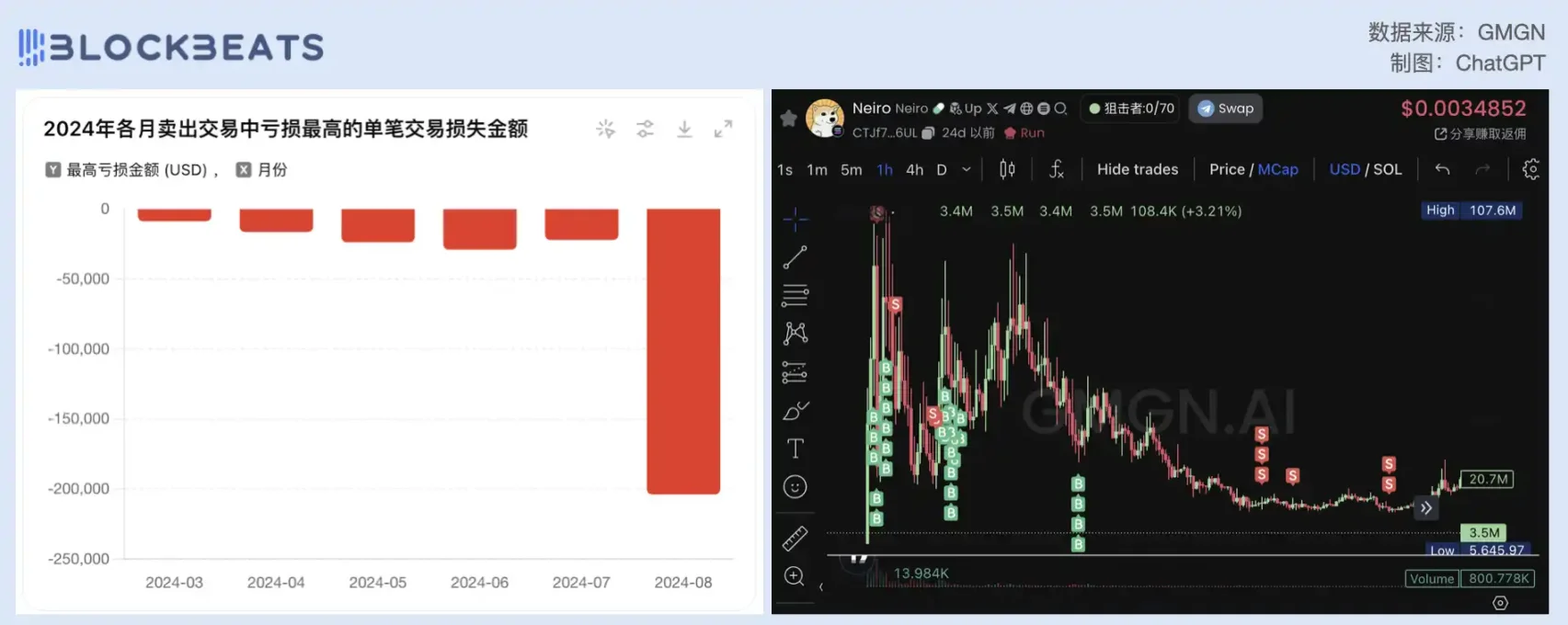
Prior to this, flaws in Ansem’s trading approach were already evident. His style leans toward “diamond hands”—focusing on a single token and persistently betting on it—which clashes with the current fast-flipping nature of the meme market. Take HAMMY, launched in March: Ansem continuously bought and sold during its two-month rise, investing $200,000 total, only to exit with a 5% loss.
In July, Ansem scored a win on meme coin BILLY, selling for a single-trade profit of $21,000. BILLY launched on June 24, and Ansem bought in shortly after launch, successfully capturing high multiples as it took off. BILLY reached a peak market cap of $281 million, earning Ansem hundreds of thousands in profit.
But after BILLY peaked, Ansem kept adding positions, causing his profits to erode. Over the past month alone, he’s lost $80,000 on BILLY, reducing his cumulative profit to just $107,000. As recently as August 20, Ansem was still buying more BILLY, making it his most-traded token with 255 transactions.
The Meme Business of a KOL
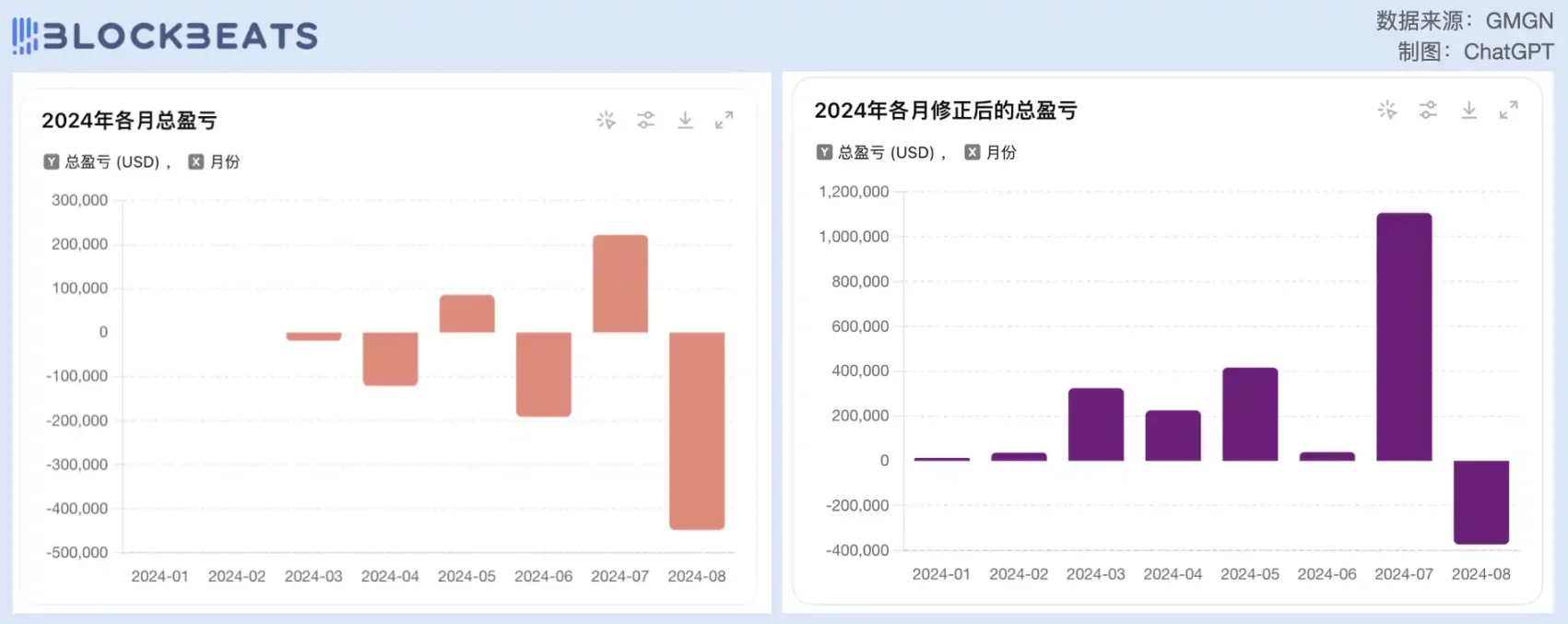
Do influencers really lose money? If we consider only trades where Ansem’s public wallet actively bought and sold tokens, existing data indicates he lost $470,000 over these eight months.
However, this calculation excludes profits from tokens transferred into the wallet from other addresses before being sold—the realized gains from such transfers amount to $2.25 million.
Tokens are sent to Ansem’s wallet in two ways: either project teams send them to create buzz around “Ansem holding,” or Ansem transfers tokens from his private wallets into the public one. In either case, these profits are inaccessible to ordinary retail followers.
When including these incoming transfers, the total net profit of Ansem’s public wallet rises to $1.014 million. Even if a KOL’s market insight and trading skill begin to decline after gaining fame, they can still leverage their influence to earn substantial returns.
In retrospect, Ansem’s journey reflects the struggles of a lucky trader who rose to prominence as a whale but now faces growing discomfort in a rapidly evolving market. There are no eternal winners in crypto. Yet, having ascended the food chain, Ansem no longer needs to grind every trade to generate income. From thousand-fold WIF gains to tweeting self-deprecatingly about quitting, Ansem may appear to be fading—but new “legendary traders” are already on the rise.
Join TechFlow official community to stay tuned
Telegram:https://t.me/TechFlowDaily
X (Twitter):https://x.com/TechFlowPost
X (Twitter) EN:https://x.com/BlockFlow_News
 BlockBeats