The Challenges and Dilemmas of Tech Giants and AI Agent Innovators
TechFlow Selected TechFlow Selected
The Challenges and Dilemmas of Tech Giants and AI Agent Innovators
By leveraging blockchain technology and smart contracts, cryptographic AI agents can offer greater transparency and security compared to centralized systems.
 Navigating Web3 tides with focused insights
Author: IOSG Ventures
1. The Promise of Centralized AI Agents
AI agents have the potential to transform how we interact with the web and perform online tasks. While much discussion centers around AI agents leveraging cryptocurrency payment rails, it's important to recognize that established Web 2.0 companies are also well-positioned to deliver comprehensive agent product suites.
Most Web2 agents currently appear as assistants or vertical tools with limited execution capabilities. This is due both to immature foundational models and regulatory uncertainty. Today’s agents remain in their first stage—performing well within specific domains but lacking generalization ability. For example, Alibaba International has an agent that helps merchants respond to credit card dispute emails. A simple agent, it retrieves shipping records and generates responses using templates, achieving high success rates in preventing chargebacks.
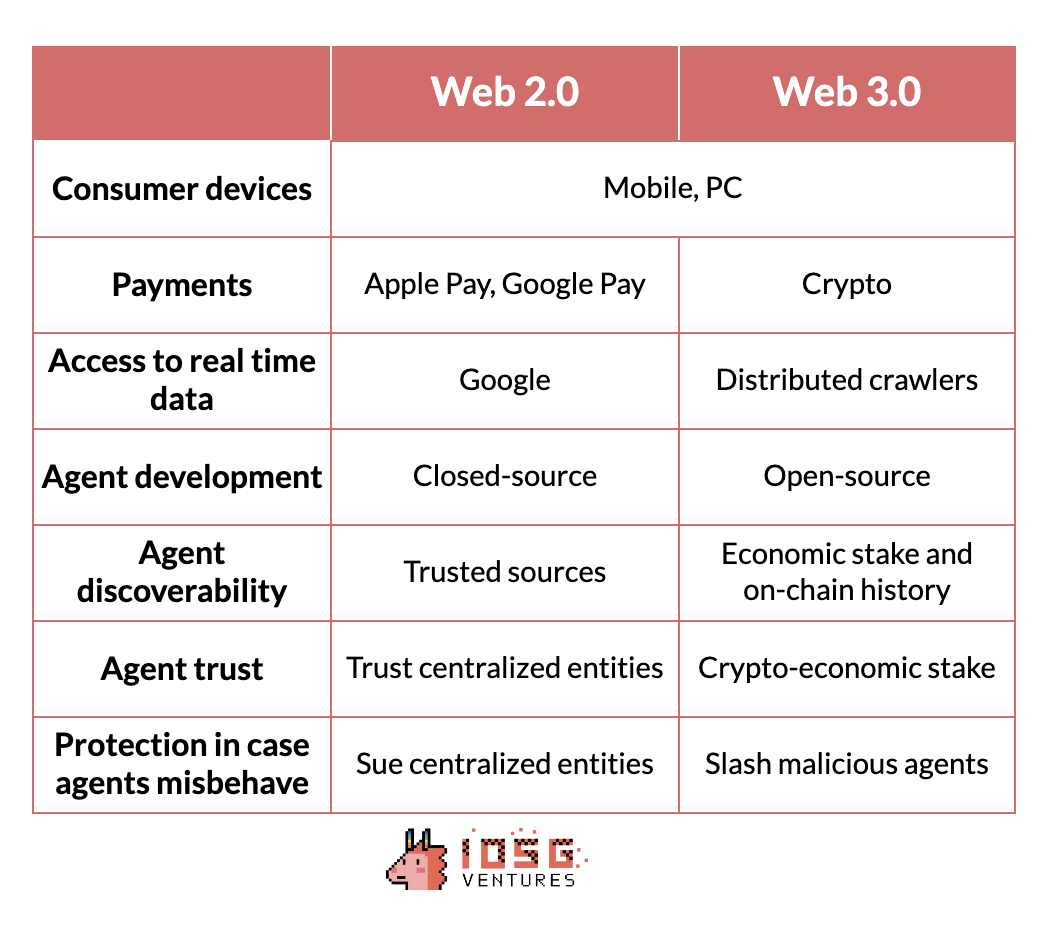
Tech giants like Apple and Google, along with AI specialists such as OpenAI or Anthropic, seem particularly suited to explore synergies in developing agent systems. Apple benefits from its ecosystem of consumer devices, which can host AI models and serve as gateways for user interaction. Its Apple Pay system could enable agents to facilitate secure online payments. Google, with its vast index of web data and real-time embedding capabilities, can provide agents with unprecedented access to information. Meanwhile, AI powerhouses like OpenAI and Anthropic can focus on building specialized models capable of handling complex tasks and managing financial transactions. Beyond Big Tech, numerous U.S. startups are building agents for narrow use cases—such as helping dentists manage appointments or generating post-treatment reports.
However, these Web 2.0 giants face the classic innovator's dilemma. Despite their technical prowess and market dominance, they must navigate the treacherous waters of disruptive innovation. Developing truly autonomous agents represents a significant departure from their established business models. Moreover, the unpredictability of AI, combined with the high stakes of financial transactions and user trust, presents substantial challenges.
2. The Innovator's Dilemma: Challenges Facing Centralized Providers
The innovator's dilemma describes a paradox where successful companies often struggle to adopt new technologies or business models—even when those innovations are crucial for long-term survival. At the core is an established company’s reluctance to introduce new products or technologies whose initial user experience may fall short of their existing polished offerings. These firms fear that adopting such innovations might alienate their current customer base, who have grown accustomed to a certain level of refinement and reliability. This hesitation stems from the risk of disrupting long-established user expectations.
2.1 Agent Unpredictability and User Trust
Large tech companies like Google, Apple, and Microsoft have built their empires on proven technologies and business models. Introducing fully autonomous agents marks a major departure from these established norms. Such agents, especially in early stages, will inevitably be imperfect and unpredictable. The non-deterministic nature of AI models means there is always a risk of unexpected behavior, even after extensive testing.
The stakes are extremely high for these companies. A single mistake could not only damage their reputation but also expose them to significant legal and financial risks. This creates a strong incentive for caution, potentially causing them to miss first-mover advantages in the agent space.
The risk of customer backlash is enormous for centralized providers considering agent deployment. Unlike startups that can pivot quickly with minimal loss, established tech giants serve millions of users who expect consistent, reliable service. Any major failure by an agent could trigger a public relations disaster.
Consider a scenario where an agent makes a series of poor financial decisions on behalf of users. The resulting backlash could erode trust painstakingly built over years. Users might not only question the agent but also the company’s entire suite of AI-powered services.
2.2 Ambiguous Evaluation Standards and Regulatory Challenges
Furthermore, determining what constitutes a “correct” agent response complicates the issue. In many cases, it's unclear whether an agent's reply was genuinely wrong or merely surprising. This gray area can spark disputes and further strain customer relationships.
Perhaps the most daunting obstacle facing centralized agent providers is the evolving and complex regulatory landscape. As agents become more autonomous and handle increasingly sensitive tasks, they enter regulatory gray zones that pose serious challenges.
Financial regulations are particularly thorny. If an agent makes financial decisions or executes transactions on behalf of users, it may fall under the jurisdiction of financial regulators. Moreover, compliance requirements can be extensive and vary significantly across jurisdictions.
There are also liability concerns. Who should be held responsible if an agent’s decision leads to user financial loss or other harm—the user, the company, or the AI itself? These are questions regulators and lawmakers are only beginning to address.
2.3 Model Bias as a Source of Controversy
In addition, as agents grow more sophisticated, they may run afoul of antitrust laws. If a company’s agent consistently favors its own products or services, this could be seen as anti-competitive behavior—a critical concern for tech giants already under scrutiny for market dominance.
The inherent unpredictability of AI models adds another layer of complexity to these regulatory challenges. When Web2 companies cannot fully predict or control AI behavior, ensuring regulatory compliance becomes exceedingly difficult. This unpredictability may slow innovation in Web2 agents, creating an opening for more agile Web3 solutions.
3. The Opportunity in Web3
As underlying LLM capabilities improve, agents have the opportunity to evolve into the next phase—exhibiting relatively high autonomy. Large corporations are unlikely to venture far in this direction; perhaps ordering a pizza may be the limit. Startups may take bolder steps, but they face significant technical hurdles—such as agents lacking identity, requiring them to operate under the user’s credentials. Even with borrowed identities, traditional systems aren’t easily navigable by agents. Web3 technology offers unique opportunities for AI agent development, potentially addressing some of the challenges faced by centralized providers. In a Web3 environment, agents can control wallets and possess multiple DIDs, making interactions with permissionless protocols and crypto-based payments highly agent-friendly. As agents begin engaging in complex economic behaviors, frequent and intense interactions between agents become likely. Without mechanisms to resolve mutual distrust among agents, the agent economy cannot form a complete economic system—another area where cryptography can help.
Moreover, crypto-economic incentives can promote agent discovery and establish penalties—such as slashing or confiscation of staked assets—for misbehavior. This creates a self-regulating system where good behavior is rewarded and bad behavior penalized, potentially reducing the need for centralized oversight and offering peace of mind to early adopters willing to delegate financial transactions to fully autonomous agents.
Crypto-economic staking serves a dual purpose: acting as a penalty mechanism when needed, and serving as a key market signal during agent discovery. The intuition is simple—more staked assets indicate higher market confidence in a given agent’s performance, leading to greater user trust. This could foster a more dynamic and responsive agent ecosystem, where the most effective and trustworthy agents naturally rise to prominence.
Web3 also enables open agent markets. Compared to relying on centralized providers, these markets allow for greater experimentation and innovation. Startups and independent developers can contribute to the ecosystem, potentially accelerating progress and specialization in agent development.
Additionally, decentralized networks like Grass and OpenLayer can give agents access to both open internet data and authenticated closed information. Broad access to diverse data sources may empower Web3 agents to make better-informed decisions and deliver more comprehensive services.
Web 2.0 vs. Web 3.0 Comparison
4. Limitations and Challenges for Web3 AI Agents
4.1 Limited Adoption of Crypto Payments
A discussion on Web3 agents would be incomplete without acknowledging adoption challenges. The elephant in the room is the still-limited use of cryptocurrency as a payment solution for off-chain economic activity. Currently, only a small number of online platforms accept crypto payments, limiting real-world use cases for crypto-based agents in the broader economy. Without deep integration between crypto payment solutions and the wider economy, the impact of Web3 agents will remain constrained.
4.2 Transaction Scale
Another challenge lies in the typical scale of online consumer transactions. Many of these involve relatively small amounts of money, which may not justify the need for a trustless system for most users. Given centralized alternatives, average consumers may not see the value in using decentralized agents for low-value, everyday purchases.
5. Conclusion
The reluctance of tech companies to offer fully autonomous AI agents—driven by the unpredictability of non-deterministic models—creates an opening for crypto-native startups. These startups can leverage open markets and crypto-economic security to bridge the gap between agent potential and practical implementation.
By harnessing blockchain technology and smart contracts, crypto-powered AI agents may offer levels of transparency and security unmatched by centralized systems. This could be especially appealing for use cases requiring high trust or involving sensitive information.
Join TechFlow official community to stay tuned
Telegram:https://t.me/TechFlowDaily
X (Twitter):https://x.com/TechFlowPost
X (Twitter) EN:https://x.com/BlockFlow_News
 IOSG Ventures