








3-Minute Guide to Understanding the New Solana L2 Landscape: Full Breakdown of Four Project Categories
TechFlow Selected TechFlow Selected
3-Minute Guide to Understanding the New Solana L2 Landscape: Full Breakdown of Four Project Categories
All You Need to Know About Solana L2s: The Ultimate Guide to Web3's Hottest New Trend, Understand It in Three Minutes and Stay Ahead of 99% of Crypto Enthusiasts!
 Navigating Web3 tides with focused insights
Author: Baize Research Institute
-
Appchain
-
SVM Rollup
-
Sidechain
-
External Extension
Baize Research Institute is honored to collaborate with HajimeAI, a top-tier AI Agent project on Solana, for this research ⬇️
In 2017, the new "ETH Killer," Solana, emerged.
Anatoly Yakovenko, co-founder, previously worked at Qualcomm and Dropbox leading operating system development and holds two patents in high-performance operating systems. He single-handedly designed Solana's high-performance underlying framework and first introduced the Proof of History (PoH) consensus mechanism—embedding timestamps into the blockchain to dramatically increase transaction speed and efficiency.
Raj Gokal, another co-founder, has been instrumental in driving the Solana ecosystem forward. A key supporter of the Saga phone and investor in DePIN and AI projects such as Helium and Render, he also launched Solana Summer and frequently represents Solana at offline events promoting its value proposition. Gokal’s business acumen and operational capabilities are an indispensable part of Solana’s success.

Solana excels both technically and commercially.
After launching its mainnet in 2020, Solana’s ecosystem rapidly expanded, attracting over a hundred DeFi and NFT projects within just one year. By the way, remember that Solana had an ICO? At $0.22 per token, and reaching a historical peak of $260, that’s an increase of 1,180x. If calculated from the private sale price of $0.04, it’s approximately 6,500x. The VCs made a killing.
Solana has also suffered from community FUD due to FTX's collapse and network outages, with market cap and TVL falling sharply—prices dropping by up to 96%. However, thanks to the foundation’s persistence during the bear market, continuous optimization of network stability, and grant programs attracting developers, Solana has rebounded strongly.
Data metrics across Solana have grown rapidly in the first half of this year, especially in DeFi, infrastructure, DePIN/AI, and consumer applications.
Why does Solana need L2s? After all, it still stands as the TPS leader in Web3—Solana’s 1,000+ TPS remains unmatched among all L1s and ETH L2s!
The simplest answer: scalability, just like Ethereum L2s.
As Solana takes off, so do the demands on its network performance. Rising adoption, widespread airdrops, memecoins, and bots flooding transactions have led to surging transaction volumes, frequent user transaction failures, and soaring priority fees. You see a good price on a DEX and try to buy—only to get a “transaction failed” message. How frustrating is that? During peak hours, gas fees spike—can you accept that?
To be honest, I think it's tolerable. For Web3 users, this kind of experience isn’t unusual—we’ve all been tempered by using Ethereum’s mainnet.
Then why does Solana still need L2s? Especially since the foundation is already working on vertical scaling solutions like Firedancer?
The key reason is that Solana L2s represent a bottom-up movement initiated by application developers.
Remember this date: March 20, 2024—the day when the Solana L2 narrative truly gained broad attention.
DRiP, a leading NFT distribution platform on Solana, is probably familiar even if you haven't used it—many have seen it inside Phantom wallets. DRiP distributes millions of NFTs weekly to thousands of wallets. But with rising SOL prices and network congestion, DRiP’s weekly on-chain costs reached as high as $20,000.
At this point, Vibhu, founder of DRiP, raised a critical question: "Does Solana actually need L2s?"
"Solana will have L2s or rollups, and it needs them. I don’t think they’ll behave exactly like those in the Ethereum ecosystem, but there will always be large-scale app builders wanting higher TPS, less blockspace competition, lower fees, and capturing more of the economic value generated by their businesses."
Pay attention to several keywords here: app builders, higher TPS, greater economic benefits.
In other words, customizable chain parameters—isn’t this the exact logic behind Appchains?
Exactly. This is something Pyth, the oracle protocol on Solana, has already done. Pythnet is Pyth’s Appchain and, according to Twitter activity, likely the earliest SVM-based Appchain. Leveraging SVM’s high throughput and low latency, Pythnet acts as Pyth’s computation layer, aggregating pricing data and delivering it across chains in sub-second time.
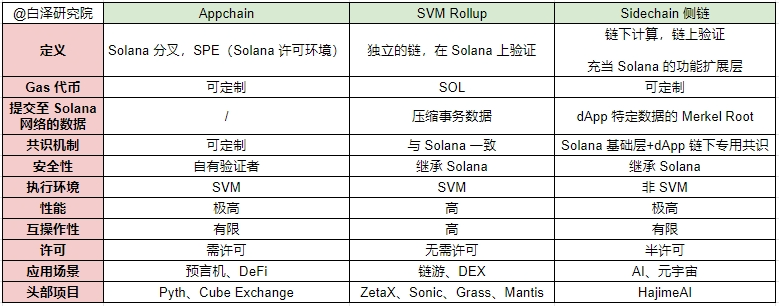
An Appchain is like a fork of Solana—same SVM environment, same architecture. The difference lies in developers having control over infrastructure, enabling customizable consensus mechanisms and defined validator sets. For example, Pythnet uses PoA (Proof of Authority), selects trusted validators, and adjusts transaction processing and data update frequencies based on specific needs.
It does not interoperate directly with the Solana mainnet, meaning even during Solana’s traffic peaks, Appchain performance remains unaffected. The downside? Assets aren’t natively interoperable—cross-chain bridging is required.
Thus, Solana Appchains emerge from application developers seeking to meet specific use cases or requirements, supported by Solana Foundation’s Solana Permissioned Environments (SPEs).
Besides Pythnet, Cube Exchange and Hyperliquid are also Solana Appchains. The future trend for Solana dApps may lean toward <application = appchain>. At the very least, dApps requiring timeliness, high transaction volume, and a substantial user base will likely need their own Appchain.
Another emerging type of Solana L2 gaining traction recently is SVM Rollup.
Like Ethereum rollups, SVM Rollups batch process numerous transactions before submitting them to the main chain to reduce load. They rely on the security of the main chain to ensure transaction validity and prevent fraud.
Unlike Appchains, SVM Rollups resemble traditional Ethereum Layer 2s: state roots are stored on Solana, while data resides on the Rollup. They can host diverse dApps and users.
Projects to watch include: ZetaX (developed by Zeta Markets), Sonic, Grass, Mantis.
In recent weeks, a new form of Solana L2 has emerged—Sidechains—which blend characteristics of both Appchains and Rollups. These projects offload heavy computation to sidechains but use Solana as the base layer to verify Merkle Roots. They’re Appchain-like because sidechains employ dedicated consensus mechanisms; they’re Rollup-like because they inherit Solana’s security.
A notable project in this category: HajimeAI
We provide a comprehensive comparison in the table below:
Worth noting: there’s another type of SVM-based L2 called external extension—essentially porting SVM to other chains. But strictly speaking, these shouldn’t be called Solana L2s. They’re more akin to various EVM chains (or SVM chains). Representative projects include Eclipse, Nitro, and inSVM—better labeled as Ethereum L2, SEI L2, and Injective L2 respectively.
Overall, whether Appchain, SVM Rollup, or sidechain, these solutions primarily target developers building high-frequency transaction applications.
Given their specialized nature, Appchains have limited interoperability. Projects like Sonic, ZetaX, Grass, and HajimeAI, which brand themselves as “Solana’s first xx-rollup,” tend to attract more attention.
-
Sonic – Solana’s first gaming rollup infrastructure
-
ZetaX – Solana’s first DeFi rollup
-
Grass – Solana’s first AI data rollup
-
Mantis – Solana’s first intent-based transaction rollup
-
HajimeAI – Solana’s first AI sidechain
With Sonic drawing attention through fundraising and airdrops, followed by Web3+AI projects like HajimeAI starting to deploy L2s, regardless of actual demand, Solana has entered its L2 era—an evolution worth long-term monitoring.
To explore potential projects across the three categories of Solana L2s—Appchain, SVM Rollup, and Sidechain—including their use cases, technical architectures, and investment opportunities, please refer to the updated “Solana L2” sector spreadsheet in the VIP group.
Join TechFlow official community to stay tuned
Telegram:https://t.me/TechFlowDaily
X (Twitter):https://x.com/TechFlowPost
X (Twitter) EN:https://x.com/BlockFlow_News
 Baize Research


